The 20Ts passed briefly through my hands when I measured them for Mikey's review, but I never got the chance to audition them in my own room. So when Michael Kelly told me at the 2008 Consumer Electronics Show that he was working on a revised version, I pulled rank and allocated the review to myself.
The V2
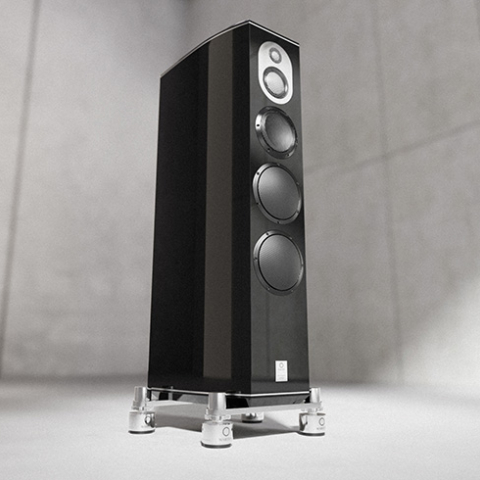
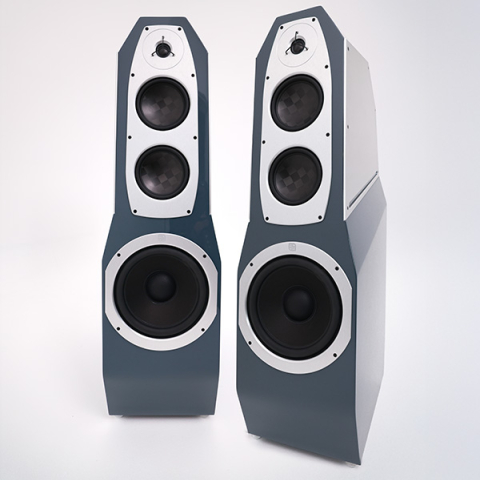
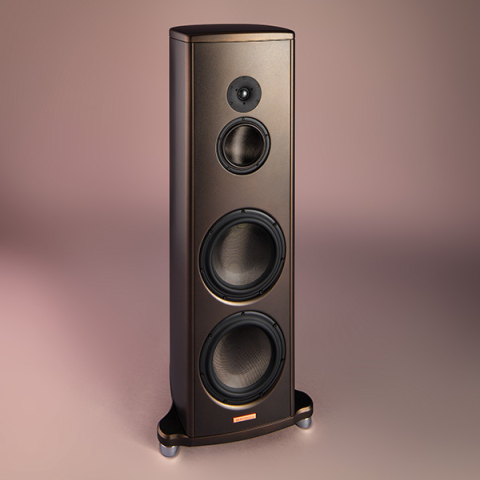
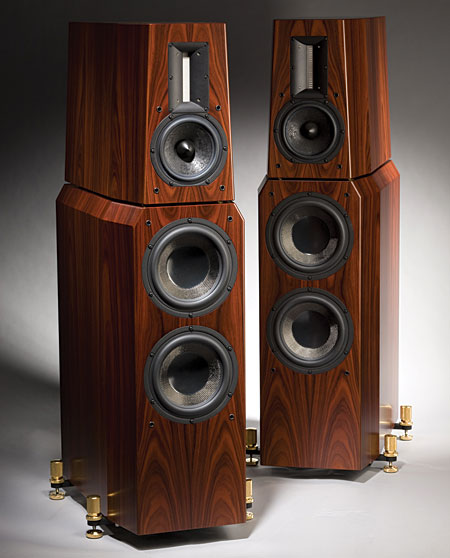
The 20T is a fairly large two-piece speaker, but because it is considerably deeper than it is wide, it hides its bulk well. On the front baffle of the bottom "bass bin" are mounted two 9" woofers, and these have been changed in the V2. The original 20T used woofers with a "bilaminate" cone material; by contrast, the new speaker's woofers, developed by Aerial in partnership with ScanSpeak, use a cone with an outer skin of woven carbon fiber and an inner skin of fine-woven fiberglass. The two skins sandwich a core of Rohacell structural foam (the stuff used to make helicopter rotor blades), to give a cone that is light and very stiff but also well damped. The woofer's magnet system has been upgraded and the voice-coil is 24mm long, to give good linearity at large excursions. The woofer's suspension is progressive in that it offers more resistance toward the ends of the cone's travel while remaining linear over most of the range. These woofers are reflex-loaded with a large flared port that fires down from the enclosure's base. Cast skeletal steel bases and spikes of heavy-duty stainless steel raise the cabinet off the floor to give the port enough room to operate optimally.
The upper-frequency drive-units are unchanged from the original 20T. The 7.1" midrange unit is a custom-made driver with a carbon-pulp cone formed from randomly arranged 1" fibers. Again, the result is said to be both stiff and very light in weight. What appears to be a stationary phase plug is actually a moving dustcap carefully profiled to control beaming at the top of the midrange unit's passband. The transformer-coupled tweeter is a true ribbon; ie, it comprises an aluminum-foil ribbon, 4.1" tall by 0.375" wide, that is loosely suspended between two vertical arrays of three powerful neodymium magnets. The ribbon is acoustically loaded with a flared waveguide; in Michael Fremer's original review, Michael Kelly was quoted as claiming that the tweeter features "smooth on-axis response flat to 30kHz, and down only 7dB at 40kHz," and "down only a few dB at 20kHz when listened to 45° off-axis." It can handle plenty of power, Kelly told me, and is actually so sensitive that, in the 20T, it needs to be padded down.
The original 20T's crossover was developed by Kelly's business partner, David Marshall, and has been significantly revised in the V2. It makes use of polypropylene-film capacitors, air-core inductors for the tweeter's high-pass feed, and high-nickel-steel coils for the lower-frequency filters. The crossover points are set at 300Hz and 3.5kHz, meaning that the midrange unit handles an entire decade of the audioband. Its performance thus becomes critical to the 20T's overall quality, and it apparently went through 28 prototype stages during its development. Michael Kelly describes it as the "star" of the 20T. Fourth-order, 24dB/octave acoustic slopes are used for the midrange-tweeter transition. Electrical connection is via two pairs of binding posts at the base of the woofer enclosure's rear panel. These are connected with bus bars that can be removed for biwiring—I auditioned the speakers single-wired with AudioQuest Kilimanjaro cable—while supplied jumper cables connect the head unit to another pair of binding posts on the bass bin's top panel. The tweeter level and midbass tuning can be adjusted with three-position rotary switches.
The two enclosures remain unchanged from those of the original 20T, other than being offered in a different range of high-gloss finishes and veneers. Made in Denmark, these cabinets are of constrained-layer-damped, dual-wall construction and are heavily braced. The tweeter/midrange enclosure tapers gently toward the top and sits on four downward-facing points that fit into conical recesses in the bass bin, themselves fitted with metal inserts to give optimal mechanical coupling. The 20T V2 is beautifully finished—my review samples were in high-gloss titanium gray—and the overall impression is one of elegance and luxury. As it should be, of course: this speaker costs $32,000/pair.
Sound
Some speakers readily achieve an effective lock with a given room's acoustic; others are more fussy about setup and positioning. The latter proved to be the case with the Aerial 20T V2. Aerial's Michael Kelly and Andrew Clark drove down from Massachusetts with the review samples and spent quite a long time trying to get them set up optimally, before they had to start the drive home. Unfortunately, the sound wasn't as good as Kelly had anticipated—the speakers were having difficulty speaking with one voice across the audioband—so he asked to come back at a later date. That was fine by me; I'd heard the 20T V2 sounding superb at hi-fi shows. I put the speakers aside while I finished my recent series of minimonitor reviews.