For 15 years, lovers of low-power amplifiers have clamored for more and better high-efficiency loudspeakers (footnote 1). For 15 years, their choices have remained limited to products with varying combinations of colored sound, poor spatial performance, basslessness, high cost, and cosmetics that range from the weak to the repulsive.
 The genre has, so far, failed to attract the lions of the loudspeaker industry. Yes, the Klipsch and Tannoy lines still include some high-efficiency models—living fossils, mostly, from an era when all amps were low-power amps—and, among smaller firms, Audio Note and Avantgarde have distinguished themselves by making consistently recommendable high-efficiency speakers. But many of the rest seem stuck in Hobbyland: Try as I might, I can't imagine a Polk, a Dynaudio, a JBL, or a B&W bringing to market a loudspeaker whose buyer is asked to assemble much of the thing himself, or to supplement an already enormous cabinet with a subwoofer just to hear notes below 60Hz, or to pretend that the lower-treble spike that's slowly draining his will to live doesn't exist.
That in itself makes the emergence of America's own Zu Audio all the more interesting. From their beginnings in 2000, Zu has embodied the progressive attitude to which, in so many minds, the flea-watt amp movement seems linked. Yet at the same time this Ogden, Utah–based maker of cables, phono cartridges, and high-efficiency speakers has impressed many with the sheer professionalism of its efforts: In contrast to so many businesses that cater to the low-power-amp community, Zu appears to have decided long ago that they want to be a real company—and then they set about to make it happen.
The latest news from Zu is twofold: They've introduced an all-new high-efficiency loudspeaker, the Essence ($5000/pair), and they've abandoned their original direct-marketing business model in favor of a network of bricks-and-mortar dealers (footnote 2). I can't tell you much about the latter, but I can suggest whether the former might make the trip worthwhile.
Description
The genre has, so far, failed to attract the lions of the loudspeaker industry. Yes, the Klipsch and Tannoy lines still include some high-efficiency models—living fossils, mostly, from an era when all amps were low-power amps—and, among smaller firms, Audio Note and Avantgarde have distinguished themselves by making consistently recommendable high-efficiency speakers. But many of the rest seem stuck in Hobbyland: Try as I might, I can't imagine a Polk, a Dynaudio, a JBL, or a B&W bringing to market a loudspeaker whose buyer is asked to assemble much of the thing himself, or to supplement an already enormous cabinet with a subwoofer just to hear notes below 60Hz, or to pretend that the lower-treble spike that's slowly draining his will to live doesn't exist.
That in itself makes the emergence of America's own Zu Audio all the more interesting. From their beginnings in 2000, Zu has embodied the progressive attitude to which, in so many minds, the flea-watt amp movement seems linked. Yet at the same time this Ogden, Utah–based maker of cables, phono cartridges, and high-efficiency speakers has impressed many with the sheer professionalism of its efforts: In contrast to so many businesses that cater to the low-power-amp community, Zu appears to have decided long ago that they want to be a real company—and then they set about to make it happen.
The latest news from Zu is twofold: They've introduced an all-new high-efficiency loudspeaker, the Essence ($5000/pair), and they've abandoned their original direct-marketing business model in favor of a network of bricks-and-mortar dealers (footnote 2). I can't tell you much about the latter, but I can suggest whether the former might make the trip worthwhile.
Description
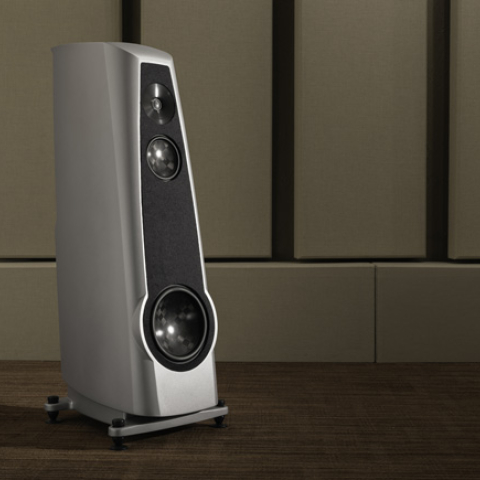
In common with earlier Zu loudspeakers, the floorstanding Essence is built around a proprietary full-range driver, augmented in the treble range by a separate tweeter. The main driver measures 10.3" overall, with an 8" pulp cone and a coincident 4" flared pulp whizzer, both driven by a single copper voice-coil on a paper-and-Kapton former. This driver's free-air resonance is approximately 40Hz, according to Sean Casey of Zu, and that number drops to the low 30s when the driver is loaded by the Essence's enclosure.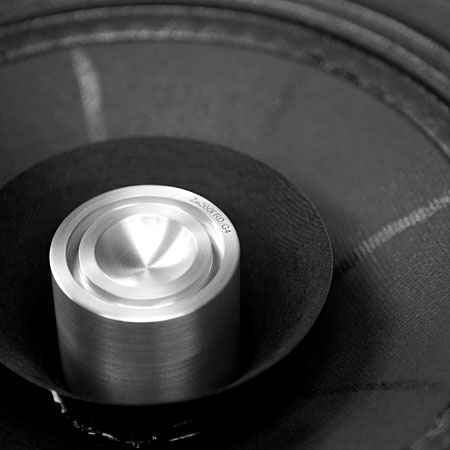 That loading scheme is remarkable for having been inspired by an innovation in motorcycle design: Casey credits the late Ron Griewe, a former editor of Cycle World magazine, for discovering that an "inside-out" muffler could be used to enhance the air-pressure/air-velocity throughput of a two-stroke engine. Recognizing a similar set of challenges in mating the rear-wave output of a dynamic driver with the mass of air surrounding its enclosure, Casey and his partner, Adam Decaria, applied Griewe's idea to cabinet design. "A rear-loading horn system is very effective at getting acoustic matching to the room," Casey says, "but a rear-loaded horn has a severe group delay."
Casey and Decaria's ZuRG system (for Zu/Ron Griewe) serves a similar acoustic impedance-matching function as a horn yet occupies a lot less space, and requires the sound to travel only a fraction of the distance before reaching the listener's ears. Basically, the Essence's enclosure is a rigid square pipe with a sealed end and an open end: The full-range driver is mounted nearest the sealed end—the top of the enclosure—and the open end is placed over a tall, thin pyramid of very dense foam. The foam is cemented to a 12" square wooden base just slightly larger than the enclosure's cross-section, and a small fixed gap is left between the enclosure's bottom edge and the base's top surface. Thus the foam cartridge, as Zu calls it, gradually changes the acoustic impedance within the column, from the driver at the top to the aperture at the bottom.
That loading scheme is remarkable for having been inspired by an innovation in motorcycle design: Casey credits the late Ron Griewe, a former editor of Cycle World magazine, for discovering that an "inside-out" muffler could be used to enhance the air-pressure/air-velocity throughput of a two-stroke engine. Recognizing a similar set of challenges in mating the rear-wave output of a dynamic driver with the mass of air surrounding its enclosure, Casey and his partner, Adam Decaria, applied Griewe's idea to cabinet design. "A rear-loading horn system is very effective at getting acoustic matching to the room," Casey says, "but a rear-loaded horn has a severe group delay."
Casey and Decaria's ZuRG system (for Zu/Ron Griewe) serves a similar acoustic impedance-matching function as a horn yet occupies a lot less space, and requires the sound to travel only a fraction of the distance before reaching the listener's ears. Basically, the Essence's enclosure is a rigid square pipe with a sealed end and an open end: The full-range driver is mounted nearest the sealed end—the top of the enclosure—and the open end is placed over a tall, thin pyramid of very dense foam. The foam is cemented to a 12" square wooden base just slightly larger than the enclosure's cross-section, and a small fixed gap is left between the enclosure's bottom edge and the base's top surface. Thus the foam cartridge, as Zu calls it, gradually changes the acoustic impedance within the column, from the driver at the top to the aperture at the bottom.
 In early Zu loudspeakers, such as the recently retired Druid, the ZuRG system was implemented by fastening absorptive materials to the inner cabinet walls. But Casey says the new approach is better: "Putting the foam in the middle allows us to tune it for a much wider range of frequencies." He also suggests that their most recent ZuRG is sufficiently improved that they could dispense with the Druid's adjustable gap between the base and the bottom edge of the column, in favor of a fixed—and presumably optimized—gap in the Essence.
Other distinctions between the old and new models are the results of gradual refinements, according to Casey. That dual-cone drive-unit, now in its fourth generation, is assembled by Zu with components engineered by Zu and Eminence, and it's said to be the product of much greater precision and consistency in manufacture. More tangible is the driver's newly designed alloy phase plug, which is used both to extend its treble response and to produce a more even dispersion pattern.
In early Zu loudspeakers, such as the recently retired Druid, the ZuRG system was implemented by fastening absorptive materials to the inner cabinet walls. But Casey says the new approach is better: "Putting the foam in the middle allows us to tune it for a much wider range of frequencies." He also suggests that their most recent ZuRG is sufficiently improved that they could dispense with the Druid's adjustable gap between the base and the bottom edge of the column, in favor of a fixed—and presumably optimized—gap in the Essence.
Other distinctions between the old and new models are the results of gradual refinements, according to Casey. That dual-cone drive-unit, now in its fourth generation, is assembled by Zu with components engineered by Zu and Eminence, and it's said to be the product of much greater precision and consistency in manufacture. More tangible is the driver's newly designed alloy phase plug, which is used both to extend its treble response and to produce a more even dispersion pattern.
Footnote 1: For our purposes, a high-efficiency loudspeaker is one that combines high electrical sensitivity with a reasonably flat impedance curve and moderate to high impedance overall. It is important to note that a speaker with a high sensitivity but a low impedance is a low-efficiency design. Footnote 2: On September 1, after this issue had gone to press, Zu announced that they were reverting to direct sales, eliminating their US dealer network and dropping the price of the Essence to $3500/pair.—Ed.
The genre has, so far, failed to attract the lions of the loudspeaker industry. Yes, the Klipsch and Tannoy lines still include some high-efficiency models—living fossils, mostly, from an era when all amps were low-power amps—and, among smaller firms, Audio Note and Avantgarde have distinguished themselves by making consistently recommendable high-efficiency speakers. But many of the rest seem stuck in Hobbyland: Try as I might, I can't imagine a Polk, a Dynaudio, a JBL, or a B&W bringing to market a loudspeaker whose buyer is asked to assemble much of the thing himself, or to supplement an already enormous cabinet with a subwoofer just to hear notes below 60Hz, or to pretend that the lower-treble spike that's slowly draining his will to live doesn't exist.
That in itself makes the emergence of America's own Zu Audio all the more interesting. From their beginnings in 2000, Zu has embodied the progressive attitude to which, in so many minds, the flea-watt amp movement seems linked. Yet at the same time this Ogden, Utah–based maker of cables, phono cartridges, and high-efficiency speakers has impressed many with the sheer professionalism of its efforts: In contrast to so many businesses that cater to the low-power-amp community, Zu appears to have decided long ago that they want to be a real company—and then they set about to make it happen.
In common with earlier Zu loudspeakers, the floorstanding Essence is built around a proprietary full-range driver, augmented in the treble range by a separate tweeter. The main driver measures 10.3" overall, with an 8" pulp cone and a coincident 4" flared pulp whizzer, both driven by a single copper voice-coil on a paper-and-Kapton former. This driver's free-air resonance is approximately 40Hz, according to Sean Casey of Zu, and that number drops to the low 30s when the driver is loaded by the Essence's enclosure.
That loading scheme is remarkable for having been inspired by an innovation in motorcycle design: Casey credits the late Ron Griewe, a former editor of Cycle World magazine, for discovering that an "inside-out" muffler could be used to enhance the air-pressure/air-velocity throughput of a two-stroke engine. Recognizing a similar set of challenges in mating the rear-wave output of a dynamic driver with the mass of air surrounding its enclosure, Casey and his partner, Adam Decaria, applied Griewe's idea to cabinet design. "A rear-loading horn system is very effective at getting acoustic matching to the room," Casey says, "but a rear-loaded horn has a severe group delay."
In early Zu loudspeakers, such as the recently retired Druid, the ZuRG system was implemented by fastening absorptive materials to the inner cabinet walls. But Casey says the new approach is better: "Putting the foam in the middle allows us to tune it for a much wider range of frequencies." He also suggests that their most recent ZuRG is sufficiently improved that they could dispense with the Druid's adjustable gap between the base and the bottom edge of the column, in favor of a fixed—and presumably optimized—gap in the Essence.
Other distinctions between the old and new models are the results of gradual refinements, according to Casey. That dual-cone drive-unit, now in its fourth generation, is assembled by Zu with components engineered by Zu and Eminence, and it's said to be the product of much greater precision and consistency in manufacture. More tangible is the driver's newly designed alloy phase plug, which is used both to extend its treble response and to produce a more even dispersion pattern.
Footnote 1: For our purposes, a high-efficiency loudspeaker is one that combines high electrical sensitivity with a reasonably flat impedance curve and moderate to high impedance overall. It is important to note that a speaker with a high sensitivity but a low impedance is a low-efficiency design. Footnote 2: On September 1, after this issue had gone to press, Zu announced that they were reverting to direct sales, eliminating their US dealer network and dropping the price of the Essence to $3500/pair.—Ed.