After Fred Kaplan reviewed Boulder Amplifiers' 810 line preamplifier and 860 power amplifier for the December 2007 Stereophile, John Atkinson requested that I listen to the 860 in my own system for a while. Never having reviewed any Boulder kit, I was curious.
 Suffice it to say that I was so impressed by that brief interlude that I wanted to know more about Boulder. I went to the company's factory in Boulder, Colorado, and watched them mill metalwork, stuff circuit boards, and assemble components—all in-house. The impressively clean facility clearly represented millions in investment. I said as much to Jeff Nelson, Boulder's founder and chief engineer, who replied, "I'd rather spend the money so that I could make things to the level of quality I'm comfortable with. It's actually easier for us to do it ourselves than it is to convince outsiders to do it our way."
A staunch refusal to compromise, an obsession with doing things right—what could be more high-end?
Founded on rock
Suffice it to say that I was so impressed by that brief interlude that I wanted to know more about Boulder. I went to the company's factory in Boulder, Colorado, and watched them mill metalwork, stuff circuit boards, and assemble components—all in-house. The impressively clean facility clearly represented millions in investment. I said as much to Jeff Nelson, Boulder's founder and chief engineer, who replied, "I'd rather spend the money so that I could make things to the level of quality I'm comfortable with. It's actually easier for us to do it ourselves than it is to convince outsiders to do it our way."
A staunch refusal to compromise, an obsession with doing things right—what could be more high-end?
Founded on rock
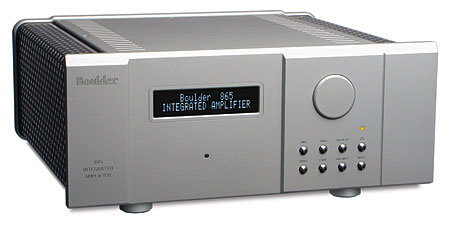
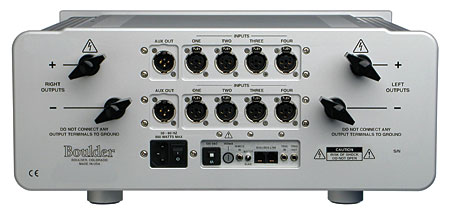
Boulder's 865 integrated amplifier is essentially an 810 preamp ($6900) and an 860 power amp ($8500) crammed into a single, large chassis for $12,000. Like the 810, the 865 has four balanced line-level inputs; a sophisticated, microprocessor-controlled, optically activated volume control; and separate power supplies for the analog and microprocessor circuits. Because the 865 is, literally, an 810 preamplifier, with controls and appearance identical to that model and built into the same chassis with an 860 power amplifier (with the slight exception of the 865's faceplate being 2" taller than the 810's), that means that the feature set of the 865's preamp section is the same as that described in FK's review of the 810 in December 2007. The 865's rear panel is slightly rejiggered from the 810 as well, as it now needs to accommodate speaker binding posts as well as inputs. Ah-ha! I hear you thinking. Surely the 865's input circuits must be longer than the shorter paths in the 810 preamp?
Well, no. The 865 has the same 15.25" chassis length as the 810 and 860—the 865 is, in every way, an 810 and an 860 in the same box. You get both products for $3400 less, and can skip purchasing an entire pair of interconnects to boot. Talk about win/win.
Like the 860, the 865 puts out 150Wpc "in [class-]A/B beyond approximately 10W," Jeff Nelson explained. In keeping with Nelson's philosophy of reducing noise as much as possible, each section of the 865 resides in its own compartment inside the amp's chassis, which is hewn from a solid billet of aluminum.
Like all Boulder products, the 865 is packed with high-quality parts—literally thousands of them. Nelson's inability to compromise leads him to hand-select gain-stage monolithic devices, use four-layer circuit boards, and deploy 16 bipolar output devices per channel. Boulder components are what they call "parts intensive."
 Nelson is also a big believer in "correct and appropriate levels of feedback" for each gain stage. In fact, he said, other manufacturers' assertions that their designs are "zero-feedback" appall his inner engineer.
One feature of the 865 that's not common to all integrateds is its balanced Auxiliary Output, which can be used as a fixed output (for recording, for example) or as a variable output (controlling another music zone, perhaps).
This rock shall fly
Nelson is also a big believer in "correct and appropriate levels of feedback" for each gain stage. In fact, he said, other manufacturers' assertions that their designs are "zero-feedback" appall his inner engineer.
One feature of the 865 that's not common to all integrateds is its balanced Auxiliary Output, which can be used as a fixed output (for recording, for example) or as a variable output (controlling another music zone, perhaps).
This rock shall fly
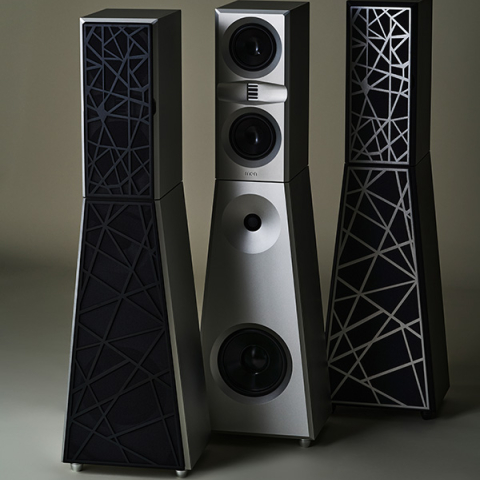
I still had the YG Acoustics Anat Reference II Professional speakers (see my review in the March issue) installed in my large listening room when the Boulder 865 arrived, so I thought it would be fun to assemble a Colorado all-stars system with the YGAs, my Ayre C-5xe universal player, and the Boulder. (Ayre Acoustics is also based in Boulder, YGA in Arvada.) And fun it was—the YGAs had all the sparkle on top that I could ask for, not to mention a feel of rock-solid control.
I listened to the superb Tallis Scholars recording of Allegri's Miserere (CD, Gimmell CDGIM 401). It wasn't revelatory, stunning, or thrilling—it was just right. The Ayre-Boulder-YGA team filled my listening room with the acoustic of Merton College Chapel, then populated that space with the Scholars' voices. In a mere two channels, of course, the conceit at the core of the Miserere doesn't exactly work. Composed specifically for the Sistine Chapel, the piece is scored for a largish group of singers on "stage," and a smaller solo group singing from a choir loft behind the worshippers. The two groups sing in a pattern of call and response, except for the final verse of five sections, where the two groups end in unison. Because, in a two-channel recording, it takes some serious gimmickry to place voices behind the listener, conductor Sir Peter Phillips decided instead to place the solo chorus deeper in the soundstage than the main group—a layered presentation that works nicely. (Perhaps the Scholars should revisit the Miserere on multichannel SACD or DVD-A.)
Indeed, the trick worked beautifully with the ABY system: The difference in perspective between the ensembles was vivid. Judging from how deep I heard into that soundstage, I believe Jeff Nelson when he says that, in designing the 865, elimination of noise and distortion was his paramount concern.
Suffice it to say that I was so impressed by that brief interlude that I wanted to know more about Boulder. I went to the company's factory in Boulder, Colorado, and watched them mill metalwork, stuff circuit boards, and assemble components—all in-house. The impressively clean facility clearly represented millions in investment. I said as much to Jeff Nelson, Boulder's founder and chief engineer, who replied, "I'd rather spend the money so that I could make things to the level of quality I'm comfortable with. It's actually easier for us to do it ourselves than it is to convince outsiders to do it our way."
A staunch refusal to compromise, an obsession with doing things right—what could be more high-end?
Boulder's 865 integrated amplifier is essentially an 810 preamp ($6900) and an 860 power amp ($8500) crammed into a single, large chassis for $12,000. Like the 810, the 865 has four balanced line-level inputs; a sophisticated, microprocessor-controlled, optically activated volume control; and separate power supplies for the analog and microprocessor circuits. Because the 865 is, literally, an 810 preamplifier, with controls and appearance identical to that model and built into the same chassis with an 860 power amplifier (with the slight exception of the 865's faceplate being 2" taller than the 810's), that means that the feature set of the 865's preamp section is the same as that described in FK's review of the 810 in December 2007. The 865's rear panel is slightly rejiggered from the 810 as well, as it now needs to accommodate speaker binding posts as well as inputs. Ah-ha! I hear you thinking. Surely the 865's input circuits must be longer than the shorter paths in the 810 preamp?
Nelson is also a big believer in "correct and appropriate levels of feedback" for each gain stage. In fact, he said, other manufacturers' assertions that their designs are "zero-feedback" appall his inner engineer.
One feature of the 865 that's not common to all integrateds is its balanced Auxiliary Output, which can be used as a fixed output (for recording, for example) or as a variable output (controlling another music zone, perhaps).
This rock shall fly
I still had the YG Acoustics Anat Reference II Professional speakers (see my review in the March issue) installed in my large listening room when the Boulder 865 arrived, so I thought it would be fun to assemble a Colorado all-stars system with the YGAs, my Ayre C-5xe universal player, and the Boulder. (Ayre Acoustics is also based in Boulder, YGA in Arvada.) And fun it was—the YGAs had all the sparkle on top that I could ask for, not to mention a feel of rock-solid control.