

Power According to Pass

Virtually all of the active components in your systemDACs, preamplifiers, power amplifierswork by modulating the DC output of their power supplies with an AC music signal. Surely, then, the more perfect your household AC is, the more perfect your audio system's output will be. Analogies aboundto dirty water used in distilling good whiskey, to inferior thread used to weave fine fabricsand all amount to the same thing: you can't make a silk purse out of a sow's ear.
Quality Lies in the Details
Time to 'fess up: How many of you actually read the "Measurements" sections of Stereophile's equipment reports and understand what's being measured, and why? I suspect that many readers skip over the technical assessment of the reviewed product and make a dash for the "Conclusion."
Questions of Impedance Interaction
On a number of occasions we have commented on the effects of an amplifier's output impedance on a system's performance. A high output impedance—such as is found in many tube amplifiers—will interact with the loudspeaker's impedance in a way which directly affects the combination's frequency response. The Cary">http://www.stereophile.com//amplificationreviews/740/">Cary CAD-805, for example, has a lower output impedance than most tube amplifiers, and should be less prone to such interaction. Some months back—before the CAD-805 arrived—I investigated this phenomenon in conjunction with measurements for a forthcoming review of the Melos 400 monoblock amplifier. Since the Melos 400 also had a relatively low output impedance for a tube amplifier (at 0.43 ohms at low and mid frequencies, rising to 1.2 ohms at 20kHz, from its 8 ohm tap), I took that opportunity to run some frequency-response measurements using an actual loudspeaker as the load for the amplifier.
Real-Life Measurements

As mentioned by two readers in this month's "Letters," amplifiers are used to drive loudspeakers but are almost exclusively measured into resistive loads. The reasons for this are twofold: 1) real loudspeakers both produce neighbor-annoying sound levels and tend to break when driven with typical amplifier test signals; and 2) the question as to which "standard" loudspeaker should be used is impossible to answer---at least the conventional resistive loads are consistent and repeatable.
Red Shift: Doppler distortion in loudspeakers
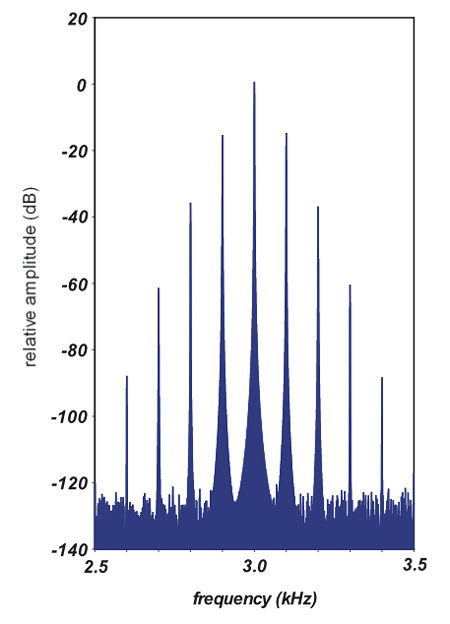
In the world of digital audio, jitter has been a focus of audiophile attention for well over a decade. It is blamed for many of the sonic ills of which CD and other digital media have been accused. But here's a puzzle: The major source of frequency intermodulation distortion in audio systems—the loudspeaker—has largely escaped such withering inquiry. Why?
Ringing False: Digital Audio's Ubiquitous Filter
 Much as I like the prospect of being able to grunt a heartfelt Je ne regrette rien immediately before expiring, I know there will be too many what-ifs and wish-I-hadn'ts to make that even remotely possible. But here is one missed opportunity that won't flash before me, because John Atkinson has granted me a second chance.
Room Tuning: ASC Tube Traps & the MATT Test

One of the challenges I faced in optimizing the performance of the Thiel">http://www.stereophile.com//loudspeakerreviews/216/">Thiel CS7.2 loudspeakers that I reviewed in February 2000 was controlling and tuning their interaction with my listening room. Intuition, experience, trial and error—all came into play, as did several of the procedures and calculations covered by Jonathan Scull in his "Fine Tunes" column.
Sounds Like? An Audio Glossary
Subjective audio is the evaluation of reproduced sound quality by ear. It is based on the novel idea that, since audio equipment is made to be listened to, what it sounds like is more important than how it measures. This was a natural outgrowth of the 1950s high-fidelity "revolution," which spawned the notion that a component, and an audio system as a whole, should reproduce what is fed into it, without adding anything to it or subtracting anything from it.
Space...the Final Frontier
High-end audiophiles are space freaks---we relish the warmth and spaciousness of a fine, old performing hall almost as much as we do the music recorded in it. But my attendance at a series of orchestral concerts held last summer brought home to me---as never before---the sad fact that our search for the ultimate soundstage is doomed to failure: we're trying to reproduce three-dimensional space from a two-dimensional system, and it simply can't be done.
Spectral X-Contamination: Problems in Op-Amp Chips

In high-end circles, the sonic repute of integrated-circuit op-amps (from "operational amplifier") is, at best, checkered. Of course, the expertise with which they are used and the parts they're used with can make all the difference. For example, my DIY preamplifier design, "AMP-02," published in Hi-Fi News & Record Review in 198990, and my earlier (198384) AMP-01 (footnote 1), I used the better IC op-amps of the time throughout. Both units were thought to outperform cost-no-object commercial units of the time that employed discrete transistors and even tubes, and only indicate what's possible.