

The Missing Specification
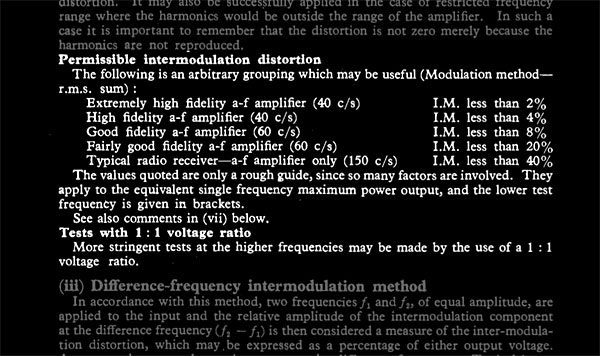
In the 1952 edition of the Radiotron Designer's Handbook, long recognized as the "bible" of the industry, the permissible level of IM distortion for a high-fidelity amplifier was given as 3%, with the alternate figure of 2% being cited as a "rather extreme" specification. We wonder what the author of that statement would think of today's solid-state amplifiers with their measured IM of 0.01% and less. And we wonder what he would think about the fact that these super-amplifiers still have audible distortion.
The Moment of Truth
Well, it's that time. The time of reckoning, the moment of truth. It's renewal time.
Most of you have noticed the hyphenated numbers on your address labels, and most of you guessed what they were: Expiration codes. If your label has a 1-12 number on it (or no hyphenated code at all), the next issue of The Stereophile, Issue Number 12 [published in September 1966Ed.], will be the last one that will arrive on your present subscription.
The Preservation of Inspiration
A world-renowned musician had scheduled an appearance as guest soloist with the string quartet in residence at a certain university. When he arrived he noticed a pair of microphones arrayed over the small stage and, following the wires, located a college student backstage next to a tape recorder and a pair of headphones.
The Pros & Cons of Electrostatic Loudspeakers

The main inherent advantage of the full-range electrostatic loud speaker system is that it allows a single diaphragm to embody the conflicting attributes needed for optimal performance at both extremes of the audio range. Its thin-membrane diaphragm can be made exceedingly light, for superb transient response and extended HF response, yet it can be about as large in area as desired, for extended LF response.
The Question of Bass / Bass Instruments & Frequencies
The Question of Bass: J. Gordon Holt
A few issues back, in Vol.9 No.3, I used "As We See It" to clarify what Stereophile writers have in mind when they use the term "transparency" in equipment reports. This time, I'll do the same thing for the performance parameters of bass reproduction.
A few issues back, in Vol.9 No.3, I used "As We See It" to clarify what Stereophile writers have in mind when they use the term "transparency" in equipment reports. This time, I'll do the same thing for the performance parameters of bass reproduction.
The Revolution That Never Was
Not too many years ago, high-fidelity movement was being hailed from all quarters (and many halves) as a revolution. In the sense that it took the country storm, and made billions of dollars for many entrepreneurs during heyday, it was indeed a revolution. But now the public has grown tired of high fidelity and is turning other electronic diversions—video, video games, and computering. And what, as of this summer of 1982, do we have to show for the high-fidelity revolution?
The Second Sense
When it comes to video, most audiophiles are insufferable snobs. These normally reasonable people, who are among the first to admit that great sound in a motion picture theater makes a great film much more enjoyable, nonetheless. scoff at the very idea of augmenting their own sound with images, or of trying to create the kind of audio-visual experience in their home that they routinely enjoy at the cinema. Doing that involves video, which they equate with TV, which they equate with LCD (footnote 1) dross. This is unfortunate, because visuals can enhance good sound, and good sound can do wonders for non-TV video programs like Hollywood motion pictures.
The Silent Minority
Until about nine months ago, in the fall of 1970, FM radio station WFLN, Philadelphia, was just another one of that dying breed: the classical FM station. Like its counterparts in the few remaining classical-radio cities, it provides the major part of the high-fidelity listener's radio diet, and also like most similar classical stations, its fidelity was nothing to brag about.
The Sound of Transistors
Editor's Note: Those of us who cut our engineering teeth on tubes still remember the advent of the solid-state amplifier with mixed feelings. Yes, they were lighter and cheaper per watt than the thermionic hulks we loved so much, but they broke all the time (thanks to the germanium transistor) and sounded like—well, let J. Gordon Holt tell us what they sounded like in an "As We See It" article from Vol.1 No.10, first published in May 1965. We also develop the theme with a JGH review of an early transistorized amp, as well as a selection of readers' letters from the early days of Stereophile. Enjoy.—John Atkinson
The Truth About High End
The October 1982 issue of Stereo Review published what must be hailed (or derided) as the first reasoned assessment of high-end audio ever presented in a mass-circulation hi-fi publication. We disagreed with a few of the author's points, but our main gripe about the piece prompted a letter to Stereo Review. This is what we wrote: