Historical

Sort By: Post DateTitle Publish Date

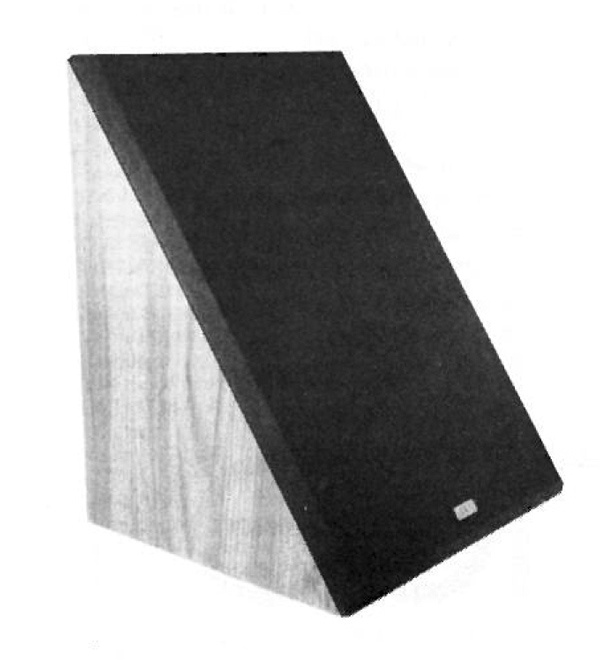
Spica TC-50 loudspeaker

High-quality, low-cost loudspeaker systems are not an everyday blessing. The Rogers LS3/5a has survived for more than a decade precisely because so few US manufacturers sought musical accuracy as distinguished from high output and powerful bass. The economics of loudspeaker manufacture also don't lend themselves to economy. The cost of woodwork is driving the price of speakers up almost as fast as the cost of sheet-metal work is escalating the price of electronics.

Recording of February 1984: Beethoven/Enescu Violin Sonatas

BEETHOVEN: Violin Sonata in G, Op.96

ENESCU: Violin Sonata No.3, Op.25 (In Rumanian Style)


David Abel, violin, Julie Steinberg, piano

Wilson Audio W-8315 (LP). David Wilson, prod., eng. AAA.


Oh, what a breath of fresh air this is! An audiophile recording of real music that isn't bombastic, overblown, or high-powered.


Imagine, if you can, a private recital in your own home by two consummate artists who play these works for their own delight as much as for yours. Imagine sound so completely and disarmingly natural that after 30 seconds you're unaware it's reproduced. That's what this record is all about.


I could rhapsodize endlessly about this record, but I won't. Suffice it to say that if you think there's even a remote chance you'll like this music, you will be positively mesmerized by this recording of it . . .

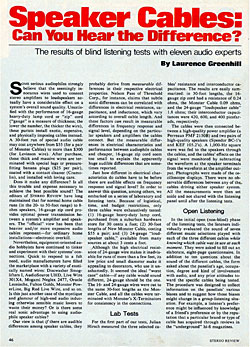
The Horse's Mouth (Stereo Review's 1983 cable tests)

It's not often that you get a chance to have extensive discussions with the horse's mouth, but we recently had that opportunity. Since July of this year there has been extensive discussion in the audio community, particularly the high-end segment, of Larry Greenhill's article">http://bruce.coppola.name/audio/Greenhill.pdf">article on speaker cable listening tests in the August, 1983 issue of Stereo Review (footnote 1). From recent talks with author Greenhill we've learned that the most interesting story was not in Stereo Review; instead it can be found in the varying reactions from different quarters, and what they say about the high-end industry in general.


CD: A Lie Repeated Often Enough Becomes Truth

Larry Archibald on CD:
This article on Compact Discs and CD players is by Doug Sax, president of Sheffield Records and a longtime opponent of digital recording. J. Gordon Holt offers a responsehttp://www.stereophile.com//digitalsourcereviews/193/">response; elsewhere in this issue, in which he advises readers to buy a Compact Disc player as soon as they can afford it. Gordon in general hails the Compact Disc as the greatest thing to hit audio since the stereophonic LP.


Watkins WE-1 loudspeaker

First I should clear up what may be an ambiguity in the driver-lineup spec for these speakers. In each system, three 8" cone units serve as woofers. Two of these crossover from the midrange drivers at 100Hz. Crossover to the third 8-incher, the subwoofer, is at 40Hz. Thus, two woofers are active from 100Hz down to 40Hz, and all three are active below 40. In other words, the third woofer does not come into play until the frequency drops to the point where the radiating area of two 8-inchers starts to become inadequate for moving air, at which point the additional area of the third speaker is thrown in. Below 40Hz, all three are working together.


Quad ESL-63 loudspeaker

Warning to Purists: Despite certain qualities about the ESL-63 speakers which you will probably like, Quad equipment is not designed primarily for audiophiles, but for serious-music (call that "classical") listeners who play records more for musical enjoyment than for the sound. Quad's loudspeakers do not reproduce very deep bass and will not play at aurally traumatizing volume levels, and Quad's preamplifier is compromised through the addition of tone controls and filters, all for the purpose of making old, mediocre, and/or worn recordings sound as listenable as possible.

Wilson Audio Modular Monitor (WAMM) loudpeaker system

No, we made no typos in the specifications sidebar. The weight of the Wilson Audio Modular Monitor (WAMM) speaker system is enough to make you consult a structural engineer before dropping it on your living room floor—fragile, 300-year old New England frame houses are probably out. And the recent price increase from $32,000 to $35,000 is enough by itself to buy a pair of Quad ESL-63s—which is not a bad speaker system. The WAMM represents an all-out assault on both the state of the art in speaker systems and on the limits to which wealthy audiophiles will go in order to have the best.
Advertisement
Advertisement
Advertisement