Historical

Sort By: Post DateTitle Publish Date

Sony PCM F1 Digital Audio Converter

In 1978, when I reviewed Sony's first audiophile-type PCM-1 converter, I earned the undying scorn of a large segment of audiophilia by reporting that, on the basis of a rather short testing period (which did however include some live recording), I was unable to hear anything the matter with its sound. Four years later, but after substantially more testing, I am obliged to report the same thing about the PCM-l's son, the PCM-Fl.

The Truth Should Out

This issue contains a report on a truly ingenious little device called the ABX Comparator, which takes the fraud out of subjective testing. It does this by making its own selection of source A or source B for each listening trial, without telling you which was selected. Only after all the tests will it reveal what you were listening to each time. "Score" sheets are provided so you can list your guesses, compare them with the cold, uncompromising truth, and file the results for posterity. Or better still, for the first hard evidence that has ever been presented that a lot of people can hear differences that cannot as yet be measured.


Changes of Everything

As of February, 1982, the ownership of this publication passed to other hands. In total despair about its precarious finances, JGH accepted with alacrity an offer by Larry Archibald (an occasional contributor in recent years) to purchase the magazine. This has now come to pass, and it is because of the resulting infusion of money that you are holding this issue in your hot little hands now instead of three months from now (and that is probably being a little optimistic about the way things were).

Plain Talk About the Unmentionable

Editor's Note: On the 52nd anniversary of Stereophile's founding in 1962 by J. Gordon Holt, we are publishing this mea culpa "As We See it" essay from 1981, in which he explains why Vol.4 No.10 was almost six months late in mailing to subscribers. Gordon had relocated from the Philadephia suburbs to Santa Fe, New Mexico in 1978, and as he had explained in the April 1978 issue, the move had not gone well. "Much of the equipment necessary for testing got damaged or destroyed in transit," he wrote, adding that "What had promised to be a superb listening room turned out to have some sticky acoustical idiosyncrasies."

The Stereo Image

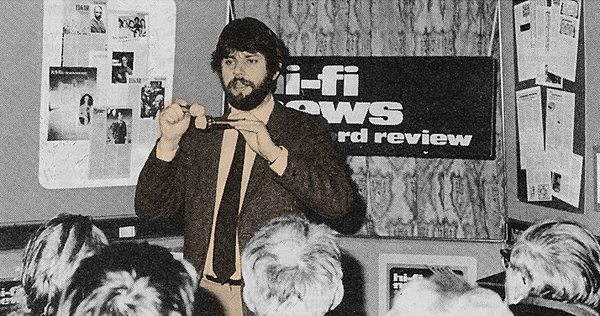
The author demonstrating stereo microphone techniques at an English audio show in 1981.


For most people the terms hi-fi and stereo are synonymous, and yet it is clear that there is still a great deal of confusion over what the word "stereo" actually means. There isn't even a consensus of opinion amongst producers of records, designers of hi-fi equipment, audio critics and music lovers as to the purpose of stereo, and considering that the arguments show no sign of diminishing in intensity, it is instructive to realise that 1981 sees both the 100th anniversary of Clement Ader's first stereo experiments and the 50th anniversary of Alan Blumlein's classic patent on stereo.

Listening Tests and Absolute Phase

The problem confronting the magazine reviewer when organising the necessary listening tests to accompany/reinforce the measured behavior of a device under test is complex. There has never been a problem with the measurement aspect; as long as someone has access to the same test gear—and full knowledge of the test conditions—then he should be able to replicate the critic's findings exactly (assuming an infinitely narrow spread of behaviour from sample to sample—a rasher assumption with some manufacturers' equipment than of others). However, when it comes to determining reliably the audible (or inaudible?) effects on music program by an amplifier/cartridge/loudspeaker etc. then the going gets tough.

How to Write an Ad

Everyone knows that advertising people make more money than ordinary people, but many assume that the high pay is because ad writing is so difficult. This is not true. Low-income people can write advertisements, too, so just in case somebody should accost you on the street and ask you to write an advertisement, here is how you may go about it.
Advertisement
Advertisement
Advertisement