Historical

Sort By: Post DateTitle Publish Date

Berning TF-10 preamplifier

Several issues back, we reviewed rather enthusiastically a pre-production prototype of this preamp. The original was an unprepossessing-looking device on two chassis, interconnected by a 3' umbilical, with a squat little preamp box and an even squatter power supply with humongous cans sticking out the top. We averred that it sounded nice. The production model is so nicely styled and functionally smooth that we wondered if it might not be another Japanese product. 'T'ain't.

Infinity RS-4.5 loudspeaker system

There are certain manufacturers for whom every new product implies the promise of countless modifications, Usually a month or so apart, culminating inevitably in a version so far removed from the original that it must be assigned a new model designation—usually a letter suffix ranging from A, to D. By the time E is envisioned, another CE Show is approaching, so the decision is made to give the unit an exterior facelift and a brand-new model number. Presto! A new product for CES.


High Fidelity at the Crossroads

101 years ago, the tinfoil cylinder started it all. Within 22 years, its heyday was done, and public support swung to favor the then-new wax-mastered disc. 1948 saw the switch to a slower speed and a finer groove, but the flat disc, traced by a stylus, has held sway for almost 80 years now. Even today, people with multi-speed turntables and a couple of arms (or plug-in cartridges) can reproduce from a single phono unit the earliest or the latest discs merely by the flip of two switches (for speed change and cartridge change). All that is about to come to an end.


We Did It!

In 1960 the high-fidelity field was in a period of stasis. The hi-fi boom was starting to crest out, and there were three magazines for audiophiles: High Fidelity, Stereo Review, and Audio. The first two were (and still are) little more than vehicles for their advertising, more dedicated to promoting their advertisers' wares than in advancing the state of the art. Audio was more into equipment testing than either of the mass-hi-fi magazines, but it too was contributing to the stagnation by listening to its test results rather than to the components.

Dahlquist DQ-10 loudspeaker

The Dalhquist DQ-10 loudspeaker has not as yet been formally submitted for review. (The designer tells us he is still working on the low end.) We auditioned a pair at the one local dealer we could find who had the DQ-10s on demo, and were immensely impressed. Obviously, Jon Dahlquist is on to something that other speaker designers have been overlooking, for, despite the multiplicity of driver speakers in the system, the DQ-10 sounds like one big speaker. There is no awareness of crossovers or separate drivers (except at the low end, about which more subsequently), and the overall sound has a degree of focus and coherence that is surpassed only by the Quad full-range electrostatic, which don't go as low at the bottom or as far out at the top.

Fulton Musical Industries Model 80 & "J-Modular" loudspeakers

In the last issue we published a rather enthusiastic "Quickie" report on a small, $190/pair speaker system from a new company—the FMI Model 80. It was virtually devoid of low end, even as a stereo pair (pairing effectively doubles bass output), and slightly rough as well as a shade soft at the high end, but it had a quality of "aliveness" to it that almost defied belief. Was it a breakthrough in design? A new transducing principle? No, it was neither. In fact, the Model 80 looks like any one of those hundreds of little bookshelf systems that clutter, the pages of Stereo Review's "Hi-Fi Directory" in tedious profusion.

Quad 405 power amplifier

This is something we don't see too often: an entirely new approach to power amplifier design. As Quad points out in its literature for the 405, class-A operation of transistors provides the lowest distortion, but drastically limits the amount of power an output transistor can deliver without overheating. (Most transistor amps use class-AB output operation, in which each of a pair of power transistors handles part of each signal cycle and shuts down during the other part. Imperfect synchronism between the two halves causes the familiar "crossover distortion," which accounts for most solid-state sound. In class-A operation, each output transistor draws current though the entirety of each signal cycle, eliminating the crossover transition but doubling the amount of time current is drawn, and thus tending to cause the transistor to heat up more.)

Late Again!

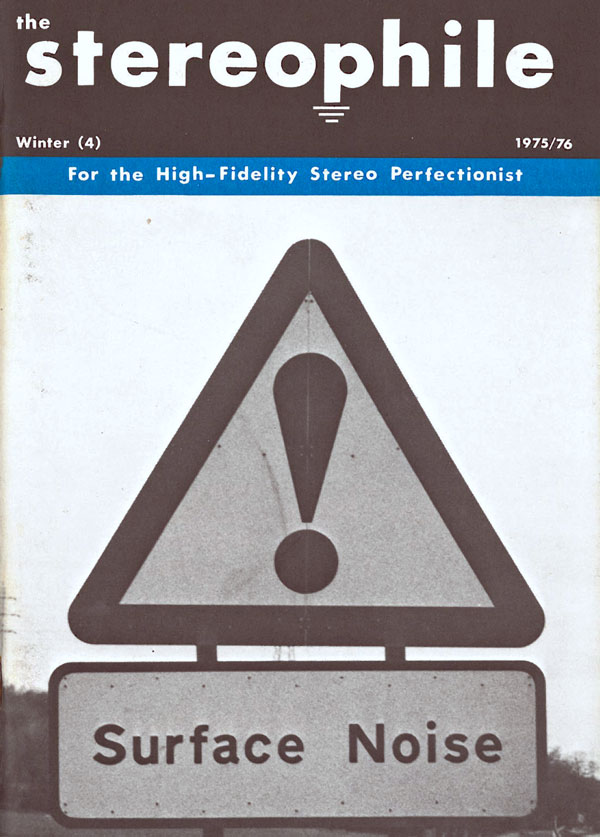
Editor's Note: In Stereophile's second decade of publication, things were starting to unravel, with long gaps between each issue. There were just seven issues published between January 1974 and January 1978. The late Harry Pearson has gone on record that he founded The Absolute Sound in 1973 part because he was tired of waiting for the next issue of Stereophile to reach his mailbox. In this "As We See It" essay from the "Surface Noise" issue in August 1976, founder J. Gordon Holt owns up to it appearing 8 months late!
Advertisement
Advertisement
Advertisement