The more integrated amps I review, the more I want to tell manufacturers: Please, skip the DAC, omit the phono stage, lose the Bluetooth—just give me the best sound quality, and the most vivid, most transparent line stage and control center (with pre-out) you can design. Make sure this line stage has appropriate gain, and high input and low output impedances. Give me at least four balanced and single-ended inputs. Make sure the volume, balance, and tone controls are durable and degrade the sound as little as possible. That way, I can add a DAC, server, phono stage, or Bluetooth, of any quality level, any time I choose.
Provide a good solid-state amplifier of medium to high power, but don't go crazy with the cost. That way, I can take my time and figure out which speakers I'd like in my room. Then, when everything else is in place, I can choose a different amp—the one that makes the most magic with the speakers I've chosen. In short, I want a cornerstone on which I can build a high-quality high-end system that should retain its usefulness and resale value—and that I should enjoy—for decades to come.
Cambridge Audio's Azur 851A might just be that type of integrated amp.
Description
On their website, Cambridge Audio describes the Azur 851A ($1900) as their "Flagship Integrated Class XD Amplifier," and that it provides "120 watts per channel of Class XD amplification" from "an acoustically damped full metal chassis." Class XD is Cambridge's "proprietary amplifier circuit design," which they say "offers superior sound quality [to that] currently available from existing amplifier configurations. . . .
"Class XD (crossover displacement), gives the benefits of pure class-A operation at low levels and eliminates the distortion associated with conventional class-B operation as the fragile audio signal passes through the zero crossing point from transistor to transistor. The result is a smooth and linear transition between the two key operating modes, class-A and -B." (Hallucination publicitaire?)
The Azur 851A's front panel is dominated by an attractive blue display with adjustable brightness. In addition to the tone controls, which can be switched out of the signal path, there are a headphone jack, seven source buttons nameable by the user, a smooth-as-a-kitten volume control, and a Mode button that lets the user shuttle between Volume, Balance, and Program modes. In Program, the gain can be trimmed for each source, which permits the user to bring all inputs up to the level of the highest gain source, or vice versa. What? No Mono button?
 The mains switch is on the rear panel, as are two sets of speaker terminals (A and B, selectable via the front panel), an infrared emitter input, an RS232C port for external control in a custom installation, preamp out, and record in and out. For two of the inputs, a choice of RCA or balanced XLR inputs is provided.
Listening
The mains switch is on the rear panel, as are two sets of speaker terminals (A and B, selectable via the front panel), an infrared emitter input, an RS232C port for external control in a custom installation, preamp out, and record in and out. For two of the inputs, a choice of RCA or balanced XLR inputs is provided.
Listening
I hooked up the Azur 851A, switched it on, and pushed the front-panel button that toggles the amp between Standby to On—which caused the rectangular display to glow a beautiful shade of soft gray-blue. I selected Source 1, and pushed Play on my CD player. It was early afternoon; I was very revved to hear Jean-Yves Thibaudet playing Satie . . . BOOM! BOOM! Hey!! OMG! What the...? A loud popping sound was followed by the cones of my DeVore Fidelity Orangutan O/93 speakers came jumping out like Miley's tongue. Holy Moley! What have I done? I groped frantically for the Standby switch and stared at that pretty blue display. It was flashing "DC ERROR! DC ERROR!" Sitting on the floor, hyperventilating, I checked the manual for troubleshooting tips and discovered explanations of the CAP5 Fiveway protection system. I checked all of my connections, including to AC, turned the volume down to –93, and powered up the 851A again, this time using a variac. Everything looked pretty okay, so I turned the volume up a smidge, to –82, and suddenly the volume went full throttle (–00), instigating crashing sounds and insanely pumping cones. Again the 851A flashed "DC ERROR! DC ERROR!" Fearful for my privates, I shut it down again. After a few stressful intimate moments with the Reset button, I called John Bevier at Audio Plus Services, Cambridge Audio's US distributor, who sent me another Azur 851A. It scared me less than the first one—and liked me more.
Life and fire
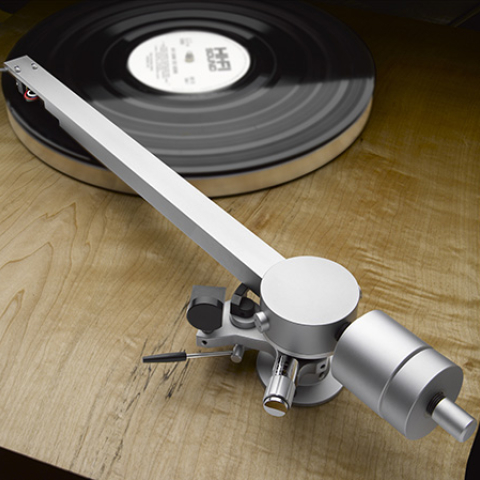
After a few days of breaking in the second Azur 851A by streaming electronic dance music, I played Japanese Koto Classics (LP, Nonesuch Explorer Series H-72008). The first track, Zangetsu (Lingering Moonlight), was composed in the 18th century and is an offering to a beloved person's spirit. I used the VPI Traveler turntable and tonearm fitted with an Ortofon 2M Black cartridge, and the Soundsmith MMP3 phono stage (footnote 1). Right out of the box, I was having feelings of warmth and excitement about this Cambridge integrated. The koto was enjoyably present, detailed, properly scaled, and sounded very natural. The starts and stops of notes felt just right—not too soft or hard, not too quick or slow. Crisp and colorful!, I kept thinking, and wondered: Maybe I underestimated how vivid and dynamic the Ortofon 2M Black and Soundsmith MMP3 could be. I can't remember having ever been impressed or excited by the 2M Black's microdynamic expression—and now I was. I was even having flashbacks of the Koetsu Rosewood Signature. I know Japanese Koto Classics from when I actually owned one of Sugano-San's psychedelic Koetsu moving-coils—and now I was enjoying this album in a way I hadn't since then. On the second cut, Fuki (Riches and Honors), koto master Shinichi Yuize improvises a vocal melody over the ancient koto composition. The Azur 851A let me lock on to and fall into this virtuously poetic musical event. It also made clear that Yuize's koto was roughly 6' long and that the mike was about 3' from it. Color and space everywhere, with more flashy sonics and sinewy transients than I'm used to from my system. Something really good was taking place—either the LP, the Cambridge Azur, or the front end was making some unusually exciting music. I decided to try a CD.
Cheating on Aldo
I am so in love with Aldo Ciccolini's spirited, irony-filled renderings of Eric Satie's piano music that, every time I listen to Ciccolini's student, Jean-Yves Thibaudet, playing these masterpieces of La Belle Epoch, I feel I'm cheating on my girlfriend. But listening to Thibaudet's Satie: The Complete Solo Piano Music (5 CDs, Decca 473 620-2), I also feel I can better grasp those eccentric, weirdly poetic "performance indications" that Satie famously inscribed between the staves: "without pride," "with astonishment," "sadly," "gravely," etc. Thibaudet brings me even closer than Ciccolini to the piquant, melancholy effects called for in Satie's notes, and shows me even more of Satie's moods.
Footnote 1: Michael Fremer reviewed the Soundsmith in Stereophile, October 2011.
On their website, Cambridge Audio describes the Azur 851A ($1900) as their "Flagship Integrated Class XD Amplifier," and that it provides "120 watts per channel of Class XD amplification" from "an acoustically damped full metal chassis." Class XD is Cambridge's "proprietary amplifier circuit design," which they say "offers superior sound quality [to that] currently available from existing amplifier configurations. . . .
The mains switch is on the rear panel, as are two sets of speaker terminals (A and B, selectable via the front panel), an infrared emitter input, an RS232C port for external control in a custom installation, preamp out, and record in and out. For two of the inputs, a choice of RCA or balanced XLR inputs is provided.
I hooked up the Azur 851A, switched it on, and pushed the front-panel button that toggles the amp between Standby to On—which caused the rectangular display to glow a beautiful shade of soft gray-blue. I selected Source 1, and pushed Play on my CD player. It was early afternoon; I was very revved to hear Jean-Yves Thibaudet playing Satie . . . BOOM! BOOM! Hey!! OMG! What the...? A loud popping sound was followed by the cones of my DeVore Fidelity Orangutan O/93 speakers came jumping out like Miley's tongue. Holy Moley! What have I done? I groped frantically for the Standby switch and stared at that pretty blue display. It was flashing "DC ERROR! DC ERROR!" Sitting on the floor, hyperventilating, I checked the manual for troubleshooting tips and discovered explanations of the CAP5 Fiveway protection system. I checked all of my connections, including to AC, turned the volume down to –93, and powered up the 851A again, this time using a variac. Everything looked pretty okay, so I turned the volume up a smidge, to –82, and suddenly the volume went full throttle (–00), instigating crashing sounds and insanely pumping cones. Again the 851A flashed "DC ERROR! DC ERROR!" Fearful for my privates, I shut it down again. After a few stressful intimate moments with the Reset button, I called John Bevier at Audio Plus Services, Cambridge Audio's US distributor, who sent me another Azur 851A. It scared me less than the first one—and liked me more.
After a few days of breaking in the second Azur 851A by streaming electronic dance music, I played Japanese Koto Classics (LP, Nonesuch Explorer Series H-72008). The first track, Zangetsu (Lingering Moonlight), was composed in the 18th century and is an offering to a beloved person's spirit. I used the VPI Traveler turntable and tonearm fitted with an Ortofon 2M Black cartridge, and the Soundsmith MMP3 phono stage (footnote 1). Right out of the box, I was having feelings of warmth and excitement about this Cambridge integrated. The koto was enjoyably present, detailed, properly scaled, and sounded very natural. The starts and stops of notes felt just right—not too soft or hard, not too quick or slow. Crisp and colorful!, I kept thinking, and wondered: Maybe I underestimated how vivid and dynamic the Ortofon 2M Black and Soundsmith MMP3 could be. I can't remember having ever been impressed or excited by the 2M Black's microdynamic expression—and now I was. I was even having flashbacks of the Koetsu Rosewood Signature. I know Japanese Koto Classics from when I actually owned one of Sugano-San's psychedelic Koetsu moving-coils—and now I was enjoying this album in a way I hadn't since then. On the second cut, Fuki (Riches and Honors), koto master Shinichi Yuize improvises a vocal melody over the ancient koto composition. The Azur 851A let me lock on to and fall into this virtuously poetic musical event. It also made clear that Yuize's koto was roughly 6' long and that the mike was about 3' from it. Color and space everywhere, with more flashy sonics and sinewy transients than I'm used to from my system. Something really good was taking place—either the LP, the Cambridge Azur, or the front end was making some unusually exciting music. I decided to try a CD.
I am so in love with Aldo Ciccolini's spirited, irony-filled renderings of Eric Satie's piano music that, every time I listen to Ciccolini's student, Jean-Yves Thibaudet, playing these masterpieces of La Belle Epoch, I feel I'm cheating on my girlfriend. But listening to Thibaudet's Satie: The Complete Solo Piano Music (5 CDs, Decca 473 620-2), I also feel I can better grasp those eccentric, weirdly poetic "performance indications" that Satie famously inscribed between the staves: "without pride," "with astonishment," "sadly," "gravely," etc. Thibaudet brings me even closer than Ciccolini to the piquant, melancholy effects called for in Satie's notes, and shows me even more of Satie's moods.
Footnote 1: Michael Fremer reviewed the Soundsmith in Stereophile, October 2011.