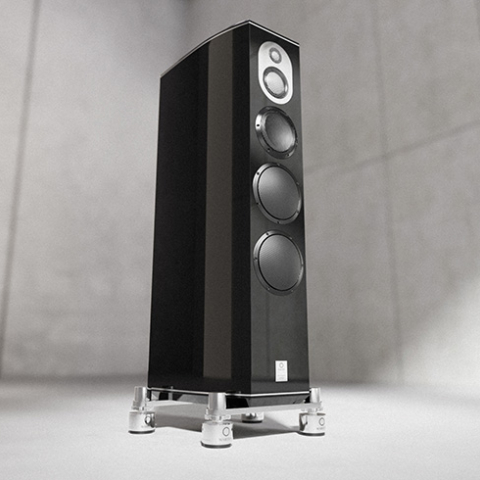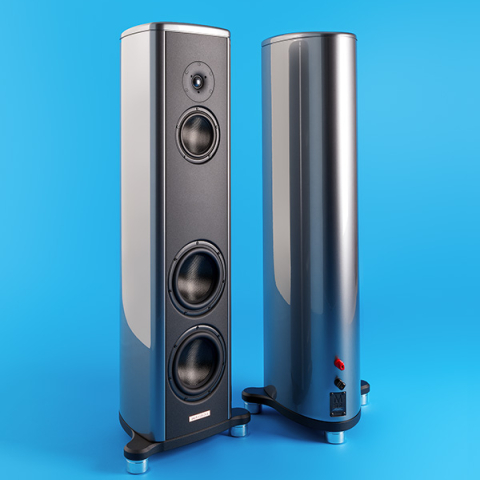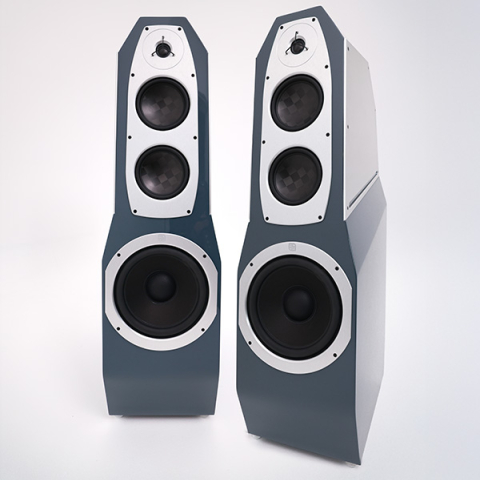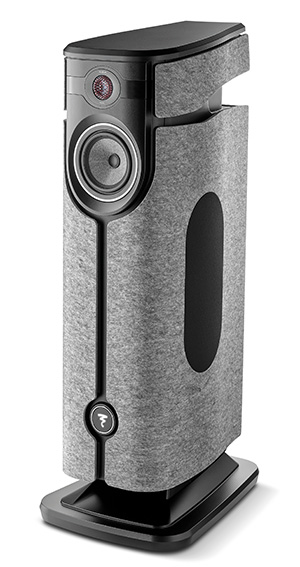
The 6.5" mid/bass driver includes a "Tuned Mass Damping" rounded surround and a "Neutral Inductance Circuit": a ring between the magnet and voice coil to keep the magnetism at the voice coil uniform throughout its range of movement. Mid/bass and woofer cones are made of Focal's "W" material, a sandwich of foam between two glass-fiber layers, designed to provide the desirable combination of rigidity and damping so that the cone vibrations are "pistonic," the whole cone vibrating at once, responding directly to the electrical signal.
The two 6.5" long-throw woofers on each side of the cabinet fire outward in phase. Focal calls this arrangement "push-push." The arrays backfire into a tuned port that blows out the bottom. Approximately an inch and a half below the port is a heavy aluminum base. The base is connected to the speaker bottom on three sides so that energy from the port is directed out the front.
Examining the tone-brain
Focal claims a usable frequency response (±3dB) of 27Hz–40kHz. There are no traditional, electrical crossover networks; the DSP processor separates the frequency bands sent to each driver's DAC. As such, sophisticated DSP tone control is possible. For now, Focal includes what Bedel called "Dynamic Loudness Control Technology": At low listening levels, the bass and treble will be boosted, akin to a traditional Loudness function but with more sophisticated control in that the amount of bass and treble boost vary with volume level, and the whole thing shuts off at 50% volume (as indicated on the app's playback screen). In the app's Audio settings screen, the loudness DSP can be switched off completely.
Along with the DSP loudness control, Focal developed the ADAPT room correction. In contrast to more traditional app-based room-correction systems, the user sets up ADAPT by using their own ears—not a microphone—to match the levels of a series of multi-frequency tones at the listening position at their preferred volume. The Focal & Naim app allows adjustment of the percent DSP-"corrected" signal vs "uncorrected." Bedel says the default is 71% corrected, which Focal found to be most to the liking of beta testers. I found turning that down to around 69%—a small but audible adjustment—was best for my ears in my room.
To set up ADAPT, I provided the app with the requested measurements: how far my speakers were placed from the back and sidewalls and how far apart they stood. I was then presented with a series of two tones, starting with higher frequencies and working down to floor-rattling low-bass. Sitting in my listening seat, I used a virtual slider control to match the tones' levels—so the resulting room correction (or equalization, or tone-control setting) was personal to
my hearing in my room at my listening seat. This is somewhat different from standardized room correction, which is based on objective measurement of frequency response at the listening seat and, usually, other points in the room. Traditional systems adjust to make the in-room response as flat as possible—which, after all that measuring and adjustment, may or may not be to the listener's liking. ADAPT, then, is a subjective, personalized room-correction system.
What if two people with slightly or greatly different hearing cohabit with a Diva Utopia system? Unfortunately, the app doesn't currently allow multiple ADAPT presets, or didn't yet at press time. The way things worked, ADAPT would need to be reconfigured for each new listener (footnote 6). Bedel acknowledged a multiple-user scenario is possible and said that app programmers would likely add the ability to save ADAPT profiles in a future update.
I set up ADAPT at a room-filling volume, used it for a few hours, then decided that I preferred the sound without it. It is easily switched on and off on the same screen in the Focal & Naim app where the percentage of "corrected sound" is adjusted. Then I set up ADAPT at a lower listening volume, a little bit louder than background music. At that level, ADAPT enhanced tonality and dynamics. This is another reason to allow multiple ADAPT configurations: to allow a user to set it up for use at different listening levels.
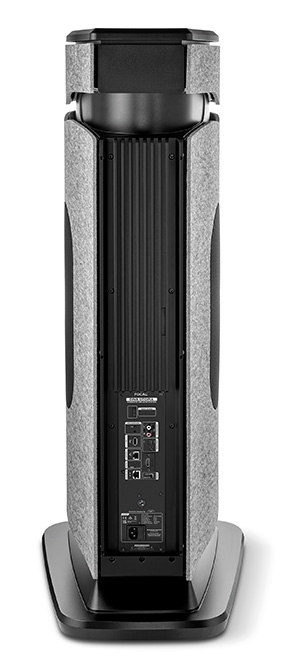
Qobuz and Tidal can both be controlled from within the Focal & Naim app, and the Diva Utopia is configured for Spotify Connect, which means you can use the Spotify app as the control interface while the music is sent directly to the speakers from Spotify's servers. It can also stream audio from a phone or tablet using Bluetooth (which is lossy), Apple AirPlay (which is lossless up to CD resolution), or Google Home.
The Diva Utopia system includes a wireless remote control, which is lightweight and plastic with small buttons but not inelegant. It's good for simple tasks like adjusting the volume, pausing streaming playback, muting the sound, or turning the system off. But to use the system well, you must master the app, which I found easy enough. The included Quick-Start pamphlet instructs how to find the speakers on the network via the app, whether they are Ethernet hardwired or Wi-Fi-connected. The app can control multiple Focal-Naim devices on the same network, so if there's a Naim networked streamer in the bedroom and the Diva Utopia speakers in the living room, one user with one phone and with one iteration of the app can control both systems.
The app's home screen includes buttons for all streaming and connected sources, plus a list of favorites and preset internet radio stations, both configurable. The streaming control apps I've previously reviewed, from T+A and Hegel, used Airable for internet radio; Airable has a robust search engine and a relatively sensible browsing menu tree. Focal-Naim has gone its own way with its app's internet radio interface. Radio stations are searchable in the same top-line search engine that scours connected streaming services. (Such a search, however, doesn't also look for files on your local NAS device.)
In general, searching for tunes on the Focal & Naim app is clunkier and takes more time than it does using Roon, the current state of the art in music streaming apps, in usability at least. Focal-Naim's position against Roon integration seems reasonable but comes at a cost. To be competitive on the app side, they need to provide universal search—of local files, connected streaming services, and internet radio all at once—and access to robust visual and textual metadata.
Help is surely already—constantly—on the way in the form of software updates. "The universal search function exists with Naim Uniti Core," Bedel told me. "We will extend this compatibility to other streaming services and a [local] file server, but it takes time to incorporate it perfectly."
For controlling the input functions and enabling and adjusting ADAPT, the Focal & Naim app worked well, though sometimes when I turned the speakers on with the remote control, the app needed several minutes to catch up. The speakers "remembered" what had been playing when they were last powered on; intriguingly, pushing the play/pause button on the remote control continued playback even before the app was back in communication with the speakers.
Footnote 6: Also, what if two or more people are listening at the same time? Only one—the one sitting in the best seat in the house, with ADAPT adjusted for their own ears—can listen optimally. The most sophisticated room-correction systems these days allow a tradeoff between optimizing at the main listening position and listening from various places in the room. They do so objectively with no "personalization." YMMV.—
Jim Austin