 Getting set for some music
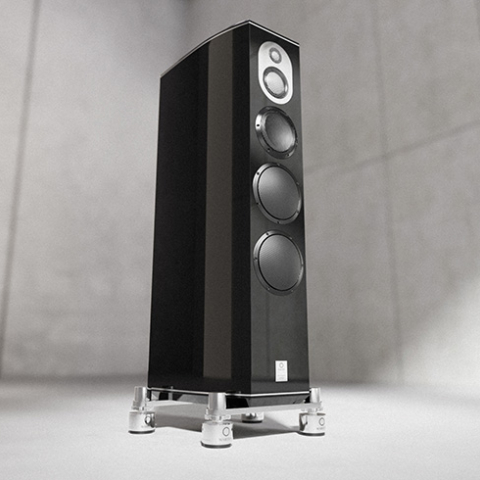
On a rainy day in September, the speakers arrived on a large pallet, one box each plus a box for accessories (remote control, documentation, spikes, and so on). The speakers weigh 141lb each; buyers will be grateful that they're delivered on wheels and with a sturdy plywood ramp. Just open the box, remove some packing material, slide the ramp under the wheels, tip the speaker upright, and roll it out. The wheels are useful not just for uncrating but also for positioning. Once that has been accomplished, the screw-in spikes or feet can be adjusted with included tools to lift each speaker off its wheels so that the feet or spikes (user's choice) interface with the floor or carpet. The delivery guys—Terry and Justin—helped me unpack the speakers and took them upstairs to my living room. I ended up with the speakers about a quarter of the way out into my large living room. Their rears were about 4½' from the back wall, their centers about 80" apart. My ears were about 90" from the center point between the fronts of the speakers. I toed them in a bit, but not so much that they fired directly at my ears. In that configuration, they presented a balanced if somewhat bass-forward sound and threw a wide, tall, 3D stereo image. Listening to each speaker in turn, I was struck with how alike they sounded, indicating not just excellent frequency-response matching but also that their placement in the room wasn't messing with the sound much. Also striking: True mono content sat dead center, not spread unnaturally wide and flat (footnote 7).
 Enough tech talk—how do they sound?
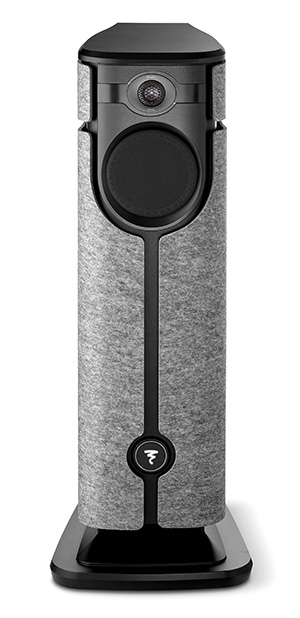
Although the Diva Utopia is a self-contained wireless streaming system, the point of the price (a dollar shy of $40k including DACs and amplifiers and the equivalent of cables) is the full-range, floorstanding speakers. Focal knows its stuff, and the company didn't skimp on parts or R&D. My first impression, diving right into my Qobuz playlists, was they make a big sound, and the bass goes low and hard. At the same time, the top end is refined and non-shrieky. The stereo imaging is as precise as the recording allows. There's a magic volume level where music fills the room without sounding unpleasantly loud. At that point, I felt like I was in my studio with near-field monitors because the details were so clear and the stereophony so precise. The music was fully present, and when the recording allowed, life forces came forth.
 Once turned up to that Goldilocks volume level, the Diva Utopia system really brought the music. That honest tonality I described earlier scales up, and I heard no evidence that the amplifiers were overtaxed at any listening level I dared try. My wife and I had fun listening to BBC regional streams, especially after we stumbled on a Friday afternoon program of 1980s Brit-pop and new wave on BBC Scotland. The Focal & Naim app offers BBC "Extra" quality streams of 320kbps, which sound quite good. We also sampled the offerings at BBC Manchester and BBC Wales, which weren't as perfect for Friday afternoon dancing in the living room.
 Plugging in and turning on
My Oppo universal player, connected via TosLink optical, operated as expected and sounded great. I compared a few CD tracks to the same tracks/versions streaming from Qobuz and didn't hear any differences. I plugged a USB thumb drive with various files into the rear of the primary speaker, and the app quickly found the files and associated metadata. Playback sounded as expected, again no different from the same tracks from the same albums as played from Qobuz. Bedel told me that the USB connection provides enough current to power a portable hard drive. I tested this with the Western Digital 4TB portable drive on which I mirror my music library. I played albums and tracks for several hours with no stalls, dropouts, or other problems. When I powered down the speakers and unplugged the drive, I felt around the back panel to see if anything had heated up from the current demand through the USB socket. All was cool to the touch.
 Bring it on home
The Focal Diva Utopia streaming wireless amplified speaker system is complex and expensive—though there's a lot built into it that you won't have to pay extra for, like DACs and (custom-matched) amplifiers. At this price (and size, and weight), I expected full-range sound that would fill my cathedral ceiling living room, including realistically large portrayal of dynamic orchestral music. I got it. The electronics handle the digital data, convert it, and amplify it in high fidelity, neutral but not cold- or thin-sounding. When cranked up enough to breathe, the Diva Utopias push precise and appropriately scaled sound out onto a wide-screen, well-defined soundstage. When it's fed a recording done right, the system sounds lifelike. The biggest drawback I heard with the Diva Utopia is its inability to produce dynamic, compelling sound at low volumes—which hopefully can be improved with future DSP updates. But at realistic SPLs, this speaker system is fully engaging, with a "Wow" factor in both appearance and sound quality. As of this writing, the Focal & Naim app wasn't as functionally complete or as user-friendly as Roon. (No manufacturer's app I've used so far is.) But the company employs engineers and software specialists with the skills to keep improving it and has a track record of steady forward progress. For now, I found the JPlay app more visually appealing and easier to find the music I wanted to hear.
Footnote 7: "Wide mono" can be pleasant to listen to—I enjoy it—but Tom is correct when he suggests that from a technical point of view, it is a bug, not a feature.—Jim Austin Footnote 8: As noted above, the woofers cross over to the mid-woofers at 200Hz. Footnote 9: See open.qobuz.com/playlist/21395182. Footnote 10: Ear strain with heavily compressed recordings played back at high volumes is not the fault of the Diva Utopia system.