Sidebar 3: Measurements
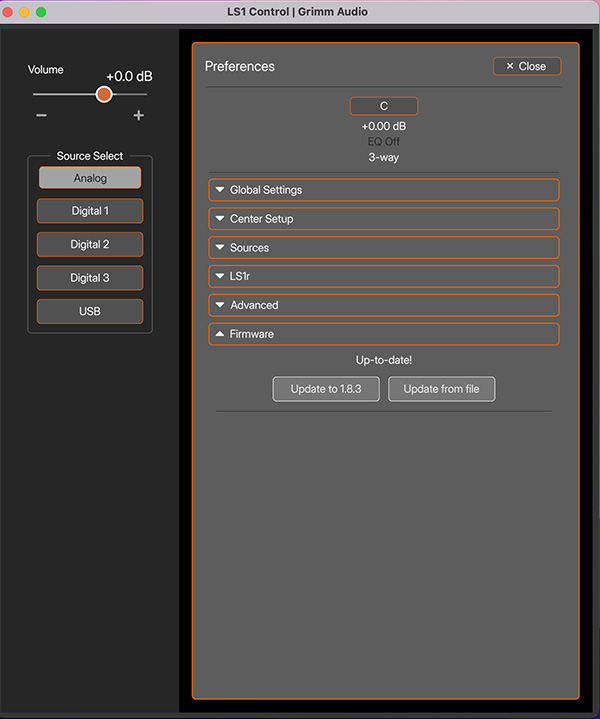 The Grimm LS1 system includes a pair of HIMACS LS1c DSP-controlled active loudspeakers (each supported on two outrigger legs), two SB1 subwoofers, an LS1i USB interface, and an LS1r Controller, which includes a display unit and a rotary volume control. The LS1i and LS1r are connected to the speakers with CAT5 cables. The LS1i has a USB port, which I connected to my MacBook Pro laptop to adjust the LS1c's settings with Grimm's LS1 Control app rather than using the LS1r.
The app reported that the system's firmware was up-to-date. Apple's USB Prober app identified the LS1i as "Grimm Audio LS1 USB interface" from "Grimm Audio" with the serial number string "2059." The USB port operated in the optimal isochronous asynchronous mode, and the AudioMIDI utility revealed that the LS1c accepts 24-bit integer data via USB sampled at all rates from 44.1kHz to 384kHz. The AES3 digital inputs accepted data sampled at rates up to 192kHz.
I only set up one speaker for testing; Eelco Grimm emphasized in an email that when I assembled a loudspeaker for the measurements, it was very important to match the serial numbers of the leg containing the electronics and the cabinet with drivers. "The reason for that is that every loudspeaker is individually calibrated, so the DSP in the leg has the correction for the drivers in that cabinet," he explained.
I matched the serial numbers—both were 3.001.044—then the LS1 Control app identified the single speaker as "Center." Eelco explained that the LS1 control interface automatically detects if the LS1 is being used in a surround setup (up to 7 speakers). If one speaker is connected, it is indeed designated as "Center."
I understood from the manual that different equalization settings needed to be used depending on whether the LS1c was aimed at the listening position ("30°") or toed in even more ("45°"). However, there were no settings available in the app to adjust the equalization. I asked Eelco if this was because the speaker had been designated "Center." He said it was, adding that a center speaker's on-axis behavior is set by DSP to be 30° since it is aimed at the listener's ears.
The Grimm LS1 system includes a pair of HIMACS LS1c DSP-controlled active loudspeakers (each supported on two outrigger legs), two SB1 subwoofers, an LS1i USB interface, and an LS1r Controller, which includes a display unit and a rotary volume control. The LS1i and LS1r are connected to the speakers with CAT5 cables. The LS1i has a USB port, which I connected to my MacBook Pro laptop to adjust the LS1c's settings with Grimm's LS1 Control app rather than using the LS1r.
The app reported that the system's firmware was up-to-date. Apple's USB Prober app identified the LS1i as "Grimm Audio LS1 USB interface" from "Grimm Audio" with the serial number string "2059." The USB port operated in the optimal isochronous asynchronous mode, and the AudioMIDI utility revealed that the LS1c accepts 24-bit integer data via USB sampled at all rates from 44.1kHz to 384kHz. The AES3 digital inputs accepted data sampled at rates up to 192kHz.
I only set up one speaker for testing; Eelco Grimm emphasized in an email that when I assembled a loudspeaker for the measurements, it was very important to match the serial numbers of the leg containing the electronics and the cabinet with drivers. "The reason for that is that every loudspeaker is individually calibrated, so the DSP in the leg has the correction for the drivers in that cabinet," he explained.
I matched the serial numbers—both were 3.001.044—then the LS1 Control app identified the single speaker as "Center." Eelco explained that the LS1 control interface automatically detects if the LS1 is being used in a surround setup (up to 7 speakers). If one speaker is connected, it is indeed designated as "Center."
I understood from the manual that different equalization settings needed to be used depending on whether the LS1c was aimed at the listening position ("30°") or toed in even more ("45°"). However, there were no settings available in the app to adjust the equalization. I asked Eelco if this was because the speaker had been designated "Center." He said it was, adding that a center speaker's on-axis behavior is set by DSP to be 30° since it is aimed at the listener's ears.
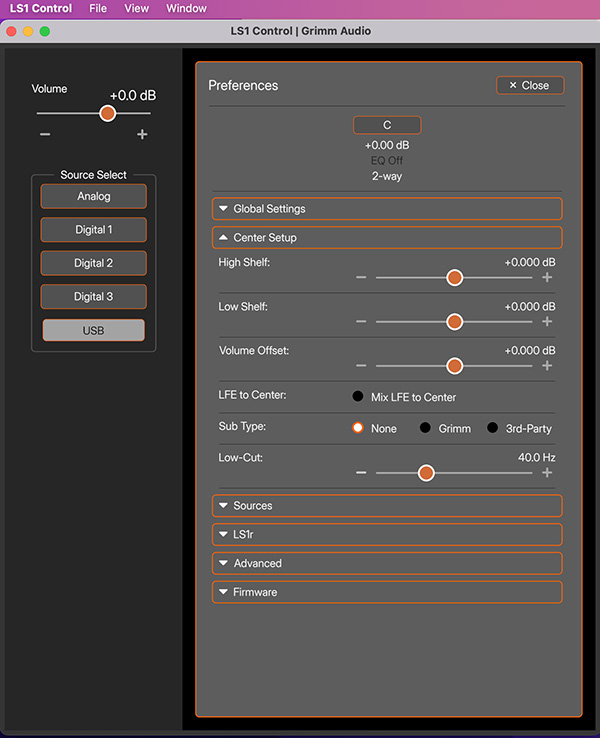 The LS1 app has two tone controls, called "High Shelf" and "Low Shelf." The effect of the High and Low shelves set to their maximum of "+7.875" was to increase levels by 5dB above 10kHz and below 100Hz. With the controls set to the minimum of "–8," the cuts were –6dB below 100Hz and above 10kHz. These controls were turned off for the rest of the testing.
I had one final question. The intended listening height wasn't clear from the manual. With the speaker mounted on its legs, the tweeter is just 32" from the floor, while the mid/woofer is 39" high. Eelco replied that the listener's ears should be level with the point between the two drive units. This is 36" from the floor, which a survey Stereophile performed in the 1990s indicated was the average ear height for a seated listener (as long as they weren't sitting in a director's chair). I performed all the primary quasi-anechoic farfield measurements with my calibrated DPA 4006 microphone on this axis, which I refer to as the "design axis." Except where noted, the LS1 was set to "2-way."
I used DRA Labs' MLSSA system with the DPA 4006 and an Earthworks QTC-40 microphone to measure the nearfield responses of the LS1c's woofer and the SB1 subwoofer. I mainly used the balanced analog input for the testing, but I repeated some measurements with the AES3 digital input.
The LS1 app has two tone controls, called "High Shelf" and "Low Shelf." The effect of the High and Low shelves set to their maximum of "+7.875" was to increase levels by 5dB above 10kHz and below 100Hz. With the controls set to the minimum of "–8," the cuts were –6dB below 100Hz and above 10kHz. These controls were turned off for the rest of the testing.
I had one final question. The intended listening height wasn't clear from the manual. With the speaker mounted on its legs, the tweeter is just 32" from the floor, while the mid/woofer is 39" high. Eelco replied that the listener's ears should be level with the point between the two drive units. This is 36" from the floor, which a survey Stereophile performed in the 1990s indicated was the average ear height for a seated listener (as long as they weren't sitting in a director's chair). I performed all the primary quasi-anechoic farfield measurements with my calibrated DPA 4006 microphone on this axis, which I refer to as the "design axis." Except where noted, the LS1 was set to "2-way."
I used DRA Labs' MLSSA system with the DPA 4006 and an Earthworks QTC-40 microphone to measure the nearfield responses of the LS1c's woofer and the SB1 subwoofer. I mainly used the balanced analog input for the testing, but I repeated some measurements with the AES3 digital input.
Footnote 1: This means that the loudspeaker is firing into hemispherical space rather than a full sphere, which boosts the low frequencies. See this discussion.
The Grimm LS1 system includes a pair of HIMACS LS1c DSP-controlled active loudspeakers (each supported on two outrigger legs), two SB1 subwoofers, an LS1i USB interface, and an LS1r Controller, which includes a display unit and a rotary volume control. The LS1i and LS1r are connected to the speakers with CAT5 cables. The LS1i has a USB port, which I connected to my MacBook Pro laptop to adjust the LS1c's settings with Grimm's LS1 Control app rather than using the LS1r.
The app reported that the system's firmware was up-to-date. Apple's USB Prober app identified the LS1i as "Grimm Audio LS1 USB interface" from "Grimm Audio" with the serial number string "2059." The USB port operated in the optimal isochronous asynchronous mode, and the AudioMIDI utility revealed that the LS1c accepts 24-bit integer data via USB sampled at all rates from 44.1kHz to 384kHz. The AES3 digital inputs accepted data sampled at rates up to 192kHz.
I only set up one speaker for testing; Eelco Grimm emphasized in an email that when I assembled a loudspeaker for the measurements, it was very important to match the serial numbers of the leg containing the electronics and the cabinet with drivers. "The reason for that is that every loudspeaker is individually calibrated, so the DSP in the leg has the correction for the drivers in that cabinet," he explained.
The LS1 app has two tone controls, called "High Shelf" and "Low Shelf." The effect of the High and Low shelves set to their maximum of "+7.875" was to increase levels by 5dB above 10kHz and below 100Hz. With the controls set to the minimum of "–8," the cuts were –6dB below 100Hz and above 10kHz. These controls were turned off for the rest of the testing.
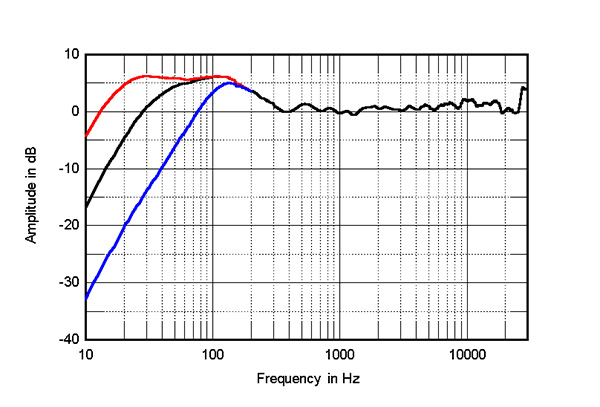
Fig.1 Grimm LS1c, set to "2-way," anechoic response on design axis at 50", averaged across 30° horizontal window and corrected for microphone response, with the nearfield response of the woofer with the low-cut frequency set to 20Hz (red), 40Hz (black), and 100.2Hz (blue), respectively plotted below 200Hz, 310Hz, and 200Hz.
The Grimm's farfield response, averaged across a 30° horizontal window centered on the design axis, is shown as the black trace above 310Hz in fig.1. It meets extraordinarily tight ±0.7dB limits from 600Hz to 6kHz, with then a very slight upward tilt, peaking at +2.2dB between 9kHz and 11kHz. The 6dB boost in the woofer's nearfield response with the low-cut frequency set to the default of 40Hz (black trace below 310Hz in fig.1) is due to the nearfield measurement technique, which assumes that the baffle extends to infinity in both planes (footnote 1). The woofer rolls off with a second-order, 12dB/octave high-pass slope, reaching –6dB at 29Hz. The blue trace shows the woofer's nearfield response with the low-cut frequency set to 100.2Hz; the output is now down by 6dB at 75Hz. Setting the low-cut frequency to 20Hz—not recommended in "2-way" mode because this will result in excessive cone excursion—extended the low-frequency response below 20Hz.
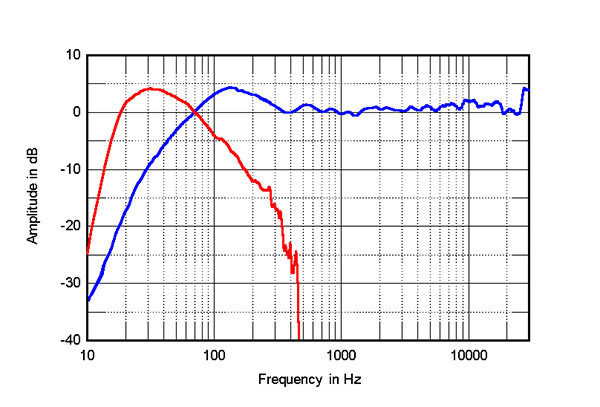
Fig.2 Grimm LS1c, set to "3-way" and Sub Type set to "Grimm," anechoic response on design axis at 50", averaged across 30° horizontal window and corrected for microphone response (blue), with the nearfield response of the LS1c woofer (blue) and the SB1 subwoofer (red).
Setting the LS1 to "3-way" and selecting "Grimm" as the chosen subwoofer in the app's menu, the system's DSP creates the necessary crossover filters, with their phase correction. The subwoofer's input is driven by a balanced cable taken from the subwoofer output on the leg that contains the electronics. The result is shown in fig.2. The crossover between the LS1c's woofer (blue trace) and the subwoofer (red trace) appears to be around 70Hz. The subwoofer's upper-frequency rolloff is clean, and the low-frequency output is down by 6dB at 17Hz. (The subwoofer's low-cut frequency is automatically set to 20Hz.)
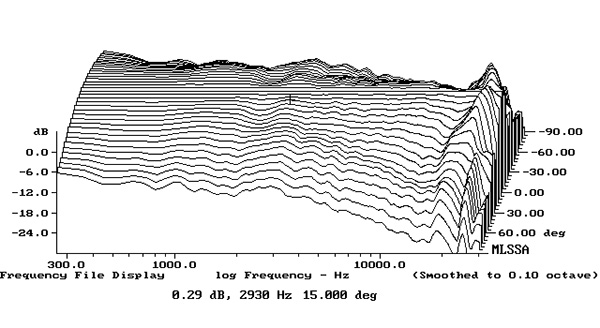
Fig.3 Grimm LS1c, set to "2-way," lateral response family at 50", normalized to response on design axis, from back to front: differences in response 90–5° off axis, reference response, differences in response 5–90° off axis.
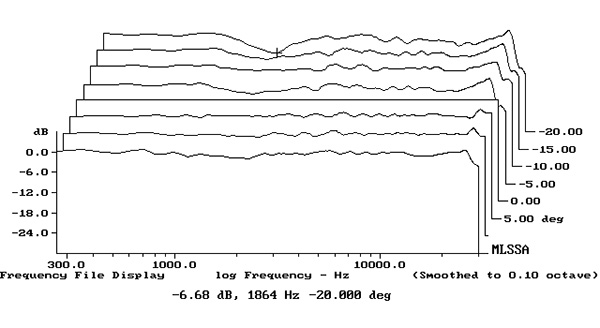
Fig.4 Grimm LS1c, set to "2-way," vertical response family at 50", normalized to response on design axis, from back to front: differences in response 20–5° above axis, reference response, differences in response 5–10° below axis.
Returning to "2-way" mode, the Grimm's horizontal radiation pattern, normalized to the response on the design axis, which therefore appears as a straight line, is shown in fig.3. The radiation pattern is superbly even through the midrange and low treble, with the speaker's off-axis output gently shelving down in a well-controlled manner above 3kHz. The LS1c's dispersion in the vertical plane (fig.4), again normalized to the response on the design axis, indicates that the balance doesn't change significantly over a wide (±10°) window. Only at 20° above the design axis, which is what a standing listener will hear, does a small suckout start to develop in the crossover region between the woofer and tweeter.
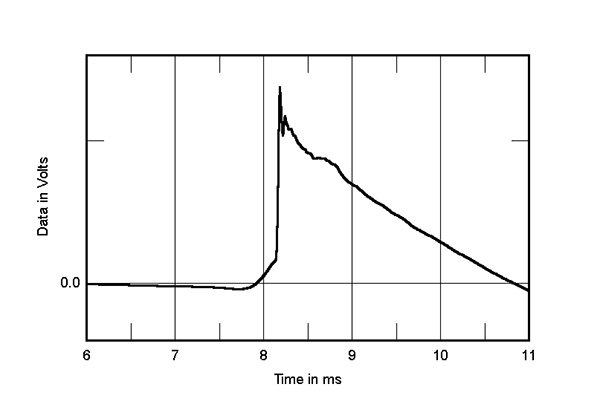
Fig.5 Grimm LS1c, set to "2-way," step response on design axis at 50" (5ms time window, 30kHz bandwidth).
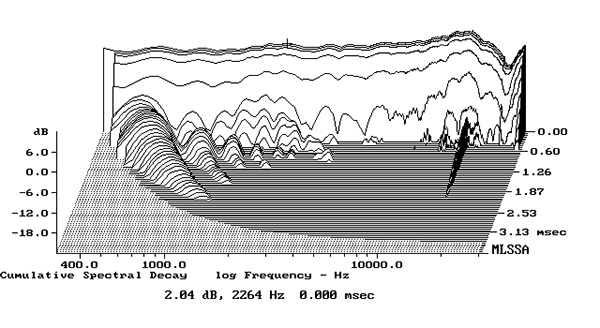
Fig.6 Grimm LS1c, set to "2-way," cumulative spectral-decay plot on design axis at 50" (0.15ms risetime).
In the time domain, the Grimm's step response on the design axis (fig.5) indicates that both drive units are connected in positive acoustic polarity, with their outputs summing to give a perfect time-coincident right-triangle shape. The microphone was 50" away for the farfield measurements, which is related to a propagation time of around 2.8ms. Note, however, that the LS1c's output arrives 6.5ms later than that; this latency is due to the speaker's digital signal processing. There are no ripples in the decay of the loudspeaker's step, and the LS1c's cumulative spectral-decay, or waterfall, plot (fig.6) is superbly clean. (As always with my measurements, ignore the small ridge of delayed energy close to 16kHz, which is due to interference from the MLSSA host PC's video circuitry.)
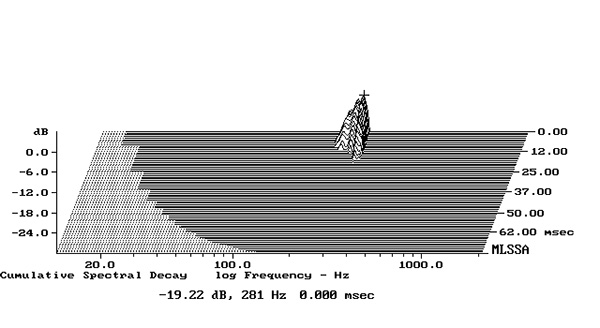
Fig.7 Grimm LS1c, cumulative spectral-decay plot calculated from output of accelerometer fastened to the center of the back panel, 95.8dB(C) spl (measurement bandwidth, 2kHz).
Finally, the LS1c's enclosure seemed inert when I rapped its panels with my knuckles. At an SPL of 95.8dB(C) at 1m and using a plastic-tape accelerometer, the highest-level resonant mode I found was at 281Hz on the back panel (fig.7). This mode has a high Q (Quality Factor) and a low level, both of which will work against audibility.
Overall, the Grimm LS1 offers superb performance in both time and frequency domains. It may be complicated, but it is the best-measuring loudspeaker I have encountered!—John Atkinson
Footnote 1: This means that the loudspeaker is firing into hemispherical space rather than a full sphere, which boosts the low frequencies. See this discussion.