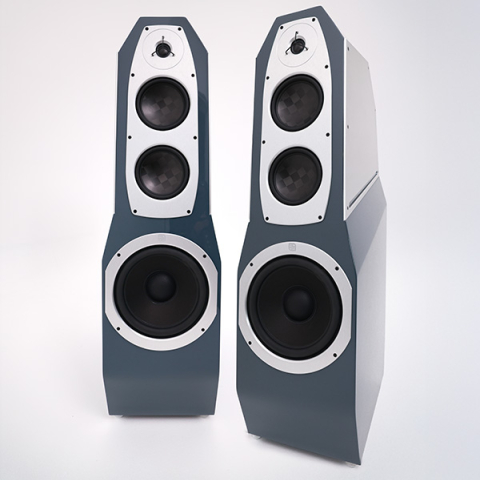
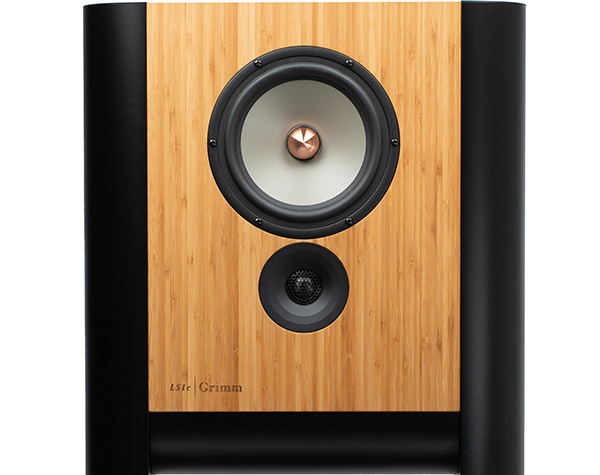
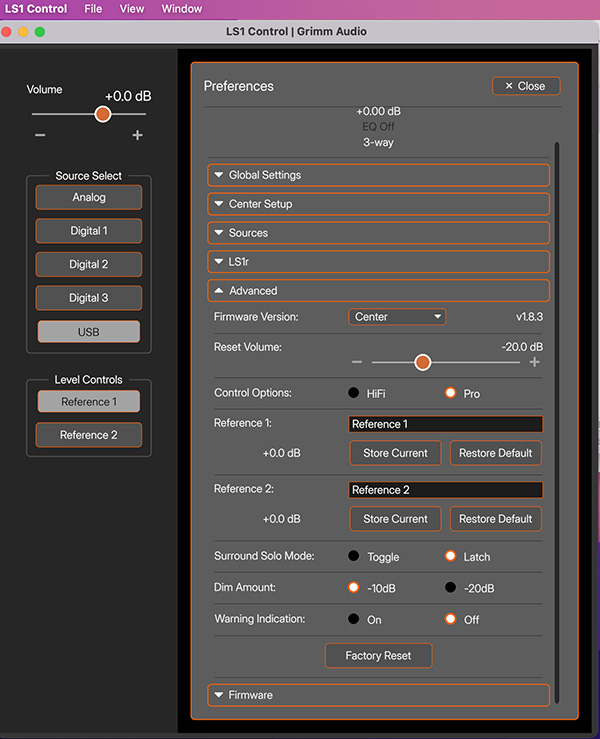
 Because every LS1 midrange driver and tweeter is measured during manufacturing, then precision-matched to the amplifier that powers them, the Grimm crew says that users should make sure that the serial number on the speaker is the same as the serial number on the speaker leg containing the electronics. Easy enough—though I will say that connection-wise and web-interface-wise, inaugurating this system was quite a bit more complicated than hooking up other powered speakers I'm familiar with, including the KEF LS50W, SVS Prime Pro Wireless, and Vanatoo Transparent One Encore. The Grimm system is also more sophisticated in just about every aspect, partly because so many parameters can be altered via either the MU1 web browser control page, or the LS1 Control software when using the LS1i USB interface. (Side note: You'll be highly dependent on that software interface because no wireless remote control comes with the system currently (footnote 4). Grimm will include one in the future. I believe that's wise.) My advice is to just work through the company's extraordinarily informative PDF documentation slowly and methodically. You'll figure it out. I did, with only a small amount of trans-Atlantic handholding by the Dutch mothership.
New tech meets old
Because every LS1 midrange driver and tweeter is measured during manufacturing, then precision-matched to the amplifier that powers them, the Grimm crew says that users should make sure that the serial number on the speaker is the same as the serial number on the speaker leg containing the electronics. Easy enough—though I will say that connection-wise and web-interface-wise, inaugurating this system was quite a bit more complicated than hooking up other powered speakers I'm familiar with, including the KEF LS50W, SVS Prime Pro Wireless, and Vanatoo Transparent One Encore. The Grimm system is also more sophisticated in just about every aspect, partly because so many parameters can be altered via either the MU1 web browser control page, or the LS1 Control software when using the LS1i USB interface. (Side note: You'll be highly dependent on that software interface because no wireless remote control comes with the system currently (footnote 4). Grimm will include one in the future. I believe that's wise.) My advice is to just work through the company's extraordinarily informative PDF documentation slowly and methodically. You'll figure it out. I did, with only a small amount of trans-Atlantic handholding by the Dutch mothership.
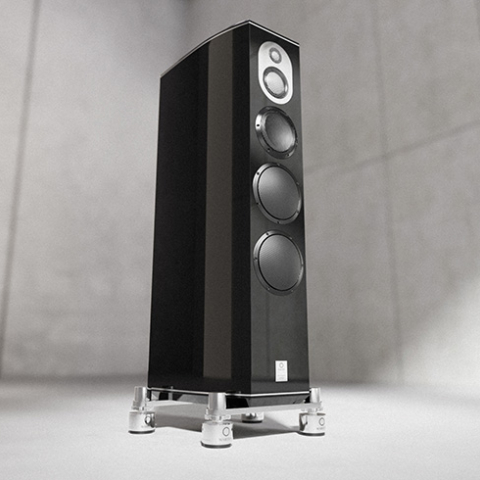
New tech meets oldOne thing that piqued my interest in the Grimm speakers is that they're a rare amalgam of cutting-edge technologies and two almost forgotten ones. Let's start with the cabinet dimensions. Speaker enclosures in the 1930s and '40s were often flat but wide. That's also true of the LS1c. The wide baffle pushes the baffle-step frequency under 250Hz. What does that mean? Below the baffle step transition frequency, sound radiates equally in all directions. Above, the sound is forward directed. So a larger portion of the energy is directed toward the user at the higher frequencies than at lower frequencies—something the crossover (analog or digital) must address. It also means fewer reflections from the front and sidewalls, which result in phase errors. According to Eelco, "Psychoacoustics says that the ear is sensitive to phase errors down to approximately 250Hz. The LS1s' wide baffle helps attenuate interfering reflections throughout that whole range." The approach comes with a bonus, he says: A wider baffle makes it possible to use a shallower cabinet. "The shallow cabinet moves the resonance along the depth axis inside the box significantly above the crossover frequency of the low-frequency driver. This serves to avoid boxiness."
 Cool, calm, and connected
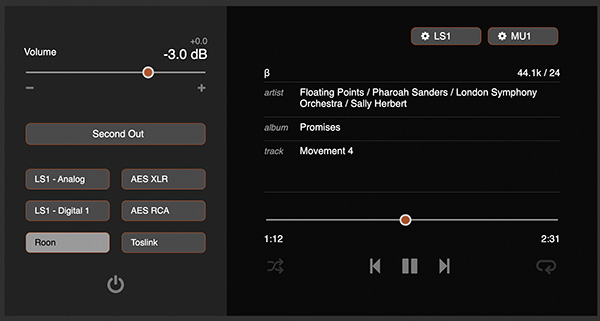
Now, how do you get music into the LS1c? You could just connect a CD player, phono front-end, or streamer-DAC to the analog input at the bottom of the left speaker leg. There's an AES3 input for digital connections in the same location, so you could also hook up a CD transport. Users in the pro market are more likely to connect their workstation using Grimm's LS1i USB interface (or the pro-oriented UC1 USB interface) with the LS1r wired remote controller (footnote 7); home users can use the USB connection of the LS1i to connect a streamer, server, or computer music source.
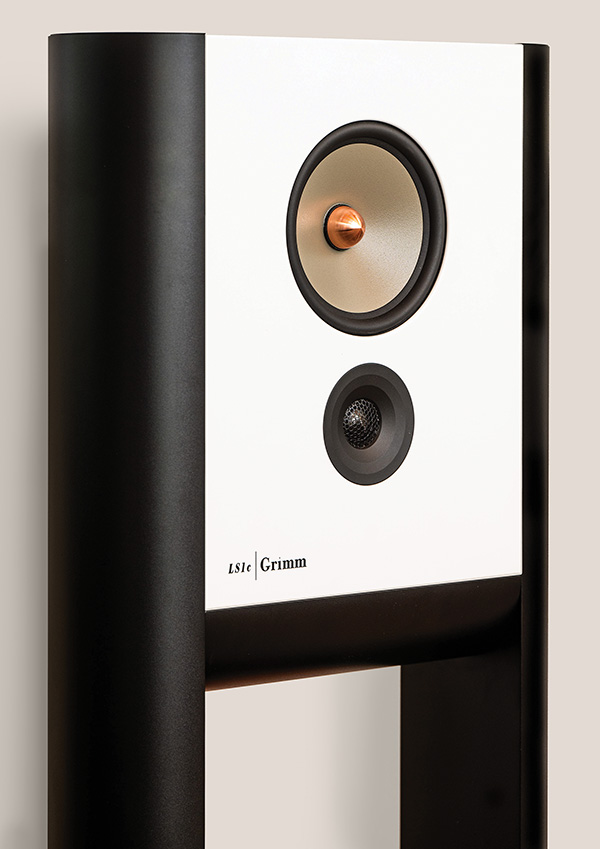
 Before we get to how the LS1c system sounds, here are some key technical features of the rest of the system. Digital input signals are reclocked via ASRC (Asynchronous Sample Rate Conversion). Analog inputs are first switched to digital with a high-performance A/D converter; then the signal enters the DSP, which Grimm Audio says has "a data path 48 bits wide with a 76-bit accumulator." The DSP handles volume control and much more. Each driver gets its own D/A converter. The output of those converters is fed directly to 120W Hypex NCORE power amplifiers, known for low harmonic distortion, high linearity, and top-notch transient response. Meanwhile, the SB1 subs are powered by their own 500W Hypex amplifiers.
Footnote 4: Grimm does supply a wired remote for setup and basic operation; see below for more details. Footnote 5: See rmsacoustics.nl/activecontrol.html. Footnote 6: See shorturl.at/1VyCk. Footnote 7: As previously mentioned, the LS1c doesn't come with a traditional wireless remote control, but because the LS1r is programmable, you can use a remote control you already own to ... control the LS1c's remote control. Got that—Jim Austin