Sidebar 3: Measurements
I used DRA Labs' MLSSA system, a calibrated DPA 4006 microphone, and an Earthworks microphone preamplifier to measure the KEF Blade Two Meta's frequency response in the farfield. I used an Earthworks QTC-40 mike for the nearfield measurements. Because I perform the quasi-anechoic response measurements in-room, I usually place a loudspeaker's tweeter midway between the floor and ceiling, which equalizes the timing of the reflections from those boundaries. But because of the speaker's bulk, I wasn't able to lift it as high as I prefer. The presence of an early reflection from the floor of the Uni-Q's output therefore reduced the anechoic time window I used for FFT analysis, which in turn reduced the farfield response measurements' resolution in the midrange.
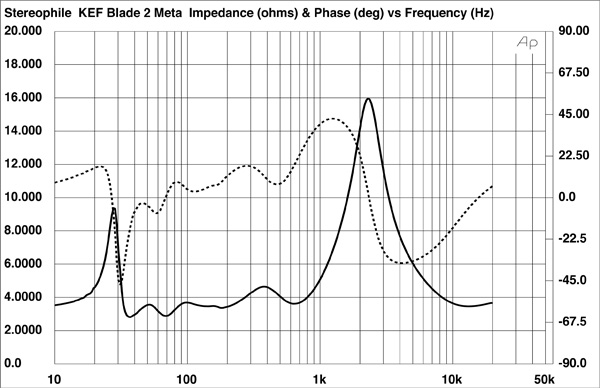
KEF specifies the Blade Two Meta's voltage sensitivity as 86dB/2.83V/m. My B-weighted estimate was slightly higher, at 86.7dB(B)/2.83V/m. The Blade Two Meta's impedance is specified as 4 ohms, with a minimum value of 3.2 ohms. The impedance magnitude, measured with Dayton Audio's DATS V2 system, is shown as the solid trace in fig.1. It varied between 3 ohms and 5 ohms over most of the audioband, with an increase in the low treble to 16 ohms due to the crossover between the Uni-Q's tweeter and midrange sections. The minimum-magnitude saddle of 2.8 ohms at 37Hz in the magnitude trace reveals that this is the tuning frequency of the twin ports on the rear panel.
 I investigated the enclosure's vibrational behavior with a plastic-tape accelerometer. Although the sidewalls emitted an audible "bonk" when I rapped them with my knuckles, especially in the region behind the twin woofers, I didn't find any significant resonant modes on these walls. This is a testament to the effectiveness of the Blade Two Meta's use of opposed and mechanically connected woofers on the two sidewalls. A couple of modes between 400Hz and 600Hz were present on the front baffle (fig.2), but these modes were very low in level and should not have audible consequences.
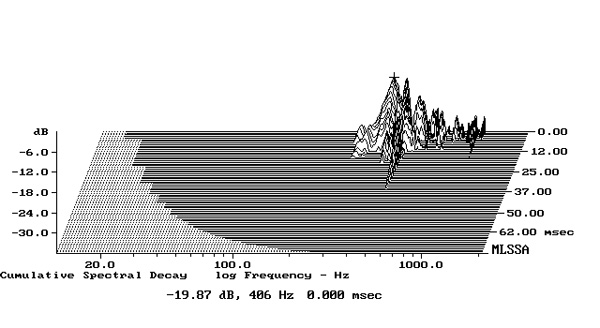
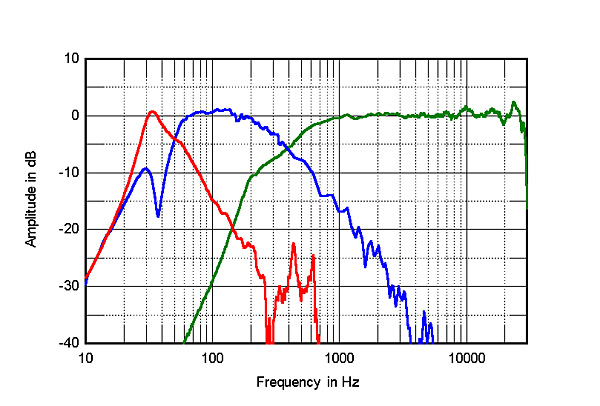
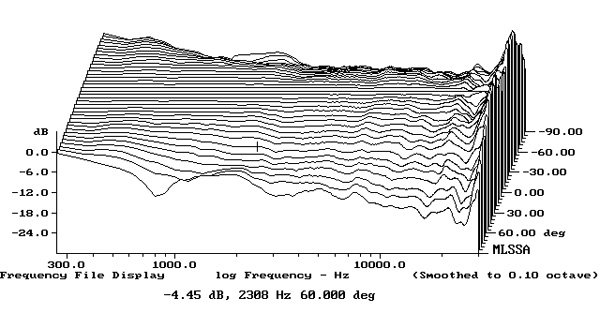
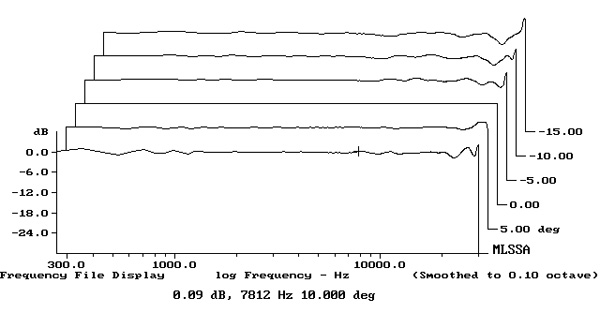
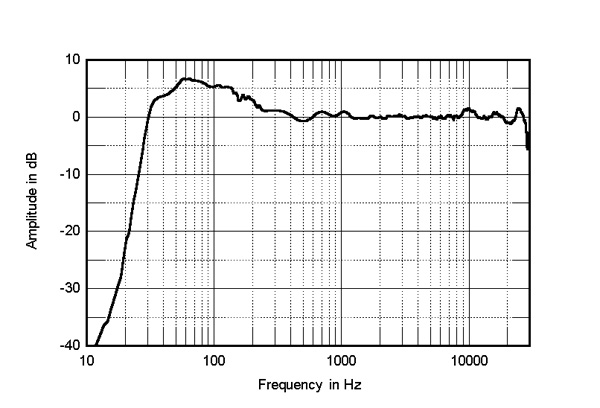 Fig.5 shows the Blade Two Meta's horizontal dispersion, normalized to the response on the tweeter axis, which thus appears as a straight line. The contour lines in this graph are commendably even up to 80° off-axis, when the higher-frequency output from the side-mounted woofers introduces some irrelevant unevenness. The KEF's vertical dispersion is shown in fig.6. The tweeter-axis response is maintained over a wide window.
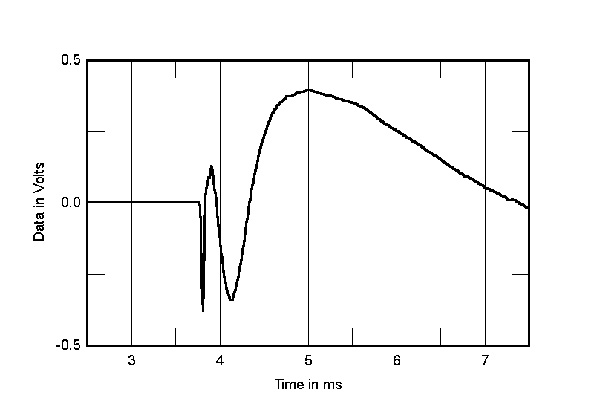
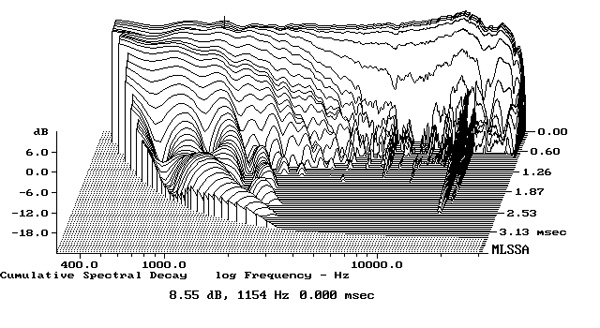
 Turning to the time domain, the Blade Two Meta's step response (fig.7) indicates that the tweeter and midrange sections of the Uni-Q drive unit are connected in negative acoustic polarity, the woofers in positive polarity. The decay of the tweeter's step, which arrives first at the microphone, blends smoothly with the start of the midrange step; its decay in turn smoothly blends with the start of the woofers' step. This, together with the different distances of each unit's acoustic center from the microphone, implies optimal crossover implementation. The Blade Two Meta's cumulative spectral-decay plot on the tweeter axis (fig.8) is superbly clean.
Footnote 1: EPDR is the resistive load that gives rise to the same peak dissipation in an amplifier's output devices as the loudspeaker. See "Audio Power Amplifiers for Loudspeaker Loads," JAES, Vol.42 No.9, September 1994, and stereophile.com/reference/707heavy/index.html. Footnote 2: See fig.3 here.
Fig.1 KEF Blade Two Meta, electrical impedance (solid) and phase (dashed) (2 ohms/vertical div.).
The electrical phase angle (dotted trace) is generally benign, but the effective resistance, or EPDR (footnote 1), lies below 2 ohms between 30Hz and 39Hz and between 813Hz and 881Hz, and below 3 ohms between 3.9kHz and 14kHz. With minimum EPDR values of 1.23 ohms at 34Hz and 1.64 ohms between 813Hz and 881Hz, the Blade Two Meta presents amplifiers with a somewhat demanding load.
Fig.2 KEF Blade Two Meta, cumulative spectral-decay plot calculated from output of accelerometer fastened to center of front baffle below Uni-Q drive-unit (MLS driving voltage to speaker, 7.55V; measurement bandwidth, 2kHz).
The red trace in fig.3 shows the response of the ports, measured in the nearfield. (Both ports behaved identically.) The output peaks slightly below the tuning frequency, and the upper-frequency rollout is clean, other than a couple of low-level peaks in the midrange. Both the low level and the fact that the ports face to the speaker's rear will minimize the audibility of this behavior. The four woofers also behaved identically. Their summed nearfield output (fig.3, blue trace) has the expected notch in its output at the tuning frequency of the ports. The woofers' farfield output crosses over to the midrange section of the Uni-Q driver at 400Hz, slightly and inconsequentially lower than the specified frequency of 450Hz. The filter slopes appear to be lower order than those of the original Blade Two (footnote 2), but the Uni-Q unit's farfield response (green trace above 500Hz) is superbly flat and even.
Fig.3 KEF Blade Two Meta, acoustic crossover on tweeter axis at 50", corrected for microphone response, with the nearfield response of the midrange unit (green), woofers (blue), and ports (red), respectively plotted below 500Hz, 450Hz, and 700Hz.
The complex sum of the woofer and port responses is shown as the black trace below 300Hz in fig.4. The peak at low frequencies will be entirely due to the nearfield measurement technique, which assumes that the drive units are mounted in a true infinite baffle, ie, one that extends to infinity in both planes. The woofers' reflex alignment is maximally flat. The black trace above 300Hz in fig.4 shows the Blade Two Meta's quasi-anechoic farfield response, averaged across a 30° horizontal window centered on the tweeter axis. The astonishingly even on-axis response—even flatter than that of the original Blade Two—is maintained over this wide measurement window.
Fig.4 KEF Blade Two Meta, anechoic response on tweeter axis at 50", averaged across 30° horizontal window and corrected for microphone response, with the complex sum of the nearfield woofer and port responses (black trace below 300Hz).
Fig.5 KEF Blade Two Meta, lateral response family at 50", normalized to response on tweeter axis, from back to front: differences in response 90–5° off axis, reference response, differences in response 5–90° off axis.
Fig.6 KEF Blade Two Meta, vertical response family at 50", normalized to response on tweeter axis, from back to front: differences in response 15–5° above axis, reference response, differences in response 5–10° below axis.
Fig.7 KEF Blade Two Meta, step response on tweeter axis at 50" (5ms time window, 30kHz bandwidth).
Fig.8 KEF Blade Two Meta, cumulative spectral-decay plot on tweeter axis at 50" (0.15ms risetime).
I've come to expect superb measured performance from Jack Oclee-Brown and his team at KEF, and the Blade Two Meta delivered. This is modern loudspeaker engineering at its best.—John Atkinson
Footnote 1: EPDR is the resistive load that gives rise to the same peak dissipation in an amplifier's output devices as the loudspeaker. See "Audio Power Amplifiers for Loudspeaker Loads," JAES, Vol.42 No.9, September 1994, and stereophile.com/reference/707heavy/index.html. Footnote 2: See fig.3 here.