Sidebar 3: Measurements
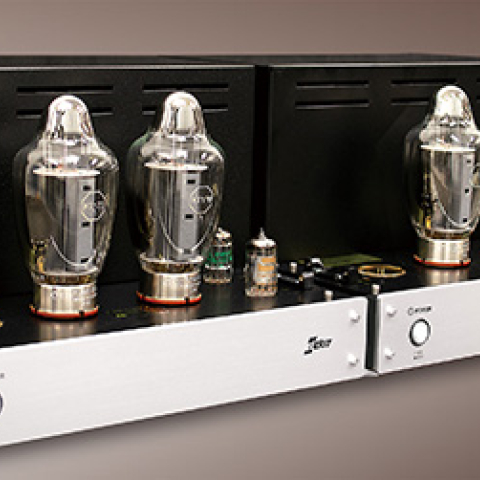
The Line Magnetic LM-845IA looks identical to the company's LM-518IA integrated amplifier that Herb Reichert reviewed in October 2015. However, there are many differences in the details. The amplifier still uses a single 845 directly heated triode for each channel's output stage. (It was fitted with the stock tubes when I received it.) I followed the instructions in the manual for setting the bias current for these tubes at the recommended 70mA. After the amplifier had been operating for 30 minutes, I shorted the inputs to ground and adjusted the hum-balancer controls to minimize the noise in each channel's output. (Care must be taken when making these adjustments, as the trimpots are close to the output tubes, which run very hot.) I measured the amplifier with my Audio Precision SYS2722 (see the January 2008 "As We See It"). The output transformer taps are marked "16," "8," and "4." I performed a complete series of tests from each of the three taps using one of the single-ended line-level inputs, then repeated some of the tests using the single-ended "Pre-In" input, which is connected directly to the LM-845's power amplifier stage. The LM-845IA's unbalanced input impedance was a high 70k ohms at 20Hz, dropping slightly to 67.5k ohms at 1kHz and to a still-high 44k ohms at 20kHz. The "Pre-In" input impedance was 55k ohms at 20Hz and 1kHz, 43k ohms at 20kHz. The Line Magnetic amplifier preserved absolute polarity with both sets of inputs from all three transformer taps. The amplifier's maximum voltage gain at 1kHz into 8 ohms depended on the output tap. The highest gain was from the 16 ohm tap, at 40.3dB. The gain from the 8 ohm tap was 38.6dB, and from the 4 ohm tap it was 36.3dB. The gains using the "Pre-In" input were all 15dB lower.
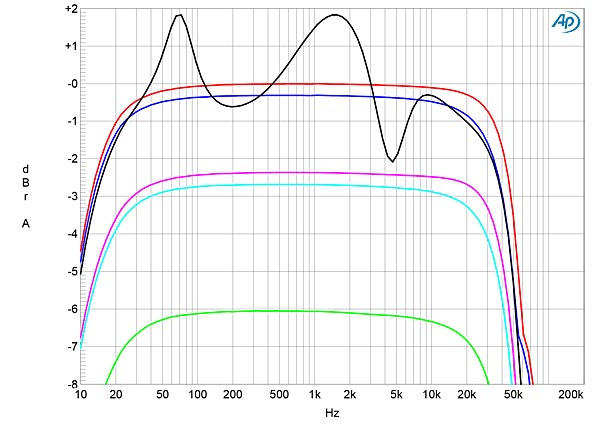
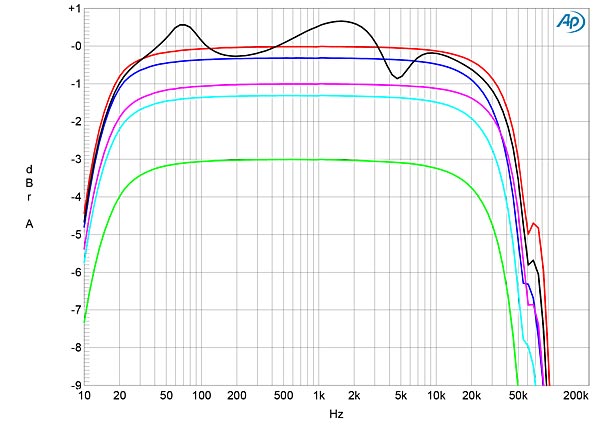
The amplifier's output impedance also depended on the output tap. From the 16 ohm tap, the impedance was a high 3.9 ohms at 20Hz and 1kHz, dropping very slightly to 3.65 ohms at 20kHz. This results in very audible ±2dB variations in frequency response with our standard simulated loudspeaker load (fig.1, gray trace). The variations in response were reduced to ±1.1dB with the 8 ohm tap, which had an output impedance of 2.1 ohms at 20Hz and 1.95 ohms at 1kHz and 20kHz. As expected, the lowest output impedance was from the 4 ohm tap: 1.2 ohms at 20Hz and 1.1 ohms at 1kHz and 20kHz. While these impedances are relatively low for a single-ended–triode amplifier, the response modification from this tap with the simulated loudspeaker was a still-audible ±0.8dB (fig.2, gray trace).
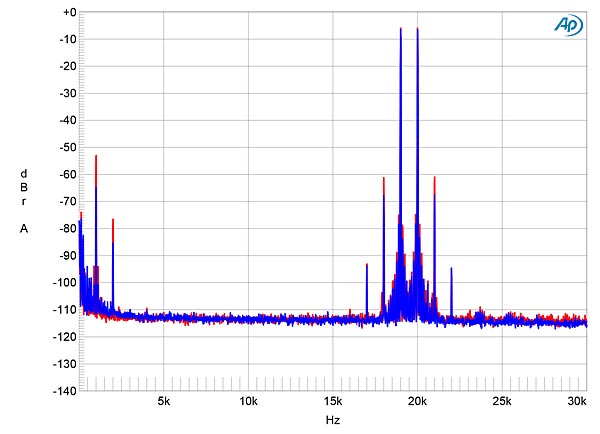
 The LM-845IA's distortion in the midrange was predominantly the sonically benign second harmonic (fig.11), though the more troubling third harmonic was only slightly lower in level at low frequencies (fig.12). When the amplifier drove an equal mix of 19 and 20kHz tones at a peak level of 1W into 4 ohms from the 8 ohm tap (fig.13), the second-order difference product at 1kHz lay at –66dB (0.05%) in the left channel (blue trace) but was 14dB higher in the right channel (red). The higher-order intermodulation products were all below 0.1% (–60dB). Repeating this spectral analysis from the 8 ohm tap into 8 ohms, the 1kHz product in the right channel rose to –50dB (0.3%, not shown).
The Line Magnetic LM-845IA looks identical to the company's LM-518IA integrated amplifier that Herb Reichert reviewed in October 2015. However, there are many differences in the details. The amplifier still uses a single 845 directly heated triode for each channel's output stage. (It was fitted with the stock tubes when I received it.) I followed the instructions in the manual for setting the bias current for these tubes at the recommended 70mA. After the amplifier had been operating for 30 minutes, I shorted the inputs to ground and adjusted the hum-balancer controls to minimize the noise in each channel's output. (Care must be taken when making these adjustments, as the trimpots are close to the output tubes, which run very hot.) I measured the amplifier with my Audio Precision SYS2722 (see the January 2008 "As We See It"). The output transformer taps are marked "16," "8," and "4." I performed a complete series of tests from each of the three taps using one of the single-ended line-level inputs, then repeated some of the tests using the single-ended "Pre-In" input, which is connected directly to the LM-845's power amplifier stage. The LM-845IA's unbalanced input impedance was a high 70k ohms at 20Hz, dropping slightly to 67.5k ohms at 1kHz and to a still-high 44k ohms at 20kHz. The "Pre-In" input impedance was 55k ohms at 20Hz and 1kHz, 43k ohms at 20kHz. The Line Magnetic amplifier preserved absolute polarity with both sets of inputs from all three transformer taps. The amplifier's maximum voltage gain at 1kHz into 8 ohms depended on the output tap. The highest gain was from the 16 ohm tap, at 40.3dB. The gain from the 8 ohm tap was 38.6dB, and from the 4 ohm tap it was 36.3dB. The gains using the "Pre-In" input were all 15dB lower.
Fig.1 Line Magnetic LM-845IA, 16 ohm tap, frequency response at 2.83V into: simulated loudspeaker load (gray), 8 ohms (left channel blue, right red), 4 ohms (left cyan, right magenta), 2 ohms (green) (1dB/vertical div.).
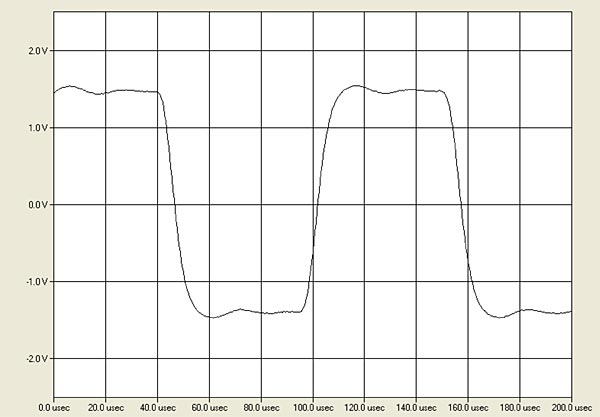
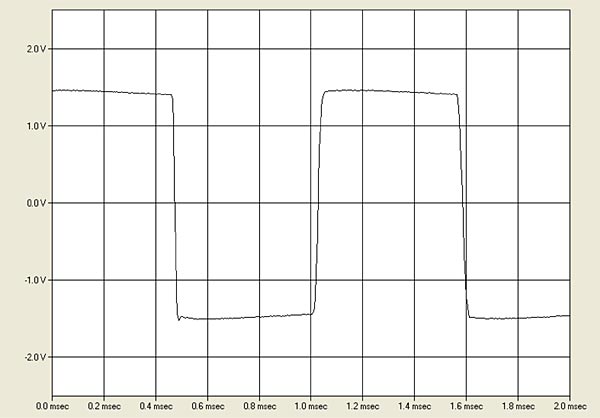
Into resistive loads, the small-signal response from all three transformer taps was flat to 20kHz and rolled off above that frequency (blue, red, cyan, magenta, and green traces in figs.1 and 2). The ultrasonic rolloff is disturbed by a residual resonance at 70kHz, this highest in level from the 4 ohm tap. This behavior is associated with a small amount of overshoot and ringing with the amplifier's reproduction of a 10kHz squarewave (fig.3). At low frequencies, the amplifier started to roll off below 30Hz, but its reproduction of a 1kHz squarewave (fig.4) had only slightly sloped-down tops and bottoms, a tribute to the Line Magnetic's massive output transformers.
Fig.2 Line Magnetic LM-845IA, 4 ohm tap, frequency response at 2.83V into: simulated loudspeaker load (gray), 8 ohms (left channel blue, right red), 4 ohms (left cyan, right magenta), 2 ohms (green) (1dB/vertical div.).
Fig.3 Line Magnetic LM-845IA, 8 ohm tap, small-signal 10kHz squarewave into 8 ohms.
Fig.4 Line Magnetic LM-845IA, 8 ohm tap, small-signal 1kHz squarewave into 8 ohms.
Figs.1 and 2 were taken with the volume control set to its maximum. The channel matching was within 0.25dB but increased to 0.4dB in favor of the left channel at lower settings of the volume control. Channel separation at 1kHz was okay, at 61dB, L–R, and 64.7dB, R–L, but reduced to 45.2dB and 52.1dB, respectively, at the top of the audioband.
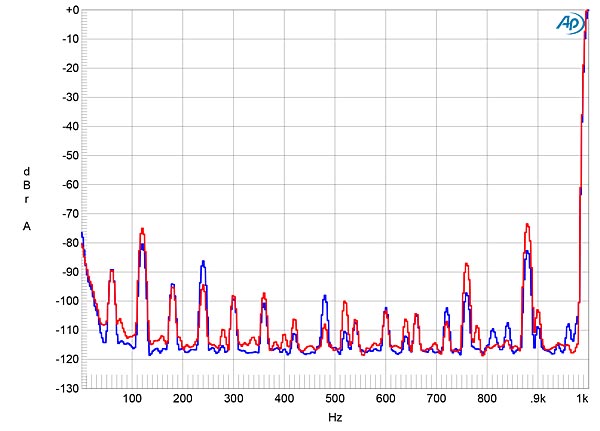
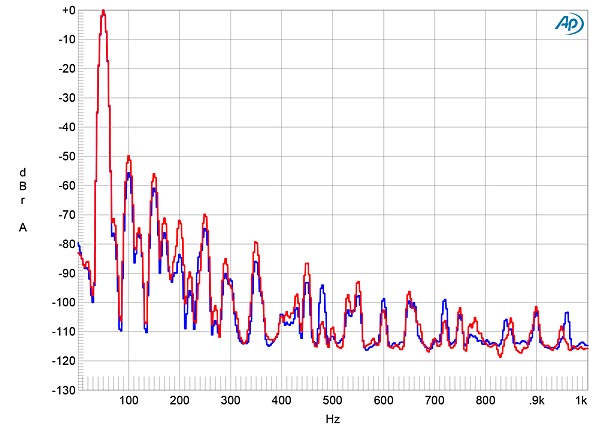
Measured at the 16 ohm taps and taken with the inputs shorted to ground and the volume control at its maximum, the amplifier's unweighted, wideband signal/noise ratio was 70.6dB (average of both channels) ref. 1W into 8 ohms. This ratio improved to 72.2dB when the measurement bandwidth was restricted to the audioband, and to 81.9dB when A-weighted. The S/N ratios from the 8 ohm tap were 2dB greater and another 2dB greater from the 4 ohm tap, these improvements correlating with the lower gain from these taps. (These ratios are all significantly better than I found with the LM-518IA, which suffered from low-frequency "flicker" noise.) The main power supply–related spuriae in the LM-845IA's noise floor were at 120Hz and 240Hz, the latter higher in the left channel than the right (fig.5, blue trace). The highest in level, at 120Hz, lay at a respectably low –76dB, right channel, and –80dB, left channel, both ref. 1W in both channels. The 120Hz sidebands around the 1kHz tone were a little higher in level in the right channel.
Fig.5 Line Magnetic LM-845IA, 4 ohm tap, spectrum of 1kHz sinewave, DC–1kHz, at 1W into 8 ohms with volume control at its maximum (left channel blue, right red; linear frequency scale).
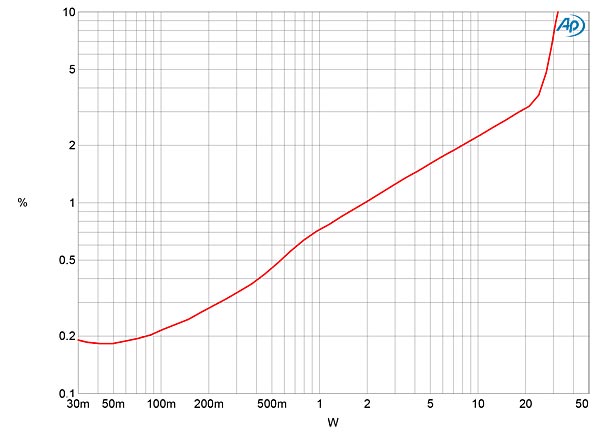
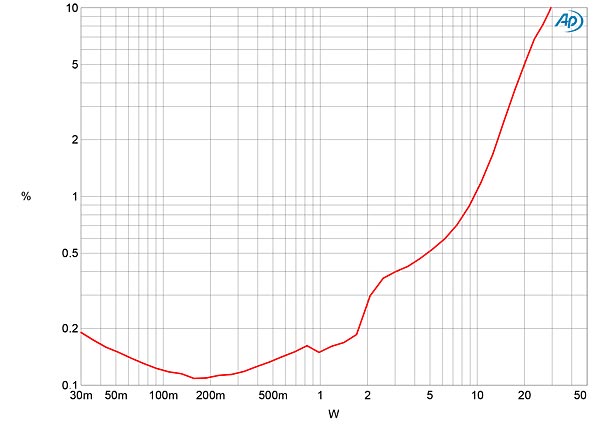
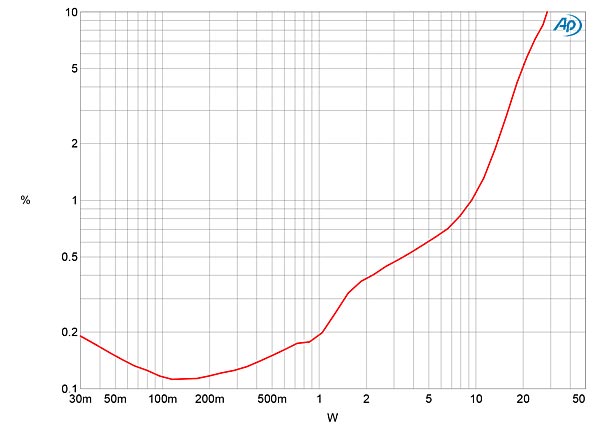
The Line Magnetic amplifier is specified as delivering 22Wpc, though no load impedance is mentioned. (Into 8 ohms, 22W is equivalent to 13.4dBW.) Using our usual definition of clipping, which is when the output's THD+noise percentage reaches 1%, with both channels driven with a 1kHz signal the LM-845IA's 16 ohm tap clipped at just 2Wpc into 16 ohms (6dBW, fig.6). Relaxing the definition of clipping to 3% THD+N resulted in a power of 18Wpc into 16 ohms (15.6dBW), and the amplifier output the specified 22W from this tap at 3.5% THD+N. Distortion at low powers was lower with the 16 ohm tap driving 8 ohms (fig.7), and the amplifier now reached 1% THD+N at 10Wpc (10dBW), though the power at 3% THD+N had dropped to 16Wpc (12dBW).
Fig.6 Line Magnetic LM-845IA, 16 ohm tap, distortion (%) vs 1kHz continuous output power into 16 ohms.
Fig.7 Line Magnetic LM-845IA, 16 ohm tap, distortion (%) vs 1kHz continuous output power into 8 ohms.
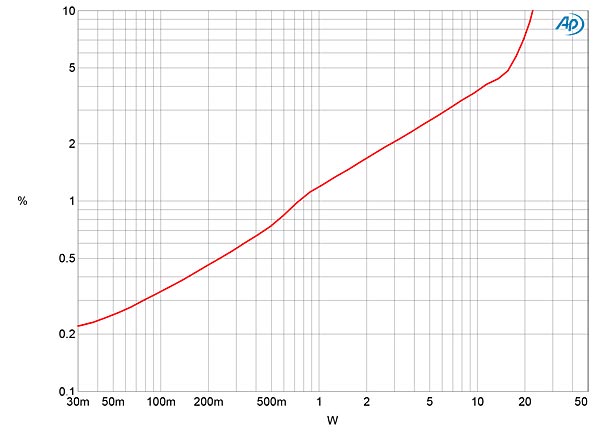
The same trend was apparent with the 8 ohm tap, where the lowest distortion at low powers was obtained with this tap driving 4 ohms (fig.8). I usually expect tube amplifiers to give lower distortion when driving impedances greater than the nominal tap value. However, the LM-845IA had greater distortion at low powers in this situation. This can be seen in fig.9, which plots the THD+N percentage against power with the 4 ohm tap driving 8 ohms. The distortion is above 1% at all powers above 800mW!
Fig.8 Line Magnetic LM-845IA, 8 ohm tap, distortion (%) vs 1kHz continuous output power into 4 ohms.
Fig.9 Line Magnetic LM-845IA, 4 ohm tap, distortion (%) vs 1kHz continuous output power into 8 ohms.
The shape of the traces in figs.6–9 suggests that the amplifier is "soft" clipping, with the usual sharp "knee" in the trace where the waveform visibly squares off occurring at THD+N levels above 10%.
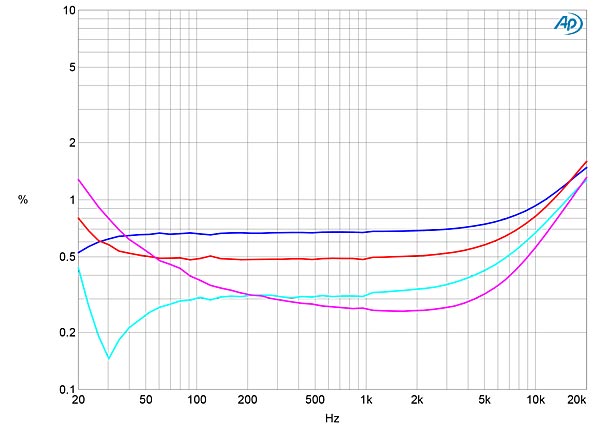
The distortion levels in figs.6–9 were taken with the left channel and never drop below 0.1% (–60dB). However, the distortion was a little lower in the right channel than the left. Fig.10 plots the THD+N percentage against frequency from the 8 ohm tap at 2.83V into 8 ohms (blue and red traces) and 4 ohms (cyan, magenta), which is equivalent to 1W and 2W, respectively. Except in the bass, the left channel (blue, cyan) had higher distortion into both impedances than the right (red, magenta). The distortion into all loads from all three transformer taps rose in the top audio octaves.
Fig.10 Line Magnetic LM-845IA, 8 ohm tap, THD+N (%) vs frequency at 2.83V into: 8 ohms (left blue, right red), 4 ohms (left cyan, right magenta).
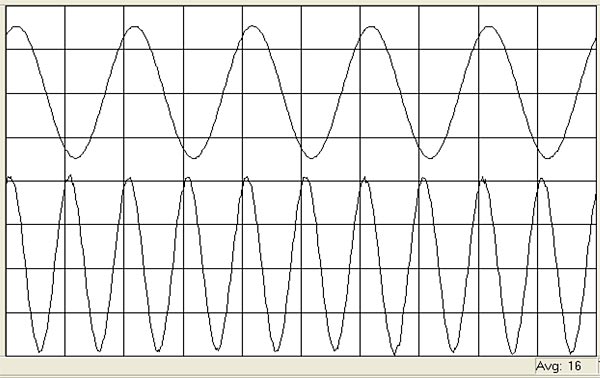
Fig.11 Line Magnetic LM-845IA, 4 ohm tap, 1kHz waveform at 1W into 8 ohms, 0.4% THD+N (top); distortion and noise waveform with fundamental notched out (bottom, not to scale).
Fig.12 Line Magnetic LM-845IA, 8 ohm tap, spectrum of 50Hz sinewave, DC–1kHz, at 1Wpc into 4 ohms (left channel blue, right red; linear frequency scale).
Fig.13 Line Magnetic LM-845IA, 8 ohm tap, HF intermodulation spectrum, DC–30kHz, 19+20kHz at 1Wpc peak into 4 ohms (left channel blue, right red; linear frequency scale).
The Line Magnetic LM-845IA's performance on the test bench was much as I expect from a tube amplifier with a single-ended output stage. It must be used with high-sensitivity speakers, like AH's Altec Valencias, if distortion is not to become audible. Counterintuitively, the Line Magnetic's 16 ohm and 8 ohm output transformer taps work best with speakers that have impedances lower than the nominal tap value. However, these two taps have sufficiently high output impedances that the amplifier's sonic character will be different with every loudspeaker with which it is used. The 4 ohm tap has a lower output impedance, but this is at the expense of higher distortion, even at low powers, than the higher-impedance taps.—John Atkinson