With 1950s and early '60s jazz recordings, there was no need to listen for the bass lines—they were easy to follow and imbued with unexpected presence and weight. Listening to the title track from Herbie Hancock's Maiden Voyage (Blue Note UCGQ-9009), one of engineer Rudy Van Gelder's most significant but technically least effective recordings, I'd never paid so much attention to Ron Carter's melodic, impressionistic playing, his bass sometimes acting as a percussive brake and at other times twining with Hancock's lilting piano lines. And on "Hot Stepper" from Gregory Isaacs's Night Nurse (Island ILPS 9721), the LM-845IA turned the crunching notes from Errol "Flabba" Holt's electric bass into stomach-massaging pulsations, leaving me happily stupefied. The Line Magnetic played this reggae classic with no audible compression, as if daring to be turned up louder.
The Line Magnetic also revealed the extent to which some other amps miniaturize the scale of recordings; it did this by restoring musicians to their correct size and role in the mix. "An Occasional Man" from Anita O'Day and Cal Tjader's Time for 2 (Verve Records UCCV-9292), a silly track performed by a serious jazz singer, opens with Wilfredo "Changuito" Vicente's congas, which I'd always heard as a kind of hollow sound effect in the right channel. The LM-845IA presented Vicente as a life-sized musician; for the first time I could hear his hands on the drumheads. The Line Magnetic did this repeatedly, drawing my attention to the scale and physical force of various sounds and reminding me that flesh-and-blood humans were playing these instruments. With certain recordings, sounds were presented as larger-than–life-size, an effect some listeners find unnatural, but that I found pretty neat.
The most impressive quality of the big Chinese amp was its way with dynamics—repeatedly, instruments and voices startled me with their volume and force. A friend was visiting when I put on "Right Off" from Miles Davis's A Tribute to Jack Johnson (Mobile Fidelity Sound Lab UDSACD 2150), and as we listened to the pounding groove laid down by drummer Billy Cobham and guitarist John McLaughlin, the hairs on my neck were standing up. "It sounds almost live," my friend remarked. The LM-845IA proved revelatory with music requiring the kind of dynamic swings most amplifiers simply can't muster—Stereolab, 2Pac, and Black Sabbath sounded more lifelike than I'd heard them in my loft. But the amp's forceful sound came through just as clearly with recordings of relatively subdued music: Listening to "Road" from Nick Drake's Pink Moon (Simply Vinyl SVLP 172),
 I was transfixed by how hard Drake was hitting the fairly dead nickel strings of his acoustic guitar. And when, on "Sister" from Angel Olsen's My Woman (Jagjaguwar JAG284cd), Olsen sings "I want to die right" and then, as the drums kick in, shouts "next to you"—that moment left me pinned back in my seat, marveling at the power of her voice. These moments weren't remarkable for demonstrating sonic hi-fi tricks but for heightening the emotional impact of the music, which is the purpose of this expensive and sometimes frustrating pastime.
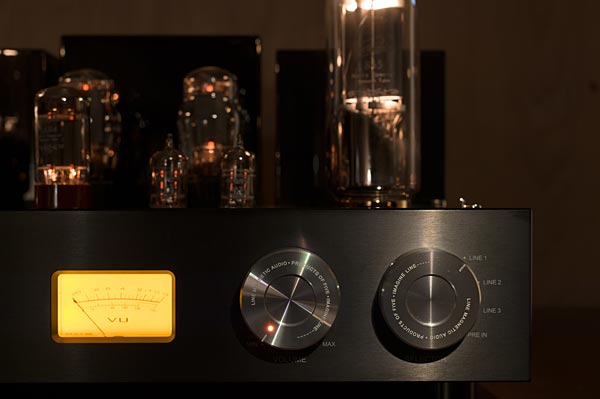
I should add that the Line Magnetic's muscular, vigorous sound was not merely a function of having access to more watts than I was accustomed to. In the past several years, I'd lived with amplifiers that put out between 1.5 and 75 watts, and none of them produced the effortless sense of control and startling dynamic contrasts of the LM-845IA, demonstrating that not all watts are created equal. Halpern told me that this energetic sound is the sonic signature of large transmitter triodes, though I haven't heard enough amps using 845, 212, and 805 tubes to venture an opinion. It soon dawned on me that the Line Magnetic music had found a picture-perfect dance partner in my Valencias; with its 98dB sensitivity and 15" alnico woofers, it was able to take full advantage of the Chinese amp's power rating, 16 ohm transformer taps, and hair-raising way with music. Separated by half a century, the two components nonetheless share the same design priorities and strengths—dynamic freedom, presence, texture, chunk—and worked together as seamlessly as whiskey and bitters.
I also began to notice that the amp-speaker combination was altering my experience of upstream components: I'd sometimes found my Denafrips Terminator DAC a tad polite and dutiful sounding, but with the Line Magnetic, it sounded bolder, bigger, and more forthright. My Ortofon SPU Classic G cartridge sounded similarly invigorated. With some embarrassment, I understood that some of the faults I'd attributed to my source components were in fact due to suboptimal pairings between my amplifier and speakers. It reminded me that the answer to the perennial question of which component is most important to the sound of a hi-fi happens to be not a component but a relationship—between the speakers and the amplifier. I'm beginning to think that they should be thought of not as two components, but one.
Tube Rollng & the DeVore Speakers
I was transfixed by how hard Drake was hitting the fairly dead nickel strings of his acoustic guitar. And when, on "Sister" from Angel Olsen's My Woman (Jagjaguwar JAG284cd), Olsen sings "I want to die right" and then, as the drums kick in, shouts "next to you"—that moment left me pinned back in my seat, marveling at the power of her voice. These moments weren't remarkable for demonstrating sonic hi-fi tricks but for heightening the emotional impact of the music, which is the purpose of this expensive and sometimes frustrating pastime.
I should add that the Line Magnetic's muscular, vigorous sound was not merely a function of having access to more watts than I was accustomed to. In the past several years, I'd lived with amplifiers that put out between 1.5 and 75 watts, and none of them produced the effortless sense of control and startling dynamic contrasts of the LM-845IA, demonstrating that not all watts are created equal. Halpern told me that this energetic sound is the sonic signature of large transmitter triodes, though I haven't heard enough amps using 845, 212, and 805 tubes to venture an opinion. It soon dawned on me that the Line Magnetic music had found a picture-perfect dance partner in my Valencias; with its 98dB sensitivity and 15" alnico woofers, it was able to take full advantage of the Chinese amp's power rating, 16 ohm transformer taps, and hair-raising way with music. Separated by half a century, the two components nonetheless share the same design priorities and strengths—dynamic freedom, presence, texture, chunk—and worked together as seamlessly as whiskey and bitters.
I also began to notice that the amp-speaker combination was altering my experience of upstream components: I'd sometimes found my Denafrips Terminator DAC a tad polite and dutiful sounding, but with the Line Magnetic, it sounded bolder, bigger, and more forthright. My Ortofon SPU Classic G cartridge sounded similarly invigorated. With some embarrassment, I understood that some of the faults I'd attributed to my source components were in fact due to suboptimal pairings between my amplifier and speakers. It reminded me that the answer to the perennial question of which component is most important to the sound of a hi-fi happens to be not a component but a relationship—between the speakers and the amplifier. I'm beginning to think that they should be thought of not as two components, but one.
Tube Rollng & the DeVore Speakers
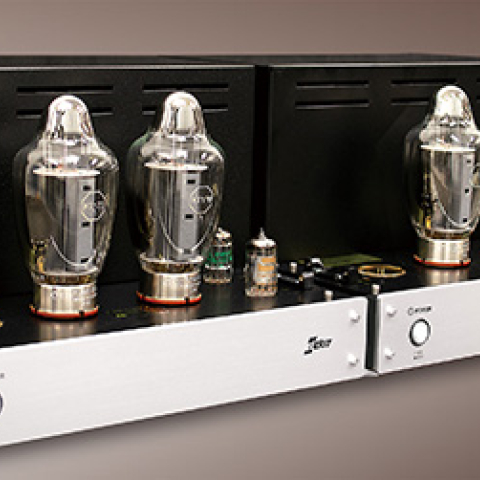
As often happens in life, the marriage between the Line Magnetic amp and the Altec Valencias turned out to be not entirely perfect. The cost of the LM-845IA's full-throttle presentation is a somewhat aggressive tone, which made certain tracks sound slightly hard and steely. This was exaggerated by the well-documented tendency of the Altec H-811B horns to ring. The pairing made some sounds—like indifferently recorded saxophones and harmonicas—difficult to enjoy. After some cable swapping, I decided to see if the LM-845IA's bull-in-a-china-shop personality could be civilized with some tube rolling.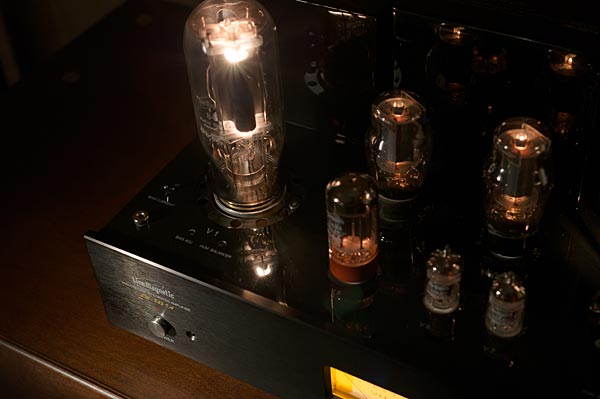 Over time, I replaced its Line Magnetic–branded Chinese tubes with vintage alternatives: the 12AX7s with RCA Commander 5751s (which slightly reduced the amp's high-ish gain, giving the volume control more usable range); the 6P3Ps with GE 6L6GCs; and the 5AR4 with a 1960s Mullard. Each of these substitutions effected small but positive changes, sounding less glassy and tonally richer, with the rectifier making the most audible difference. Finally, I replaced the 845s with "best grade" Linlai 845-DGs ($499/pair), lent to me by Rachel Zhang at Grant Fidelity. These beautifully made tubes are larger than standard 845s and rendered the tube cage unusable, but I kept them in anyway. To my surprise, after 200 hours of use, this change resulted in a far greater sonic improvement than swapping the smaller tubes, turning the LM-845IA into a significantly more delicate and insightful component. At times, it reminded me of SET amplifiers that use the 300B tube, playing music with more tonal and textural finesse and precision, even more psychedelic airiness—and less hardness and harshness.
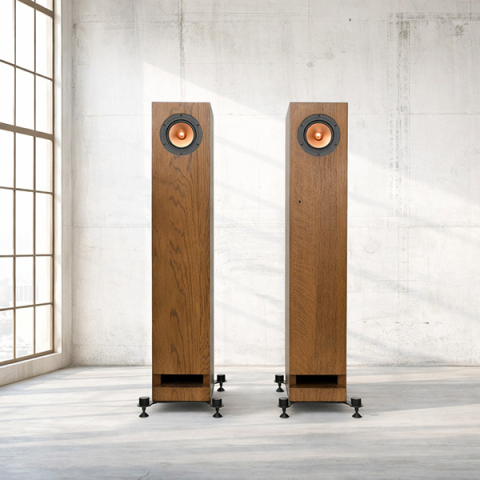
One Friday afternoon in early spring, speaker designer John DeVore stopped by with two large boxes. I wanted to hear the Line Magnetic with current-production speakers that would still play loudly in my loft, with its 1200-square-foot floor space and 15.5'-high ceilings. With their claimed 96dB sensitivity (footnote 1), usefully high 10 ohm impedance, and impressive dynamic abilities, his DeVore Fidelity Orangutan O/96s seemed ideal.
After John set them up on their matching wooden stands, we sat down to listen. With the O/96s connected to the 16 ohm taps, I'm happy to report that the hi-fi still sounded fierce and big, but the Orangutans sounded sweeter and less colored than the Valencias, imaged with more precision, and did away with the last traces of hardness (confirming my suspicion that the Altecs were contributing to it). For the next few days, I listened to this terrific combination, admiring the O/96s' balanced and beautifully detailed way with the music. In the end, I found myself missing the Altecs' unrestrained dynamics, startling presence, and saturated tone colors, which made the more accurate and "correct" Orangutans sound a bit domesticated and polite in comparison.
Conclusion
Over time, I replaced its Line Magnetic–branded Chinese tubes with vintage alternatives: the 12AX7s with RCA Commander 5751s (which slightly reduced the amp's high-ish gain, giving the volume control more usable range); the 6P3Ps with GE 6L6GCs; and the 5AR4 with a 1960s Mullard. Each of these substitutions effected small but positive changes, sounding less glassy and tonally richer, with the rectifier making the most audible difference. Finally, I replaced the 845s with "best grade" Linlai 845-DGs ($499/pair), lent to me by Rachel Zhang at Grant Fidelity. These beautifully made tubes are larger than standard 845s and rendered the tube cage unusable, but I kept them in anyway. To my surprise, after 200 hours of use, this change resulted in a far greater sonic improvement than swapping the smaller tubes, turning the LM-845IA into a significantly more delicate and insightful component. At times, it reminded me of SET amplifiers that use the 300B tube, playing music with more tonal and textural finesse and precision, even more psychedelic airiness—and less hardness and harshness.
One Friday afternoon in early spring, speaker designer John DeVore stopped by with two large boxes. I wanted to hear the Line Magnetic with current-production speakers that would still play loudly in my loft, with its 1200-square-foot floor space and 15.5'-high ceilings. With their claimed 96dB sensitivity (footnote 1), usefully high 10 ohm impedance, and impressive dynamic abilities, his DeVore Fidelity Orangutan O/96s seemed ideal.
After John set them up on their matching wooden stands, we sat down to listen. With the O/96s connected to the 16 ohm taps, I'm happy to report that the hi-fi still sounded fierce and big, but the Orangutans sounded sweeter and less colored than the Valencias, imaged with more precision, and did away with the last traces of hardness (confirming my suspicion that the Altecs were contributing to it). For the next few days, I listened to this terrific combination, admiring the O/96s' balanced and beautifully detailed way with the music. In the end, I found myself missing the Altecs' unrestrained dynamics, startling presence, and saturated tone colors, which made the more accurate and "correct" Orangutans sound a bit domesticated and polite in comparison.
Conclusion
Despite the Line Magnetic's scary-high voltages and intense heat, in the months it spent in my home it performed faultlessly, without stutters, burps, or parts failures. It brought a new dimension to my musical enjoyment, revealing the physicality and force in every recording I played through it, from Monteverdi to Merle Haggard, an experience that provided addictive amounts of fun. $4895 is hardly a modest sum, but using nearly any sensible metric of value, the Line Magnetic is a stone bargain. If Rubens had lived in the hi-fi age, I imagine that he would have appreciated its way of making music pulse with vigor and vitality. Unless you listen to little except baroque trio sonatas, and maybe even then, you should find a way to hear one. It's that good.
Footnote 1: JA measured 91dB(B)/2.83V/m, while DeVore Fidelity specifies sensitivity in units of watts not volts; the two measures are numerically the same only with an 8 ohm load. See JA's measurements here and John DeVore's Manufacturers' Comment here.
I was transfixed by how hard Drake was hitting the fairly dead nickel strings of his acoustic guitar. And when, on "Sister" from Angel Olsen's My Woman (Jagjaguwar JAG284cd), Olsen sings "I want to die right" and then, as the drums kick in, shouts "next to you"—that moment left me pinned back in my seat, marveling at the power of her voice. These moments weren't remarkable for demonstrating sonic hi-fi tricks but for heightening the emotional impact of the music, which is the purpose of this expensive and sometimes frustrating pastime.
I should add that the Line Magnetic's muscular, vigorous sound was not merely a function of having access to more watts than I was accustomed to. In the past several years, I'd lived with amplifiers that put out between 1.5 and 75 watts, and none of them produced the effortless sense of control and startling dynamic contrasts of the LM-845IA, demonstrating that not all watts are created equal. Halpern told me that this energetic sound is the sonic signature of large transmitter triodes, though I haven't heard enough amps using 845, 212, and 805 tubes to venture an opinion. It soon dawned on me that the Line Magnetic music had found a picture-perfect dance partner in my Valencias; with its 98dB sensitivity and 15" alnico woofers, it was able to take full advantage of the Chinese amp's power rating, 16 ohm transformer taps, and hair-raising way with music. Separated by half a century, the two components nonetheless share the same design priorities and strengths—dynamic freedom, presence, texture, chunk—and worked together as seamlessly as whiskey and bitters.
I also began to notice that the amp-speaker combination was altering my experience of upstream components: I'd sometimes found my Denafrips Terminator DAC a tad polite and dutiful sounding, but with the Line Magnetic, it sounded bolder, bigger, and more forthright. My Ortofon SPU Classic G cartridge sounded similarly invigorated. With some embarrassment, I understood that some of the faults I'd attributed to my source components were in fact due to suboptimal pairings between my amplifier and speakers. It reminded me that the answer to the perennial question of which component is most important to the sound of a hi-fi happens to be not a component but a relationship—between the speakers and the amplifier. I'm beginning to think that they should be thought of not as two components, but one.
As often happens in life, the marriage between the Line Magnetic amp and the Altec Valencias turned out to be not entirely perfect. The cost of the LM-845IA's full-throttle presentation is a somewhat aggressive tone, which made certain tracks sound slightly hard and steely. This was exaggerated by the well-documented tendency of the Altec H-811B horns to ring. The pairing made some sounds—like indifferently recorded saxophones and harmonicas—difficult to enjoy. After some cable swapping, I decided to see if the LM-845IA's bull-in-a-china-shop personality could be civilized with some tube rolling.
Over time, I replaced its Line Magnetic–branded Chinese tubes with vintage alternatives: the 12AX7s with RCA Commander 5751s (which slightly reduced the amp's high-ish gain, giving the volume control more usable range); the 6P3Ps with GE 6L6GCs; and the 5AR4 with a 1960s Mullard. Each of these substitutions effected small but positive changes, sounding less glassy and tonally richer, with the rectifier making the most audible difference. Finally, I replaced the 845s with "best grade" Linlai 845-DGs ($499/pair), lent to me by Rachel Zhang at Grant Fidelity. These beautifully made tubes are larger than standard 845s and rendered the tube cage unusable, but I kept them in anyway. To my surprise, after 200 hours of use, this change resulted in a far greater sonic improvement than swapping the smaller tubes, turning the LM-845IA into a significantly more delicate and insightful component. At times, it reminded me of SET amplifiers that use the 300B tube, playing music with more tonal and textural finesse and precision, even more psychedelic airiness—and less hardness and harshness.
One Friday afternoon in early spring, speaker designer John DeVore stopped by with two large boxes. I wanted to hear the Line Magnetic with current-production speakers that would still play loudly in my loft, with its 1200-square-foot floor space and 15.5'-high ceilings. With their claimed 96dB sensitivity (footnote 1), usefully high 10 ohm impedance, and impressive dynamic abilities, his DeVore Fidelity Orangutan O/96s seemed ideal.
Despite the Line Magnetic's scary-high voltages and intense heat, in the months it spent in my home it performed faultlessly, without stutters, burps, or parts failures. It brought a new dimension to my musical enjoyment, revealing the physicality and force in every recording I played through it, from Monteverdi to Merle Haggard, an experience that provided addictive amounts of fun. $4895 is hardly a modest sum, but using nearly any sensible metric of value, the Line Magnetic is a stone bargain. If Rubens had lived in the hi-fi age, I imagine that he would have appreciated its way of making music pulse with vigor and vitality. Unless you listen to little except baroque trio sonatas, and maybe even then, you should find a way to hear one. It's that good.
Footnote 1: JA measured 91dB(B)/2.83V/m, while DeVore Fidelity specifies sensitivity in units of watts not volts; the two measures are numerically the same only with an 8 ohm load. See JA's measurements here and John DeVore's Manufacturers' Comment here.