I'm old enough to remember Fizzies: tablets that were promised to transform mere water into an effervescent soft drink. They showed up on my radar when I was five, at a time when impatience stood between me and the full Fizzies experience: I couldn't wait for the Bromo-Seltzer–like tablet to dissolve completely, so I was rewarded with little flavor and lots of undissolved sugar shards. At my present age, I would be likelier to drop a Fizzie into a glass of water, walk away, and forget I had ever done so.
Fizzies came to mind the first time I used the Audiodesksysteme Gläss Vinyl Cleaner ($4450, footnote 1), a sample of which was loaned to me late last year by its US distributor, Ultra Systems. For those who haven't already read the reviews by Fred Kaplan and Michael Fremer, in these pages and on Analogplanet.com (footnote 2), the Vinyl Cleaner is a fully automated, wet-bath-and-blow-dry record-washing machine that uses cavitation and distilled water, the latter enhanced with a surfactant, to remove contaminants from LP grooves. Cavitation is, literally, the creation of cavities—which, in a liquid medium, means the creation of bubbles. Microscopic bubbles, at that. Zillions of them.
Pause for a moment and bear in mind that the width of a stereophonic LP groove is 25.4µm—about one-third the diameter of an average human hair—while its depth is usually no greater than two-thirds its width. (The width of a typical mono groove made with a mono cutter head ranges between 55 and 80µm.) Keep in mind, also, that the modulations within the groove are far smaller than the groove itself, and can range in size down to a fraction of a micron: the approximate size of the average bacteria (0.2–0.3µm, to be precise). The size of the largest groove modulations is more on a par with that of a red blood cell or a single dust-mite feces, both of which measure about 5µm.
Get the picture? There does not exist, in this world or the next, a brush whose bristles can get in there and mix it up with that crap. Period.
Cavitation is a different kettle of microscopic fish. By using an ultrasonic wave to stimulate cavitation in a cleaning bath, bubbles can be created that range in size down to 2µm, depending on the frequency of the wave. And the agitation created by the movement of these bubbles is such that contaminants, once removed, are carried away from the substrate, and thus prevented from reattaching.
I know what you're thinking: Sign me up.
Which is why Reiner Gläss invented the Vinyl Cleaner. And it's why I asked to borrow one, so that I could see whether, some 55 years after Fizzies, record lovers such as I could experience better living through effervescence, as opposed to mere chemistry.
Full fathom five
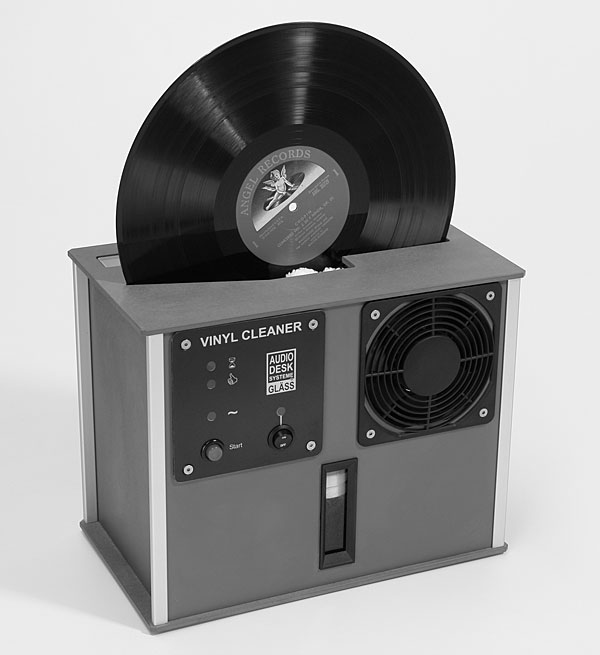
I guess I wasn't paying close enough attention. Yes, I'd heard of the Audiodesksysteme Vinyl Cleaner. And, yes, I'd understood that it comprises a fluid tank, an ultrasonic cavitation system, four rotating cleaning drums, a motorized record-drive system, two drying fans, and a microchip-based system to automate and coordinate all of the above. Naturally, as an American, I assumed that the product was enormous and heavy: How else could the thing be done? Imagine my surprise when a 19-lb carton measuring just 11" by 14" by 16" showed up on my doorstep. Damn, I thought. The cleaning fluid and accessories made it here, but the cleaner itself must've gotten lost. I opened the carton, and there was the Vinyl Cleaner itself plus two much smaller boxes, containing an AC adapter and two bottles of cleaning solution (footnote 3). Each bottle was the size of one of those little jars of marmalade one finds on the breakfast tables of nice hotels. I was fascinated. The Vinyl Cleaner, which is made in Königsbronn, in Baden-WÅrttemberg, Germany, appeared very well crafted and was surprisingly easy to set up. The only real challenge was getting the thing level on my tabletop, the need for which may be obvious. A bubble level is built into the Vinyl Cleaner's top surface, yet its bottom lacks adjustable feet. I used business cards as shims.
With the Vinyl Cleaner both level and reasonably stable, I set about filling its cleaning chamber with the prescribed 4.5 liters of distilled water (footnote 4) after which I dumped in the contents of one bottle of cleaning solution. The bilingual instructions, which are quite good, suggest that air pockets—the unwanted kind, not the bubbles for which we hope—can get into the system whenever one fills a completely empty Vinyl Cleaner; air must be removed by running one full cycle without a record in place, which I did.
Notwithstanding the well-considered raves the Vinyl Cleaner has received, I proceeded with caution; my choice for its maiden voyage was a thoroughly unlistenable, beat-to-hell US mono copy of the Rolling Stones' Between the Buttons. As you've no doubt seen from pics of the Vinyl Cleaner, records are loaded vertically—edge-down rather than face-down—into an arrow-shaped slot on the machine's top surface. Not without reason is this opening only 11 3/8" long: The dimension is meant to limit just how far into the cleaning chamber a standard LP can fit. And when a 12" record is loaded into the Vinyl Cleaner, its downward travel is stopped at the precise point where its outermost edge is gripped between two rubber-rimmed, counter-rotating turnstiles, which gently turn the disc. It is apparently mostly for this reason that the Vinyl Cleaner can accommodate only 12" discs; with any smaller size, it would seem possible for the drive mechanism to grip the disc at a point inward from its edge, thus damaging the groove.
I pressed the Vinyl Cleaner's Start button. It took about five seconds for the LP to begin to spin—prior to which I followed the manual's advice and gave the disc's edge a bit of a nudge. After that, the cleaning chamber filled with the fluid, which had, during setup, flowed straight down into the storage tank below. Viewed from above, the cleaning chamber is a canyon in which the record is flanked by two pairs of cleaning drums, each covered in microfiber toweling and measuring 4.5" tall by 1" in diameter. When the drums are at rest, there's a gap of about ½" between the two pairs. When the cleaning cycle begins, the drums move inward to briefly contact the record, then move back out to their resting positions; then, when the chamber is full, they move back in and begin to rotate, their sides in contact with the record's surfaces. The record-drive turnstiles also move inward and outward, but only slightly. At rest, they're held tightly together, but when the cycle begins, the turnstiles part just enough to let the outermost edge of the record drop between their rubber grommets. At the end of the drying cycle, the turnstiles again come together, expelling the edge and slightly lifting the record.
The entire wash cycle took about 75 seconds. After that, the disc stopped turning, the water drained from the cleaning chamber into the storage tank, and the two drying fans—one for each side of the record—started up. The drying cycle comprised 120 seconds with the record turning at a very slow speed, then 10 seconds at a fast speed, then another 150 seconds at slow, seeming to turn even more slowly, until the machine stopped and a gentle beep told me that this record was done.
The record in question was a noisy one to begin with, and the noise proved to be the consequence of physical damage: After the washing and drying, it sounded neither better nor worse. Perversely or not, I persisted with hard cases: awful-looking, awful-sounding records from lawn sales, garage sales, and the nearest Salvation Army store. With the next two records, the Vinyl Cleaner again made the sound neither better nor worse, but the one after that—a ca 1964 blue-label Prestige copy of Sonny Rollins's Tenor Madness—produced my holy shit moment. The Vinyl Cleaner not only transformed its noisy lead-in grooves into utterly dead-silent ones, it removed 95% of the ticks and pops, and allowed the instruments to sound more colorful and more vivid. As I said: Holy shit.
The next LP provided a similar transformation, but here I must pause and reflect: Only now do I realize how lucky I've been to live in a very small town that's miles from the nearest grocery store, pharmacy, or pizzeria—yet that had, for a brief time, its own LP store. And Xavwax wasn't just any LP store. It stocked great new records and a frequently replenished supply of used vinyl, the latter accounting for my own copies of Miles Ahead, Sketches of Spain, Gerry Mulligan Meets Ben Webster, The Jazz Soul of Oscar Peterson, and Benny Carter's New Jazz Sounds. The store's excellent proprietor has moved to Vermont, and I wish him well.
Footnote 1: Audiodesksysteme Gläss, Seestrasse 1, D 89551 Königsbronn, Germany. Tel./Fax: (49) 07328-7138. Cell: (49) 171-600-1363. Web: www.audiodesksysteme.de. US distributor: Ultra Systems, Inc., 127 Union Square, New Hope, PA 18913. Tel: (215) 862-6570. Fax: (215) 862-4871. Web: www.ultrasystem.com Footnote 2: Click here and here. Footnote 3: Vinyl Cleaner Cleaning Fluid Concentrate costs $19.95 (add 1.2 gallons of distilled water to make cleaning solution to clean 100 used LPs or 200 new LPs). A Fluid 6-Pak costs $99.95. Replacement filters cost $19.95 (can be rinsed out; not necessary to replace in normal use). A set of 4 Microfiber Cleaning Barrels costs $99.95.—Ed. Footnote 4: A tip for those lucky enough to own one of these things: The Audiodesksysteme Gläss Vinyl Cleaner requires 4.5 liters of distilled water. Here in the US, distilled water is generally sold in gallons—but a gallon is only 3.785 liters. What the Vinyl Cleaner owner needs to do is to add one full gallon, then another three cups: That will bring the level up to 4.495 liters, which is pretty dang close.
I guess I wasn't paying close enough attention. Yes, I'd heard of the Audiodesksysteme Vinyl Cleaner. And, yes, I'd understood that it comprises a fluid tank, an ultrasonic cavitation system, four rotating cleaning drums, a motorized record-drive system, two drying fans, and a microchip-based system to automate and coordinate all of the above. Naturally, as an American, I assumed that the product was enormous and heavy: How else could the thing be done? Imagine my surprise when a 19-lb carton measuring just 11" by 14" by 16" showed up on my doorstep. Damn, I thought. The cleaning fluid and accessories made it here, but the cleaner itself must've gotten lost. I opened the carton, and there was the Vinyl Cleaner itself plus two much smaller boxes, containing an AC adapter and two bottles of cleaning solution (footnote 3). Each bottle was the size of one of those little jars of marmalade one finds on the breakfast tables of nice hotels. I was fascinated. The Vinyl Cleaner, which is made in Königsbronn, in Baden-WÅrttemberg, Germany, appeared very well crafted and was surprisingly easy to set up. The only real challenge was getting the thing level on my tabletop, the need for which may be obvious. A bubble level is built into the Vinyl Cleaner's top surface, yet its bottom lacks adjustable feet. I used business cards as shims.
Footnote 1: Audiodesksysteme Gläss, Seestrasse 1, D 89551 Königsbronn, Germany. Tel./Fax: (49) 07328-7138. Cell: (49) 171-600-1363. Web: www.audiodesksysteme.de. US distributor: Ultra Systems, Inc., 127 Union Square, New Hope, PA 18913. Tel: (215) 862-6570. Fax: (215) 862-4871. Web: www.ultrasystem.com Footnote 2: Click here and here. Footnote 3: Vinyl Cleaner Cleaning Fluid Concentrate costs $19.95 (add 1.2 gallons of distilled water to make cleaning solution to clean 100 used LPs or 200 new LPs). A Fluid 6-Pak costs $99.95. Replacement filters cost $19.95 (can be rinsed out; not necessary to replace in normal use). A set of 4 Microfiber Cleaning Barrels costs $99.95.—Ed. Footnote 4: A tip for those lucky enough to own one of these things: The Audiodesksysteme Gläss Vinyl Cleaner requires 4.5 liters of distilled water. Here in the US, distilled water is generally sold in gallons—but a gallon is only 3.785 liters. What the Vinyl Cleaner owner needs to do is to add one full gallon, then another three cups: That will bring the level up to 4.495 liters, which is pretty dang close.