My nice mono copy of Back to Back: Duke Ellington and Johnny Hodges Play the Blues (Verve 6055), like other albums purchased from Xavwax, apparently once belonged to a library; there are even Dymo adhesive labels in its run-out grooves. (You can bet I'm always on hand to lift up the tonearm at the end of the last song.) When I bought it, the sleeve looked rough, and the record looked and sounded rough. Now, after one trip through the Audiodesksysteme Gläss Vinyl Cleaner, Duke Ellington, Johnny Hodges, and their band—especially drummer Jo Jones—sounded like their old selves. My record went from G– to VG+ in just under six minutes—or, if you prefer, my $8 mono Verve LP with its DSM center labels is now worth more like $40. (Those Dymo labels are holding it back.)
Were I a more profit-oriented individual rather than just an undisciplined collector, I might think: "I just made $32. If I do that 138 more times, the Vinyl Cleaner will have paid for itself."
Then there's the transformation the Vinyl Cleaner wrought in my copy of Elgar's Symphony 1, with John Barbirolli and the Philharmonia Orchestra (EMI ASD 540). When I was in Munich last year, I'd reserved my very last hour at the show for record shopping, and selected as my target the display by Blue Danube Records (based in, you guessed it, Vienna). I began browsing the classical selections, setting aside a handful of titles. One was the Elgar, in a later pressing and graded only VG. Whether it was because of my press badge or my interest in Elgar I don't know, but the proprietor approached me with the kind offer to have a look through his private stock. He produced from under one of his tables a fiberglass flight case containing 70 or 80 LPs. Therein was the same Elgar—in an original white-and-gold–label pressing, the record graded M–. The price was more or less my entire vinyl budget of $50, yet I decided on the spot to bring home one very special record instead of three or four average ones.
Back home, I cleaned the Elgar LP on a borrowed Keith Monks Record Cleaning Machine—which I would return to its owner just a few months later—and settled in to listen. The M– grade was reasonable and fair: I heard a few small ticks on both sides, and in the fourth movement there was a bit of groove distortion, lasting about one second. No big deal, but I was disappointed to find that the recording itself was less spectacular—less open, less colorful—than I'd expected. Just one of those things, I figured.
A few weeks ago I remembered that LP, and decided to run it through the Vinyl Cleaner. I was gobsmacked. Now there were no ticks—zero, zilch, none—on either side. The one-second distortion in the fourth movement endured, but seemed less objectionable. And, above all, the thing that unfolded in front of me was among the smoothest, most colorful, most delicately clear and brilliantly insightful recordings of orchestral music I've heard. That record was a bargain.
But even that doesn't compare to last Saturday, when I discovered in my collection a record I'd forgotten I even had: the SocietÖ Corelli's recording of Vivaldi's The Four Seasons (RCA Living Stereo LSC-2424). The jacket was frayed on all edges, and the inner sleeve torn in two places—but the disc itself was a shaded-dog pressing with 1S/1S stamper markings, so it seemed worth a try. A brief listen before its trip through the Vinyl Cleaner did not leave me encouraged—yet its sound après le bain was and is nothing short of amazing. The SocietÖ Corelli's performance is intense and deliberate, not fluffy and superficial—and the recording, made in Italy, is dry, up-front, and intensely colorful and tactile. This record is worth seeking out.
Again: Wow.
Splish Splash
There's a nice passage in Tune In, the first volume of All These Years, Mark Lewisohn's incomparably exhaustive (and mildly exhausting) three-volume Beatles biography: Pointing to the boys' very humble backgrounds, the author reminds us that, in 1962, 50,000 homes in war-racked, economically depressed Liverpool still lacked bathrooms, and that bathing for those households was limited to one night a week—and to one tub of hot water for all members of the family, one after the other. Eww. That crossed my mind during my first few days with the Audiodesksysteme. Yet my concerns pretty much went down the drain once I understood the Vinyl Cleaner's hydraulics, key to which is its efficient electric pump. Once the user presses that little red Start button, and after the Vinyl Cleaner's microprocessor has completed a quick system check—noting, in particular, whether the bottom-level fluid tank is sufficiently full—the pump forces the liquid straight up into the cleaning chamber through a gap at the bottom of said chamber. The volume of fluid is sufficient to assume a level of about 4" above the cleaning-chamber floor, yet in one side of the chamber is a long horizontal opening whose bottom edge is only about 3.75" above that floor. Because the pump continues to work throughout the cleaning cycle, the fluid has no choice but to spill over the bottom edge of that gap, beneath which it flows into a tightly enclosed sponge of white foam measuring 1" by 4" by 6". The sponge filters out contaminants, and the fluid continues down through three holes at the bottom of the filter chamber, where the fluid reenters the tank. Working in tandem with the pump are those four counter-rotating barrels. Their microfiber pile is, of course, far too big to get into the grooves themselves, but serves two other purposes: to clean the outer surfaces of the record—removing, for example, fingerprint oil that didn't make its way into the groove—and to stimulate the fluid into constantly flowing away from both sides of the record, so that contaminants detached from the vinyl are unlikely to become reattached.
That brings to mind two other points. First, the bubbles one sees during the Vinyl Cleaner's cleaning cycle are not cavitation bubbles—those are too small to see with the naked eye—but instead result from the combined hydrodynamic actions of the pump and the counter-rotating barrels. Second, Rainer Gläss designed the Vinyl Cleaner to apply cavitation as briefly and gently as is practically possible. I'm told that it doesn't take long for the ultrasonic generator to loosen caked-on mold-release compound and the like—after which, the machine's major chore is to direct such contaminants as far from the record as possible.
And after that, the Vinyl Cleaner's major chore is to dry the record in a similarly noninvasive way, with no penalties in terms of static buildup. Hence the twin drying fans, which blow through openings in the cleaning chamber about 4.5" above its floor—high enough to be safe, but low enough to remind the user never to overfill the Vinyl Cleaner. "Thing bad," as author Mary Roach would say.
Speaking of drains, Audiodesksysteme recommends that the fluid be changed approximately every 100 records; the distributor suggests that same number for dirtier records, adding that, if one tends to wash only new records, it's okay to stretch it to 150. Since I began this little experiment with the filthiest of the filthy, and because I wanted to gauge the Vinyl Cleaner's effectiveness with relatively clean, new records—and to describe in this space the fluid-changing experience—I decided to bail after about 40 or so, and to start all over again with fresh distilled water and a fresh dose of cleaning fluid.
Working in tandem with the pump are those four counter-rotating barrels. Their microfiber pile is, of course, far too big to get into the grooves themselves, but serves two other purposes: to clean the outer surfaces of the record—removing, for example, fingerprint oil that didn't make its way into the groove—and to stimulate the fluid into constantly flowing away from both sides of the record, so that contaminants detached from the vinyl are unlikely to become reattached.
That brings to mind two other points. First, the bubbles one sees during the Vinyl Cleaner's cleaning cycle are not cavitation bubbles—those are too small to see with the naked eye—but instead result from the combined hydrodynamic actions of the pump and the counter-rotating barrels. Second, Rainer Gläss designed the Vinyl Cleaner to apply cavitation as briefly and gently as is practically possible. I'm told that it doesn't take long for the ultrasonic generator to loosen caked-on mold-release compound and the like—after which, the machine's major chore is to direct such contaminants as far from the record as possible.
And after that, the Vinyl Cleaner's major chore is to dry the record in a similarly noninvasive way, with no penalties in terms of static buildup. Hence the twin drying fans, which blow through openings in the cleaning chamber about 4.5" above its floor—high enough to be safe, but low enough to remind the user never to overfill the Vinyl Cleaner. "Thing bad," as author Mary Roach would say.
Speaking of drains, Audiodesksysteme recommends that the fluid be changed approximately every 100 records; the distributor suggests that same number for dirtier records, adding that, if one tends to wash only new records, it's okay to stretch it to 150. Since I began this little experiment with the filthiest of the filthy, and because I wanted to gauge the Vinyl Cleaner's effectiveness with relatively clean, new records—and to describe in this space the fluid-changing experience—I decided to bail after about 40 or so, and to start all over again with fresh distilled water and a fresh dose of cleaning fluid.
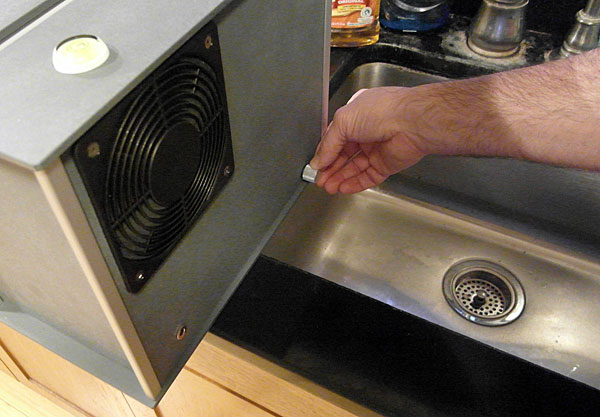
 It was almost laughably easy. I unplugged the Vinyl Cleaner from the AC, carried it to the edge of the kitchen sink, removed its knurled metal drain plug—it's fitted with a rubber grommet—and watched as the machine quickly and thoroughly voided itself. I had allotted for the job far more time than it took, so I killed the extra minutes by rinsing in distilled water the filter and the rotating cleaning drums—the latter which are mildly difficult but not impossible to remove and reinstall. The manual recommends rinsing the filter for every 100 records, though it strikes me as easy enough to do every few days; rinsing the drums isn't mentioned anywhere, though the manual does recommend replacing the drums every 500 records. (A set of drums costs $99.95.)
Is it a wash?
It was almost laughably easy. I unplugged the Vinyl Cleaner from the AC, carried it to the edge of the kitchen sink, removed its knurled metal drain plug—it's fitted with a rubber grommet—and watched as the machine quickly and thoroughly voided itself. I had allotted for the job far more time than it took, so I killed the extra minutes by rinsing in distilled water the filter and the rotating cleaning drums—the latter which are mildly difficult but not impossible to remove and reinstall. The manual recommends rinsing the filter for every 100 records, though it strikes me as easy enough to do every few days; rinsing the drums isn't mentioned anywhere, though the manual does recommend replacing the drums every 500 records. (A set of drums costs $99.95.)
Is it a wash?
My reservations comprise a very short list indeed, topped by the Vinyl Cleaner's lack of adjustable feet. It's easy to see why they were left off—the internal storage tank occupies so much downstairs room that the manufacturer would have to add to the bottom of the machine a plate thick enough to accommodate the threaded axles of such feet—yet the omission is unseemly on so expensive a device. And I'm a bit suspicious of the soft, rubber-like lips through which the record passes when being loaded into and out of the Vinyl Cleaner. For one thing, after the cleaning cycle is complete, wayward drops of fluid sometimes cling to the lips' undersides, only to be flicked onto the record and record label by the wind from the fans: a rare but nonetheless annoying occurrence. For another, it seems to me that the lips could become contaminated with dirt or grit, and their undersides, which exert a mild squeegee effect on each side of an LP, are hard to get at with a cleaning swab. Spare lips are available (I felt dirty writing that) from the distributor, so I assume they're user-replaceable; if so, perhaps the Vinyl Cleaner owner should observe some regimen for their renewal.
Apart from that, my only regret is the price: I regret that I can't afford a Vinyl Cleaner, but I do not consider Audiodesksysteme's price of $4450 regrettable in and of itself. This product is so well thought out, so thoroughly debugged, that I can only imagine that its gestation required more than a few months' work—and probably more like several years. And the Vinyl Cleaner's build quality, like its effectiveness, is beyond reproach. You'd be within your rights to believe that Reiner Gläss applied to the problem of dirty records an unreasonable level of technology (in which case you should, with all haste, set about not buying one); he did it anyway, and you would not be within your rights to call the Audiodesksysteme's price unreasonable.
Where does that leave everything else? For a little more than half the price of the Audiodesksysteme Gläss Vinyl Cleaner, you can buy a Keith Monks Audio Labs discOvery One: a wet-wash, vacuum-dry machine that safely cleans dirty records, but not quite as effectively as the Vinyl Cleaner. On the other hand, all KMAL machines will clean 7" and 10" as well as 12" discs—an advantage of no small importance to me and other collectors. (I should also say that I've never actually had a problem with static buildup when using KMAL's tonearm-style vacuum wands—though I can't say the same about those vacuum-dry cleaners that evacuate fluid by means of a velvet-lined radial slot.)
By all accounts, the Audiodesksysteme Gläss Vinyl Cleaner has already enjoyed considerable success: with record dealers, music archives, and some of the world's most serious record collectors, not to mention audiophiles of comfortable means who simply want the best. As for myself, I've laid in a good supply of fresh, new Original Master Sleeves from Mobile Fidelity Sound Lab, and I'm trying to clean as many records as I can before the Vinyl Cleaner has to go back to its owners. If there exists a more effective, easy, reliable, and utterly transformative way of cleaning LPs, I have yet to hear it.
There's a nice passage in Tune In, the first volume of All These Years, Mark Lewisohn's incomparably exhaustive (and mildly exhausting) three-volume Beatles biography: Pointing to the boys' very humble backgrounds, the author reminds us that, in 1962, 50,000 homes in war-racked, economically depressed Liverpool still lacked bathrooms, and that bathing for those households was limited to one night a week—and to one tub of hot water for all members of the family, one after the other. Eww. That crossed my mind during my first few days with the Audiodesksysteme. Yet my concerns pretty much went down the drain once I understood the Vinyl Cleaner's hydraulics, key to which is its efficient electric pump. Once the user presses that little red Start button, and after the Vinyl Cleaner's microprocessor has completed a quick system check—noting, in particular, whether the bottom-level fluid tank is sufficiently full—the pump forces the liquid straight up into the cleaning chamber through a gap at the bottom of said chamber. The volume of fluid is sufficient to assume a level of about 4" above the cleaning-chamber floor, yet in one side of the chamber is a long horizontal opening whose bottom edge is only about 3.75" above that floor. Because the pump continues to work throughout the cleaning cycle, the fluid has no choice but to spill over the bottom edge of that gap, beneath which it flows into a tightly enclosed sponge of white foam measuring 1" by 4" by 6". The sponge filters out contaminants, and the fluid continues down through three holes at the bottom of the filter chamber, where the fluid reenters the tank.
Working in tandem with the pump are those four counter-rotating barrels. Their microfiber pile is, of course, far too big to get into the grooves themselves, but serves two other purposes: to clean the outer surfaces of the record—removing, for example, fingerprint oil that didn't make its way into the groove—and to stimulate the fluid into constantly flowing away from both sides of the record, so that contaminants detached from the vinyl are unlikely to become reattached.
It was almost laughably easy. I unplugged the Vinyl Cleaner from the AC, carried it to the edge of the kitchen sink, removed its knurled metal drain plug—it's fitted with a rubber grommet—and watched as the machine quickly and thoroughly voided itself. I had allotted for the job far more time than it took, so I killed the extra minutes by rinsing in distilled water the filter and the rotating cleaning drums—the latter which are mildly difficult but not impossible to remove and reinstall. The manual recommends rinsing the filter for every 100 records, though it strikes me as easy enough to do every few days; rinsing the drums isn't mentioned anywhere, though the manual does recommend replacing the drums every 500 records. (A set of drums costs $99.95.)
Is it a wash?My reservations comprise a very short list indeed, topped by the Vinyl Cleaner's lack of adjustable feet. It's easy to see why they were left off—the internal storage tank occupies so much downstairs room that the manufacturer would have to add to the bottom of the machine a plate thick enough to accommodate the threaded axles of such feet—yet the omission is unseemly on so expensive a device. And I'm a bit suspicious of the soft, rubber-like lips through which the record passes when being loaded into and out of the Vinyl Cleaner. For one thing, after the cleaning cycle is complete, wayward drops of fluid sometimes cling to the lips' undersides, only to be flicked onto the record and record label by the wind from the fans: a rare but nonetheless annoying occurrence. For another, it seems to me that the lips could become contaminated with dirt or grit, and their undersides, which exert a mild squeegee effect on each side of an LP, are hard to get at with a cleaning swab. Spare lips are available (I felt dirty writing that) from the distributor, so I assume they're user-replaceable; if so, perhaps the Vinyl Cleaner owner should observe some regimen for their renewal.