"You do not want to put the speaker directly on softer-material dampers because they will allow it to move. So how do you couple it below a certain frequency, yet let it float above a certain frequency? That's how we came up with the MPods. We use constrained-layer damping to very effectively dissipate high-frequency vibration as heat. Below 300Hz, the speaker sees just a direct contact, there's no dissipation of any energy. But above that frequency, the constrained-layer damping dissipates the noise."
Setup
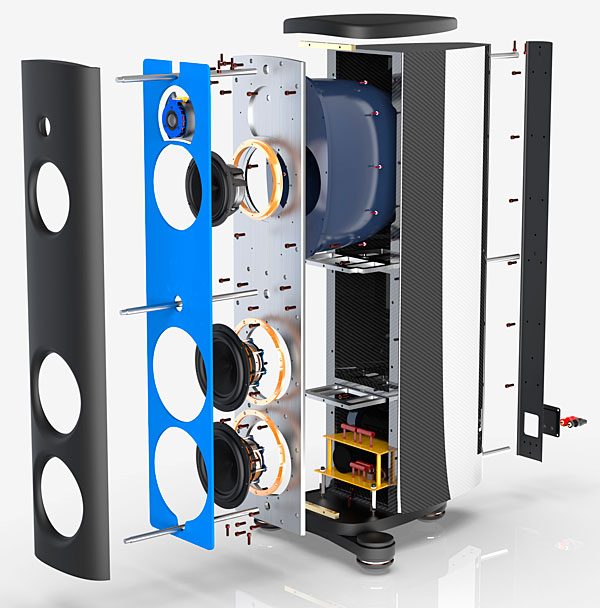
After making sure the M2s' tension rods were correctly torqued, Wolf and Mackay started with the speakers in exactly the same positions in my room where the S5 Mk.IIs had worked best. Then, listening to familiar recordings, they moved the M2s in small increments side to side and forward and back until the low bass was well-integrated with the mid and upper bass and the stereo imaging was well-focused and stable. Measured with a Bosch laser tool, the speakers' front baffles were 75" from the wall behind them and 122" from my listening position; the left speaker was 53" from the closest sidewall, the right 49" from its sidewall. The big surprise came when, after the optimal speaker positioning had been determined, Mackay installed the three MPods for each speaker and removed the pins that had locked their suspensions. The tightly focused imaging became more palpable, the soundstage floating free of the loudspeaker locations. While the MPod outrigger bases are not inexpensive, I feel that their use is essential with the M2s.
 Listening
As with all my loudspeaker reviews, I started my critical listening to the M2s using the test tracks I created for my Editor's Choice CD (Stereophile STPH016-2), using Lamm M1.2 monoblock amplifiers. The M2s reproduced the 1/3-octave warble tones with full weight and minimal distortion down to the 50Hz band, with a slight reduction in level for the 40Hz band. The 32Hz tone was boosted by the lowest-frequency mode in my room, the 25Hz warble was just audible, but I couldn't hear the 20Hz tone at my normal listening level. The half-step–spaced low-frequency tonebursts on this CD spoke very cleanly down to 32Hz, with no emphasis of any of the tones and without any of the aliasing-like pre-echo I sometime hear with other speakers. When I listened to the cabinet walls of both speakers with a stethoscope while these tones played, I could hear some liveliness between 600Hz and 800Hz. The dual-mono pink noise track on Editor's Choice sounded hollow if I stood up but evenly balanced, uncolored, and smooth when I sat with my ears level with the M2s' tweeters, which are 38.5" from the floor. The pink noise sounded mellower than it had with the Q Acoustics Concept 300s that I reviewed in the January 2020 issue, but the central image of the noise signal was appropriately narrow and stable. Stable, accurate stereo imaging was a consistent feature during my auditioning of the M2s. I have been a fan of pianist Mitsuko Uchida since Stereophile's then-publisher Larry Archibald and I saw her performing at London's Royal Festival Hall the February 1986 night we sealed the deal on my replacing J. Gordon Holt as the magazine's editor. A recent purchase was Ms. Uchida's live 2010 Beethoven Piano Concerto cycle with Simon Rattle conducting the Berlin Philharmonic (24/48 FLAC files, Berliner Philharmoniker BPHR 180241).
I have many performances of the "Emperor" concerto in my library, but this powerful performance has taken pride of place. The M2s presented an upfront image of the piano—I suspect that that is how it was recorded—with the orchestra set farther back in the soundstage within a somewhat reticent dome of ambience. Each piano note at the hushed start of the concerto's second movement was precisely and unambiguously positioned in space. What was unusual about the M2's imaging was that it was preserved even when I was sitting at my desk to the left of my listening seat. Yes, Uchida's piano moved to the left, but I could still perceive sufficient stereo spread of the Berlin orchestra when sitting off-axis. I have only experienced this phenomenon before with some minimonitors. That a tower like the Magico can do this is a tribute to its dispersion and even tonal balance.
The M2 may feature sealed-box woofers, but the low frequencies were weighty when appropriate. The orchestral basses in the Uchida "Emperor" sounded suitably rich but without sacrificing articulation. The solo double bass on "Come Together" from Musica Nuda's Live à Fip (16/44.1 Tidal FLAC stream, BHM Productions) was reproduced with excellent weight, as was my Fender bass guitar on the channel ID and phasing tracks on Editor's Choice. Both instruments also benefited from the M2's superb low-frequency clarity.
 Staying with Simon Rattle, I was streaming his Sibelius Symphony No.5 with the Berliners (16/44.1 Tidal FLAC stream, Berliner Philharmoniker) when I realized just how transparent the M2's low-frequency reproduction was. At 4:30 in the third and final movement, to echo the ambiguous tonality of the symphony, Sibelius has the double basses, normally used by composers to provide a solid foundation to the harmony taking place above, playing divisi two notes that "fight," G-flat and F natural. At 6:20, the composer does the same thing, but now the contrarian notes are E-flat and F.
With many speakers, especially those with an underdamped reflex alignment, while I would be aware that there was something sour with the apparently muddy bass writing, it took a look at the orchestral score to comprehend what I was hearing. With the Magicos, the score is unnecessary. You hear the discord as Sibelius intended: two low notes very close in frequency but far enough apart in pitch to be distinguished. This double-bass discord is something I hear in real life but not often as clearly with recordings as it was reproduced by the Magicos.
Toward the end of the five weeks I had the M2s in my system, I had to prepare the CD master for the Portland State Chamber Choir's second album of works by contemporary Latvian composer Eriks Eenvalds, Translation, which is scheduled to be released by Naxos in March. Doug Tourtelot and I had recorded the original sessions at 24/96. I therefore needed to audition the various noise-shaping options and sample-rate conversion filters offered by my dCS 972 processor, in order to preserve as much as possible of the hi-rez album's resolution. The Magico M2's transparency and its lack of coloration were a boon when it came to this task. They allowed me to make a clear choice which processing options worked best.
This transparency was maximized by the MPod stands, which made me suspect that Wolf was correct when he said that these dissipate noise, which will reduce noise modulation. When there's no music, there is no noise, of course. But when there is music, the noise rides on top of it. This noise might be at a low level, but listeners are more sensitive to it than the level would suggest because it's correlated with the music.
Conclusion
Staying with Simon Rattle, I was streaming his Sibelius Symphony No.5 with the Berliners (16/44.1 Tidal FLAC stream, Berliner Philharmoniker) when I realized just how transparent the M2's low-frequency reproduction was. At 4:30 in the third and final movement, to echo the ambiguous tonality of the symphony, Sibelius has the double basses, normally used by composers to provide a solid foundation to the harmony taking place above, playing divisi two notes that "fight," G-flat and F natural. At 6:20, the composer does the same thing, but now the contrarian notes are E-flat and F.
With many speakers, especially those with an underdamped reflex alignment, while I would be aware that there was something sour with the apparently muddy bass writing, it took a look at the orchestral score to comprehend what I was hearing. With the Magicos, the score is unnecessary. You hear the discord as Sibelius intended: two low notes very close in frequency but far enough apart in pitch to be distinguished. This double-bass discord is something I hear in real life but not often as clearly with recordings as it was reproduced by the Magicos.
Toward the end of the five weeks I had the M2s in my system, I had to prepare the CD master for the Portland State Chamber Choir's second album of works by contemporary Latvian composer Eriks Eenvalds, Translation, which is scheduled to be released by Naxos in March. Doug Tourtelot and I had recorded the original sessions at 24/96. I therefore needed to audition the various noise-shaping options and sample-rate conversion filters offered by my dCS 972 processor, in order to preserve as much as possible of the hi-rez album's resolution. The Magico M2's transparency and its lack of coloration were a boon when it came to this task. They allowed me to make a clear choice which processing options worked best.
This transparency was maximized by the MPod stands, which made me suspect that Wolf was correct when he said that these dissipate noise, which will reduce noise modulation. When there's no music, there is no noise, of course. But when there is music, the noise rides on top of it. This noise might be at a low level, but listeners are more sensitive to it than the level would suggest because it's correlated with the music.
Conclusion
It has been said about loudspeakers that "A good big'un always beats a good little'un!" While the speakers I have purchased and used for much of my critical listening over the past 40 years have been good little'uns—Rogers LS3/5a's, Celestion SL600s, Bowers & Wilkins Silver Signatures, KEF LS50s—there are still good big'uns that catch my ears and that I would be happy to live with. Magico's M2 joins that exclusive club—if I could afford them. Yes, this is an expensive loudspeaker, even without the mandatory MPod bases. However, this level of quality, not just of sound but also of construction, has never been cheap, as you will appreciate watching the 2018 video "How To Build A Magico Loudspeaker in 10 Easy Steps." The M2 is a loudspeaker designed and manufactured by craftsmen, to be appreciated by well-heeled music lovers.
After making sure the M2s' tension rods were correctly torqued, Wolf and Mackay started with the speakers in exactly the same positions in my room where the S5 Mk.IIs had worked best. Then, listening to familiar recordings, they moved the M2s in small increments side to side and forward and back until the low bass was well-integrated with the mid and upper bass and the stereo imaging was well-focused and stable. Measured with a Bosch laser tool, the speakers' front baffles were 75" from the wall behind them and 122" from my listening position; the left speaker was 53" from the closest sidewall, the right 49" from its sidewall. The big surprise came when, after the optimal speaker positioning had been determined, Mackay installed the three MPods for each speaker and removed the pins that had locked their suspensions. The tightly focused imaging became more palpable, the soundstage floating free of the loudspeaker locations. While the MPod outrigger bases are not inexpensive, I feel that their use is essential with the M2s.
ListeningAs with all my loudspeaker reviews, I started my critical listening to the M2s using the test tracks I created for my Editor's Choice CD (Stereophile STPH016-2), using Lamm M1.2 monoblock amplifiers. The M2s reproduced the 1/3-octave warble tones with full weight and minimal distortion down to the 50Hz band, with a slight reduction in level for the 40Hz band. The 32Hz tone was boosted by the lowest-frequency mode in my room, the 25Hz warble was just audible, but I couldn't hear the 20Hz tone at my normal listening level. The half-step–spaced low-frequency tonebursts on this CD spoke very cleanly down to 32Hz, with no emphasis of any of the tones and without any of the aliasing-like pre-echo I sometime hear with other speakers. When I listened to the cabinet walls of both speakers with a stethoscope while these tones played, I could hear some liveliness between 600Hz and 800Hz. The dual-mono pink noise track on Editor's Choice sounded hollow if I stood up but evenly balanced, uncolored, and smooth when I sat with my ears level with the M2s' tweeters, which are 38.5" from the floor. The pink noise sounded mellower than it had with the Q Acoustics Concept 300s that I reviewed in the January 2020 issue, but the central image of the noise signal was appropriately narrow and stable. Stable, accurate stereo imaging was a consistent feature during my auditioning of the M2s. I have been a fan of pianist Mitsuko Uchida since Stereophile's then-publisher Larry Archibald and I saw her performing at London's Royal Festival Hall the February 1986 night we sealed the deal on my replacing J. Gordon Holt as the magazine's editor. A recent purchase was Ms. Uchida's live 2010 Beethoven Piano Concerto cycle with Simon Rattle conducting the Berlin Philharmonic (24/48 FLAC files, Berliner Philharmoniker BPHR 180241).
Staying with Simon Rattle, I was streaming his Sibelius Symphony No.5 with the Berliners (16/44.1 Tidal FLAC stream, Berliner Philharmoniker) when I realized just how transparent the M2's low-frequency reproduction was. At 4:30 in the third and final movement, to echo the ambiguous tonality of the symphony, Sibelius has the double basses, normally used by composers to provide a solid foundation to the harmony taking place above, playing divisi two notes that "fight," G-flat and F natural. At 6:20, the composer does the same thing, but now the contrarian notes are E-flat and F.
It has been said about loudspeakers that "A good big'un always beats a good little'un!" While the speakers I have purchased and used for much of my critical listening over the past 40 years have been good little'uns—Rogers LS3/5a's, Celestion SL600s, Bowers & Wilkins Silver Signatures, KEF LS50s—there are still good big'uns that catch my ears and that I would be happy to live with. Magico's M2 joins that exclusive club—if I could afford them. Yes, this is an expensive loudspeaker, even without the mandatory MPod bases. However, this level of quality, not just of sound but also of construction, has never been cheap, as you will appreciate watching the 2018 video "How To Build A Magico Loudspeaker in 10 Easy Steps." The M2 is a loudspeaker designed and manufactured by craftsmen, to be appreciated by well-heeled music lovers.