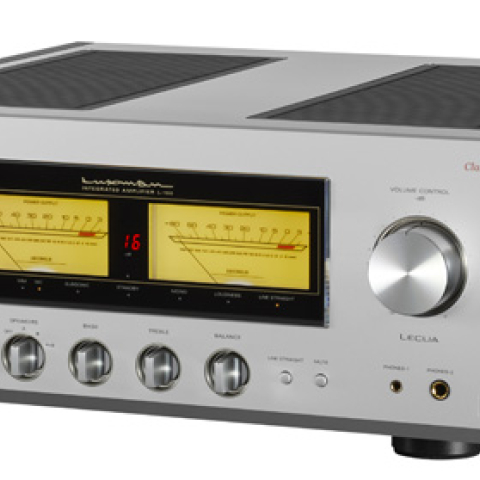
Was it the Hegel amp or just the loudness? Sorta both. I switched over to the Benchmark AHB2 amps and, with the volume control still at 11, the same thing happened: a bit less bass and a little more detail, but still: Wow. Next up was the Parasound Halo A 31, with the same specified gain (29dB), but the result was merely . . . fine. The impact of the opening seemed diminished, and the ensuing flow didn't sweep me away. At a mere 150Wpc into 8 ohms, the C53 sounded much like my 380Wpc stack of Benchmarks.
The clear verdict: Hegel Music Systems' C53 is an outstanding amplifier that performs beyond its modest specs and not-so-modest price. With only three of its five amp-module bays occupied, it never ran warm or showed any indication of clipping, even when greatly challenged. I just wish I could lift it.
DSPeaker Anti-Mode X4 preamplifier-DAC
The Anti-Mode X4 isn't really a multichannel component, so what is it doing here? I seem to be following the string of equalization and room-correction devices from DSPeaker that began in January 2009, with my review of their monophonic Anti-Mode 8033—a nice "Look, Ma, no hands!" automatic subwoofer equalizer that then cost only 225. It offered very little tweaking, and displayed no information about what it was doing: You heard what it did or you didn't. I heard it.
After that came DSPeaker's very stereo Anti-Mode 2.0 Dual Core digital room equalizer (then $1099), which I reviewed in November 2012. This offered a good range of control and configuration options, as well as multiple inputs and remote control—and, unlike the 8033, it had a display. It's still a good option for those who want to add a subwoofer and EQ to a stereo system but don't want anything in that system that requires a computer for setup and/or operation.
 A couple of years ago, DSPeaker announced the new Anti-Mode X4 preamplifier-DAC, which was to provide EQ for a stereo pair of main speakers and two subwoofers. However, it was also intimated (I don't recall by whom) that there would be a specific mode for EQing as many as four subwoofers. I've waited for it with diminishing patience, but at last it's here, it works, and it's more and less than I'd hoped for.
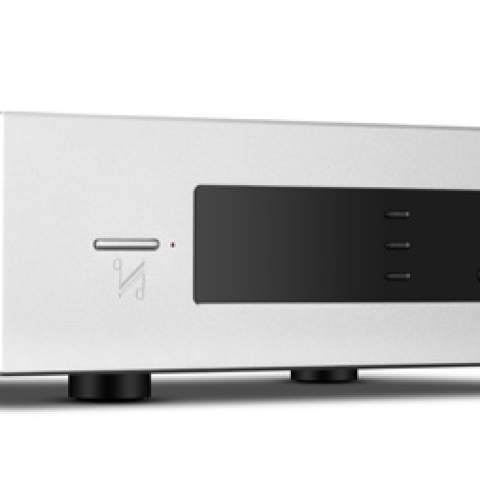
The Anti-Mode X4 ($4250) is a full-featured, modern stereo preamplifier with multiple inputs, multiple outputs, and a head-spinning array of digital signal-processing (DSP) tools that go beyond those of any other consumer hardware device I know of. Such tools are generally available only with computer programs, but the X4 is an entirely standalone audio component. Its slim, rectangular case measures 17.2" wide by 2.8" high by 11.6" deep and weighs 9.9 lb. The sleek front panel, available in Black or Silver, surrounds a bright, clear display at center. To the right of this is the Volume knob, which also provides access to all control and setup operations. To the left of the display is an XLR jack for the calibration microphone; at the XLR's center is a 6.3mm jack for headphones; both jacks have automatic insertion detection. All operations are also accessible from the remote control, but I found it easier to use the front-panel knob for setup and calibration—you need to be close to the X4 anyway, to read the menus on its display. Documentation is skimpy—not as forthcoming as it should be, but usable. I had to e-mail some questions to DSPeaker, but they responded quickly and to the point.
A couple of years ago, DSPeaker announced the new Anti-Mode X4 preamplifier-DAC, which was to provide EQ for a stereo pair of main speakers and two subwoofers. However, it was also intimated (I don't recall by whom) that there would be a specific mode for EQing as many as four subwoofers. I've waited for it with diminishing patience, but at last it's here, it works, and it's more and less than I'd hoped for.
The Anti-Mode X4 ($4250) is a full-featured, modern stereo preamplifier with multiple inputs, multiple outputs, and a head-spinning array of digital signal-processing (DSP) tools that go beyond those of any other consumer hardware device I know of. Such tools are generally available only with computer programs, but the X4 is an entirely standalone audio component. Its slim, rectangular case measures 17.2" wide by 2.8" high by 11.6" deep and weighs 9.9 lb. The sleek front panel, available in Black or Silver, surrounds a bright, clear display at center. To the right of this is the Volume knob, which also provides access to all control and setup operations. To the left of the display is an XLR jack for the calibration microphone; at the XLR's center is a 6.3mm jack for headphones; both jacks have automatic insertion detection. All operations are also accessible from the remote control, but I found it easier to use the front-panel knob for setup and calibration—you need to be close to the X4 anyway, to read the menus on its display. Documentation is skimpy—not as forthcoming as it should be, but usable. I had to e-mail some questions to DSPeaker, but they responded quickly and to the point.
 The X4's rear panel has an amazing but logically arranged array of connectors. Beginning at the right and working left: first come four pairs of analog outputs, labeled Primary Output and Auxiliary Output/Sub (both on RCA and XLR). These are, in effect, the main L/R outputs and subwoofer outputs. Next are three pairs of analog stereo inputs (two RCA, one XLR) and seven digital inputs: one USB, three S/PDIF (coax), and three TosLink. There are one S/PDIF and one TosLink digital outputs, followed by: a USB host port for firmware updates; jacks for thermometer, service, and 12V trigger outputs; and a socket for the power cord. The X4's digital inputs top out at resolutions of 24/192 for coax and 24/96 for TosLink, while the USB can handle up to 24/192 PCM, and DSD64 and DSD128 via DoP. The X4 converts all analog signals to digital at 24/96, optimized with selectable input sensitivities for the coax and XLR inputs. The analog output specifications include dynamic range of 126dB and THD of 0.0008%. The output voltage capability can be set to one of two ranges: 3.2 or 6.4V RMS (RCA) and 6.4 or 14.0V (!) RMS (XLR).
Also included with the Anti-Mode X4 is everything you'll need to use all of its DSP functions: a calibrated microphone, with cable and tripod stand. The stand is perfectly capable but too lightweight—with the mike affixed to it, the whole thing was a bit top-heavy.
The X4 can do so many things that it's a challenge to describe them all. Here's a list of just some of them; explanations of my experience with them follow.
Room/speaker equalization for a stereo pair of speakers
Room/speaker equalization for two subwoofers, in mono or as a stereo pair
Setting of main/sub crossover manually or by automated measurement
Bandwidth control for equalization/correction
Bass and treble tilt controls with selectable gain and bandwidth
Parametric EQ (up to nine filters per channel)
Infrasonic filter
Headroom compensation
L/R balance
Subwoofer level control
All results of these operations, along with a chosen speaker configuration, can be stored in one or more of six Profiles, which can be accessed on the fly with the remote control. Two additional Profiles are dedicated to use with headphones.
The X4's rear panel has an amazing but logically arranged array of connectors. Beginning at the right and working left: first come four pairs of analog outputs, labeled Primary Output and Auxiliary Output/Sub (both on RCA and XLR). These are, in effect, the main L/R outputs and subwoofer outputs. Next are three pairs of analog stereo inputs (two RCA, one XLR) and seven digital inputs: one USB, three S/PDIF (coax), and three TosLink. There are one S/PDIF and one TosLink digital outputs, followed by: a USB host port for firmware updates; jacks for thermometer, service, and 12V trigger outputs; and a socket for the power cord. The X4's digital inputs top out at resolutions of 24/192 for coax and 24/96 for TosLink, while the USB can handle up to 24/192 PCM, and DSD64 and DSD128 via DoP. The X4 converts all analog signals to digital at 24/96, optimized with selectable input sensitivities for the coax and XLR inputs. The analog output specifications include dynamic range of 126dB and THD of 0.0008%. The output voltage capability can be set to one of two ranges: 3.2 or 6.4V RMS (RCA) and 6.4 or 14.0V (!) RMS (XLR).
Also included with the Anti-Mode X4 is everything you'll need to use all of its DSP functions: a calibrated microphone, with cable and tripod stand. The stand is perfectly capable but too lightweight—with the mike affixed to it, the whole thing was a bit top-heavy.
The X4 can do so many things that it's a challenge to describe them all. Here's a list of just some of them; explanations of my experience with them follow.
Room/speaker equalization for a stereo pair of speakers
Room/speaker equalization for two subwoofers, in mono or as a stereo pair
Setting of main/sub crossover manually or by automated measurement
Bandwidth control for equalization/correction
Bass and treble tilt controls with selectable gain and bandwidth
Parametric EQ (up to nine filters per channel)
Infrasonic filter
Headroom compensation
L/R balance
Subwoofer level control
All results of these operations, along with a chosen speaker configuration, can be stored in one or more of six Profiles, which can be accessed on the fly with the remote control. Two additional Profiles are dedicated to use with headphones.
 Faced with the Anti-Mode X4's almost bewildering range of capabilities, I decided to focus on two tasks. Task 1 would be to use the X4 as a stereo preamp with two mono subwoofers, in a 2.1-channel setup. In Task 2, I would use the X4 to equalize my three subs as fed by the subwoofer output of my Marantz AV8805—nominally, a 5.3-channel system with the X4 running only the subs.
Task 1
Faced with the Anti-Mode X4's almost bewildering range of capabilities, I decided to focus on two tasks. Task 1 would be to use the X4 as a stereo preamp with two mono subwoofers, in a 2.1-channel setup. In Task 2, I would use the X4 to equalize my three subs as fed by the subwoofer output of my Marantz AV8805—nominally, a 5.3-channel system with the X4 running only the subs.
Task 1
Setup—I connected the USB feed from my Mac mini (running JRiver Media Center in Windows) to the X4's USB input and determined that I could play signals up to 24/192 and DSD128 through the system. The main L/R XLR outputs were connected to my Bryston 9B five-channel amplifier and Monitor Audio Silver 8 L/R speakers, and its main L/R RCA outputs went to my two JL Audio E-Sub e110 subwoofers up front. Unequalized, of course, there was some room boom and no sub output. (One needs to set that up.)
I put the calibration mike in the stand, placed it at my main listening position, and plugged its cable into the X4, which immediately asked for my speaker configuration. I selected "2.1." After warning me to turn down the system volume, the X4 played something like white noise while I adjusted each speaker's volume until the mike input level fell within a suitable range. In my first attempt, I set the levels in the middle of the range, but this gave less consistent results than setting them toward the top of that range. I then left the room to let the X4 run successive sweeps through the speakers, individually and together. That took between 5 and 10 minutes.
Results—Playing familiar tracks revealed that there was no more room boom, and that the blend of the outputs of the main speakers and subwoofers was completely undetectable at the 47Hz crossover frequency the X4 had chosen. Bypassing the Anti-Mode X4's EQ using a menu option, and leaving the crossover and level settings intact, confirmed that the EQ had increased the soundstage's width and depth, and that overall detail was improved. But while the room boom was gone, I was less than thrilled with the overall tonal balance. That was easily fixed with a "house curve" I created with a lift of about +5dB descending from 600Hz and a treble slope of –2dB beginning at about 1kHz.
The Anti-Mode X4 is really powerful, and it's easy to use, due in no small part to the fact that, as you make adjustments, its screen displays the graphs changing even as you're actually hearing the results of those adjustments. Overall, the results with the X4 were better than what I've achieved with Audyssey, and nearly as satisfying as from Dirac Live.
Task 2
Setup—I connected the subwoofer output on the Marantz AV8805 to the X4's Analog 1 L/R inputs (RCA) with a Y-connector, the X4's subwoofer L output to the daisy-chained pair of JL Audio e110 subs at the front of the room, and the X4's R output to the Paradigm Sub15 at the back of the room. I figured that I could get away with treating the two e110s as one—I've found that, in situ, they measure pretty much the same without EQ (footnote 1). When I began the calibration routine, I selected the "0.2" configuration so that the X4 would recognize the sub groups as separate. The calibration procedure was as before; again, the subs were swept individually and together. Results—Again, a success. With the Marantz's built-in Audyssey room correction defeated but with its bass management retained (and the levels manually rebalanced), my system's sound entered a new realm. It was not merely smooth, but the bass output was now so well integrated with the output of the five main speakers that it was localized to them—or, rather, to the sources of the music on the soundstage—and not to any of the subs. Comparing this sound to unequalized (but level-balanced) conditions was a no-brainer, but even the improvement over what had been a relatively successful Audyssey calibration was obvious to my ears. It was also measurable (fig.1).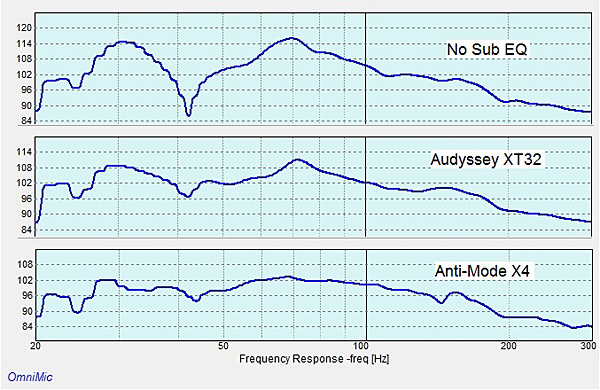 I was so enthralled by what the Anti-Mode X4 did for my subwoofers that I'm almost willing to forget my disappointment that this four-channel DSP device (two Primary outputs, two Auxiliary) can't be configured to handle three or four independent subs. When asked about this, DSPeaker said, "The genuine 4-channel modes are on our development list." This could be a killer app—the alternatives for soundfield management are complex or expensive, or discontinued. I wait with hope.
In the meantime, I'm happy to tell you that DSPeaker's Anti-Mode X4 is great just as it is, and will appeal to user needs that until now have not been addressed. This is a first-rate two-channel preamplifier with flexible bass management and potent DSP for setup and room EQ. It requires no additional parts or a computer—everything is already built-in or is supplied by DSPeaker. Even better, it requires no additional technical background: the menu options are clear, and you can hear the effects of your tweaks as you make them. If you've wanted these features but have been deterred by any of those impediments, the Anti-Mode X4 should be in your system.
I was so enthralled by what the Anti-Mode X4 did for my subwoofers that I'm almost willing to forget my disappointment that this four-channel DSP device (two Primary outputs, two Auxiliary) can't be configured to handle three or four independent subs. When asked about this, DSPeaker said, "The genuine 4-channel modes are on our development list." This could be a killer app—the alternatives for soundfield management are complex or expensive, or discontinued. I wait with hope.
In the meantime, I'm happy to tell you that DSPeaker's Anti-Mode X4 is great just as it is, and will appeal to user needs that until now have not been addressed. This is a first-rate two-channel preamplifier with flexible bass management and potent DSP for setup and room EQ. It requires no additional parts or a computer—everything is already built-in or is supplied by DSPeaker. Even better, it requires no additional technical background: the menu options are clear, and you can hear the effects of your tweaks as you make them. If you've wanted these features but have been deterred by any of those impediments, the Anti-Mode X4 should be in your system.
Footnote 1: See fig.1 in my review of the JL Audio E-Sub e110 in my September 2016 column.
The Anti-Mode X4 isn't really a multichannel component, so what is it doing here? I seem to be following the string of equalization and room-correction devices from DSPeaker that began in January 2009, with my review of their monophonic Anti-Mode 8033—a nice "Look, Ma, no hands!" automatic subwoofer equalizer that then cost only 225. It offered very little tweaking, and displayed no information about what it was doing: You heard what it did or you didn't. I heard it.
A couple of years ago, DSPeaker announced the new Anti-Mode X4 preamplifier-DAC, which was to provide EQ for a stereo pair of main speakers and two subwoofers. However, it was also intimated (I don't recall by whom) that there would be a specific mode for EQing as many as four subwoofers. I've waited for it with diminishing patience, but at last it's here, it works, and it's more and less than I'd hoped for.
The Anti-Mode X4 ($4250) is a full-featured, modern stereo preamplifier with multiple inputs, multiple outputs, and a head-spinning array of digital signal-processing (DSP) tools that go beyond those of any other consumer hardware device I know of. Such tools are generally available only with computer programs, but the X4 is an entirely standalone audio component. Its slim, rectangular case measures 17.2" wide by 2.8" high by 11.6" deep and weighs 9.9 lb. The sleek front panel, available in Black or Silver, surrounds a bright, clear display at center. To the right of this is the Volume knob, which also provides access to all control and setup operations. To the left of the display is an XLR jack for the calibration microphone; at the XLR's center is a 6.3mm jack for headphones; both jacks have automatic insertion detection. All operations are also accessible from the remote control, but I found it easier to use the front-panel knob for setup and calibration—you need to be close to the X4 anyway, to read the menus on its display. Documentation is skimpy—not as forthcoming as it should be, but usable. I had to e-mail some questions to DSPeaker, but they responded quickly and to the point.
The X4's rear panel has an amazing but logically arranged array of connectors. Beginning at the right and working left: first come four pairs of analog outputs, labeled Primary Output and Auxiliary Output/Sub (both on RCA and XLR). These are, in effect, the main L/R outputs and subwoofer outputs. Next are three pairs of analog stereo inputs (two RCA, one XLR) and seven digital inputs: one USB, three S/PDIF (coax), and three TosLink. There are one S/PDIF and one TosLink digital outputs, followed by: a USB host port for firmware updates; jacks for thermometer, service, and 12V trigger outputs; and a socket for the power cord. The X4's digital inputs top out at resolutions of 24/192 for coax and 24/96 for TosLink, while the USB can handle up to 24/192 PCM, and DSD64 and DSD128 via DoP. The X4 converts all analog signals to digital at 24/96, optimized with selectable input sensitivities for the coax and XLR inputs. The analog output specifications include dynamic range of 126dB and THD of 0.0008%. The output voltage capability can be set to one of two ranges: 3.2 or 6.4V RMS (RCA) and 6.4 or 14.0V (!) RMS (XLR).
Also included with the Anti-Mode X4 is everything you'll need to use all of its DSP functions: a calibrated microphone, with cable and tripod stand. The stand is perfectly capable but too lightweight—with the mike affixed to it, the whole thing was a bit top-heavy.
The X4 can do so many things that it's a challenge to describe them all. Here's a list of just some of them; explanations of my experience with them follow.
Faced with the Anti-Mode X4's almost bewildering range of capabilities, I decided to focus on two tasks. Task 1 would be to use the X4 as a stereo preamp with two mono subwoofers, in a 2.1-channel setup. In Task 2, I would use the X4 to equalize my three subs as fed by the subwoofer output of my Marantz AV8805—nominally, a 5.3-channel system with the X4 running only the subs.
Task 1Setup—I connected the USB feed from my Mac mini (running JRiver Media Center in Windows) to the X4's USB input and determined that I could play signals up to 24/192 and DSD128 through the system. The main L/R XLR outputs were connected to my Bryston 9B five-channel amplifier and Monitor Audio Silver 8 L/R speakers, and its main L/R RCA outputs went to my two JL Audio E-Sub e110 subwoofers up front. Unequalized, of course, there was some room boom and no sub output. (One needs to set that up.)
Setup—I connected the subwoofer output on the Marantz AV8805 to the X4's Analog 1 L/R inputs (RCA) with a Y-connector, the X4's subwoofer L output to the daisy-chained pair of JL Audio e110 subs at the front of the room, and the X4's R output to the Paradigm Sub15 at the back of the room. I figured that I could get away with treating the two e110s as one—I've found that, in situ, they measure pretty much the same without EQ (footnote 1). When I began the calibration routine, I selected the "0.2" configuration so that the X4 would recognize the sub groups as separate. The calibration procedure was as before; again, the subs were swept individually and together. Results—Again, a success. With the Marantz's built-in Audyssey room correction defeated but with its bass management retained (and the levels manually rebalanced), my system's sound entered a new realm. It was not merely smooth, but the bass output was now so well integrated with the output of the five main speakers that it was localized to them—or, rather, to the sources of the music on the soundstage—and not to any of the subs. Comparing this sound to unequalized (but level-balanced) conditions was a no-brainer, but even the improvement over what had been a relatively successful Audyssey calibration was obvious to my ears. It was also measurable (fig.1).
Fig.1 In-room frequency response, 20–300Hz, with no subwoofer equalization (top); as corrected by Audyssey XT32 (middle); and corrected by the Antinode X4 (bottom) (6dB/vertical div.)
Footnote 1: See fig.1 in my review of the JL Audio E-Sub e110 in my September 2016 column.