Sidebar 2: Recordings in the Round
This is an unusual installment of "Recordings in the Round." Rather than a few multichannel releases that have recently impressed me, I offer two excellent recordings whose very formats have done the selecting for me. The music on these Blu-ray discs is presented in 2.0- and 5.1-channel mixes, as well as in immersive formats that offer even greater listening pleasure: Dolby Atmos and Auro-3D, which require the addition of one or more pairs of speakers above the horizontal plane occupied by the speakers in a standard 5.1-channel array.
I feel that there are still too few recordings available in Dolby Atmos and Auro-3D to justify the cost and effort of making room for and installing those extra speakers, and after this I'll probably revert to my 5.1 system. But many have already made this investment in their home theaters—they can enjoy these recordings in ways that most of us still can't.
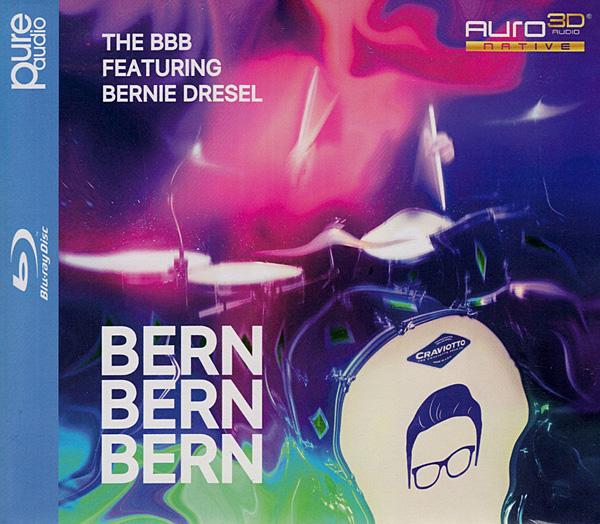 The BBB featuring Bernie Dresel: Bern Bern Bern
Dig-It Recordings (no catalog number) (BD). www.berniedresel.com
I'd been looking for a recording that demonstrated the musical power of immersive recording formats. Sure, a few have used it to re-create the sounds of large ensembles in three-dimensional space, but they offered a traditional listening perspective. What's been needed is a good recording that actually immerses the listener in the music, similar to what Willie Nelson's Night and Day (DVD-A, Surrounded By SBE-1001-9) did for 5.1-channel. Here is that recording.
I'm out of my depth to describe this music fairly, other than that it's big-band—really big—jazz that is both sufficiently traditional to be easily enjoyed and sufficiently modern to sound fresh. I'll just say that this session's leader, Bernie Dresel, was the drummer for the Brian Setzer Orchestra and Gordon Goodwin's Big Phat Band, and the liner notes indicate that all of the participants have comparable credits. These are professionals, and the entire ensemble and their guests, the Los Angeles Clarinet Choir, play with precision and gusto.
I'm telling you about Bern Bern Bern because it was recorded at Capitol Studios in Hollywood, and mixed and mastered at Galaxy Studios, the home of Auro-3D. All tracks are in 24-bit/96kHz, but the 2.0- and even the 5.1-channel mixes aren't the point here. Through my 7.2.4-channel system, the Auro-3D tracks sound spectacular. Dresel's drum kit is front and center, in my face, percussion behind me, and the brass are arrayed in a deep, wide arc: saxophones at left, trumpets in front, and trombones at right. Sitting inside that arc and just beyond the drums are the keyboards, guitar, and double bass.
Yes, I saw the diagram in the booklet—but even before that, I heard it. Whichever combination of instruments is playing, I know exactly where they were, and their presence was formidable. Aside from the actual instrument positions, there were no noticeable effects introduced in the studio, and the four height channels (in my setup) let this big band bellow with a freedom that's stinted even in the 5.1 mix, which itself is pretty okay. Even when only the instruments on one side of the stage are playing, the three dimensions of the sound space remain. In addition, the bass is impressively full yet natural, and everything sounds so clear that I feel the urge to play it at very high levels. I've never sat in a big band, but this is everything I ever hoped it might sound like. Bern Bern Bern is 72 minutes of thrills.
 Beethoven: Symphonies 1–9
Herbert von Karajan, Berlin Philharmonic Orchestra. In Symphony 9: Anna Tomowa-Sintow, soprano; Agnes Baltsa, alto; Peter Schreier, tenor; José van Dam, bass.
Deutsche Grammophon 0735557 (2 BDs). These two Blu-rays offer Herbert von Karajan's second full traversal of the Beethoven Nine with the Berlin Philharmonic, recorded in 1975–77, more than a decade after his first (1961–62). The earlier set was evidence of his maturation well beyond that of his very first cycle, with the Philharmonia Orchestra (1951–55), and is often regarded as his most successful. In the 1970s recordings we heard less warmth and more control, but we also heard just plain more, due to advances in recording technology and the change of recording venue, to the then-new Berliner Philharmonie. The 1960s set has been reissued more than once, including a 24/96 remastering in 2014 (1 BD, 5 CDs, Deutsche Grammophon 0289 479 3442 4). However, taking advantage of the technical resources of the last recording, DG has remastered it again, and now offers it in 24/192 in both two- and 5.1-channel mixes—and in 24/48 in Dolby Atmos, which plays in as many channels as your system supports.
What does this mean for two-channel stereo recordings made more than four decades ago? In all of the formats offered, and regardless of the resolution, these new remasterings benefit from increases in clarity and improved soundstage coherence. The immersive mix of the Dolby Atmos tracks is subtle but well appreciated. Without denying the obvious improvements, DG's successful remasterings of recordings from this and earlier eras typically remain burdened by the slightly hard or pinched tonal quality of the original recordings. An example is the successive reissues of Carlos Kleiber's recording of Beethoven's Symphony 5, which comprise a history of improvement that seems to have hit a glass (!) ceiling.
When I play the Dolby Atmos tracks, there's no ceiling. No tricky effects relocate or elevate instruments in space, but there is a newfound breathing space in the Philharmonie for the entire orchestra. The sound is relaxed, unstrained, and spacious. In fact, in rehearing these recordings, I better appreciate and enjoy these performances, particularly reveling in that spectacular vocal quartet in the "Ode to Joy." Oh, joy.—Kalman Rubinson
The BBB featuring Bernie Dresel: Bern Bern BernDig-It Recordings (no catalog number) (BD). www.berniedresel.com
Beethoven: Symphonies 1–9Herbert von Karajan, Berlin Philharmonic Orchestra. In Symphony 9: Anna Tomowa-Sintow, soprano; Agnes Baltsa, alto; Peter Schreier, tenor; José van Dam, bass.
Deutsche Grammophon 0735557 (2 BDs). These two Blu-rays offer Herbert von Karajan's second full traversal of the Beethoven Nine with the Berlin Philharmonic, recorded in 1975–77, more than a decade after his first (1961–62). The earlier set was evidence of his maturation well beyond that of his very first cycle, with the Philharmonia Orchestra (1951–55), and is often regarded as his most successful. In the 1970s recordings we heard less warmth and more control, but we also heard just plain more, due to advances in recording technology and the change of recording venue, to the then-new Berliner Philharmonie. The 1960s set has been reissued more than once, including a 24/96 remastering in 2014 (1 BD, 5 CDs, Deutsche Grammophon 0289 479 3442 4). However, taking advantage of the technical resources of the last recording, DG has remastered it again, and now offers it in 24/192 in both two- and 5.1-channel mixes—and in 24/48 in Dolby Atmos, which plays in as many channels as your system supports.