Sidebar 3: Measurements
I started testing the sample of the Technics SU-R1000 that KM had auditioned, serial number GJ1001007, with my Audio Precision SYS2722 system (see the January 2008 As We See It). However, while I was performing the small-signal tests, the amplifier turned itself off. The temperature of the black grilles on the amplifier's top panel, which cover the internal heatsinks, was 127.9°F/52.9°C. I wondered if the amplifier had over-heated. According to the manual, "one of the unit's safety devices may have been activated. Press the unit on/off button to the Off position. If the unit does not switch to standby, disconnect the AC power supply cord, wait for at least 3 minutes, then reconnect it."
I followed these instructions, waiting 20 minutes instead of 3 minutes to allow the amplifier to cool down. However, when I turned the amplifier on, it turned itself off and would not turn itself on again. Bill Voss, Technics US's business development manager, had a new sample, serial number GJ1DA001010, shipped to me so that I could continue with the measurements.
As the SU-R1000 has an output stage operating in a mode that resembles class-D (although Technics says that it's not class-D), I inserted an Audio Precision auxiliary AUX-0025 passive low-pass filter between the test load and the Audio Precision analyzer. This filter eliminates RF noise that could drive its input circuitry into slew-rate limiting. I used it for all the loudspeaker output tests other than frequency response. After two hours of operation, the temperature of the black grilles was lower than that of the first sample, at 114.2°F (45.7°C).
I looked first at the Technics's performance via its balanced and single-ended line inputs. The SU-R1000 preserved absolute polarity at all outputs. The volume control operated in accurate 0.5dB steps, and the maximum gain at the loudspeaker outputs was 46.5dB for both types of inputs. (The optional 20dB attenuation was bypassed for this measurement.) At the preamplifier output, the gain was 16.7dB and at the headphone output it was 33.1dB. The Technics's power amplifier can be accessed separately. It offered a fixed gain of 30.1dB. The input impedance at the unbalanced line inputs was 50k ohms at 20Hz and 1kHz, with an inconsequential drop to 37k ohms at 20kHz. The balanced input impedance was 92k ohms at low and middle frequencies, dropping to 64k ohms at the top of the audioband. The input impedance at the single-ended power amplifier input jacks was 50k ohms at 20Hz, 65k ohms at 1kHz, and 42k ohms at 20kHz.
The amplifier's output impedance at the headphone output was a relatively high 100 ohms. At the preamplifier output, it ranged from 728 ohms at 20Hz to 706 ohms at 20kHz. The output impedance at the loudspeaker terminals was 0.09 ohm at 20Hz and 1kHz rising to 0.7 ohm at 20kHz. (These figures include the series impedance of 6' of spaced-pair loudspeaker cable.) The modulation of the amplifier's frequency response due to the Ohm's law interaction between this source impedance and the impedance of my standard simulated loudspeaker was therefore a low ±0.25dB (fig.1, gray trace). The response into an 8 ohm resistive load (fig.1, blue and red traces) peaked by almost 2dB at 70kHz but rolled off rapidly above that frequency. (The analog inputs appear to be digitized with a sample rate of 192kHz.) With a resistive 4 ohm load (cyan and magenta traces), the output started to roll off slightly in the top audio octave, reaching –3dB at 61kHz. Into 2 ohms (green trace), the output was down by 3dB at 18kHz. This graph was taken with the volume control set to its maximum. The excellent channel matching was preserved at lower settings of the control.
 The SU-R1000 has a unique LAPC function, which is intended to compensate for the changes in a loudspeaker's impedance with frequency. I investigated this by connecting an 8 ohm resistor to the left channel and my simulated loudspeaker to the right. (I don't have two simulated loudspeakers, and I assumed that LAPC would be set differently for the two channels.) I selected LAPC with the remote control, waited for the amplifier to finish measuring the load impedances, and after it said that it was finished, I measured the SU-R1000's frequency response with and without LAPC. The blue and red traces in fig.2 were taken without LAPC and are identical to the blue and gray traces in fig.1, plotted with an expanded scale. The green and gray traces respectively show the responses of the 8 ohm resistor and the simulated loudspeaker with LAPC. The variations in response have been reduced in amplitude but not eliminated. I suspect that the SU-R1000 is applying the same LAPC compensation to both channels; in real-world use of course, the channels would be connected to identical loudspeakers.


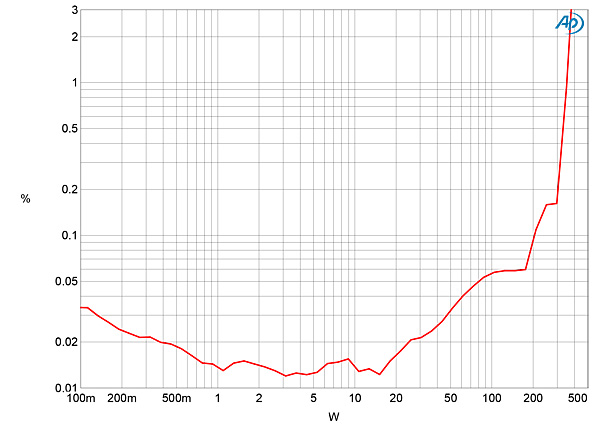
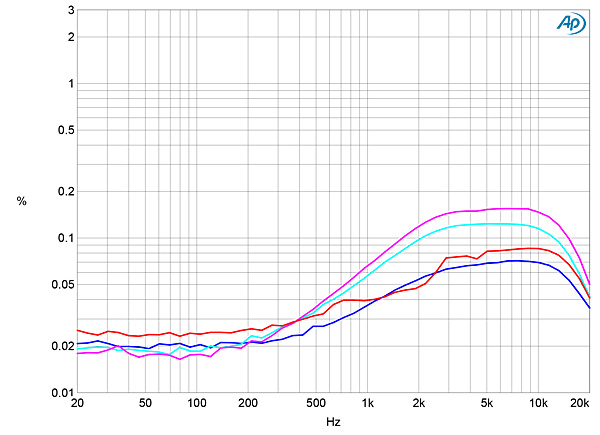
 With both channels driven, the SU-R1000 exceeded its specified maximum power into 8 ohms of 150Wpc (21.76dBW), delivering 190Wpc at 1% THD+noise (22.8dBW, fig.6). Into 4 ohms, the Technics clipped at 355Wpc (22.5dBW, fig.7), which is still higher than the specified power into that load. I didn't test clipping power into 2 ohms, as the amplifier isn't specified into that load. The distortion is low at low powers, so I examined how the THD+N varied with frequency at 20V, which is equivalent to 50W into 8 ohms and 100W into 4 ohms. The results are shown in fig.8. The distortion is very similar into both impedances, at 0.03%. It does rise in the top two octaves, however—more into 4 ohms (cyan and magenta traces) than into 8 ohms (blue and red traces).


 The Technics SU-R1000 offered excellent measured performance from its line inputs.
Digital Input Measurements: I looked at the Technics SU-R1000's digital-input performance using its TosLink input, then repeated some of the tests with the USB input. To avoid damaging the power amplifier stage with high-level digital data, I primarily examined the digital inputs' behavior at the headphone output, which mutes the loudspeaker output. The SU-R1000's optical and coaxial S/PDIF inputs locked to data sampled up to 192kHz. Apple's Audio-MIDI utility revealed that the USB inputs accepted 16-, 24-, and 32-bit integer data sampled at rates up to 768kHz. Apple's USB Prober utility identified the Technics as "Technics USB Audio" from "Panasonic Corporation" and confirmed that the USB port operated in the optimal isochronous asynchronous mode.
The Technics SU-R1000's digital inputs all preserved absolute polarity. With the volume control set to its maximum, a 1kHz digital signal at –30dBFS resulted in a level at the preamplifier output of 441.4mV, at the headphone output of 2.918V, and at the loudspeaker outputs of 13.44V. The latter voltage is 9.2dB below the amplifier's measured clipping voltage into 8 ohms. It appears, therefore, that the digital inputs have around 21dB of excess gain. Fortunately, the SU-R1000 has a 20dB input attenuator setting that can be activated for both analog and digital inputs.
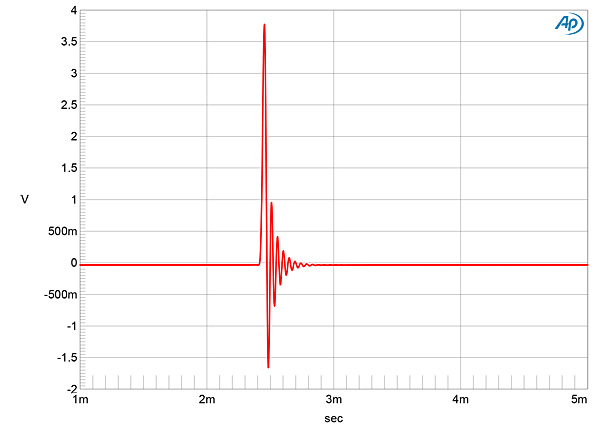
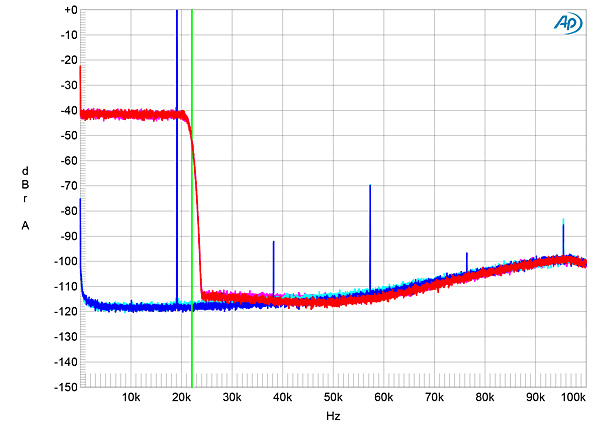
The impulse response with 44.1kHz data and MQA decoding turned off (fig.12) indicates that the reconstruction filter is a conventional linear-phase type, with time-symmetrical ringing on either side of the single sample at 0dBFS. Turning on MQA resulted in a short, minimum-phase impulse response (fig.13); this is the filter applied by the MQA decoder to non-MQA data. With 44.1kHz-sampled white noise (fig.14, red and magenta traces), the linear-phase filter's response rolled off sharply above 20kHz, reaching full stop-band suppression at 24kHz, just above half the sample rate (vertical green line, footnote 1). The aliased image at 25kHz of a 19.1kHz tone at 0dBFS (blue and cyan traces) is completely suppressed, and the highest-level distortion harmonic of the 19.1kHz tone lay at –70dB (0.03%). With the MQA decoder active, white noise rolled off slowly above the audioband, and a large number of aliased images of a 19.1kHz tone were visible both in and above the audioband. Reducing the level of the 19.1kHz tone by 3dB eliminated most of these images (fig.15).
The Technics SU-R1000 offered excellent measured performance from its line inputs.
Digital Input Measurements: I looked at the Technics SU-R1000's digital-input performance using its TosLink input, then repeated some of the tests with the USB input. To avoid damaging the power amplifier stage with high-level digital data, I primarily examined the digital inputs' behavior at the headphone output, which mutes the loudspeaker output. The SU-R1000's optical and coaxial S/PDIF inputs locked to data sampled up to 192kHz. Apple's Audio-MIDI utility revealed that the USB inputs accepted 16-, 24-, and 32-bit integer data sampled at rates up to 768kHz. Apple's USB Prober utility identified the Technics as "Technics USB Audio" from "Panasonic Corporation" and confirmed that the USB port operated in the optimal isochronous asynchronous mode.
The Technics SU-R1000's digital inputs all preserved absolute polarity. With the volume control set to its maximum, a 1kHz digital signal at –30dBFS resulted in a level at the preamplifier output of 441.4mV, at the headphone output of 2.918V, and at the loudspeaker outputs of 13.44V. The latter voltage is 9.2dB below the amplifier's measured clipping voltage into 8 ohms. It appears, therefore, that the digital inputs have around 21dB of excess gain. Fortunately, the SU-R1000 has a 20dB input attenuator setting that can be activated for both analog and digital inputs.
The impulse response with 44.1kHz data and MQA decoding turned off (fig.12) indicates that the reconstruction filter is a conventional linear-phase type, with time-symmetrical ringing on either side of the single sample at 0dBFS. Turning on MQA resulted in a short, minimum-phase impulse response (fig.13); this is the filter applied by the MQA decoder to non-MQA data. With 44.1kHz-sampled white noise (fig.14, red and magenta traces), the linear-phase filter's response rolled off sharply above 20kHz, reaching full stop-band suppression at 24kHz, just above half the sample rate (vertical green line, footnote 1). The aliased image at 25kHz of a 19.1kHz tone at 0dBFS (blue and cyan traces) is completely suppressed, and the highest-level distortion harmonic of the 19.1kHz tone lay at –70dB (0.03%). With the MQA decoder active, white noise rolled off slowly above the audioband, and a large number of aliased images of a 19.1kHz tone were visible both in and above the audioband. Reducing the level of the 19.1kHz tone by 3dB eliminated most of these images (fig.15).


 To examine the ultimate resolution of the SU-R1000's digital inputs, I disabled the 20dB attenuation, set the volume control to its maximum, and examined the spectrum at the headphone output with a dithered 1kHz tone at –90dBFS with 16- and 24-bit data (fig.17).



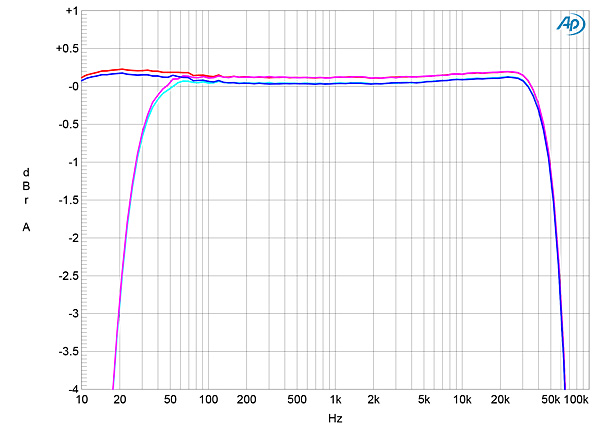
 I didn't test the Intelligent Phono EQ, but even without it the SU-R1000's RIAA correction (fig.23) was extraordinarily accurate—one of the best I have ever measured—with superb channel matching. The switchable subsonic filter (cyan and magenta traces) rolled off the response by 3dB at 20Hz. The MM phono input's unweighted, wideband S/N ratio, measured with the input shorted to ground, was a very good 67.2dB (average of both channels) referred to an input signal of 1kHz at 5mV. Restricting the measurement bandwidth to 22Hz–22kHz increased the ratio to 75dB, while switching an A-weighting filter into circuit increased the ratio to 84.6dB. The balanced MC input's ratios were around 20dB lower due to this input's higher gain.
Footnote 1: My continued thanks to MBL's Jürgen Reis for suggesting this test to me.
Fig.1 Technics SU-R1000, volume control set to maximum, frequency response at 2.83V into: simulated loudspeaker load (gray), 8 ohms (left channel blue, right red) 4 ohms (left cyan, right magenta), 2 ohms (green) (1dB/vertical div.).
Fig.2 Technics SU-R1000, volume control set to –20dB, frequency response at 2.83V into simulated loudspeaker load (red) and 8 ohms (blue) with LAPC bypassed, and into simulated loudspeaker load (gray) and 8 ohms (green) with LAPC activated (0.5dB/vertical div.).
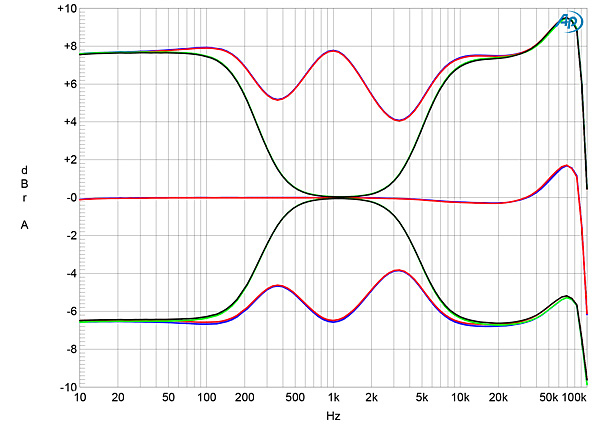
The peak at 70kHz with 8 ohms in fig.1 correlates with the slight overshoot with the Technics's reproduction of a 10kHz squarewave's leading edges into that load (fig.3). There is also some ringing and a slight overshoot with the waveform's trailing edges, both of which will be due to the antialiasing filter of the amplifier's A/D converter. There are three tone controls: bass, midrange, and treble. These offered a maximum boost of 7.8dB and a maximum cut of 6.3dB (fig.3, blue and red traces). The gray and green traces were taken with the midrange control operating but set to "0." You can see that this control covers the region between 300Hz and 3kHz.
Fig.3 Technics SU-R1000, small-signal 10kHz squarewave into 8 ohms.
Channel separation was excellent, at >100dB in both directions below 2.5kHz and still 67dB at the top of the audioband. Without the auxiliary low-pass filter, 316mV of ultrasonic noise was present at the loudspeaker outputs. With the filter, the Technics's unweighted, wideband signal/noise ratio, taken with the unbalanced line inputs shorted to ground but the volume control set to its maximum, was 48.2dB ref. 2.83V into 8 ohms in both channels. (Note that the filter is not designed to remove all ultrasonic noise.) This ratio improved to 71dB when the measurement bandwidth was restricted to the audioband, and to 74.4dB when A-weighted. Spuriae at the supply frequency of 60Hz and its harmonics were absent in the amplifier's output, but the spectrum of the random noise background varied with the setting of the volume control. The magenta and red traces in fig.5 were taken with the volume control set to the maximum. Reducing the volume to "–20.0" lowered the levels of the random noise at higher frequencies in both channels (cyan and blue traces). However, even at the maximum volume control setting the noise is relatively low in level.
Fig.4 Technics SU-R1000, frequency response at 2.83V into 8 ohms with treble, midrange, and bass controls set to their maximum and minimum and set to "0" (left channel blue, right red), and with midrange set to "0" ((left green, right gray, 2dB/vertical div.)
Fig.5 Technics SU-R1000, spectrum of 1kHz sinewave, DC–1kHz, at 1W into 8 ohms, volume control set to maximum (left channel magenta, right red) and to –20dB (left cyan, right blue; linear frequency scale).
Fig.6 Technics SU-R1000, distortion (%) vs 1kHz continuous output power into 8 ohms.
Fig.7 Technics SU-R1000, distortion (%) vs 1kHz continuous output power into 4 ohms.
Fig.8 Technics SU-R1000, THD+N (%) vs frequency at 20V into: 8 ohms (left channel blue, right red), 4 ohms (left cyan, right magenta).
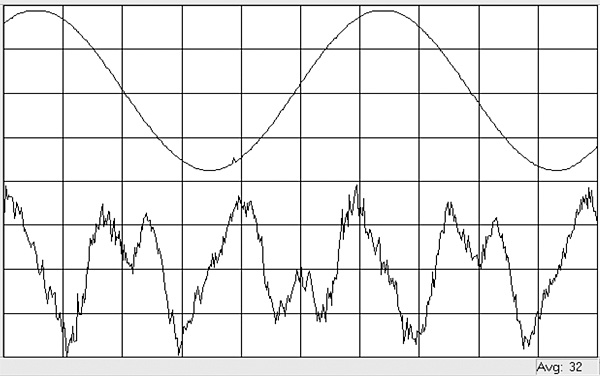
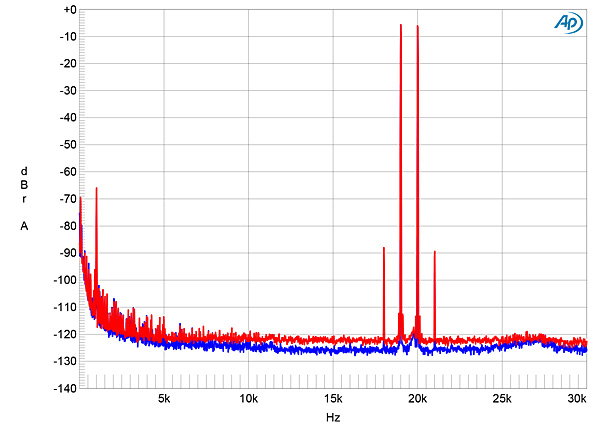
The distortion was predominantly the third harmonic (fig.9), but at low and moderate powers it lay below the analog noisefloor. The third harmonic can just be seen at –89dB (0.003%) when the Technics drove a 50Hz tone at 100Wpc into 4 ohms (fig.10) with the volume control set to –12dB. I got somewhat different results in the two channels when the SU-R1000 drove an equal mix of 19 and 20kHz tones at 50W peak into 8 ohms (fig.11). The second-order difference product at 1kHz is very low in both channels, at close to –110dB (0.0003%), but more high-order products are present in the right channel (red trace) than the left (blue). I repeated this test with different signal and speaker cables and with the analyzer input channels swapped but got the same result each time. It is fair to note that other than those at 17kHz, 18kHz, 21kHz, and 22kHz, all the intermodulation products lay at or below –84dB (0.006%) in both channels.
Fig.9 Technics SU-R1000, 1kHz waveform at 50W into 8 ohms, 0.052% THD+N (top); distortion and noise waveform with fundamental notched out (bottom, not to scale).
Fig.10 Technics SU-R1000, spectrum of 50Hz sinewave, DC–1kHz, at 100W into 4 ohms (left channel blue, right red; linear frequency scale).
Fig.11 Technics SU-R1000, HF intermodulation spectrum, DC–30kHz, 19+20kHz at 50W peak into 8 ohms (left channel blue, right red; linear frequency scale).
Fig.12 Technics SU-R1000, digital inputs, MQA decoding switched off, impulse response (one sample at 0dBFS, 44.1kHz sampling, 4ms time window).
Fig.13 Technics SU-R1000, digital inputs, MQA decoding switched on, impulse response (one sample at 0dBFS, 44.1kHz sampling, 4ms time window).
Fig.14 Technics SU-R1000, digital inputs, MQA decoding switched off, wideband spectrum of white noise at –4dBFS (left channel red, right magenta) and 19.1kHz tone at 0dBFS (left blue, right cyan), with data sampled at 44.1kHz (20dB/vertical div.).
Fig.15 Technics SU-R1000, digital inputs, MQA decoding switched on, wideband spectrum of white noise at –4dBFS (left channel red, right magenta) and 19.1kHz tone at –3dBFS (left blue, right cyan), with data sampled at 44.1kHz (20dB/vertical div.).
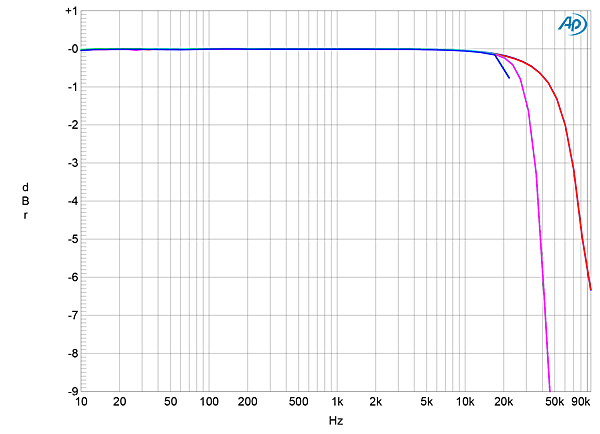
The digital-input frequency response with the MQA decoder active was flat in the audioband then rolled off relatively gently above half of each sample rate (fig.16). The levels of the two channels were perfectly matched.
Fig.16 Technics SU-R1000, digital inputs, MQA decoding switched on, frequency response at –12dBFS into 100k ohms with data sampled at: 44.1kHz (left channel green, right gray), 96kHz (left channel cyan, right magenta), 192kHz (left blue, right red) (1dB/vertical div.).
Fig.17 Technics SU-R1000, digital inputs, no input attenuation and volume control set to maximum, spectrum with noise and spuriae of dithered 1kHz tone at –90dBFS with: 16-bit data (left channel cyan, right magenta), 24-bit data (left blue, right red) (20dB/vertical div.).
With 24-bit data, the noisefloor dropped by 30dB at low and middle frequencies, which implies that the SU-R1000 offers close to 21.5 bits of resolution. However, the headphone output will be well into clipping at levels typical of music recordings, so I reran this test with the 20dB attenuator in-circuit and the volume control set to –5dB. (This is just below the setting where the headphone output clipped with full-scale signals.) The increase in bit depth now lowers the noisefloor by around 9dB at low and middle frequencies (fig.18), which suggests that in practical use the SU-R1000's digital inputs will give between 17 and 18 bits of resolution. (The same calculation using the preclipping voltage at the loudspeaker outputs gives a resolution of about 18 bits.)
Fig.18 Technics SU-R1000, digital inputs, 20dB attenuation active and volume control set to "–5.0," spectrum with noise and spuriae of dithered 1kHz tone at –90dBFS with: 16-bit data (left channel cyan, right magenta), 24-bit data (left blue, right red) (20dB/vertical div.).
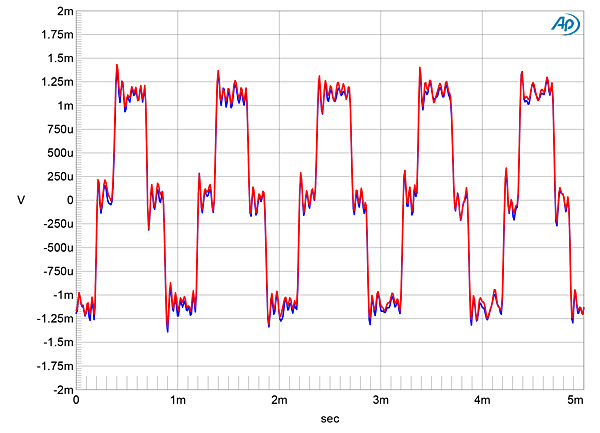
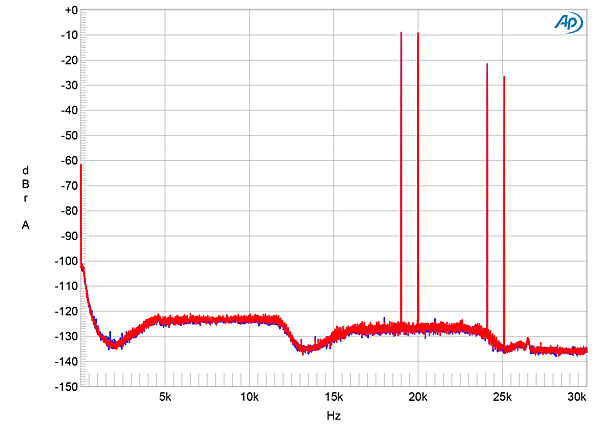
With undithered data representing a tone at exactly –90.31dBFS (fig.19), the three DC voltage levels described by the data were well resolved. With undithered, 24-bit data (fig.20), the result was a relatively clean sinewave. Intermodulation distortion via the Technics amplifier's digital inputs with the MQA filter active was extremely low in both channels. Though the expected aliasing products were present, I could eliminate those in the audioband by reducing the level of the mix of 19kHz and 20kHz tones by 3dB (fig.21).
Fig.19 Technics SU-R1000, digital inputs, waveform of undithered 1kHz sinewave at –90.31dBFS, 16-bit data (left channel blue, right red).
Fig.20 Technics SU-R1000, digital inputs, waveform of undithered 1kHz sinewave at –90.31dBFS, 24-bit data (left channel blue, right red).
Fig.21 Technics SU-R1000, digital inputs, MQA decoding switched on, HF intermodulation spectrum, DC–30kHz, 19+20kHz at –3dBFS peak (left channel blue, right red; linear frequency scale).
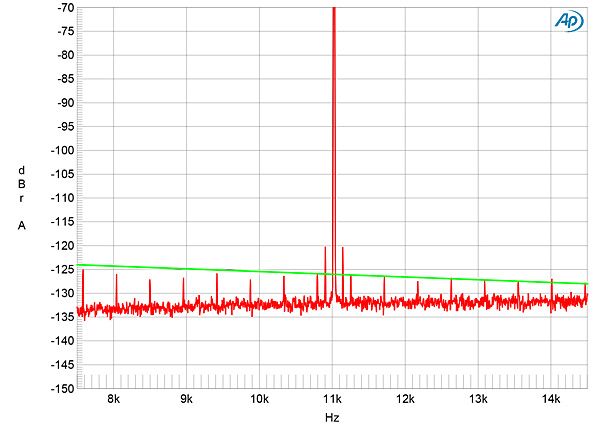
I tested the SU-R1000 for its rejection of word-clock jitter via its TosLink and USB input using 16- and 24-bit J-Test data sampled at 44.1kHz. All the odd-order harmonics of the 16-bit J-Test signal's LSB-level, low-frequency squarewave were close to the correct levels (fig.22, sloping green line), though a pair of sidebands at ±120Hz can be seen surrounding the spectral spike that represents the high-level tone at one-quarter of the 44.1kHz sample rate.
Fig.22 Technics SU-R1000, digital inputs, high-resolution jitter spectrum of analog output signal, 11.025kHz at –6dBFS, sampled at 44.1kHz with LSB toggled at 229Hz: 16-bit data (left channel blue, right red). Center frequency of trace, 11.025kHz; frequency range, ±3.5kHz.
Phono Input Measurements: Turning to the SU-R1000's balanced and single-ended phono inputs, I followed the manual's advice, connecting a separate ground wire from the terminal on the amplifier's chassis to the ground of the Audio Precision analyzer. I primarily examined the phono inputs' behavior at the headphone output, again to avoid damaging the amplifier's output stages with high-level signals. The Technics's phono inputs all preserved absolute polarity.
The phono inputs can operate at full level or have their sensitivity reduced by 3dB, 6dB, or 9dB. Without the attenuation, the balanced phono input, which is only compatible with moving coil cartridges, has a maximum gain of 72.6dB at the preamplifier outputs, 89.1dB at the headphone outputs, and 102.3dB at the speaker outputs. The single-ended phono input, set to moving magnet, offered maximum gains of 56.0dB, 72.5dB, and 85.7dB, respectively. The balanced phono input had an input impedance of 112 ohms across the audioband; set to MM, the single-ended phono input's impedance was 44k ohms at 20Hz and 1kHz, falling to 35k ohms at 20kHz.
Fig.23 Technics SU-R1000, phono input, response with RIAA correction into 100k ohms (left channel blue, right red) and with subsonic filter (left cyan, right magenta.) (0.5dB/vertical div.).
The overload margins of the Technics phono inputs, measured with no input attenuation and with the volume control set to –30dB to avoid clipping the headphone output, were at least 15.3dB ref. 1kHz at 5mV, MM, and 17.5dB ref. 1kHz at 500µV, balanced MC, from 20Hz to 20kHz. The phono stage's distortion was very low: The only harmonic visible above the noisefloor was the second, at just –90dB (0.003%, not shown). High-order intermodulation distortion with an equal mix of 19kHz and 20kHz tones at a peak input level equivalent to 1kHz at 10mV, was very low in level (fig.24), though the second-order difference product at 1kHz lay at –66dB (0.05%).
Fig.24 Technics SU-R1000, MM phono input, HF intermodulation spectrum, DC–30kHz, 19+20kHz at 100mV peak input (left channel blue, right red; linear frequency scale).
As with the Technics SU-R1000's line-level analog inputs, this amplifier's digital and phono inputs offered excellent measured performance.—John Atkinson
Footnote 1: My continued thanks to MBL's Jürgen Reis for suggesting this test to me.