Oddly for an amplifier—especially one that digitizes its analog inputs—the SU-R1000 comes with an LP, which is used to measure and implement the Crosstalk Canceller and Response Optimizer. Crosstalk Canceller "measures the crosstalk characteristic of the installed cartridge by using the crosstalk measuring signal recorded on the calibration record," states the website. "It then performs reverse-correction using the built-in DSP to achieve significant improvement of the crosstalk characteristic."
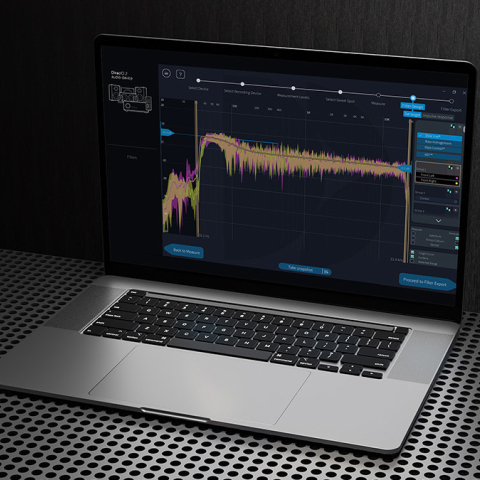
"Response Optimizer," the site continued, "measures the frequency characteristics of the installed pickup cartridge by using a TSP (Time Stretched Pulse) signal recorded on the bundled calibration record and corrects ... the effect of impedance matching between the pickup cartridge and the phono equalizer to reveal the true sound quality of the cartridge."
"The disc measures gain and phase response over 400 points across the entire audible frequency band," Balzuweit said. "This improves transparency, imaging, and depth." Crosstalk Canceller and Response Optimizer can be turned on or off using the unit's stocky, brushed aluminum remote, permitting easy before-and-after comparisons.
The basics
The SU-R1000's knobs and front panel are formed from 10mm aluminum; the side and top panels are made of 6mm alumite-treated aluminum plates. As already noted, steel plates divide the top and bottom sections and the left and right channels; the plates act as reinforcement to make the chassis more rigid and resist vibrations. Visually, the SU-R1000 resembles Technics products from the mid-1990s: lots of silver brushed aluminum. A large volume knob and a large viewing window, the latter exposing those familiar Technics VU meters. A finger-friendly power button is stationed top left, followed by a power indicator light, a quarter-inch headphone jack, that volume knob, a small (but visible) source display, an input selector knob, the meters, an LAPC indicator, and a remote-control signal sensor. The SU-R1000 is not a streaming DAC; it has no Ethernet or WiFi. What it does have is two pairs of brass speaker terminals that can be turned on or off independently, balanced (XLR) and unbalanced (RCA) analog inputs, and RCA connectors for pre out, main in, rec in, and rec out. There's an output for recording and another for driving a subwoofer. On the digital side of things, there are two USB inputs (labeled PC1 and PC2), and two each of S/PDIF RCA and TosLink digital inputs. The remote control controls pretty much everything on the SU-R1000.
Setup
The SU-R1000 is not a streaming DAC; it has no Ethernet or WiFi. What it does have is two pairs of brass speaker terminals that can be turned on or off independently, balanced (XLR) and unbalanced (RCA) analog inputs, and RCA connectors for pre out, main in, rec in, and rec out. There's an output for recording and another for driving a subwoofer. On the digital side of things, there are two USB inputs (labeled PC1 and PC2), and two each of S/PDIF RCA and TosLink digital inputs. The remote control controls pretty much everything on the SU-R1000.
Setup
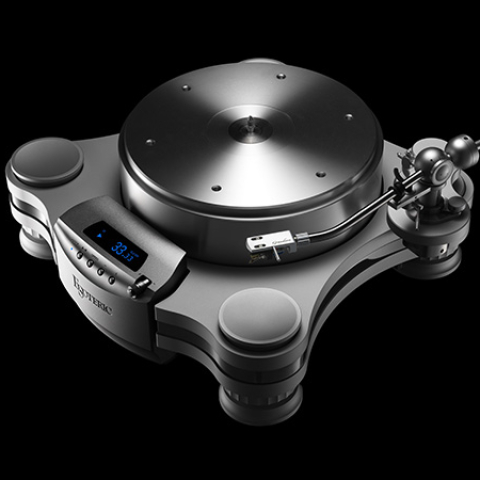
I introduced the Technics SU-R1000 to my system using a 2m run of AudioQuest Robin Hood speaker cables mated first to the DeVore Fidelity O/96, then to the Klipsch Forte IV, and Canton 7K loudspeakers. My Thorens TD 124/Jelco 350S 9" tonearm/Clearaudio Concept MC cart/Sculpture A Mini Nano Step Up came into play, and streaming files from Roon/Tidal via laptop, the latter using a Furutech 2M USB digital cable. I used the Ayre EX-8 2.0 integrated amp (100Wpc into 8 ohms, 170Wpc into 4 ohms) for comparison. Before playing music, I set up LAPC and Intelligent Phono EQ using the enclosed calibration disc, paying close attention to the user manual and remote functions. The manual's descriptions are complex, but implementing its procedures is simple. As you engage the calibration disc and remote, the system emits a series of test tones over a period of minutes. The display screen updates the amp's progress, from "Measuring" to "Completed."
The Technics's SU-R1000 is a complicated product. I endlessly queried Frank Balzuweit and Bill Voss, pored over the company's white paper and website—which, though not without PR-speak, is helpful. Perhaps the most instructive thing—and what mattered most—was listening to the SU-R1000 in my reference system.
The sound of something new
Before playing music, I set up LAPC and Intelligent Phono EQ using the enclosed calibration disc, paying close attention to the user manual and remote functions. The manual's descriptions are complex, but implementing its procedures is simple. As you engage the calibration disc and remote, the system emits a series of test tones over a period of minutes. The display screen updates the amp's progress, from "Measuring" to "Completed."
The Technics's SU-R1000 is a complicated product. I endlessly queried Frank Balzuweit and Bill Voss, pored over the company's white paper and website—which, though not without PR-speak, is helpful. Perhaps the most instructive thing—and what mattered most—was listening to the SU-R1000 in my reference system.
The sound of something new
The Technics SU-R1000 is not a class-D amp "on steroids," and it's not a solid-state amp emulating a tube amp. It's unlike any amplifier I've heard. The SU-R1000 achieved levels of performance and sound quality I've not previously heard from any amplifier, except in terms of tone and texture, where the E.A.T. E-Glo I and my Shindo separates bested it. The Technics SU-R1000 is a breakthrough product.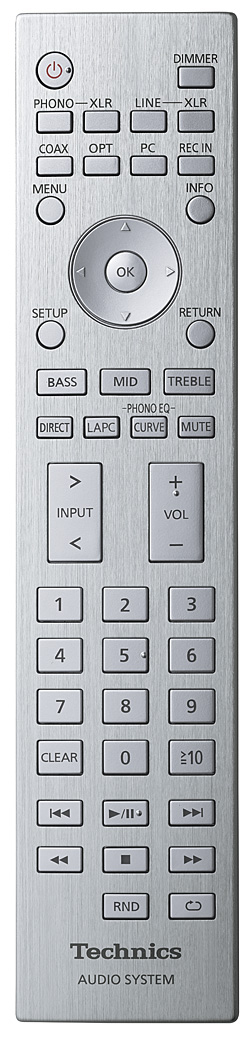 What first impressed me was the SU-R1000's immaculate separation of musical lines. Each instrument and vocal occupied a clear, spatially dense, immediate, dynamic, coherent, physical presence. Enabled by the amp's bottomless noisefloor, it was easy to closely follow melodic lines within (eg) complex orchestral material. I heard so deeply into recordings that I wanted to do nothing more than ride the soundwaves wherever they took me. I found myself thinking while playing familiar recordings: "That's on this record?" The SU-R1000 framed recordings, especially vintage vinyl, in their unique, historic time, to a greater extent than any amplifier I'd previously heard. Through the Technics, the constituent ingredients of each recording were shaped and arranged in seemingly perfect order as though snapped to attention by an invisible hand. The SU-R1000 may be technically complex, but its sound was simple, whole, and true with exceptional transparency, flow, and imaging.
The SU-R1000 did display a sonic signature. Its basic sound, whether the source was digital or analog, was warm and a touch rich. Its character was like a drink before a meal: settling the stomach and palette, framing and infusing what's to come. Occasionally though, during vinyl playback, a guitar figure or cymbal crash would exhibit a slight, processed-sounding sheen.
The SU-R1000 is heavy on subtleties that add up to something that's not subtle at all. LAPC and Intelligent Phono EQ, for example, created different flavors of playback depending on the recordings and ancillary gear. LAPC added bass weight, presence, and smoothness. The Response Optimizer improved spaciousness and 3D soundstage depth; the Technics was almost tubelike in that regard. I kept LAPC and Response Optimizer engaged much of the time and found it added a silky touch and a bit of depth to recordings. The amp sounded a bit more powerful, open, dynamic, and transparent without these effects, but at a loss of soundstage width and depth, physicality of imaging, and sweetness. On the other hand, I heard little difference when I turned off the Crosstalk Canceller, perhaps owing to the very capable Clearaudio Concept cartridge.
The Technics unfurled Frank Sinatra's "It Gets Lonely Early" from September of My Years (16/44.1 FLAC, Reprise/ Tidal) in nearly psychedelic sensations, the enveloping strings and brass line beautifully imaged and present. The song's left channel harp hung high above the system and to the far left, like some sprite watching overhead. It was spooky and a little startling.
What first impressed me was the SU-R1000's immaculate separation of musical lines. Each instrument and vocal occupied a clear, spatially dense, immediate, dynamic, coherent, physical presence. Enabled by the amp's bottomless noisefloor, it was easy to closely follow melodic lines within (eg) complex orchestral material. I heard so deeply into recordings that I wanted to do nothing more than ride the soundwaves wherever they took me. I found myself thinking while playing familiar recordings: "That's on this record?" The SU-R1000 framed recordings, especially vintage vinyl, in their unique, historic time, to a greater extent than any amplifier I'd previously heard. Through the Technics, the constituent ingredients of each recording were shaped and arranged in seemingly perfect order as though snapped to attention by an invisible hand. The SU-R1000 may be technically complex, but its sound was simple, whole, and true with exceptional transparency, flow, and imaging.
The SU-R1000 did display a sonic signature. Its basic sound, whether the source was digital or analog, was warm and a touch rich. Its character was like a drink before a meal: settling the stomach and palette, framing and infusing what's to come. Occasionally though, during vinyl playback, a guitar figure or cymbal crash would exhibit a slight, processed-sounding sheen.
The SU-R1000 is heavy on subtleties that add up to something that's not subtle at all. LAPC and Intelligent Phono EQ, for example, created different flavors of playback depending on the recordings and ancillary gear. LAPC added bass weight, presence, and smoothness. The Response Optimizer improved spaciousness and 3D soundstage depth; the Technics was almost tubelike in that regard. I kept LAPC and Response Optimizer engaged much of the time and found it added a silky touch and a bit of depth to recordings. The amp sounded a bit more powerful, open, dynamic, and transparent without these effects, but at a loss of soundstage width and depth, physicality of imaging, and sweetness. On the other hand, I heard little difference when I turned off the Crosstalk Canceller, perhaps owing to the very capable Clearaudio Concept cartridge.
The Technics unfurled Frank Sinatra's "It Gets Lonely Early" from September of My Years (16/44.1 FLAC, Reprise/ Tidal) in nearly psychedelic sensations, the enveloping strings and brass line beautifully imaged and present. The song's left channel harp hung high above the system and to the far left, like some sprite watching overhead. It was spooky and a little startling.
 I played "Every Hungry Woman" from The Allman Brothers Band's 1970 debut (16/44.1 FLAC, Atlantic/ ATCO/Qobuz): Butch Trucks playing four-to-the-bar on his hi-hat during the intro and the overdubbed conga and the two separate bass drums of Trucks and Jai Johanny Johanson (aka Jaimoe) colliding and clamoring for sonic supremacy, presented as I'd never heard before. Greg Allman's vocal and organ were surrounded by air. The band snarled and bucked. This was time travel with the SU-R1000 as time machine.
 Whether the source is vinyl or digital, on Pat Metheny and Charlie Haden's "Message to a Friend" from Beyond the Missouri Sky (16/44.1 FLAC Verve/Tidal), the lower register of Haden's bass can sound like a fat, overhanging blob. The Technics reproduced Haden's bass with exacting clarity, good tone, and sinewy texture—coherent, clean, and well defined throughout the instrument's range.
Steely Dan's "Godwhacker," from 2003's Everything Must Go (16/44.1 MQA, Reprise/Tidal), filled my listening room with a large-scale performance, physically imaged through the SU-R1000. Forceful drums, electric bass, guitars, and especially vocals were spacious, airy, detailed, and so very clear. It was as if Donald Fagen and his background vocalists were singing to me, alone.
Whether the source is vinyl or digital, on Pat Metheny and Charlie Haden's "Message to a Friend" from Beyond the Missouri Sky (16/44.1 FLAC Verve/Tidal), the lower register of Haden's bass can sound like a fat, overhanging blob. The Technics reproduced Haden's bass with exacting clarity, good tone, and sinewy texture—coherent, clean, and well defined throughout the instrument's range.
Steely Dan's "Godwhacker," from 2003's Everything Must Go (16/44.1 MQA, Reprise/Tidal), filled my listening room with a large-scale performance, physically imaged through the SU-R1000. Forceful drums, electric bass, guitars, and especially vocals were spacious, airy, detailed, and so very clear. It was as if Donald Fagen and his background vocalists were singing to me, alone.
 Vinyl was just as robust and 3D through the SU-R1000, from the deep organ pedal bass of Jimmy Smith's Softly as a Summer Breeze (LP, Blue Note BLP 4200), to the intensified articulation and spaciousness of drums and tenor on Wayne Shorter's Night Dreamer (45RPM LP, Music Matters MMBST-84173). On Kirill Kondrashin's recording of Kalinnikov's Symphony No.1 in G Minor with the Moscow Philharmonic Symphony Orchestra (LP, EMI ASD 2720), the orchestra was presented with stirring speed and scale.
I was eager to hear how well the Klipsch Forte IVs (99dB specified sensitivity, 8 ohms impedance) would mate with the Technics integrated. LAPC benefited the Klipsch's midrange and treble horns, making them sound silkier and even more refined—the IVs were already a big improvement in this respect over the IIIs—while retaining the speaker's power, speed, and excellent dynamics. More information isn't always good: The IVs plus LAPC revealed previously unheard surface noise on my copy of Kalinnikov's Symphony No.1, but the music flowed in large swaths of microdynamics-rich sound, the orchestra undulating with power and speed. Again, the SU-R1000 made the most of vinyl and loudspeakers.
Next, I tried the Canton 7K loudspeakers. The Kalinnikov disc sounded great. The sense of spaciousness and separation was increased on Wayne Shorter's tenor on Night Dreamer. The SU-R1000's advanced phono features even seemed to smooth out pops and ticks on a 1955, red-vinyl copy of Cal Tjader's Tjader Plays Mambo (LP, Fantasy 3-221). On the other hand, Smith's Softly as a Summer Breeze sounded more transparent and alive without LAPC engaged.
Vinyl was just as robust and 3D through the SU-R1000, from the deep organ pedal bass of Jimmy Smith's Softly as a Summer Breeze (LP, Blue Note BLP 4200), to the intensified articulation and spaciousness of drums and tenor on Wayne Shorter's Night Dreamer (45RPM LP, Music Matters MMBST-84173). On Kirill Kondrashin's recording of Kalinnikov's Symphony No.1 in G Minor with the Moscow Philharmonic Symphony Orchestra (LP, EMI ASD 2720), the orchestra was presented with stirring speed and scale.
I was eager to hear how well the Klipsch Forte IVs (99dB specified sensitivity, 8 ohms impedance) would mate with the Technics integrated. LAPC benefited the Klipsch's midrange and treble horns, making them sound silkier and even more refined—the IVs were already a big improvement in this respect over the IIIs—while retaining the speaker's power, speed, and excellent dynamics. More information isn't always good: The IVs plus LAPC revealed previously unheard surface noise on my copy of Kalinnikov's Symphony No.1, but the music flowed in large swaths of microdynamics-rich sound, the orchestra undulating with power and speed. Again, the SU-R1000 made the most of vinyl and loudspeakers.
Next, I tried the Canton 7K loudspeakers. The Kalinnikov disc sounded great. The sense of spaciousness and separation was increased on Wayne Shorter's tenor on Night Dreamer. The SU-R1000's advanced phono features even seemed to smooth out pops and ticks on a 1955, red-vinyl copy of Cal Tjader's Tjader Plays Mambo (LP, Fantasy 3-221). On the other hand, Smith's Softly as a Summer Breeze sounded more transparent and alive without LAPC engaged.
 I replaced the Technics integrated with the Ayre EX-8 2.0—my favorite integrated until I heard the SU-R1000—for a quick comparison. The Colorado kit did not fail to please. Streaming the Allman Brothers and Steely Dan from Roon, the Ayre boogied hard, sounding upfront and immediate. My air guitars were set in motion. But I missed the delicious refinement, spaciousness, clarity, transparency, and super detail of the SU-R1000. I'm an analog guy, but these digital technologies simply worked.
Conclusion
I replaced the Technics integrated with the Ayre EX-8 2.0—my favorite integrated until I heard the SU-R1000—for a quick comparison. The Colorado kit did not fail to please. Streaming the Allman Brothers and Steely Dan from Roon, the Ayre boogied hard, sounding upfront and immediate. My air guitars were set in motion. But I missed the delicious refinement, spaciousness, clarity, transparency, and super detail of the SU-R1000. I'm an analog guy, but these digital technologies simply worked.
Conclusion
The Technics SU-R1000 Digital Integrated Amplifier provides nearly everything I could hope for in a contemporary integrated amplifier. It reproduces vinyl and digital files with high levels of transparency, dimensionality, spaciousness, and dynamics. Its various modern technologies actually, obviously work, allowing me to achieve the highest levels of realism I've heard in my circa-1865 listening space.
The Technics does not equal my reference Shindo amplification in the areas where they—the Shindo components—excel: tonal and timbral verisimilitude. Nothing else I've tried does; that's why they're still my reference. But the Technics was superior in every other way. The SU-R1000 is a technological breakthrough and a remarkable integrated amplifier.
The SU-R1000's knobs and front panel are formed from 10mm aluminum; the side and top panels are made of 6mm alumite-treated aluminum plates. As already noted, steel plates divide the top and bottom sections and the left and right channels; the plates act as reinforcement to make the chassis more rigid and resist vibrations. Visually, the SU-R1000 resembles Technics products from the mid-1990s: lots of silver brushed aluminum. A large volume knob and a large viewing window, the latter exposing those familiar Technics VU meters. A finger-friendly power button is stationed top left, followed by a power indicator light, a quarter-inch headphone jack, that volume knob, a small (but visible) source display, an input selector knob, the meters, an LAPC indicator, and a remote-control signal sensor.
The SU-R1000 is not a streaming DAC; it has no Ethernet or WiFi. What it does have is two pairs of brass speaker terminals that can be turned on or off independently, balanced (XLR) and unbalanced (RCA) analog inputs, and RCA connectors for pre out, main in, rec in, and rec out. There's an output for recording and another for driving a subwoofer. On the digital side of things, there are two USB inputs (labeled PC1 and PC2), and two each of S/PDIF RCA and TosLink digital inputs. The remote control controls pretty much everything on the SU-R1000.
I introduced the Technics SU-R1000 to my system using a 2m run of AudioQuest Robin Hood speaker cables mated first to the DeVore Fidelity O/96, then to the Klipsch Forte IV, and Canton 7K loudspeakers. My Thorens TD 124/Jelco 350S 9" tonearm/Clearaudio Concept MC cart/Sculpture A Mini Nano Step Up came into play, and streaming files from Roon/Tidal via laptop, the latter using a Furutech 2M USB digital cable. I used the Ayre EX-8 2.0 integrated amp (100Wpc into 8 ohms, 170Wpc into 4 ohms) for comparison.
Before playing music, I set up LAPC and Intelligent Phono EQ using the enclosed calibration disc, paying close attention to the user manual and remote functions. The manual's descriptions are complex, but implementing its procedures is simple. As you engage the calibration disc and remote, the system emits a series of test tones over a period of minutes. The display screen updates the amp's progress, from "Measuring" to "Completed."
The Technics's SU-R1000 is a complicated product. I endlessly queried Frank Balzuweit and Bill Voss, pored over the company's white paper and website—which, though not without PR-speak, is helpful. Perhaps the most instructive thing—and what mattered most—was listening to the SU-R1000 in my reference system.
The Technics SU-R1000 is not a class-D amp "on steroids," and it's not a solid-state amp emulating a tube amp. It's unlike any amplifier I've heard. The SU-R1000 achieved levels of performance and sound quality I've not previously heard from any amplifier, except in terms of tone and texture, where the E.A.T. E-Glo I and my Shindo separates bested it. The Technics SU-R1000 is a breakthrough product.
What first impressed me was the SU-R1000's immaculate separation of musical lines. Each instrument and vocal occupied a clear, spatially dense, immediate, dynamic, coherent, physical presence. Enabled by the amp's bottomless noisefloor, it was easy to closely follow melodic lines within (eg) complex orchestral material. I heard so deeply into recordings that I wanted to do nothing more than ride the soundwaves wherever they took me. I found myself thinking while playing familiar recordings: "That's on this record?" The SU-R1000 framed recordings, especially vintage vinyl, in their unique, historic time, to a greater extent than any amplifier I'd previously heard. Through the Technics, the constituent ingredients of each recording were shaped and arranged in seemingly perfect order as though snapped to attention by an invisible hand. The SU-R1000 may be technically complex, but its sound was simple, whole, and true with exceptional transparency, flow, and imaging.
The SU-R1000 did display a sonic signature. Its basic sound, whether the source was digital or analog, was warm and a touch rich. Its character was like a drink before a meal: settling the stomach and palette, framing and infusing what's to come. Occasionally though, during vinyl playback, a guitar figure or cymbal crash would exhibit a slight, processed-sounding sheen.
The SU-R1000 is heavy on subtleties that add up to something that's not subtle at all. LAPC and Intelligent Phono EQ, for example, created different flavors of playback depending on the recordings and ancillary gear. LAPC added bass weight, presence, and smoothness. The Response Optimizer improved spaciousness and 3D soundstage depth; the Technics was almost tubelike in that regard. I kept LAPC and Response Optimizer engaged much of the time and found it added a silky touch and a bit of depth to recordings. The amp sounded a bit more powerful, open, dynamic, and transparent without these effects, but at a loss of soundstage width and depth, physicality of imaging, and sweetness. On the other hand, I heard little difference when I turned off the Crosstalk Canceller, perhaps owing to the very capable Clearaudio Concept cartridge.
I played "Every Hungry Woman" from The Allman Brothers Band's 1970 debut (16/44.1 FLAC, Atlantic/ ATCO/Qobuz): Butch Trucks playing four-to-the-bar on his hi-hat during the intro and the overdubbed conga and the two separate bass drums of Trucks and Jai Johanny Johanson (aka Jaimoe) colliding and clamoring for sonic supremacy, presented as I'd never heard before. Greg Allman's vocal and organ were surrounded by air. The band snarled and bucked. This was time travel with the SU-R1000 as time machine.
Whether the source is vinyl or digital, on Pat Metheny and Charlie Haden's "Message to a Friend" from Beyond the Missouri Sky (16/44.1 FLAC Verve/Tidal), the lower register of Haden's bass can sound like a fat, overhanging blob. The Technics reproduced Haden's bass with exacting clarity, good tone, and sinewy texture—coherent, clean, and well defined throughout the instrument's range.
Vinyl was just as robust and 3D through the SU-R1000, from the deep organ pedal bass of Jimmy Smith's Softly as a Summer Breeze (LP, Blue Note BLP 4200), to the intensified articulation and spaciousness of drums and tenor on Wayne Shorter's Night Dreamer (45RPM LP, Music Matters MMBST-84173). On Kirill Kondrashin's recording of Kalinnikov's Symphony No.1 in G Minor with the Moscow Philharmonic Symphony Orchestra (LP, EMI ASD 2720), the orchestra was presented with stirring speed and scale.
I was eager to hear how well the Klipsch Forte IVs (99dB specified sensitivity, 8 ohms impedance) would mate with the Technics integrated. LAPC benefited the Klipsch's midrange and treble horns, making them sound silkier and even more refined—the IVs were already a big improvement in this respect over the IIIs—while retaining the speaker's power, speed, and excellent dynamics. More information isn't always good: The IVs plus LAPC revealed previously unheard surface noise on my copy of Kalinnikov's Symphony No.1, but the music flowed in large swaths of microdynamics-rich sound, the orchestra undulating with power and speed. Again, the SU-R1000 made the most of vinyl and loudspeakers.
I replaced the Technics integrated with the Ayre EX-8 2.0—my favorite integrated until I heard the SU-R1000—for a quick comparison. The Colorado kit did not fail to please. Streaming the Allman Brothers and Steely Dan from Roon, the Ayre boogied hard, sounding upfront and immediate. My air guitars were set in motion. But I missed the delicious refinement, spaciousness, clarity, transparency, and super detail of the SU-R1000. I'm an analog guy, but these digital technologies simply worked.
ConclusionThe Technics SU-R1000 Digital Integrated Amplifier provides nearly everything I could hope for in a contemporary integrated amplifier. It reproduces vinyl and digital files with high levels of transparency, dimensionality, spaciousness, and dynamics. Its various modern technologies actually, obviously work, allowing me to achieve the highest levels of realism I've heard in my circa-1865 listening space.