Sidebar 3: Measurements
I performed a full set of measurements using Audio Precision SYS2722 system (see www.ap.com and the January 2008 "As We See It"). As the Theta Prometheus has a switching output stage that produces ultrasonic noise that would overload the Audio Precision's input circuitry, I carried out most of the tests using, ahead of the analyzer, an Audio Precision AUX-0025 passive low-pass filter. Usually, before measuring an amplifier, I run it for an hour at one-third power into 8 ohms—the most thermally stressful condition for a class-B output stage. But as the Prometheus has a class-D output, that preconditioning is irrelevant. Even so, I subjected serial number 050085 to this test to ensure that it had settled into its long-term operating condition. (The chassis was slightly warm at the end of this period.)
The Theta's voltage gain into 8 ohms was the same, at 27.7dB, for its balanced and unbalanced inputs, and the amplifier preserved absolute polarity for both inputs (ie, was non-inverting); its XLR jack is wired with pin 2 hot. At 90k ohms, the balanced input impedance was very close to the specification of 94k ohms at low and middle frequencies, though it dropped to 84k ohms at the top of the audioband. The unbalanced input impedance was half these values.
The Prometheus's output impedance was 0.11 ohm at 20Hz and 1kHz, rising slightly at 20kHz to 0.13 ohm. The modification of the Theta's frequency response, which results from the interaction between this impedance and the impedance of our standard simulated loudspeaker, was very low (fig.1, gray trace). This graph also shows that the ultrasonic rolloff doesn't change significantly as the load impedance drops to 2 ohms, with a –3dB point of 40kHz. However, a small peak at 77kHz becomes a little more pronounced into higher impedances. Without the Audio Precision low-pass filter, the Theta's reproduction of a 1kHz squarewave into 8 ohms is obscured by switching noise (fig.2). With the filter, however, this noise is eliminated (fig.3), and a 10kHz squarewave can be seen to have a small degree of overshoot that correlates with the slight response peak at 77kHz (fig.4). Commendably, however, no ringing is associated with this overshoot.
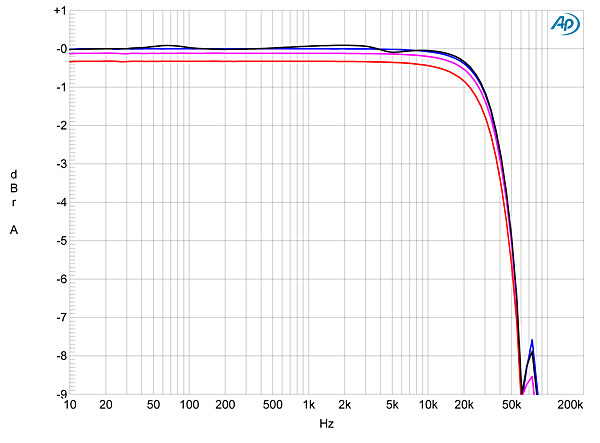


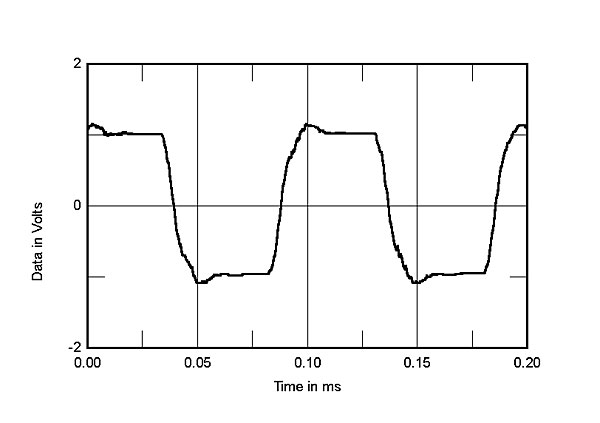
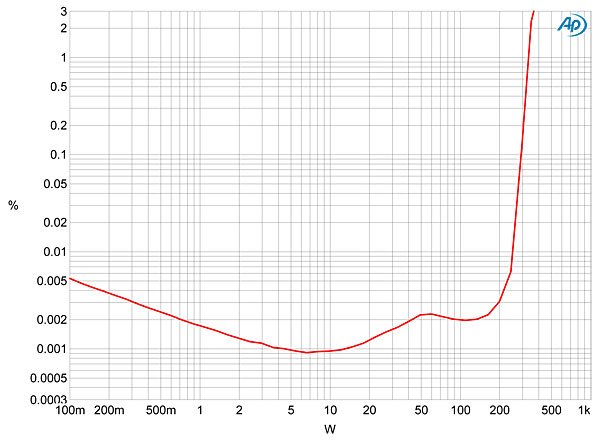
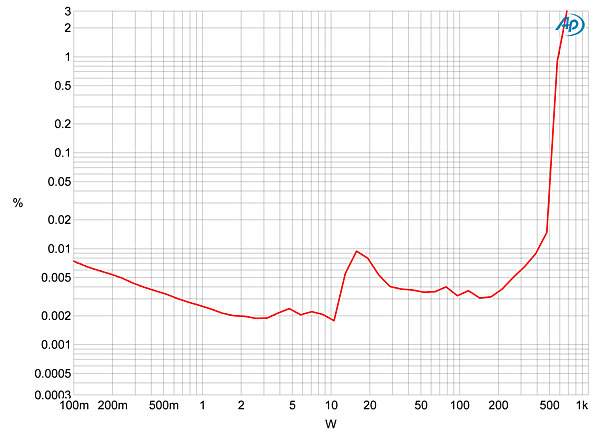
 Fig.6 reveals that the Theta's distortion starts to rise above the audioband noise floor just below 10W into 8 ohms, but remains below a low 0.003% until the start of actual waveform clipping. Even then, the rise in THD is relatively gradual, and the amplifier doesn't reach 1% THD until 320W (25.05dBW), just over 1dB higher than the rated 250W into 8 ohms (24dBW). Into 4 ohms (fig.7), the Prometheus delivers 600W (24.8dBW) at 1% THD rather than the specified 500W, though this graph shows that the amplifier is less linear below clipping into this load. Into 2 ohms (fig.8), the Theta still easily exceeded its specified maximum power of 850W, delivering 980W (23.9dBW). (The wall voltage was 123.4V during these tests.)

 Into 8 ohms at moderately high power, the distortion is predominantly third harmonic (fig.10), though at just 0.0024%, this, again, will be of only academic interest. As the current increases, the third harmonic is joined by even-order harmonics (fig.11), but these are all at lower levels. Intermodulation distortion is also very low, even at high powers into 4 ohms (fig.12), with the 1kHz difference product associated with tones at 19 and 20kHz lying 100dB below the peak signal level (0.001%).


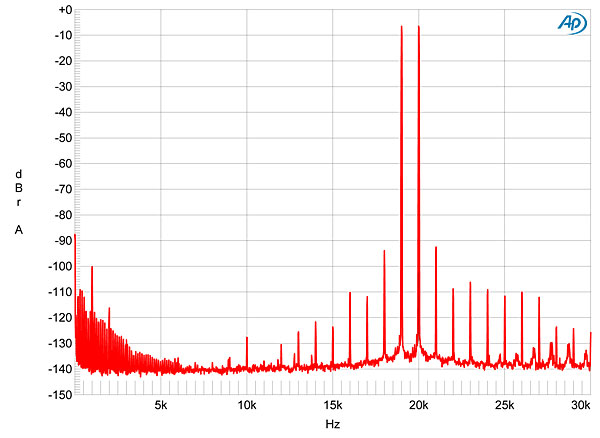
Fig.1 Theta Prometheus, frequency response at 2.83V into: simulated loudspeaker load (gray), 8 ohms (blue), 4 ohms (magenta), 2 ohms (red) (1dB/vertical div.).
Fig.2 Theta Prometheus, small-signal 1kHz squarewave into 8 ohms without AP LPF.
Fig.3 Theta Prometheus, small-signal 1kHz squarewave into 8 ohms with AP LPF.
Without the Audio Precision low-pass filter, and with the Theta's input short-circuited, there was 321mV of ultrasonic noise present in the amplifier's output, with a center frequency of 453kHz. With the filter, the unweighted, wideband signal/noise ratio, ref. 2.83V into 8 ohms, was 76.3dB, this improving to an excellent 94dB when the measurement bandwidth was restricted to the audioband—and improving even more, to 95.6dB, when the measurement was A-weighted. With the amplifier passing signal, however, there was the noise level depended to some extent on the output power. Fig.5, taken with the auxiliary AP low-pass filter (LPF) (as were all the subsequent graphs), shows low-frequency spectra of the Theta's output while it reproduced a 1kHz tone at 1W (blue trace), then 100W (red), into 8 ohms. Spuriae are present at the AC-related frequency of 60Hz and its odd harmonics, which increase with the power level. This behavior usually suggests magnetic interference from the amplifier's power transformer, but as the spuriae are still all at or below –110dB (0.0003%) at the high power, their presence will be of only academic interest.
Fig.4 Theta Prometheus, small-signal 10kHz squarewave into 8 ohms with AP LPF.
Fig.5 Theta Prometheus, spectrum of 1kHz sinewave, DC–1kHz, at 1W (blue) and 100W (red) into 8 ohms (linear frequency scale).
Fig.6 Theta Prometheus, distortion (%) vs 1kHz continuous output power into 8 ohms.
Fig.7 Theta Prometheus, distortion (%) vs 1kHz continuous output power into 4 ohms.
Fig.8 Theta Prometheus, distortion (%) vs 1kHz continuous output power into 2 ohms.
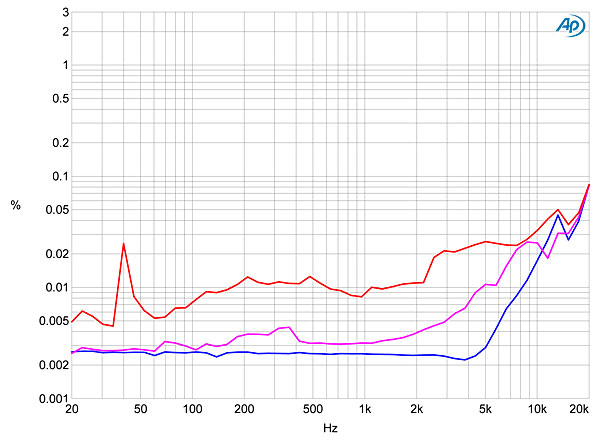
To be sure I was looking at distortion rather than noise, I examined how the percentage of THD+noise changed with frequency at a fairly high level, 20V, equivalent to 50W into 8 ohms. Fig.9 reveals that the Prometheus is still very linear below the mid-treble region at this level, even into 4 ohms (magenta trace). However, the distortion rises considerably into 2 ohms (red), and in the top two octaves into the higher impedances, though it still remains below 0.08%.
Fig.9 Theta Prometheus, THD+N (%) vs frequency at 20V into: 8 ohms (blue), 4 ohms (magenta), 2 ohms (red).
Fig.10 Theta Prometheus, 1kHz waveform at 60W into 8 ohms, 0.0024% THD+N (top); distortion and noise waveform with fundamental notched out (bottom, not to scale).
Fig.11 Theta Prometheus, spectrum of 50Hz sinewave, DC–1kHz, at 200W into 4 ohms (linear frequency scale).
Fig.12 Theta Prometheus, HF intermodulation spectrum, DC–30kHz, 19+20kHz at 200W peak into 4 ohms (linear frequency scale).
The measured performance of Theta Digital's Prometheus is superb, even for an amplifier with a class-D output stage. It's similar to that of the more expensive MBL Corona C15 monoblock, which I reviewed in June 2014, which shouldn't be surprising—the MBL also uses a custom version of the Hypex output module designed by the very talented Bruno Putzeys.—John Atkinson