Sidebar 3: Measurements
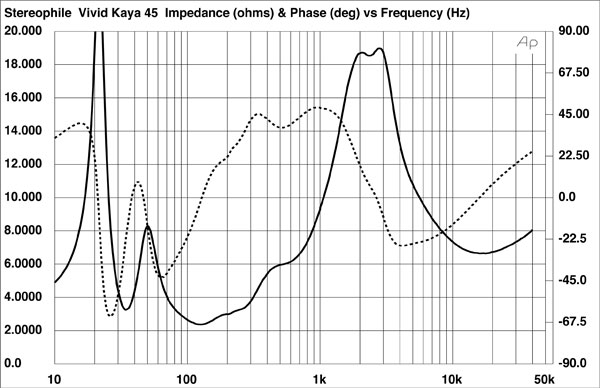
Using DRA Labs' MLSSA system, I measured the Vivid Kaya 45's farfield behavior with a calibrated DPA 4006 microphone and its nearfield responses with an Earthworks QTC-40 mike. The Kaya 45's specified sensitivity is 87dB/2.83V/m. To my surprise, my estimated sensitivity was higher, at 90dB(B)/2.83V/m. (I say "surprise" because my experience is that measured sensitivities are often lower than the specified figures, but they're rarely significantly higher.) The Kaya 45's nominal impedance is specified as 6 ohms, with a minimum magnitude of 2.8 ohms. The solid trace in fig.1 shows that the impedance drops below 6 ohms throughout the upper bass and lower midrange, with a minimum value of 2.4 ohms at 122Hz. The electrical phase angle (dashed trace) is often high, and the combinations of –51° and 4.3 ohms at 30Hz and +41° and 3.65 ohms at 195Hz will be particularly demanding on amplifiers. The Kaya 45 should be partnered with amplifiers that are comfortable with 2 ohm loads.
 The ports on the Vivid's sidewalls are tuned to a low 35Hz, this indicated by the fact that the impedance-magnitude plot has a saddle centered on that frequency. The blue trace in fig.3 shows the nearfield response of the two woofers, and the minimum-motion notch, which is the frequency at which the back pressure from the port resonance holds the cones stationary, occurs as expected at 35Hz. The nearfield response of the ports (green trace) peaks between 25Hz and 60Hz, and its upper-frequency rolloff is clean. The woofers cross over to the midrange unit (red trace) at the specified 300Hz with symmetrical steep slopes. The black trace below 300Hz in fig.3 shows the sum of the Kaya 45's nearfield woofer and port outputs, taking into account acoustic phase and the different distance of each radiator from a nominal farfield microphone position. The usual peak in the upper bass in the output, which will be due to the nearfield measurement technique, is absent. This suggests the Vivid's bass alignment is tuned for articulation rather than absolute extension, the speaker relying on the usual room gain at low frequencies to give sufficient bass weight.
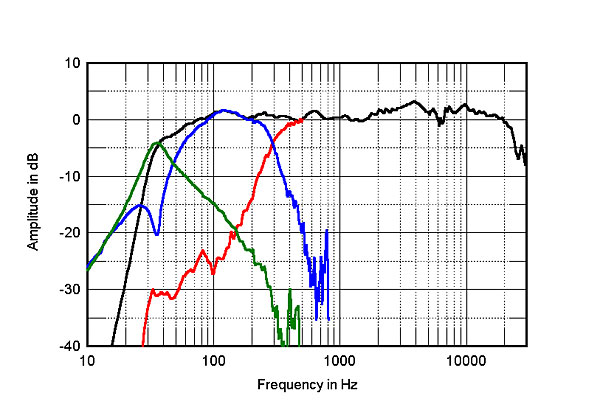
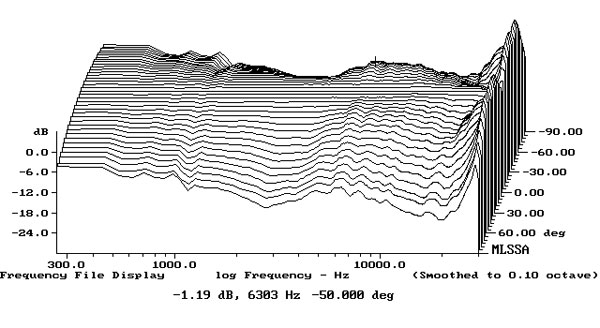
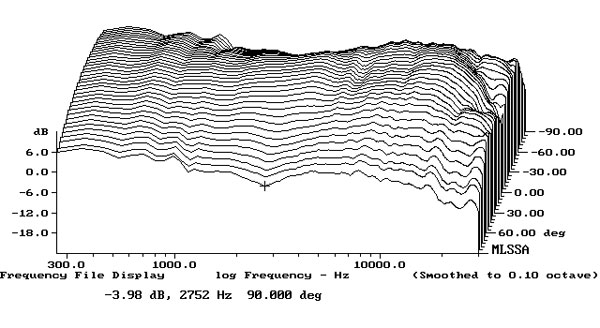
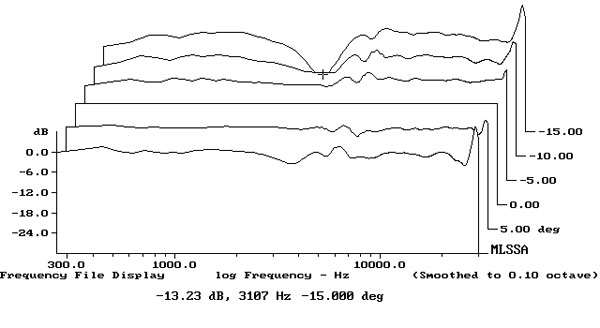
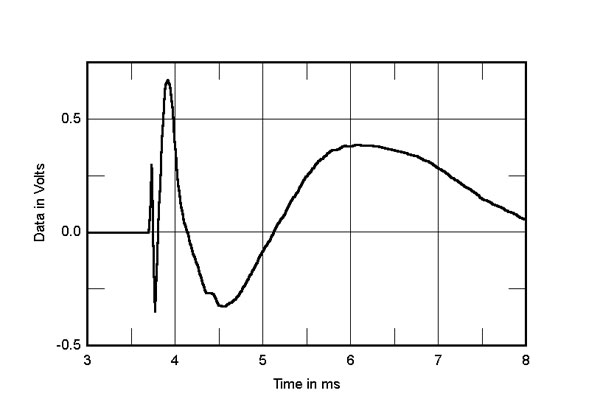
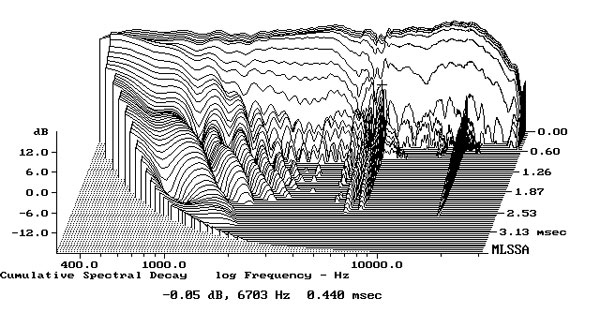
Fig.1 Vivid Kaya 45, electrical impedance (solid) and phase (dashed) (2 ohms/vertical div.).
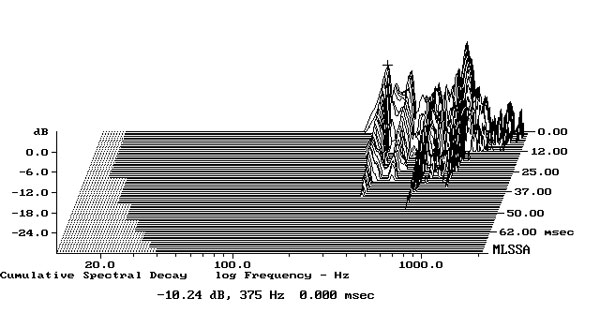
The gracefully curved enclosure seemed lively when I rapped it with my knuckles. When I investigated the enclosure's vibrational behavior with a plastic-tape accelerometer, I found resonant modes at 375Hz, 414Hz, and 777Hz on the front baffle (fig.2) and the sidewalls. This behavior is not too high in level, however, and, in combination with the modes' relatively high Q (Quality Factor), might not lead to audible coloration.
Fig.2 Vivid Kaya 45, cumulative spectral-decay plot calculated from output of accelerometer fastened to center of front baffle midway between the midrange unit and the woofers (MLS driving voltage to speaker, 4V; measurement bandwidth, 2kHz).
Fig.3 Vivid Kaya 45, anechoic response on tweeter axis at 50", averaged across 30° horizontal window and corrected for microphone response (black), with the nearfield responses of the midrange unit (red), woofers (blue), ports (green), and their complex sum (black) respectively plotted below 500Hz, 800Hz, 500Hz, and 300Hz.
The Kaya 45's farfield response, averaged across a 30° horizontal window centered on the tweeter axis, is shown as the black trace above 300Hz in fig.3. The balance is superbly even up to the presence region, where there is an excess of energy reaching +3dB at 4kHz. (This might have affected my sensitivity estimate.) However, the plot of the Kaya 45's horizontal dispersion, referenced to the response on the tweeter axis (fig.4), indicates that there is a lack of energy in this same region to the speaker's sides. In medium-sized and large rooms, this will tend to balance the on-axis excess, though the speaker might sound a touch bright in small rooms. The contour lines in this graph are otherwise even throughout the midrange and treble, implying stable stereo imaging. The apparent off-axis peaks above 20kHz in this graph are actually due to the tweeter's output rolling off faster on-axis than it does to the sides. This is shown in fig.5, which shows the actual off-axis responses rather than normalizing them to the on-axis output.
Fig.4 Vivid Kaya 45, lateral response family at 50", normalized to response on tweeter axis, from back to front: differences in response 90–5° off axis, reference response, differences in response 5–90° off axis.
Fig.4 Vivid Kaya 45, lateral response family at 50", from back to front: responses 90–5° off axis, response on tweeter axis, responses 5–90° off axis.
In the vertical plane (fig.6), a suckout develops in the crossover region 15° above the tweeter axis. The tweeter is 39" from the floor, and this suckout won't affect the Vivid's tonal balance for listeners with their ears level with or just below the tweeter.
Fig.6 Vivid Kaya 45, vertical response family at 50", normalized to response on tweeter axis, from back to front: differences in response 15–5° above axis, reference response, differences in response 5–10° below axis.
In the time domain, the Kaya 45's step response on the tweeter axis (fig.7) indicates that the tweeter, midrange unit, and woofers are all connected in positive acoustic polarity. The decay of the tweeter's step, which arrives first at the microphone, blends smoothly with the start of the midrange unit's step. The slight discontinuity at 4.4ms suggests that the optimal blend between the midrange unit's output and that of the twin woofers occurs just below the tweeter axis.
Fig.7 Vivid Kaya 45, step response on tweeter axis at 50" (5ms time window, 30kHz bandwidth).
The Vivid's cumulative spectral-decay plot (fig.8) is very clean overall. While two ridges of decayed energy can be seen in the mid-treble, which are presumably due to breakup modes in the midrange unit's metal cone, these are suppressed by the crossover. (As always with my CSD plots, ignore the small ridge just below 17kHz, which is due to interference from the computer monitor's line-scan frequency.)
Fig.8 Vivid Kaya 45, cumulative spectral-decay plot on tweeter axis at 50" (0.15ms risetime).
Overall, the Vivid Kaya 45 offers excellent measured performance.—John Atkinson