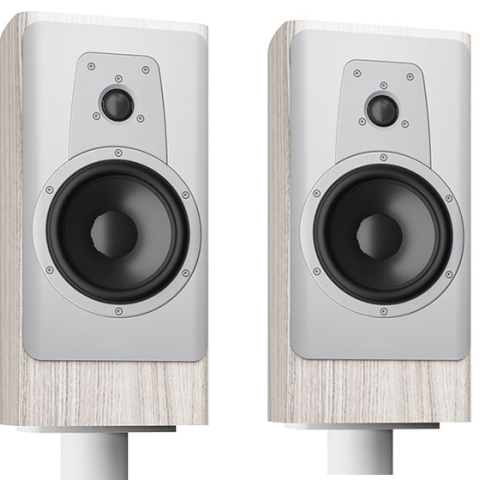
One can generalize from that to other female voices—and to male voices, too. The latter were endowed with appropriate body but without unnatural resonance. I was particularly struck by the massed male voices in a recent recording, with Hannu Lintu and the Finnish Radio Symphony Orchestra, of Sibelius's choral work Kullervo (SACD, Ondine ODE 1338-5). From the pictures in the recording's accompanying booklet, I estimate there are about 90 men in the combined Estonian National Male Choir and Polytech Choir—and no, I cannot distinguish them all individually by ear. However, the Kaya 45s did resolve them so that I was always aware that the work was being performed by a multiplicity of individual voices, yet with combined weight and power. The baritone soloist, Ville Rusanen, is recorded closer, as is appropriate, and sounded remarkably present, almost in the room, when I played the recording loud, the way I like this one. Even at those levels, the Kayas had no problems with the volume and dynamic range of the combined chorus and orchestra at these levels.
The Kaya passed another test with flying colors: The First Tears, from Eriks Eenvalds's The Doors of Heaven, performed by Ethan Sperry and the Portland State University Chamber Choir (CD, Naxos 8.579008). This mixed choir recording has become my standard for soundstaging and ensemble imaging, and while the Kayas presented the collective voices clearly and in a warm acoustic space, they also allowed me to attend to the tone and locations of individual voices.
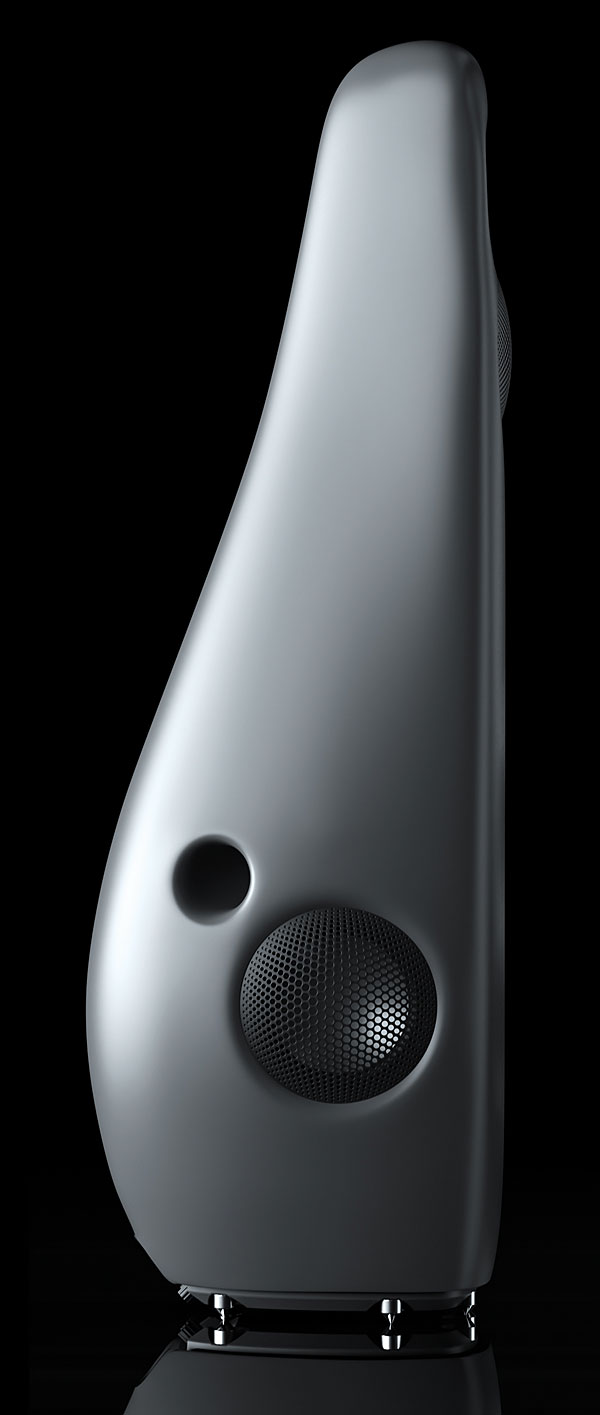 In general, the bass performance of the Kaya 45s was remarkable for their size. From a closely recorded Spanish guitar to pipe organ and large, dynamic ensembles, these relatively small floorstanders delivered respectable—and musical—bass. That's not to say a pair of 5" woofers per cabinet can push as much air as bigger or more drivers. What was wonderful about the Kaya 45s is that the quality and balance of the bass and upper bass in my altogether normal listening room was such that I lacked for nothing, except in direct comparison to bigger speakers (and Vivid makes those, too). With a classic recording of Mendelssohn's Organ Sonata in F, performed by Thomas Murray on the E. & G.G. Hook organ at Jamaica Plain (CD, Raven 3901), the detail and fullness were immensely satisfying. As the tones descend in the fourth movement, there was a slight attenuation of the lowest tones, but that did not affect the progression or impact of the music.
Especially noteworthy is my experience with a recent and wonderful recording, by Viktoria Mullova, Paavo Järvi, and the Estonian National Symphony Orchestra, of Arvo Pärt's Fratres (CD, Onyx ONYX4201). After violinist Mullova's brilliantly played solo introduction—reproduced by the Kayas with equal brilliance—the orchestra steps in with a thud, followed by a slow progression in the lower strings. With the Kayas, I could hear the hall during the solo, but I feel it when the orchestra enters. Getting that and the weight of the strings was unexpected from a couple of 5" drivers per channel.
The Kaya 45s feasted on Hugh Masakela's "Stimela (The Coal Train)," from Hope (SACD, Sheridan Square Records/Analogue Productions APJ 82020). With the right speakers, this is a powerful and exciting experience, but it requires the capacity to recreate a large and lively space that can barely contain all the performers and audience participants. Other versions of this recording, even in multichannel, never seem to achieve this effect, but with this stereo release, the Kaya 45s proved up to the task in a way that some bigger or more expensive speakers have not. I turned it up, and the Kayas delivered the crescendos, the contrasts, the buzz of the space (and electricity of the crowd), and the immediacy of Masakela's voice and trumpet.
The Kaya 45s played bigger than they appear. And not just because of bass. They recreated a deep and detailed soundstage—and a wide one. Lately, I've been enjoying the delightful and offbeat album Pure Imagination, by oboist Keve Wilson (CD, Composers Concordance COMCON002). It contains refreshing arrangements of Broadway and pop tunes, framing Wilson's skillful playing and honeyed tone with a small ensemble—piano, bass, etc.—that varies from track to track. The Kayas vividly recreated the recording's evidently modest space, making it seem like an extension of my room, stretching about 15' behind the fronts of the speakers.
I did most of my listening with the aforementioned Benchmark AHB2s, but I also spent time listening with other amps: the Hegel C53, the Parasound A31, and the Classé Sigma Mono. All had sufficient power, and each had subtle and ultimately unobtrusive distinctions. The Classé sounded much like the Benchmark, offering a lively and open upper midrange but with slightly less detail. The Parasound, too, presented slightly less detail. Those presentations may appeal to some listeners who do not share my fondness for the ruthless revelation the Kayas proved capable of.
With the Hegel, the Kayas sounded much as they did with Benchmarks. The Hegel or a single AHB2 in stereo would drive these speakers well in smaller rooms, or in systems that use a subwoofer.
In general, the bass performance of the Kaya 45s was remarkable for their size. From a closely recorded Spanish guitar to pipe organ and large, dynamic ensembles, these relatively small floorstanders delivered respectable—and musical—bass. That's not to say a pair of 5" woofers per cabinet can push as much air as bigger or more drivers. What was wonderful about the Kaya 45s is that the quality and balance of the bass and upper bass in my altogether normal listening room was such that I lacked for nothing, except in direct comparison to bigger speakers (and Vivid makes those, too). With a classic recording of Mendelssohn's Organ Sonata in F, performed by Thomas Murray on the E. & G.G. Hook organ at Jamaica Plain (CD, Raven 3901), the detail and fullness were immensely satisfying. As the tones descend in the fourth movement, there was a slight attenuation of the lowest tones, but that did not affect the progression or impact of the music.
Especially noteworthy is my experience with a recent and wonderful recording, by Viktoria Mullova, Paavo Järvi, and the Estonian National Symphony Orchestra, of Arvo Pärt's Fratres (CD, Onyx ONYX4201). After violinist Mullova's brilliantly played solo introduction—reproduced by the Kayas with equal brilliance—the orchestra steps in with a thud, followed by a slow progression in the lower strings. With the Kayas, I could hear the hall during the solo, but I feel it when the orchestra enters. Getting that and the weight of the strings was unexpected from a couple of 5" drivers per channel.
The Kaya 45s feasted on Hugh Masakela's "Stimela (The Coal Train)," from Hope (SACD, Sheridan Square Records/Analogue Productions APJ 82020). With the right speakers, this is a powerful and exciting experience, but it requires the capacity to recreate a large and lively space that can barely contain all the performers and audience participants. Other versions of this recording, even in multichannel, never seem to achieve this effect, but with this stereo release, the Kaya 45s proved up to the task in a way that some bigger or more expensive speakers have not. I turned it up, and the Kayas delivered the crescendos, the contrasts, the buzz of the space (and electricity of the crowd), and the immediacy of Masakela's voice and trumpet.
The Kaya 45s played bigger than they appear. And not just because of bass. They recreated a deep and detailed soundstage—and a wide one. Lately, I've been enjoying the delightful and offbeat album Pure Imagination, by oboist Keve Wilson (CD, Composers Concordance COMCON002). It contains refreshing arrangements of Broadway and pop tunes, framing Wilson's skillful playing and honeyed tone with a small ensemble—piano, bass, etc.—that varies from track to track. The Kayas vividly recreated the recording's evidently modest space, making it seem like an extension of my room, stretching about 15' behind the fronts of the speakers.
I did most of my listening with the aforementioned Benchmark AHB2s, but I also spent time listening with other amps: the Hegel C53, the Parasound A31, and the Classé Sigma Mono. All had sufficient power, and each had subtle and ultimately unobtrusive distinctions. The Classé sounded much like the Benchmark, offering a lively and open upper midrange but with slightly less detail. The Parasound, too, presented slightly less detail. Those presentations may appeal to some listeners who do not share my fondness for the ruthless revelation the Kayas proved capable of.
With the Hegel, the Kayas sounded much as they did with Benchmarks. The Hegel or a single AHB2 in stereo would drive these speakers well in smaller rooms, or in systems that use a subwoofer.
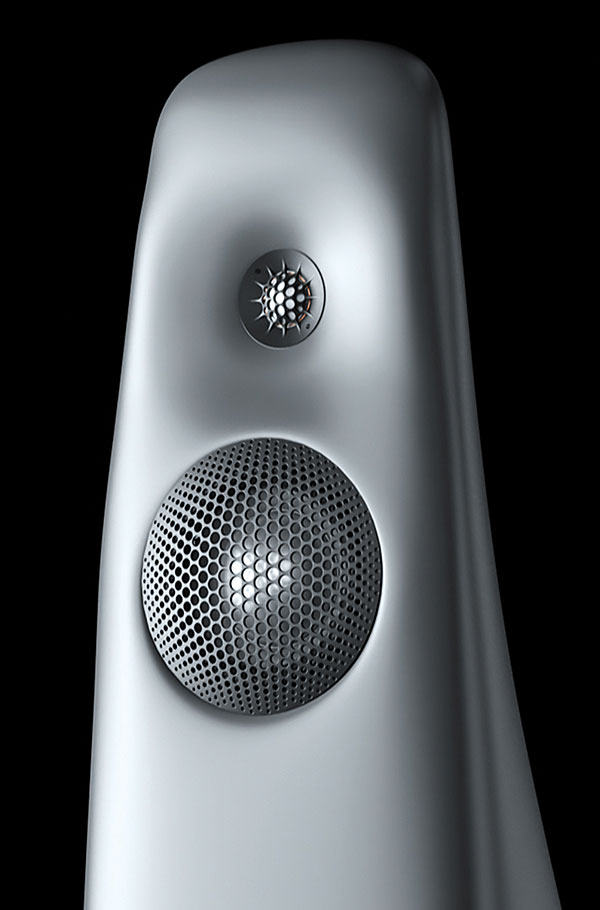 In the larger context of speakers I've recently reviewed, the Kaya 45s stood out. Compared to the bigger but less expensive GoldenEar Triton One.R, the Kayas were more transparent and resolving but didn't play as loud or go as deep in the bass. The Revel Performa F228Be had superior bass extension, while the Kayas disappeared more completely. The active Dutch & Dutch 8cs must be placed close to the front wall, and their soundstage presentation differs from that of a passive system placed well away from room boundaries. Each satisfied in its own way.
Summing up
In the larger context of speakers I've recently reviewed, the Kaya 45s stood out. Compared to the bigger but less expensive GoldenEar Triton One.R, the Kayas were more transparent and resolving but didn't play as loud or go as deep in the bass. The Revel Performa F228Be had superior bass extension, while the Kayas disappeared more completely. The active Dutch & Dutch 8cs must be placed close to the front wall, and their soundstage presentation differs from that of a passive system placed well away from room boundaries. Each satisfied in its own way.
Summing up
Vivid's Kaya 45 speakers exceeded the expectations raised by their heritage and impressive show previews. Sure, some speakers can play louder and go deeper, but one must pay one price or another for that privilege: larger size, higher cost, or less beauty. The Kayas sounded good from the moment they hit the carpet, and better after I toed them in toward the listening position. They never failed to please, with any musical source at any reasonable listening level. (Perhaps they really are Shmoos!) The Kaya 45s are among a handful of speakers that I will miss after they are gone. You should not miss auditioning them.
Footnote 1: Originally released on a Sheffield LP (S-13).
In general, the bass performance of the Kaya 45s was remarkable for their size. From a closely recorded Spanish guitar to pipe organ and large, dynamic ensembles, these relatively small floorstanders delivered respectable—and musical—bass. That's not to say a pair of 5" woofers per cabinet can push as much air as bigger or more drivers. What was wonderful about the Kaya 45s is that the quality and balance of the bass and upper bass in my altogether normal listening room was such that I lacked for nothing, except in direct comparison to bigger speakers (and Vivid makes those, too). With a classic recording of Mendelssohn's Organ Sonata in F, performed by Thomas Murray on the E. & G.G. Hook organ at Jamaica Plain (CD, Raven 3901), the detail and fullness were immensely satisfying. As the tones descend in the fourth movement, there was a slight attenuation of the lowest tones, but that did not affect the progression or impact of the music.
In the larger context of speakers I've recently reviewed, the Kaya 45s stood out. Compared to the bigger but less expensive GoldenEar Triton One.R, the Kayas were more transparent and resolving but didn't play as loud or go as deep in the bass. The Revel Performa F228Be had superior bass extension, while the Kayas disappeared more completely. The active Dutch & Dutch 8cs must be placed close to the front wall, and their soundstage presentation differs from that of a passive system placed well away from room boundaries. Each satisfied in its own way.
Vivid's Kaya 45 speakers exceeded the expectations raised by their heritage and impressive show previews. Sure, some speakers can play louder and go deeper, but one must pay one price or another for that privilege: larger size, higher cost, or less beauty. The Kayas sounded good from the moment they hit the carpet, and better after I toed them in toward the listening position. They never failed to please, with any musical source at any reasonable listening level. (Perhaps they really are Shmoos!) The Kaya 45s are among a handful of speakers that I will miss after they are gone. You should not miss auditioning them.
Footnote 1: Originally released on a Sheffield LP (S-13).