Sidebar 3: Measurements
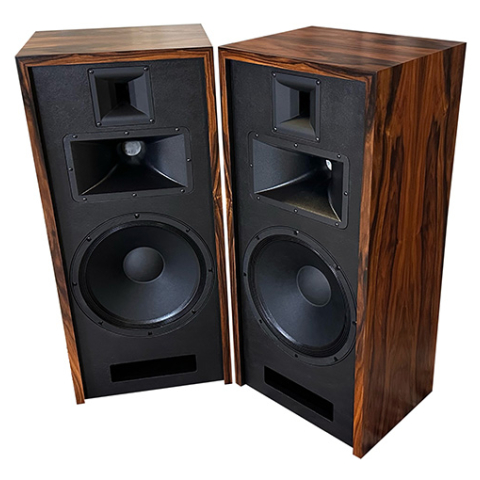
For logistical reasons, I measured a different sample of the Volti Audio Razz (serial number V1, 007) to those auditioned by Tom Gibbs. (There wasn't a grille supplied with this sample.) I measured the loudspeaker's farfield behavior with DRA Labs' MLSSA system and a calibrated DPA 4006 microphone. I used an Earthworks QTC-40 mike for the speaker's nearfield responses. I repeated some of the testing with Dayton Audio's OmniMic V2 and DATS V2 systems.
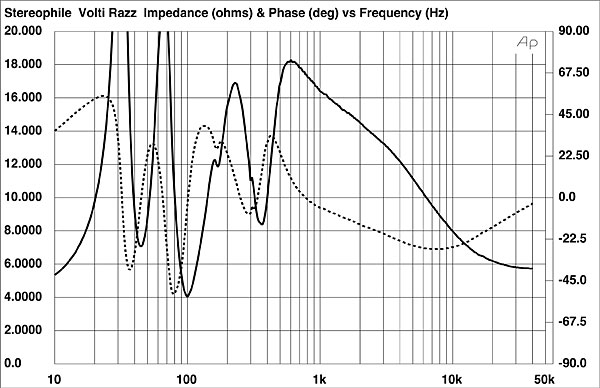
Volti specifies the Razz's sensitivity as "97dB." My estimate was 93dB(B)/2.83V/m—while this is lower than the specification, it is still much higher than average. Although the Razz's nominal impedance is specified as 6 ohms, the magnitude (fig.1, solid trace) rarely drops below 8 ohms. The average impedance is around 12 ohms, though there is a minimum value of 4.1 ohms at 100Hz. Though the electrical phase angle (dashed trace) is occasionally high, the magnitude is also high at the same frequencies, which ameliorates the Volti speaker's demand for current. There is an exception at 90Hz, however, when a magnitude of 5.5 ohms is coupled with a capacitive phase angle of –39°. The EPDR (equivalent peak dissipation resistance) calculated with the formula in a 1994 AES paper by Eric Benjamin, is generally 4 ohms or higher but it does drop to 2 ohms between 85Hz and 95Hz. Although Volti recommends using their 8 ohm output taps, tube amplifiers will probably work best with the Razz from their 4 ohm taps, as music can have high energy in the mid-bass region.
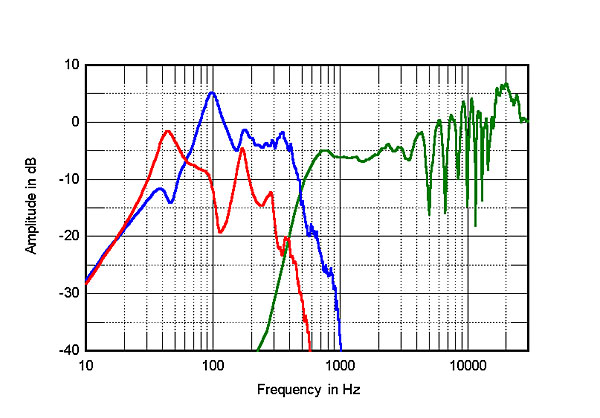 The woofer's output above 100Hz is relatively even, and the crossover frequency between the woofer and the horn-loaded midrange unit (fig.3, green trace) appears to be set at 500Hz, with symmetrical slopes that are close to third-order in nature. The output of the midrange unit is also even up to 3.5kHz, but above that frequency the Volti's output is both tilted up and marred by a series of sharply defined suckouts. Although it wasn't possible to drive the midrange unit and tweeter individually, I did investigate this behavior by blocking each drive-unit in turn while I measured the other. It appears that while the two upper-frequency drive-units cross over around 5.5kHz, either the crossover filters are slow-rolloff types or the designer has relied on the drivers' natural low- and high-pass behavior. The result is that there is significant overlap of their outputs between 3kHz and 13kHz. The suckouts are therefore due to the fact that the acoustic center of the horn-loaded midrange unit is several inches behind that of the tweeter. There is destructive interference at frequencies where this distance is equivalent to an odd number of half-wavelengths, the so-called comb filter effect.
The black trace below 300Hz in fig.4 shows the sum of the Razz's nearfield woofer and port outputs, taking into account acoustic phase and the different distance of each radiator from a nominal farfield microphone position. The apparent rising response below 500Hz will again be partly due to the nearfield measurement technique, but some of the rise is real, which I confirmed with a farfield measurement. The upper bass region is disturbed by a dip centered on 145Hz, and the Razz rolls off with the usual fourth-order reflex slope below 45Hz. This is a relatively high frequency for a large speaker, but there is always a tradeoff between low-frequency extension and sensitivity.
The woofer's output above 100Hz is relatively even, and the crossover frequency between the woofer and the horn-loaded midrange unit (fig.3, green trace) appears to be set at 500Hz, with symmetrical slopes that are close to third-order in nature. The output of the midrange unit is also even up to 3.5kHz, but above that frequency the Volti's output is both tilted up and marred by a series of sharply defined suckouts. Although it wasn't possible to drive the midrange unit and tweeter individually, I did investigate this behavior by blocking each drive-unit in turn while I measured the other. It appears that while the two upper-frequency drive-units cross over around 5.5kHz, either the crossover filters are slow-rolloff types or the designer has relied on the drivers' natural low- and high-pass behavior. The result is that there is significant overlap of their outputs between 3kHz and 13kHz. The suckouts are therefore due to the fact that the acoustic center of the horn-loaded midrange unit is several inches behind that of the tweeter. There is destructive interference at frequencies where this distance is equivalent to an odd number of half-wavelengths, the so-called comb filter effect.
The black trace below 300Hz in fig.4 shows the sum of the Razz's nearfield woofer and port outputs, taking into account acoustic phase and the different distance of each radiator from a nominal farfield microphone position. The apparent rising response below 500Hz will again be partly due to the nearfield measurement technique, but some of the rise is real, which I confirmed with a farfield measurement. The upper bass region is disturbed by a dip centered on 145Hz, and the Razz rolls off with the usual fourth-order reflex slope below 45Hz. This is a relatively high frequency for a large speaker, but there is always a tradeoff between low-frequency extension and sensitivity.
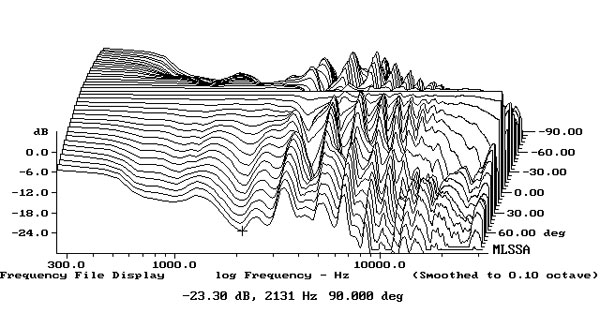
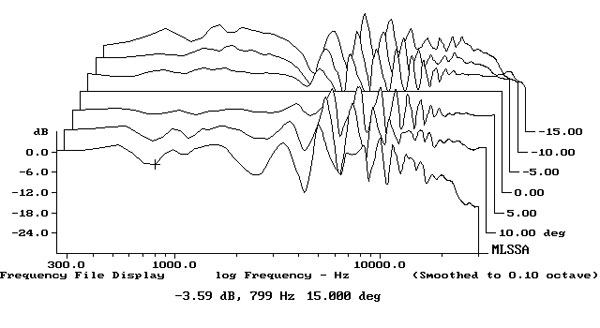
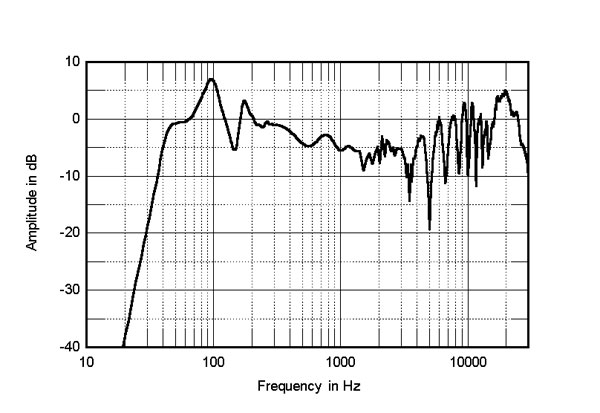 The Volti's farfield response, averaged across a 30° horizontal window centered on the tweeter axis, is shown as the black trace above 300Hz in fig.4. The response trend is relatively even between 500Hz and 3kHz, but above that frequency the rising response, disturbed by interference peaks and dips, is again evident. How audible the speaker's behavior in the top two audio octaves will be will depend on how directional it is. The plot of the Razz's dispersion in the horizontal plane, referenced to the response on the tweeter axis, is shown in fig.5. The apparent peaks to the speaker's sides are mostly due to the on-axis suckouts filling in to some extent, but this graph also shows that the Razz becomes very directional above 10kHz, which will work against the excess of energy on the tweeter axis. The horn-loaded midrange unit also becomes relatively directional in the low treble. In the vertical plane (fig.6), the Razz's tweeter-axis balance is maintained over a ±5° window. (The tweeter is 38" from the floor.)
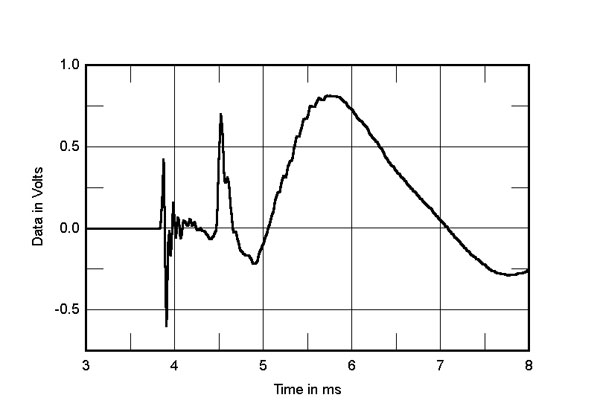
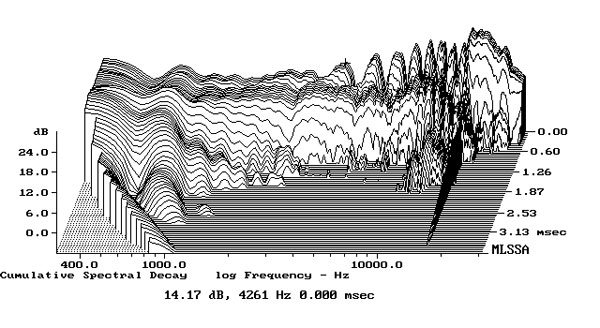
 In the time domain, the Volti Razz's step response on the tweeter axis (fig.7) reveals that all three drive-units are connected in positive acoustic polarity. The tweeter's output arrives first at the microphone, with that of the midrange unit following 0.7ms later and that of the woofer 0.5ms after that (footnote 1). The decay of the midrange unit's step does smoothly blend with the beginning of the woofer's step, which implies good crossover implementation. The Razz's cumulative spectral-decay plot (fig.8) is difficult to interpret because of the time delay between the upper-frequency drive-units' outputs. However, it appears that, other than the interference effects between their outputs, the decay in the midrange and mid-treble region is relatively clean. However, because of the slow upper-crossover slopes, the midrange-unit output has some ridges of delayed energy above 10kHz.
Footnote 1: In the on-line comments that accompanied the late Art Dudley's review of the Klipschorn AK6 in September 2019, a reader conjectured that with a loudspeaker that behaves like this in the time domain, the outputs of the drive-units could be brought into time alignment with DSP and tri-amping. However, Volti's Greg Roberts commented that doing so can detract from the essential sound quality offered by a horn loudspeaker. Greg wrote "I tri-amped and digitally time-aligned my own Khorns back in 2009 and I quite enjoyed it for a while. The time-alignment was a noticeable improvement. But the complexity of the system took something away that I missed and I went back to passive crossovers and a really nice tube amplifier and a simpler system and I enjoyed that a lot more."
Footnote 2: There Ain't No Such Thing As A Free Lunch. In his 1961 book Stranger in a Strange Land, Heinlein also introduced me to the concept of a "Fair Witness," something I try to emulate in these measurements sidebars.
Fig.1 Volti Razz, electrical impedance (solid) and phase (dashed) (2 ohms/vertical div.).
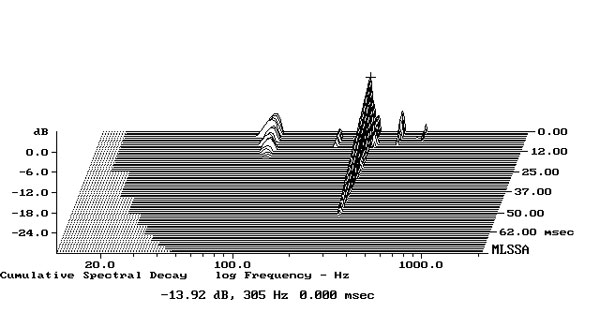
Discontinuities in the impedance traces at 180Hz and 305Hz imply the presence of resonances of various kinds. When I investigated the enclosure's behavior with a plastic-tape accelerometer, the only vibrational mode I found was at 305Hz, which was present on all the walls but was very low in level (fig.2). A very small amount of flexing at 100Hz can also be seen in this graph, but the large cabinet appears to be well-braced.
Fig.2 Volti Razz, cumulative spectral-decay plot calculated from output of accelerometer fastened to center of sidewall level with woofer (MLS driving voltage to speaker, 7.55V; measurement bandwidth, 2kHz).
The saddle at 44Hz in the impedance magnitude trace suggests that this is the tuning frequency of the Razz's port. This was confirmed by the fact that the nearfield response of the woofer (fig.3, blue trace) has its minimum-motion notch at the same frequency, which is when the back pressure from the port resonance holds the cone stationary. The woofer's output peaks sharply at 100Hz. This will be due in part to the nearfield measurement, which assumes the drive-unit is mounted in a baffle that extends to infinity in both planes. However, the amplitude of this peak does suggest that the woofer's alignment is underdamped. The nearfield response of the port (red trace) peaks between 35Hz and 70Hz, but the port's upper-frequency rolloff is disturbed by a major peak just below 200Hz. This is the same region as the other discontinuity in the impedance traces.
Fig.3 Volti Razz, acoustic crossover on tweeter axis at 50", corrected for microphone response, with the nearfield responses of the woofer (blue) and port (red), respectively plotted below 1kHz and 600Hz.
Fig.4 Volti Razz, anechoic response averaged across 30° horizontal window centered on the tweeter axis at 50", corrected for microphone response, with the complex sum of the nearfield woofer and port responses plotted below 300Hz.
Fig.5 Volti Razz, lateral response family at 50", normalized to response on tweeter axis, from back to front: differences in response 90–5° off axis, reference response, differences in response 5–90° off axis.
Fig.6 Volti Razz, vertical response family at 50", normalized to response on tweeter axis, from back to front: differences in response 15–5° above axis, reference response, differences in response 5–15° below axis.
Fig.7 Volti Razz, step response on tweeter axis at 50" (5ms time window, 30kHz bandwidth).
Fig.8 Volti Razz, cumulative spectral-decay plot on tweeter axis at 50" (0.15ms risetime).
The Volti Razz's measured performance suggests that its treble balance can be adjusted by experimenting with toe-in. The manner in which its impedance magnitude smoothly drops from just over 18 ohms in the midrange to 6 ohms at the top of the audioband also suggests that the rise in the speaker's high-frequency on-axis response will, to some extent, be countered by using a tube amplifier's 8 ohm tap, which will offer a higher output impedance than the 4 ohm tap. The treble might also be subjectively balanced by the Volti's somewhat excessive lows. Overall, while the Razz has an impressively high sensitivity—it will play loud with only a few amplifier watts—this achievement must be measured against the maxim TANSTAAFL (footnote 2), which I first came across in the 1960s in a book by the late science-fiction writer Robert Heinlein, The Moon Is a Harsh Mistress.—John Atkinson
Footnote 1: In the on-line comments that accompanied the late Art Dudley's review of the Klipschorn AK6 in September 2019, a reader conjectured that with a loudspeaker that behaves like this in the time domain, the outputs of the drive-units could be brought into time alignment with DSP and tri-amping. However, Volti's Greg Roberts commented that doing so can detract from the essential sound quality offered by a horn loudspeaker. Greg wrote "I tri-amped and digitally time-aligned my own Khorns back in 2009 and I quite enjoyed it for a while. The time-alignment was a noticeable improvement. But the complexity of the system took something away that I missed and I went back to passive crossovers and a really nice tube amplifier and a simpler system and I enjoyed that a lot more."