Sidebar 3: Measurements
Because of the Von Schweikert Ultra 55's bulk and weight, I drove my measurement gear to Michael Fremer's place in deepest, darkest New Jersey to perform the measurements. I chose a day that was forecast to be sunny with minimal wind, because I was going to measure the speaker in his driveway, so that the only source of reflections would be the ground. (Even so, the proximity of the ground necessarily led to aggressive windowing of the time-domain data, which reduced the measurements' midrange resolution.)
 I first measured the speaker's spatially averaged response in Mikey's listening room, then we maneuvered one of the speakers onto a small dolly—easier to write than do, given the Ultra 55's 190lb weight and its spikes—and wheeled it outside. To avoid heating up the drive-units, I positioned the speaker with its back to the sun, facing the garage where I had set up my gear (see photo). I used DRA Labs' MLSSA system and a calibrated DPA 4006 microphone to measure the Von Schweikert Ultra 55's farfield behavior and an Earthworks QTC-40 microphone for the nearfield and in-room measurements.
As always, I used my Krell KSA-50 amplifier for the quasi-anechoic measurements with MLSSA; for the in-room behavior the speakers were driven by the Valve Amplification Company Statement 452 IQ monoblocks that were reviewed in the May issue and that Mikey had been using for most of his auditioning.
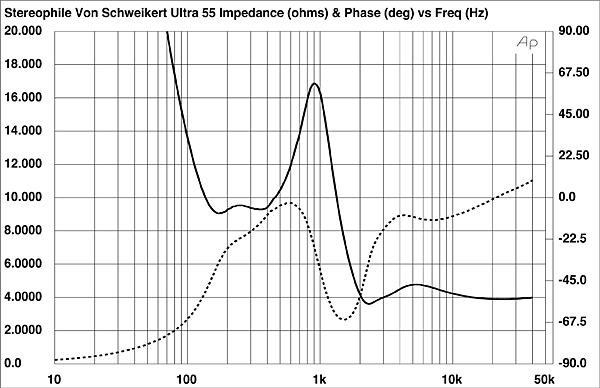
Von Schweikert specifies the Ultra 55's sensitivity as a moderately high 89dB/W/m, which was confirmed by my estimate. The Ultra 55's nominal impedance is specified as 4 ohms. The solid trace in fig.1 reveals that, while the impedance does average 4 ohms in the treble, it is higher than that in the midrange. The minimum magnitude is 3.6 ohms at 2.3kHz. However, there is a combination of 4 ohms magnitude and a phase angle (dashed trace) of –50° at 2kHz. As music can have high energy in this region, the amplifier used with the Von Schweikert speaker must be comfortable driving 2 ohms. Although the electrical phase angle becomes extreme at low frequencies, the magnitude is extremely high in this region, mitigating any drive difficulty. This behavior is due to the use of a high-pass filter in the feed to the midrange unit and tweeter, because of the Ultra 55 using an internal amplifier to drive the woofers.
I first measured the speaker's spatially averaged response in Mikey's listening room, then we maneuvered one of the speakers onto a small dolly—easier to write than do, given the Ultra 55's 190lb weight and its spikes—and wheeled it outside. To avoid heating up the drive-units, I positioned the speaker with its back to the sun, facing the garage where I had set up my gear (see photo). I used DRA Labs' MLSSA system and a calibrated DPA 4006 microphone to measure the Von Schweikert Ultra 55's farfield behavior and an Earthworks QTC-40 microphone for the nearfield and in-room measurements.
As always, I used my Krell KSA-50 amplifier for the quasi-anechoic measurements with MLSSA; for the in-room behavior the speakers were driven by the Valve Amplification Company Statement 452 IQ monoblocks that were reviewed in the May issue and that Mikey had been using for most of his auditioning.
Von Schweikert specifies the Ultra 55's sensitivity as a moderately high 89dB/W/m, which was confirmed by my estimate. The Ultra 55's nominal impedance is specified as 4 ohms. The solid trace in fig.1 reveals that, while the impedance does average 4 ohms in the treble, it is higher than that in the midrange. The minimum magnitude is 3.6 ohms at 2.3kHz. However, there is a combination of 4 ohms magnitude and a phase angle (dashed trace) of –50° at 2kHz. As music can have high energy in this region, the amplifier used with the Von Schweikert speaker must be comfortable driving 2 ohms. Although the electrical phase angle becomes extreme at low frequencies, the magnitude is extremely high in this region, mitigating any drive difficulty. This behavior is due to the use of a high-pass filter in the feed to the midrange unit and tweeter, because of the Ultra 55 using an internal amplifier to drive the woofers.
 The two powered woofers behave identically. The blue trace in fig.3 shows the sum of their nearfield outputs, with their passband output normalized to that of the midrange unit. (There is a level control for the woofers.) The notch at 27Hz indicates that this is the tuning frequency of the 4"-diameter port on the rear panel. The port's output (red trace), plotted in the ratio of the square roots of its and the woofers' radiating areas, peaks broadly between 15Hz and 55Hz, suggesting that the Ultra 55 is a true full-range loudspeaker. The port's upper-frequency rollout is free from any resonant peaks.
 The plot of the Ultra 55's horizontal dispersion, referenced to the response on the tweeter axis (fig.4), reveals that this apparent rolloff is due in part to the fact that the output of the tweeter drops off relatively quickly to the sides above 10kHz. Averaging the output over the 30° horizontal window centered on the tweeter axis downplays the flatter on-axis response in this region (footnote 1). The apparent peak just below 3.5kHz off-axis in this graph is due to the slight lack of energy in this region in the on-axis response filling in to the speaker's sides. Other than that and the top-octave rolloff off-axis, the contour lines in this graph are relatively even, which correlates with stable stereo imaging. In the vertical plane (not shown), the Ultra 55's response doesn't change over a ±5° window centered on the tweeter axis, which is 38" from the floor.

Footnote 1: When the response is measured at a single position, some of the fine detail in the treble will be specific to just that one point in space. When I started measuring loudspeakers 30 years ago, I decided to implement some kind of spatial averaging to smooth out any position-dependent wrinkles in the measured response while leaving the significant information intact. Accordingly, my published responses are the average of seven measured responses, taken at 5° intervals across a 30° horizontal window centered on the reference axis.
I first measured the speaker's spatially averaged response in Mikey's listening room, then we maneuvered one of the speakers onto a small dolly—easier to write than do, given the Ultra 55's 190lb weight and its spikes—and wheeled it outside. To avoid heating up the drive-units, I positioned the speaker with its back to the sun, facing the garage where I had set up my gear (see photo). I used DRA Labs' MLSSA system and a calibrated DPA 4006 microphone to measure the Von Schweikert Ultra 55's farfield behavior and an Earthworks QTC-40 microphone for the nearfield and in-room measurements.
As always, I used my Krell KSA-50 amplifier for the quasi-anechoic measurements with MLSSA; for the in-room behavior the speakers were driven by the Valve Amplification Company Statement 452 IQ monoblocks that were reviewed in the May issue and that Mikey had been using for most of his auditioning.
Fig.1 Von Schweikert Ultra 55, electrical impedance (solid) and phase (dashed) (2 ohms/vertical div.).
The impedance traces are free from the small discontinuities that would imply the presence of cabinet resonances. When I examined the vibrational behavior of the Ultra 55's enclosure with a plastic-tape accelerometer, the only resonant mode I found was on the sidewall level with the midrange unit (fig.2). This mode is high in both frequency and Q (Quality Factor) and is very low in level. It is safe to say that it will have no effect on sound quality. The Von Schweikert's enclosure is effectively inert.
Fig.2 Von Schweikert Ultra 55, cumulative spectral-decay plot calculated from output of accelerometer fastened to sidewall level with midrange unit (MLS driving voltage to speaker, 7.55V; measurement bandwidth, 2kHz).
Fig.3 Von Schweikert Ultra 55, anechoic response of tweeter and midrange unit on tweeter axis at 50", averaged across 30° horizontal window and corrected for microphone response, with the nearfield responses of the woofers (blue) and port (red), respectively plotted below 350Hz and 250Hz.
The woofers roll off rapidly above 200Hz, with the midrange unit (fig.3, black trace) rolling in above that frequency. Other than a slight excess of energy in the presence region, the Von Schweikert's output in the midrange and low- and mid-treble, averaged across a 30° horizontal window centered on the tweeter axis, is commendably flat. There is a gentle rolloff in the top audio octave, reaching –6dB at 20kHz. When I substituted the Earthworks microphone for the DPA, the response still gently sloped down above 11kHz.
Fig.4 Von Schweikert Ultra 55, lateral response family at 50", normalized to response on tweeter axis, from back to front: differences in response 90–5° off axis, reference response, differences in response 5–90° off axis.
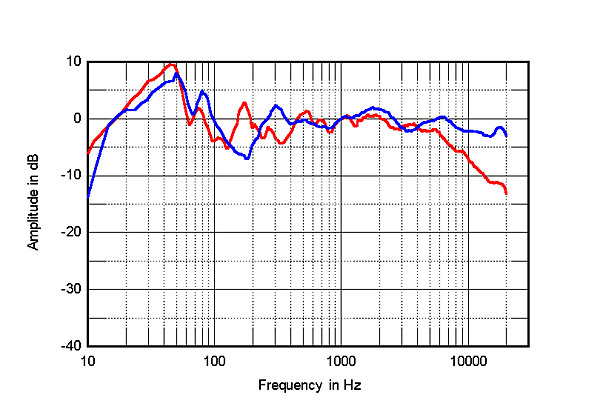
The red trace in fig.5 shows the Von Schweikerts' spatially averaged response in Michael Fremer's listening room, driven by the V.A.C. monoblocks, with the woofer and rear-tweeter level controls as set for his auditioning. (This trace is generated by averaging 20 spectra, taken for the left and right speakers individually in a vertical rectangular grid 36" wide by 18" high and centered on the positions of his ears.) For reference, the blue trace shows the spatially averaged response of the Wilson Alexx speakers that Mikey reviewed in the May 2017 issue of Stereophile and subsequently purchased to use as a long-term reference. (The Wilsons were driven by Michael's darTZeel NHB-458 monoblocks for this measurement.) The responses are normalized at 1kHz, and the Von Schweikerts can be seen to have a more even in-room response than the Wilsons from 400Hz to 6kHz. The outputs of both pairs of speakers between 80Hz and 400Hz are disturbed by room acoustics effects that have not been eliminated by the spatial averaging. Below that region, the Ultra 55s excite the lowest-frequency mode in Mikey's room to a greater extent than the Alexxes, something I could hear when I performed the in-room measurement.
Fig.5 Von Schweikert Ultra 55, spatially averaged, 1/6-octave response in MF's listening room (red) and of the Wilson Alexx (blue).
The Von Schweikerts' in-room output starts to shelve down in the mid-treble to a greater extent than the Wilsons, but then rolls off relatively quickly in the top octave due to the tweeter's limited top-octave dispersion. By contrast, the Alexxes have a little too much energy in this region. When I listened to some music, as I always do when I visit Michael—his system always sounds superb—the Ultra 55s did sound a touch too sweet.
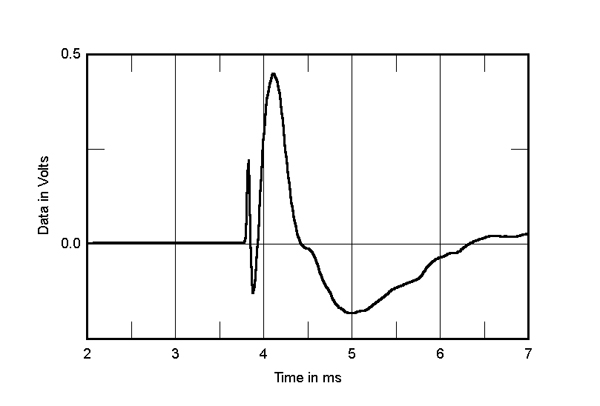
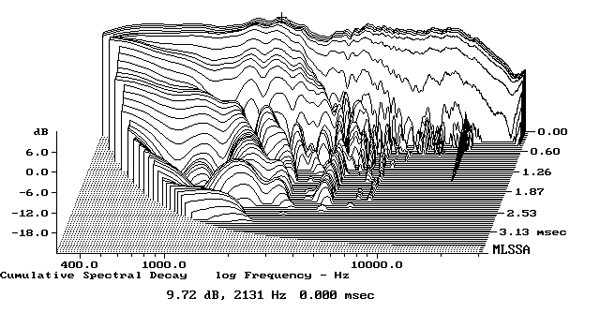
Turning to the time domain, the step response of the upper-frequency units on the tweeter axis (fig.6) indicates that the tweeter and midrange unit are connected in positive acoustic polarity. The decay of the tweeter's step blends smoothly with the start of the midrange unit's woofer's step, which suggests optimal crossover design. I had the woofers turned off for this measurement to eliminate their reflections from the ground, but a separate measurement indicated that the woofers are also connected in positive acoustic polarity. Finally, the Von Schweikert's cumulative spectral-decay plot (fig.7) is impressively clean in the treble, though the slight excess of on-axis energy centered on 2kHz is associated with some low-level delayed energy. And as this measurement was taken on the tweeter axis with no spatial averaging, you can see that the gentle top-octave rolloff doesn't start until 15kHz rather than the 11kHz shown in fig.3.
Fig.6 Von Schweikert Ultra 55, step response of upper-frequency drive-units on tweeter axis at 50" (5ms time window, 30kHz bandwidth).
Fig.7 Von Schweikert Ultra 55, cumulative spectral-decay plot on tweeter axis at 50" (0.15ms risetime).
Overall, the Von Schweikert Ultra 55's measurements indicate excellent audio engineering.—John Atkinson
Footnote 1: When the response is measured at a single position, some of the fine detail in the treble will be specific to just that one point in space. When I started measuring loudspeakers 30 years ago, I decided to implement some kind of spatial averaging to smooth out any position-dependent wrinkles in the measured response while leaving the significant information intact. Accordingly, my published responses are the average of seven measured responses, taken at 5° intervals across a 30° horizontal window centered on the reference axis.