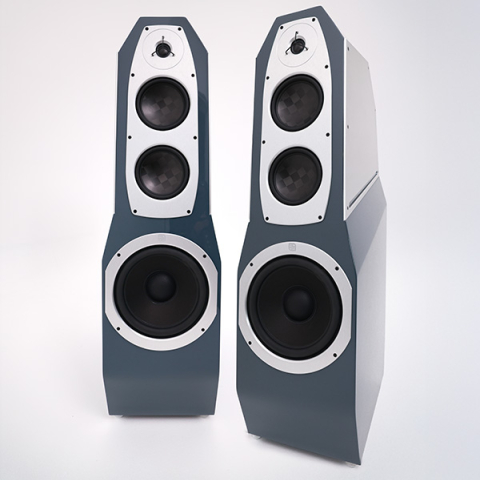
Usually with new speakers there's an adjustment period: It takes time to acclimate to the different timbral and spatial perspective. But jumping into the Ultra 55s' sonics was easy. I immediately liked what they did, especially timbrally, thanks partly to flawless, seamless driver integration: The drivers sang as one, producing an agreeable picture that was rich and supple in the middle, extended, sweet, and airy on top, and assertive and full-bodied on bottom but never obtrusive.
Powered-woofer integration can be problematic. You hear assertive bass, so you turn it down. Then it's anemic, so you turn it back up. Rinse, repeat.
Here, the blend was seamless with both the tubed VAC and solid-state darTZeel amplifiers. The bass was set "by ear," to my preference, with Mr. Swanson adjusting as I listened. Only when I went to retrieve the serial number, late in the review period, did I notice it had been set to just about 0dB—very near the middle, in other words.
Pressed to find fault with the spectral balance, I'd say the top end was ever so slightly mellow and the mids a bit forward—either that, or I'm acclimated to more-recessed mids—but when asked to be aggressive on top, it delivered all the edge and sharpness you'd want or expect. On recordings demanding warmth, I got all of it.
The recently released The Girl and the Cat (2 45rpm LPs, Drive on Records 115115 17) is an engaging, deeply heartfelt, beautifully recorded weepfest from Lori Lieberman, accompanied by the Matangi String Quartet. This recording is intimate to the point of "what am I doing eavesdropping on her in her bedroom?" It's a great record to play for your wife or girlfriend if you want to score points or impress her with your stereo system.
On this record, you don't want so much as a hint of mood-destroying edge or stridency on Lieberman's intimate vocals—nor do you want the strings that caress her sorrows to melt into sludge. The Ultra 55s nailed it:
Lieberman's voice hung in three dimensions between the speakers surrounded by the lush, well-textured, equally 3D strings, combining to produce a close facsimile of the live event, which I experienced in the 599-seat Zankel Hall, downstairs from Carnegie Hall.
I went from there to Mobile Fidelity's superb double-45 reissue of Miles Davis's Porgy and Bess (MFSL 2-485), orchestrated by Gil Evans, an inexplicably bright, bass-shy Frank Laico recording. The Ultra 55s presented an honest rendering of this ground-breaking 1959 album, with clear, clean brass transients with no added etch or glare, so that each brass element was focused and discernible. Gil Evans's upper-register–heavy arrangement calls for four trumpets, four tubas, four French horns (including Gunther Schuller), woodwinds, and reeds. The Ultra's top end sorted them all out without added glare, grit, or smearing.
 Davis's horn floated vividly on a 3D center stage, well in front of the drums, immersed in artificial reverb. Those drums—from Philly Joe Jones and (on four tracks) Jimmy Cobb—were reproduced with the kind of transient speed, clarity, delicacy, and precision that would more than satisfy fans of planar or electrostatic speakers. Here you get speed, delicacy, extension, and wide-stage, even coverage—as well as effortless dynamic slam and low-frequency extension—although there's no LF extension on this Miles record!
You do get the low lows, and all the rest, on a new Beethoven Triple Concerto release with Yo-Yo Ma, Anne-Sophie Mutter, and Daniel Barenboim conducting the West-Eastern Divan Orchestra, which I streamed in MQA on Tidal (vinyl, CD, and Blu-ray are also available from Deutsche Grammophon). It's a fine live recording that showcases the Ultra 55's strengths—those I've already mentioned such as timbral accuracy and textural delicacy, and others I haven't mentioned yet, including fine microdynamic expression and an especially graceful attack and decay. The venue isn't listed, but the space sounds cavernous, imparting a pleasing warmth that occasionally overwhelms, though through the Ultra 55s it doesn't swallow the three soloists, who appear in clear relief, centered in front of the orchestra on a compact soundstage, appropriate to the somewhat distant perspective (footnote 1). A speaker with excess lower midrange and low end would swallow this recording whole.
Take the aisle seat
Davis's horn floated vividly on a 3D center stage, well in front of the drums, immersed in artificial reverb. Those drums—from Philly Joe Jones and (on four tracks) Jimmy Cobb—were reproduced with the kind of transient speed, clarity, delicacy, and precision that would more than satisfy fans of planar or electrostatic speakers. Here you get speed, delicacy, extension, and wide-stage, even coverage—as well as effortless dynamic slam and low-frequency extension—although there's no LF extension on this Miles record!
You do get the low lows, and all the rest, on a new Beethoven Triple Concerto release with Yo-Yo Ma, Anne-Sophie Mutter, and Daniel Barenboim conducting the West-Eastern Divan Orchestra, which I streamed in MQA on Tidal (vinyl, CD, and Blu-ray are also available from Deutsche Grammophon). It's a fine live recording that showcases the Ultra 55's strengths—those I've already mentioned such as timbral accuracy and textural delicacy, and others I haven't mentioned yet, including fine microdynamic expression and an especially graceful attack and decay. The venue isn't listed, but the space sounds cavernous, imparting a pleasing warmth that occasionally overwhelms, though through the Ultra 55s it doesn't swallow the three soloists, who appear in clear relief, centered in front of the orchestra on a compact soundstage, appropriate to the somewhat distant perspective (footnote 1). A speaker with excess lower midrange and low end would swallow this recording whole.
Take the aisle seat
When I sat in the off-center seat in my room, the Ultra 55s imaged very well; indeed, they produced the least spatial and timbral shift I've encountered from a loudspeaker in my room. This wasn't surprising because it's what I've experienced at shows and it's what Von Schweikert claims its speakers do especially well. This is not advertising hype: I can't recall another speaker I've reviewed or owned that was so well behaved off-axis. These speakers do not beam or produce sharp off-axis edges or abrupt timbral shifts. The recently reissued Bach Suites for Unaccompanied Cello, performed by János Starker for Mercury, was recorded with three Schoeps M201 omnis, making this an ideal demo record for a speaker intended to accurately reproduce spaced-omni recordings. The reissue set was sourced from the original ½" 3-track tape mixed down live to the cutter head with groove margins adjusted manually by Ryan K. Smith and supervised by Tom Fine, son of Robert and Wilma Cozart Fine. Tom had brought test pressings over some time ago so that I could compare them to my clean original pressings and the Speakers Corner edition cut from 3–2 mixdown tapes, which to me has always sounded compressed and bass-boosted. People who have that set have filled my inbox asking if they need to rebuy. Yes, you do.
The Ultra 55 performed as advertised on this omni-mike–produced recording. Here was the spatial coherence and the "you are there" sensation—"seeing" before you a cellist playing in a large reverberant room (with occasional spatial-shift hiccups in the recording). Here was the timbral coherence and instrumental verisimilitude. The presentation was somewhat different with the different amplifiers: The VAC amps were more supple and more timbrally accurate. The darTZeels came close in that regard, but they were not quite as texturally luxurious—spatially, though, the solid-state amps provided more focus.
A seat for everyone
Compared to my reference Alexxes, the Ultra 55s' soundstage was less enveloping—more like a 3D curtain spread between the speakers and less like headphones wrapping around you, which is how some visitors describe the Alexxes in my room. With the Ultra 55s, the soundstage spread beyond the speakers when appropriate and disappeared completely, but the picture was not as enveloping. Imaging and instrumental focus, while very good and satisfying, were not as visceral or intense as through the Wilsons, which produce vivid, pinpoint, almost eerily real images that can appear dramatically farther forward or backward in space and more tightly focused—like a good 3D movie. With the Alexxes, though, that effect is fully realized only for the one person lucky enough to sit in the seat for which the speaker has been optimized. Everyone else gets considerably less. The Ultra 55s give everyone an excellent seat.
Conclusion
Walk the halls at a hi-fi show and peer into the rooms. You'll find numerous speaker brands using Accuton drivers all lined up on a front baffle. You could say to yourself, "Oh, another Accuton lineup, I know what that's going to sound like." But you really don't. I've found huge sonic variations among such speakers, including ones I've reviewed and a few I haven't but would like to. Here, Von Schweikert opted to match Accuton woofers and midrange drivers with a Scan-Speak tweeter (modified in-house) and made them work and play well together to produce a rich, detailed, fully coherent, near–full-range speaker that was free of obvious sonic seams and never bored or engaged in a musical "cover up": All the information is there, and it sounds great. The Ultra 55s were a welcome companion during the early part of the COVID-19 lockdown. They play bigger, louder, and with greater dynamic authority than their size would suggest. With the powered-woofer option, they should be easy to drive. Whatever the measurements might say—I won't see them until after I've submitted this review—I found the Ultra 55 to be among the more timbrally neutral and pleasing speakers I've reviewed, from the very first listen. They served every musical genre well and are highly competitive in the $100,000/pair price region. If you're shopping in that price range, I recommend an audition.
Footnote 1: The recording was made at La Ballena Azul—the Blue Whale—at the CCK, formerly the Centro Cultural Kirchner, in Buenos Aires, a blimp-shaped, three-story hall that was formerly the packing area of the Buenos Aires post office.—Editor
Davis's horn floated vividly on a 3D center stage, well in front of the drums, immersed in artificial reverb. Those drums—from Philly Joe Jones and (on four tracks) Jimmy Cobb—were reproduced with the kind of transient speed, clarity, delicacy, and precision that would more than satisfy fans of planar or electrostatic speakers. Here you get speed, delicacy, extension, and wide-stage, even coverage—as well as effortless dynamic slam and low-frequency extension—although there's no LF extension on this Miles record!
When I sat in the off-center seat in my room, the Ultra 55s imaged very well; indeed, they produced the least spatial and timbral shift I've encountered from a loudspeaker in my room. This wasn't surprising because it's what I've experienced at shows and it's what Von Schweikert claims its speakers do especially well. This is not advertising hype: I can't recall another speaker I've reviewed or owned that was so well behaved off-axis. These speakers do not beam or produce sharp off-axis edges or abrupt timbral shifts. The recently reissued Bach Suites for Unaccompanied Cello, performed by János Starker for Mercury, was recorded with three Schoeps M201 omnis, making this an ideal demo record for a speaker intended to accurately reproduce spaced-omni recordings. The reissue set was sourced from the original ½" 3-track tape mixed down live to the cutter head with groove margins adjusted manually by Ryan K. Smith and supervised by Tom Fine, son of Robert and Wilma Cozart Fine. Tom had brought test pressings over some time ago so that I could compare them to my clean original pressings and the Speakers Corner edition cut from 3–2 mixdown tapes, which to me has always sounded compressed and bass-boosted. People who have that set have filled my inbox asking if they need to rebuy. Yes, you do.
Compared to my reference Alexxes, the Ultra 55s' soundstage was less enveloping—more like a 3D curtain spread between the speakers and less like headphones wrapping around you, which is how some visitors describe the Alexxes in my room. With the Ultra 55s, the soundstage spread beyond the speakers when appropriate and disappeared completely, but the picture was not as enveloping. Imaging and instrumental focus, while very good and satisfying, were not as visceral or intense as through the Wilsons, which produce vivid, pinpoint, almost eerily real images that can appear dramatically farther forward or backward in space and more tightly focused—like a good 3D movie. With the Alexxes, though, that effect is fully realized only for the one person lucky enough to sit in the seat for which the speaker has been optimized. Everyone else gets considerably less. The Ultra 55s give everyone an excellent seat.
Walk the halls at a hi-fi show and peer into the rooms. You'll find numerous speaker brands using Accuton drivers all lined up on a front baffle. You could say to yourself, "Oh, another Accuton lineup, I know what that's going to sound like." But you really don't. I've found huge sonic variations among such speakers, including ones I've reviewed and a few I haven't but would like to. Here, Von Schweikert opted to match Accuton woofers and midrange drivers with a Scan-Speak tweeter (modified in-house) and made them work and play well together to produce a rich, detailed, fully coherent, near–full-range speaker that was free of obvious sonic seams and never bored or engaged in a musical "cover up": All the information is there, and it sounds great. The Ultra 55s were a welcome companion during the early part of the COVID-19 lockdown. They play bigger, louder, and with greater dynamic authority than their size would suggest. With the powered-woofer option, they should be easy to drive. Whatever the measurements might say—I won't see them until after I've submitted this review—I found the Ultra 55 to be among the more timbrally neutral and pleasing speakers I've reviewed, from the very first listen. They served every musical genre well and are highly competitive in the $100,000/pair price region. If you're shopping in that price range, I recommend an audition.
Footnote 1: The recording was made at La Ballena Azul—the Blue Whale—at the CCK, formerly the Centro Cultural Kirchner, in Buenos Aires, a blimp-shaped, three-story hall that was formerly the packing area of the Buenos Aires post office.—Editor