

What a Difference a Wire Makes
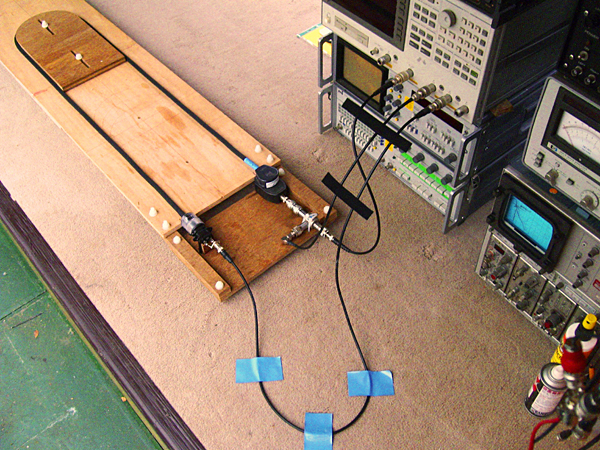
Testing the RF transmission of Kimber Kable, up to 3GHz, at Ben Duncan Research Labs, in 2008. The resulting proof of RF rejection was published on-line by Russ Andrews Accessories in England. (Photo: Naomi Swain).
Editor's Preface: In an article in the October 1995 issue of Stereophile, Professor Malcolm Omar Hawksford used Maxwell's Equations to develop a mathematical model describing the behavior of cables at audio frequencies. Among the predictions of this model were that for good conductors there exists an optimum size of wire for audio signal transmission, and that for a wire larger than this size an energy storage mechanism would exist. In his article Malcolm described a simple experiment, the results of which appeared to confirm his hypothesis.
Then serendipity struck. English engineer Ben Duncan, whose writings have occasionally appeared in Stereophile, sent me an article he had written for the pro-audio magazine Studio Sound. The results of a series of cable measurements he had performed seemed to confirm the Hawksford Hypothesis. We offer them here for your delight and delectation.John AtkinsonWhat It All Means: line-level preamplifier measurements
Though we sometimes take for granted that the basic "language" of our measurements is clear to all of our readers, letters to the editor tell us that this is not the case. Periodically, then, we will attempt to explain exactly what our measurements are and what they purport to show. Though those with technical training may find our explanations a bit simplistic, they're aimed at the reader who lacks such experience.
Why a Preamp?
That was the question asked by a reader who was perfectly happy with his CD-based system. He was using the gain control provided by the variable output of his CD player and was apparently in no need of phono playback or greater flexibility. He asked us to answer this question, ignoring for the moment the obvious functions of switching, volume and tone control, and phono preamplification. With those hardly trivial qualifiers—and bearing in mind the high output available from many of today's line sources, CD players in particular—do you really need the added expense and complexity of a preamplifier?
Zen & the Art of A/D Conversion

In a series of recent feature articles for Stereophile, Jim Austin has examined how the controversial MQA codec works: "MQA Tested, Part 1," "MQA Tested Part 2: Into the Fold," "MQA Contextualized," "MQA, DRM, and Other Four-Letter Words," and, most recently, "MQA: Aliasing, B-Splines, Centers of Gravity." I doubt there is a Stereophile reader who is unaware of the fracas associated with MQA, and I have been repeatedly criticized on web forums for describing its underlying concept as "elegant."
But elegant it is, I feel.
Zen & The Art of D/A Conversion

It has become accepted lore in audiophile circles that the 44.1kHz sampling rate adopted for Compact Disc is too low. Some writers have argued that, as a 20kHz sinewave will only be sampled about twice per cycle, it will not be reconstructed accurately, if at all.