

40 Years of Stereophile: The 40 Essential Albums

 And I used to think our annual "Records">http://www.stereophile.com/showcategory.cgi?category=Records%202%20Die%… To Die For" issue was difficult. Whew! When it came down to choosing the 40 most influential rock/pop, jazz, and classical records of the past 40 years, during which this magazine has been the most honest and enjoyable source of high-end audio journalism, my initial list contained more than 200 choices. A painful paring-down process ensued, with input from every member of the Stereophile staff.
4DTV Satellite receiver

When it comes to delivering audio/video programming to the home, there's no substitute for bandwidth. Typically measured in megahertz (MHz) for analog signals or megabits per second (Mbps) for digital datastreams, the amount of bandwidth your system can access determines how much programming you can receive and at what level of quality.
500 Issues And Counting: a Publishing Milestone
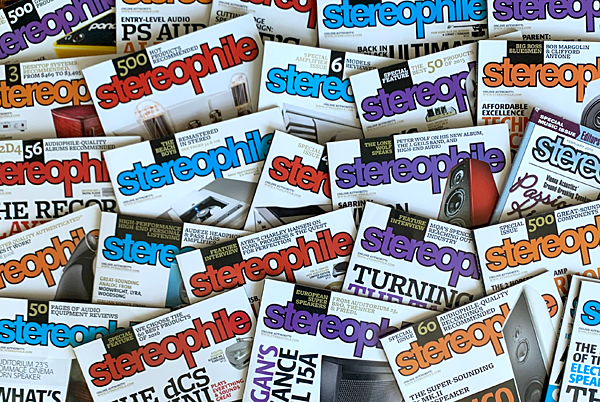
We're all involved with the world we live in. Friends from 20 years ago? Hey, nice to see ya, put on a little weight I see. Generally, you hang with your crew, although you might miss the bigger picture that way.
I wrote for Stereophile from 1993 through 2002, and I remember my experiences fondly, including the pure pleasure of listening to music on all that wonderful audio equipment. But I hung with my tribe and never fully appreciated the crucible in which Stereophile was formed. It's a genuine saga; cue Ennio Morricone's soundtrack to Once Upon a Time in the West.
A Babel, a Babble . . .
Twice a year, Stereophile brings some of its writers out to Santa Fe, New Mexico, to discuss the compilation of the magazine's "Recommended Components" listing, the most recent of which appeared in the October issue. Following a comment from Will Hammond, John Atkinson's collaborator on the recent">http://www.stereophile.com//features/113/">recent amplifier blind listening tests, that the magazine's readers would love to eavesdrop on the conversations that take place on these occasions, it seemed a good idea to tape (footnote 1) some of the discussions and publish the transcript as this month's "As We See It" (footnote 2). Accordingly, Lewis Lipnick, Gary A. Galo, Robert Harley, Thomas J. Norton, Guy Lemcoe, Richard Lehnert, Dick Olsher, Peter Mitchell, Robert Deutsch, J. Gordon Holt, Larry Greenhill, John Atkinson, and Arnis Balgalvis all gathered in LA's palatial listening room one August Saturday. JA set the ball rolling by asking the assembled writers where they thought Stereophile had been, where it was, and where they thought it should be going, particularly in view of Robert Harley joining the magazine as Technical Editor.
A Case of the Jitters

"How sour sweet music is / When time is broke and no proportion kept!"
William Shakespeare, King Richard II, V, v, 42
William Shakespeare, King Richard II, V, v, 42
A Matter Of Diffusion
Like many Stereophile readers, I have often sped home from a concert to fire up the audio system and then, to the sore vexation of my wife and guests, spent the rest of the evening plunged in the morbid contemplation of what, exactly, was missing.
A Mosaic of Music: Stereophile's Clarinet Quintet CD
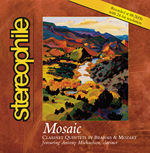
It's the grain elevators that break the monotony of driving across the Texas and Oklahoma Panhandle. As you pass one, another one appears on the horizon. Thus you know you're making progress, despite the fact that the landscape remains unchanged.
A Question of Bits
Someday we may speak wistfully to our grandchildren about the "golden age" of digital audio when consumer formats (CD and DAT) contained a bitstream that was an exact bit-for-bit duplicate of the original studio master recording—not a digitally compressed, filtered, copy-resistant version whose sound is "close enough" to the original. Digitally compressed formats such as DCC and MiniDisc represent, in effect, a return to the pre-CD era when consumer-release formats were always understood to be imperfect copies of the studio original. Even the most ardent audiophile accepted the fact that LPs and mass-produced tapes did not, and could not, sound as good as the master tapes they were derived from.
A Transport of Delight: CD Transport Jitter
Not that long ago, digital audio was considered perfect if all the bits could be stored and retrieved without data errors. If the data coming off the disc were the same as what went on the disc, how could there be a sound-quality difference with the same digital/analog converter? This "bits is bits" mentality scoffs at sonic differences between CD transports, digital interfaces, and CD tweaks. Because none of these products or devices affects the pattern of ones and zeros recovered from the disc, any differences must be purely in the listener's imagination. After all, they argued, a copy of a computer program runs just as well as the original.
A Visit to Bowers & Wilkins
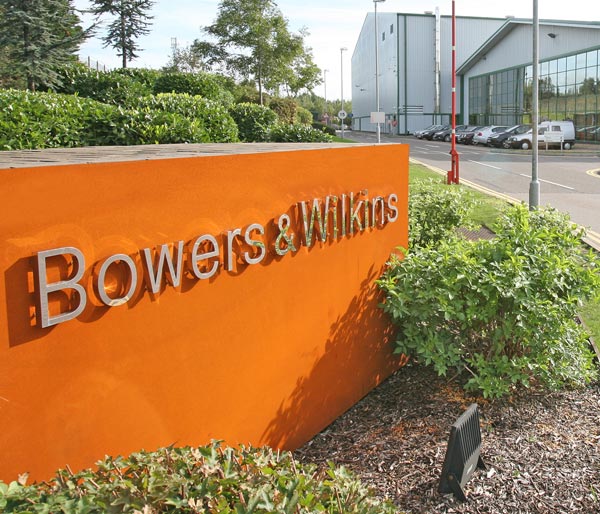
In August 2015, I visited loudspeaker manufacturer Bowers & Wilkins in England. It was an exciting prospect to see the factory, and meet the people who designed and built the speakers I've been using for years. Of course, as the time of my visit approached, it was impossible not to speculate that something important was afootthere was growing Internet buzz that it was time for B&W to update its 800-series speakers. Nonetheless, B&W remained tight-lipped.