

Truth vs Beauty: A Tale of Two Transports

It is a truism that audiophiles love music. What distinguishes us (footnote 1) from the vast majority of music lovers is the importance we ascribe to the high-quality reproduction of recorded music. But what, exactly, constitutes high-quality sound reproduction? To many audiophiles, the answer relates to accuracy. Useful indices of accuracy include many of the parameters that editor John Atkinson routinely measures: flat frequency response, time and phase accuracy, and low distortion, to name a few. On the other hand, many audiophiles apparently have little interest in these aspects and instead seek nothing more—or less—than a romantic and pleasant sound. Such individuals are unfazed by demonstrable inaccuracies in their systems; as long as it sounds good to their ears, they are happy. Are these two schools of thought both compatible with the notion of high-end audio? If so, is one "more correct" than the other? Are they mutually exclusive? What brought this issue to mind was, of all things, a digital transport. Actually, two transports.
Tubes Do Something Special

Most people who now listen to tube amplifiers began with a transistor amp, and know from experience that a tube amp of a given measured power output sounds louder than its nominally identical transistorized equivalent. The unofficial consensus is that you need two to four times the transistor power to achieve the same loudness as you would using tubes. In other words, given the (subjectively) undistorted sound level a 25W (footnote 1) tube amplifier can provide, if you want the same loudness from solid-state technology you would have to replace it with at least a 50W transistor amp (footnote 2).
Two Days in August: Stereophile's First Jazz Recording

The genesis of this project goes back nearly 17 years, when my wife, Joan, and I moved into a brownstone floorthrough in Brooklyn. As we were about to sign the lease, our soon-to-be landlord said, "Oh, one more thing: your upstairs neighbor is a musician." This did not exactly discourage us from signing the lease, however, and soon I began to see a steady stream of musicians trudging up the stairs outside our apartment: Oliver Lake, Sonny Rollins, Pheeroan akLaff, Bob Moses, Marty Ehrlich, and a whole bunch of other people I was reading about in the jazz press. Just who was this guy?
Vinyl Apocalypse: the LP Shelving Dilemma
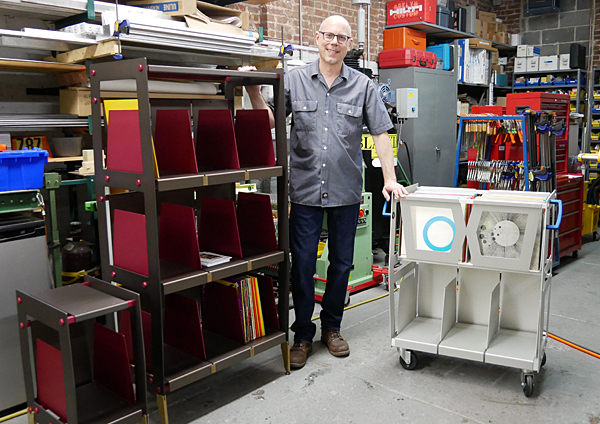
The three most traumatic events anyone can experience in life? The death of a loved one? A surprise audit by the IRS? Your entire LP collection purloined by a disgruntled ex-lover?
And, oh yesmoving.
As 2016 turned to 2017, my wife and I were forced to move from an apartment we wrongly assumed we'd never ever have to leave, which in New York City means a lot. Perhaps we were just a tad naïve?
What's Going On Up There?
A much-touted benefit of DVD-Audio and Super Audio CD is that these new media can store digital audio data extending one or more octaves higher in frequency response than the capabilities of the CD. In the August issue's "Industry Update" (pp.27-29), Paul Messenger reported on an add-on supertweeter from English manufacturer Tannoy that would extend the ultrasonic response of loudspeakers so they can reproduce this new information. Putting to one side for now the issue of whether a loudspeaker really needs to be able to reproduce frequencies that no one can hear, the subject of how much ultrasonic content is present in real musical signals is still a contentious one.
Where the Rubber Meets the Road
There's one phrase a Ferrari dealer never hears from a potential customer: "Ferrari? What's a Ferrari?" Marques such as Ferrari, Lamborghini, and Maserati are so embedded in mainstream culture that their dealers never have to introduce an unfamiliar but exorbitantly expensive set of wheels to their prospects.
Who Stole The Bass? / No One Stole The Bass
Editor's Introduction: Stereophile's "Recommended Components" feature is, as I am sure you will have guessed, produced by a committee. The reviews are studied, the reviewers polled to verify the continued validity, the merits and demerits of specific pieces of equipment are discussed or, rather, argued over at length by JGH, JA, and LA, and out of the whole business emerges the "truth." But, as with the findings of any committee, what is presented as a consensus will have significant undertows and countercurrents of opinion; if these are very strong, a "Minority Report" is often also produced. Such has been the case this time, concerning loudspeakers.
Working the Room

What goes into building and outfitting a listening room? One of Stereophile's reviewers found out first-handand almost bit off more than he could chew. A tale of white powder, a mummified dog, and various deals with the devil.