

The Science of Subwoofing
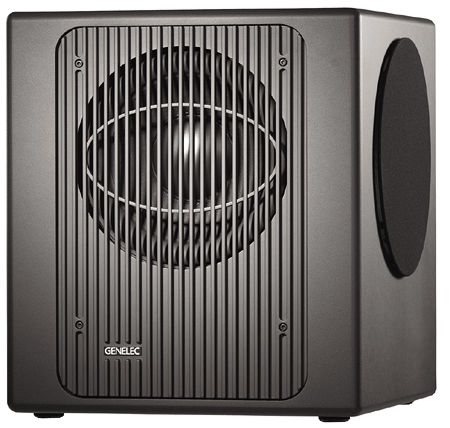
There was a time, as recently as 40 years ago, when frequencies below 100Hz were considered extreme lows, and reproduction below 50Hz was about as common as the unicorn. From our present technological perch, it's too easy to smirk condescendingly at such primitive conditions. But just so you're able to sympathize with the plight of these disadvantaged audiophiles, I should tell you that there were two perfectly good reasons for this parlous state of affairs. First of all, program material at that time was devoid of deep bass; not because it was removed during disc mastering but simply because there wasn't any to begin with. The professional tape recorders of the day featured a frequency response of 50–15kHz, ±2dB—just about on a par with the frequency performance capability of a cheap 1988 cassette tape deck.
The Shun Mook Affair
Editor's note: When Jonathan Scull reviewed the Shun Mook devices back in 1994, he unleashed a hailstorm of controversy that continues to this day. Below is his original report along with some of the follow-up articles and fallout.
The Silverman Concert
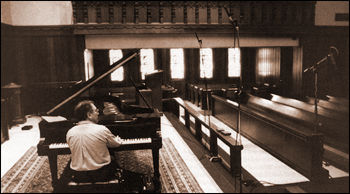
"What's that noise?" Bob Harley and I looked at each other in puzzlement. We thought we'd debugged the heck out of the recording setup, but there, audible in the headphones above the sound of Robert Silverman softly stroking the piano keys in the second Scherzo of Schumann's "Concerto Without Orchestra" sonata, was an intermittent crackling sound. It was almost as if the God of Vinyl was making sure there would be sufficient surface noise on our live recording to endow it with the Official Seal of Audiophile Approval. Bob tiptoed out of the vestry where we'd set up our temporary control room and peeked through a window into the church, where a rapt audience was sitting as appropriately quiet as church mice.
The Sound of Surprise (the loudspeaker/stand interface)
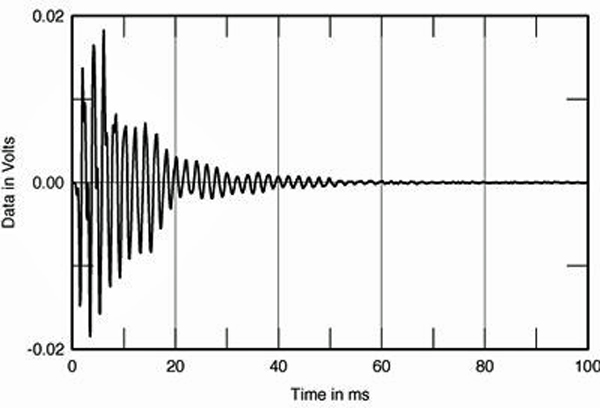
One of the great imponderables in hi-fi is how much the vibrations of a dynamic loudspeaker's cabinet walls contribute to its overall sound quality. Studies by William Stevens in the mid-1970s showed that, with some speakers, the acoustic output of the enclosure could be almost as much as that from the drive-units. Since then, responsible speaker designers have worked hard either to damp cabinet vibrations or to shift them to higher frequencies where their effect on the music will be less deleterious.
The Stereo Image
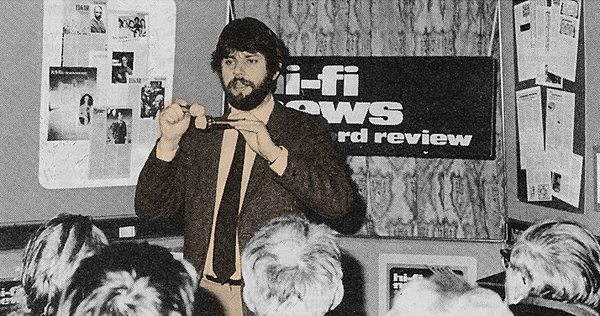
The author demonstrating stereo microphone techniques at an English audio show in 1981.
For most people the terms hi-fi and stereo are synonymous, and yet it is clear that there is still a great deal of confusion over what the word "stereo" actually means. There isn't even a consensus of opinion amongst producers of records, designers of hi-fi equipment, audio critics and music lovers as to the purpose of stereo, and considering that the arguments show no sign of diminishing in intensity, it is instructive to realise that 1981 sees both the 100th anniversary of Clement Ader's first stereo experiments and the 50th anniversary of Alan Blumlein's classic patent on stereo.The Thick And The Dead
Alright already, quit shoving. I know I don't belong here. This magazine already has a place for manufacturers---in the back, where those large egos are squeezed into small column inches so they can't hurt you. Not that I'm exactly proud of my job. On social occasions, if pressed as to my profession, I will usually admit to some honest toil such as mortician or hodcarrier. Speaker design is downright devious work. As proof, examine the specifications for the 1376 models in Audio's 1988 equipment directory. Much of this data, when compared with each described system's real-world performance, looks like Joe Isuzu wrote it on a bad day.
The Unseen Variable
Although I still haven't been able to listen to the Cary Audio Design 805 single-ended tube monoblocks that Stereophile praised so highly a year ago (Vol.17 No.1, p.104), I've recently auditioned many other tubed single-ended designs. Undeniably, a good SE design has a distinctive quality of harmony and atmosphere in the midrange that reaches well beyond the average attainment of its solid-state brethren.
There's No Business Like the Hi-Fi Business
You're a typical audiophile. You read this magazine and others like it cover to cover, month after month, keeping up with industry trends and insider gossip. You've ingratiated yourself with every hi-fi dealer in your area, all of whom will let you take equipment home for extended auditions, give you generous trade-in allowances, and sell to you at a small percentage above their cost. Never pay retail, you chuckle to yourself, checking the newspaper's classifieds for audio bargains.
Time Dilation, Part 1
Pick an expletive—one you would normally use to express deep intellectual frustration—but don't vocalize it. Hold it in reserve for a few minutes, letting it simmer to concentrate its intensity. I'll tell you when to let rip.
Tish, Boom, Awwk! Loudspeakers at the 1985 CES

There were no surprises, innovations, or breakthrough designs in loudspeakers at the 1985 Summer Consumer Electronics Show in Chicago. By and large, those on display were nothing more than refinements of, or variations on, previous speaker designs. Of course, there's nothing the matter with that; any improvement in a product is a step in the right direction. It merely perpetuates the pattern of the past ten years: evolution but no revolution.