Reference

Sort By: Post DateTitle Publish Date

Spectral X-Contamination: Problems in Op-Amp Chips

In high-end circles, the sonic repute of integrated-circuit op-amps (from "operational amplifier") is, at best, checkered. Of course, the expertise with which they are used and the parts they're used with can make all the difference. For example, my DIY preamplifier design, "AMP-02," published in Hi-Fi News & Record Review in 1989–90, and my earlier (1983–84) AMP-01 (footnote 1), I used the better IC op-amps of the time throughout. Both units were thought to outperform cost-no-object commercial units of the time that employed discrete transistors and even tubes, and only indicate what's possible.

A Future Without Feedback?

Over the years as a reviewer, I have tracked the swings of opinion and popularity of various audio ideas and technologies. Amid a sea of advanced designs that achieve powerful technical performance and laudable specifications, I'm reminded of a major blind listening test of 18 power amplifiers that I set up for the long-since-defunct UK magazine Hi-Fi for Pleasure back in 1975. We had "advanced technology" then: the transistor amplifier had matured and was well accepted by audiophiles. Prices of the review samples ranged from $300 to $3000 (equivalent to $1000-$10,000 in today's dollars). The auditioning sessions were graced by the presence of many industry leaders, among them the late Spencer Hughes of Spendor, Julian Vereker of Naim, Philip Swift then of Audiolab, Alan Harris then of retailer Audio T., Bob Stuart of Meridian, and John Wright of IMF (now TDL in the UK).


What a Difference a Wire Makes

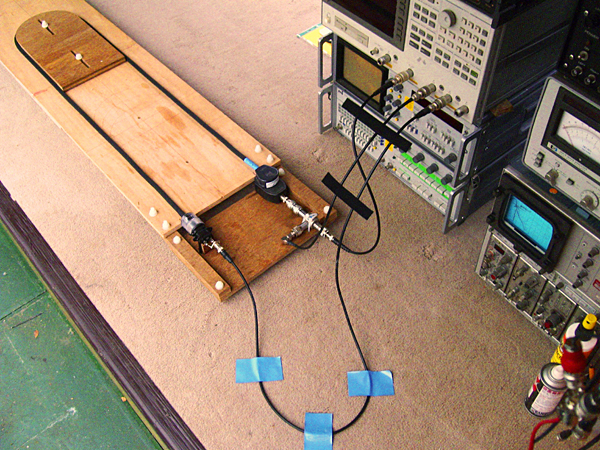
Testing the RF transmission of Kimber Kable, up to 3GHz, at Ben Duncan Research Labs, in 2008. The resulting proof of RF rejection was published on-line by Russ Andrews Accessories in England. (Photo: Naomi Swain).


Editor's Preface: In an article in the October 1995 issue of Stereophile, Professor Malcolm Omar Hawksford used Maxwell's Equations to develop a mathematical model describing the behavior of cables at audio frequencies. Among the predictions of this model were that for good conductors there exists an optimum size of wire for audio signal transmission, and that for a wire larger than this size an energy storage mechanism would exist. In his article Malcolm described a simple experiment, the results of which appeared to confirm his hypothesis.


Then serendipity struck. English engineer Ben Duncan, whose writings have occasionally appeared in Stereophile, sent me an article he had written for the pro-audio magazine Studio Sound. The results of a series of cable measurements he had performed seemed to confirm the Hawksford Hypothesis. We offer them here for your delight and delectation.—John Atkinson

Bad Vibes!

A thorough exploration in a magazine article of such a pervasive and complex topic as vibration control in audio systems is next to impossible; vibration and sound are so intimately bonded that it would be very easy to extend this discussion to just about any area of interest in audio. My intention here is simply to lay a foundation for understanding the basic mechanical forces affecting our quest for improved sonic fidelity, and in the process provide the tools for anyone to achieve good, practical vibration control in his or her system.


The Essex Echo 1995: Electrical Signal Propagation & Cable Theory

Editor's Note: The matter of whether—and if so, how—speaker cables and interconnects can affect the sound of an audio system has vexed the audiophile community since Jean Hiraga, Robert Fulton, and others first made us aware of the subject in the mid-1970s. Most of the arguments since then have involved a great deal of heat but not much light. Back in August 1985, Professor Malcolm Omar Hawksford Ph.D (of the UK's University of Essex and a Fellow of the Audio Engineering Society) wrote an article for the British magazine Hi-Fi News & Record Review, of which I was then Editor, in which he examined AC signal transmission from first principles. Among his conclusions was the indication that there is an optimal conductor diameter for audio-signal transmission, something that I imagined might lead to something of a conciliation between the two sides in the debate. Or at least when a skeptic proclaimed that "The Laws of Physics" don't allow for cables to affect audio performance, it could be gently pointed out to him or her that "The Laws of Physics" predict exactly the opposite.

Real-Life Measurements

As mentioned by two readers in this month's "Letters," amplifiers are used to drive loudspeakers but are almost exclusively measured into resistive loads. The reasons for this are twofold: 1) real loudspeakers both produce neighbor-annoying sound levels and tend to break when driven with typical amplifier test signals; and 2) the question as to which "standard" loudspeaker should be used is impossible to answer---at least the conventional resistive loads are consistent and repeatable.


The Uncertainty Principle

Have you ever suspected that the component you bought after diligent research is somehow not "typical"? That its sound seems to bear little resemblance to the descriptions in the reviews you read? Sure, you listened to the unit before purchase, but the one you took out of the box at home—was that the same unit? And if you suspect your new unit's sonic quality is below par, just how do you or your dealer go about proving it?

Tweaks'n'Squeaks

If you read Stereophile regularly, you already know that all audio equipment does not sound the same. But did you know that a given piece of gear can sound better or worse depending upon how it's set up and used? With a few simple tweaks, you can bring out the best in your audio system.


Advertisement
Advertisement
Advertisement