
Features

Sort By: Post DateTitle Publish Date

A Question of Bits

Someday we may speak wistfully to our grandchildren about the "golden age" of digital audio when consumer formats (CD and DAT) contained a bitstream that was an exact bit-for-bit duplicate of the original studio master recording—not a digitally compressed, filtered, copy-resistant version whose sound is "close enough" to the original. Digitally compressed formats such as DCC and MiniDisc represent, in effect, a return to the pre-CD era when consumer-release formats were always understood to be imperfect copies of the studio original. Even the most ardent audiophile accepted the fact that LPs and mass-produced tapes did not, and could not, sound as good as the master tapes they were derived from.
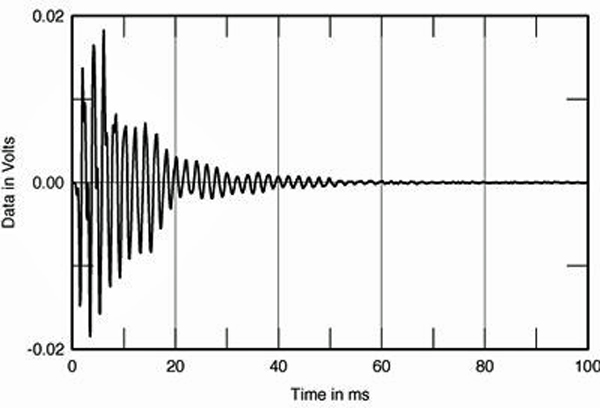
The Sound of Surprise (the loudspeaker/stand interface)

One of the great imponderables in hi-fi is how much the vibrations of a dynamic loudspeaker's cabinet walls contribute to its overall sound quality. Studies by William Stevens in the mid-1970s showed that, with some speakers, the acoustic output of the enclosure could be almost as much as that from the drive-units. Since then, responsible speaker designers have worked hard either to damp cabinet vibrations or to shift them to higher frequencies where their effect on the music will be less deleterious.

Stereophile's Test CD 2

Back in the Spring of 1990, Stereophile introduced its first">http://www.stereophile.com//reference/176/">first Test CD. Featuring a mixture of test signals and musical tracks recorded by the magazine's editors and writers, it sold in large numbers—around 50,000 had been produced at last count. Even as we were working on that first disc, however, we had plans to produce a second disc that would expand on the usefulness of the first and feature a more varied selection of music. The result is our Test CD 2, introduced this month for just $7.95">http://ssl.blueearth.net/primedia/home.php">$7.95 plus postage and handling. With a playing time of over 74 minutes, the new disc should prove an invaluable tool to help audiophiles optimally set up their systems and rooms by ear—and the music's pretty good, too!—John Atkinson


The Listeners' Manifesto

Editor's Note: This article is now only available as an Audio Engineering Society preprint, under the title "The Role of Critical Listening in Evaluating Audio Equipment Quality," preprint number 3176. The price is $4.00 for AES members, and $5.00 for non-members; it can be ordered (currently on paper only, not as a downloadable pdf) by entering the number in the appropriate field on the preprint">http://www.aes.org/publications/preprints/search.html">preprint search page at the AES">http://www.aes.org">AES website.


As Reviewers See It

Every summer, I invite a representative sample of Stereophile's equipment reviewers to the magazine's Santa Fe HQ. For the third successive year, I decided to tape some of the free-for-all discussion that takes place and offer readers the opportunity of peeking over the participants' shoulders by publishing a tidied-up version of the transcript.

Installing a Dedicated AC Line

The most important change made to the system was one that held up the writing of my review of the Mark">http://www.stereophile.com/solidpoweramps/991ml23">Mark Levinson No.23.5 power amplifier for several months, such was its anticipated impact. Though my listening room is well-equipped with wall sockets, there are actually only two 15A circuits serving these outlets. Ever since I had converted what had hitherto been our house's master bedroom into my listening room, I had intended to run new circuits to it.


Stereophile's Writers on an Audio Quest

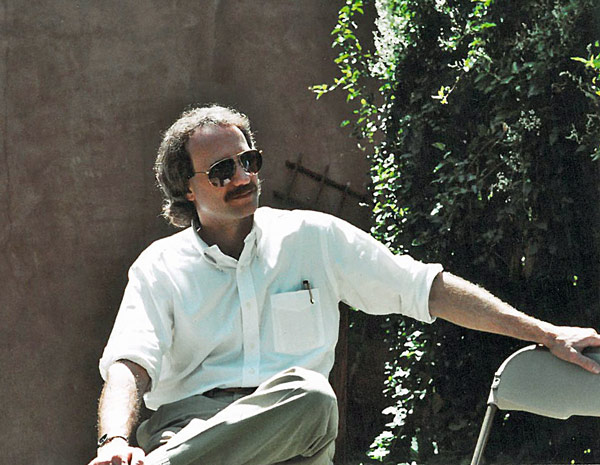
One Saturday afternoon in August 1990, a number of Stereophile's writers—John Atkinson, Arnis Balgalvis, Robert Deutsch, Larry Greenhill, Robert Harley, J. Gordon Holt, Richard Lehnert, Guy Lemcoe, Lewis Lipnick, Peter Mitchell, Tom Norton, Dick Olsher, Don Scott, and Bill Sommerwerck—gathered together in the magazine's Santa Fe, NM listening room to discuss the "Recommended Components" listing that was due to appear in the October 1990 issue. To add a little Tabasco to the proceedings, JA had invited AudioQuest's main man Bill Low (above) to give a short talk on whatever subject was uppermost in his mind that weekend, to be followed by an open discussion.

Looking Back at the 1980s

A freelance reviewer's workload is erratic. On the odd occasion one might have a few moments' respite, while at other times the coincidence of multiple deadlines for copy results in several weeks of panic. As I write this missive I have just completed one such overload period covering so much equipment that I thought that it would be worthwhile to look back and take stock at the audio in the past decade (footnote 1).
Advertisement
Advertisement
Advertisement