As We See It

Sort By: Post DateTitle Publish Date

The Flexible Firms

Some years ago, we attended a hi-fi show in New York City where one of the exhibitors was RCA Victor. Their presence there would have been forgotten were it not for the fact that their exhibit, featuring their own discs played on their own line of phonographs, was producing some of the filthiest sound at the entire show. And that, in the proverbial nutshell, is why you never see reports in Stereophile on equipment made by RCA, Philco or General Electric.
The Tin-Eared Americans

How would you feel after paying $2000 for super-stereo system, you learned that genuinely high-fidelity recordings of many excellent classical musical performances were not available to you? Could you excuse it with a shrug and the philosophical observation that nothing's perfect but things will get better as the state of the recording art improves? Okay then, what if you learned that truly high-fidelity recordings of these performances, that would sound very much like the real thing if reproduced through your super system, are available to millions of other people but not to you? Would you begin to feel just a little bit slighted, or maybe even irritated?

What's Right?

A recent experience with two excellent loudspeaker systems and two of the top power amplifiers raised a question that has been cropping up more and more frequently these days: When one component sounds more toppish or more bassy than another, which one is really flat and which isn't?


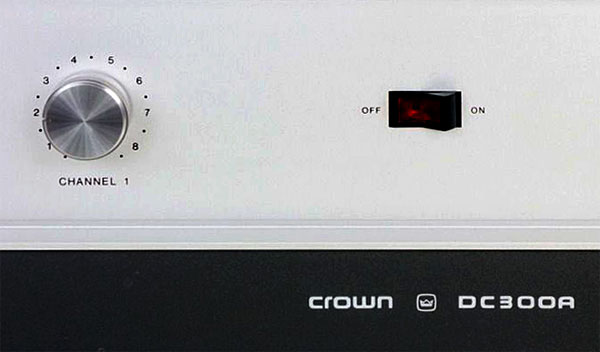
The question arose this time in connection with some listening tests on a pair of FMI 80 speakers and a pair of IMF Monitor III speakers, using Audio Research Dual 75 and Crown DC-300A power amplifiers.

The Great Distortion Delusion

Hey, kids, here's the Big News. We've been deluding ourselves all along, worrying about piddling little bits of distortion that we can't hear at all. How's your preamp distortion? 1% at 1 volt out? You have a perfect preamp—a veritable straight wire with gain! That ear-shattering shrillness is all in your mind, because it has now been demonstrated that the human ear cannot perceive distortion levels of less than 6–12% on "normally complex music." If you think you can hear 0.1%, you are deluding yourself.

Bye Bye, Quadrifi?

"As We See It" in the Stereophile issue dated Summer 1968 (actually published in 1970) noted the idealistic, glowing claims about how four-channel sound could put you right in the concert hail, but urged readers to wait before buying, to see whether quadrisound would indeed bring higher fidelity. We predicted it wouldn't—that whatever the potential of quadrisound (footnote 1), it would not be used to increase fidelity, but rather to play ring-around-the-rosy with music.

The Silent Minority

Until about nine months ago, in the fall of 1970, FM radio station WFLN, Philadelphia, was just another one of that dying breed: the classical FM station. Like its counterparts in the few remaining classical-radio cities, it provides the major part of the high-fidelity listener's radio diet, and also like most similar classical stations, its fidelity was nothing to brag about.

The Missing Specification

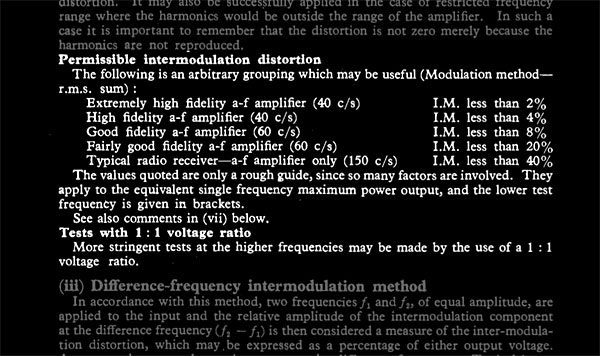
In the 1952 edition of the Radiotron Designer's Handbook, long recognized as the "bible" of the industry, the permissible level of IM distortion for a high-fidelity amplifier was given as 3%, with the alternate figure of 2% being cited as a "rather extreme" specification. We wonder what the author of that statement would think of today's solid-state amplifiers with their measured IM of 0.01% and less. And we wonder what he would think about the fact that these super-amplifiers still have audible distortion.

The Comparable Cassette


Thanks to two developments and a promise, the compact cassette has finally become, as they say, a force to be reckoned with.


Development one, perhaps the most significant factor in the changing picture, is the ready availability of B-type Dolby devices (which are single-band Dolbys, acting only on hiss frequencies). Advent makes two that can be used with any tape machine, cassette or otherwise, while Fisher, Advent, and Harman-Kardon (as of this moment) are producing cassette recorders with built-in Dolby-B. No doubt there will be others by the time this gets in print.

Universal Components

A reader who asked to remain anonymous wrote to tell us the results of some tests he saw conducted on one of our top-rated loudspeaker systems. Frequency-response checks showed that the system had virtually no deep bass, a midbass peak, a midrange slump, and a high-end rise. Further checks had shown gross distortion at input levels of over about 6W, and a definitely limited (although adequate for Row-M listening) maximum output-level capability. Said reader then went on to ask how we could possibly consider such a speaker to be one of the best available.
Advertisement
Advertisement
Advertisement