Historical

Sort By: Post DateTitle Publish Date

2020 Jitter Measurements

Even as digital/analog processors were becoming a hot product category in the early 1990s, audiophiles were also learning that timing uncertainties in the AES/EBU and S/PDIF serial datastreams—jitter—would compromise any improvement in sound quality offered by these DACs. Some companies therefore introduced products to reduce or eliminate jitter—in the November 1994 issue of Stereophile, Robert Harley reviewed three such products: the Audio Alchemy DTI Pro, the Digital Domain VSP, and the Sonic Frontiers UltrajitterBug. I still have Stereophile's review samples of the UltraJitterBug and VSP, along with two contemporary DACs: a PS Audio UltraLink and a Parts Connection Assemblage DAC-1.


As our reviews of these products were published before Paul Miller's and the late Julian Dunn's development of the "J-Test" diagnostic signal, I performed J-Test jitter measurements to bring that 1994 review into the 21st Century. You can see what I found here.

Stereophile: A Personal Odyssey

John Atkinson (left) and Richard Lehnert (right) in RL's house in May 2011, the day before RL moved from Santa Fe, New Mexico, to Ashland, Oregon. (Photo: Susannah Tyrrell)


I first became aware of the existence of Stereophile sometime in spring 1985, while working as a typesetter in Santa Fe, New Mexico. (Remember typesetting?) From far down the hall behind me I heard a big, high-pitched laugh. I turned to see my present boss guiding toward my dark typesetting cell my future boss: a very tall, balding, round-faced man with a huge grin who shambled along in loose chinos and a Hawaiian shirt in full sail.

The Smaller Advent loudspeaker

One day last year, my friend Larry and I were talking about our college-fraternity days and loudspeakers. Those were four of the best years of my life. Strong friendships were formed, and ever since, we've kept in touch with most of our fraternity's brothers-in-heart. Ours was not a jock house, nor was it the last bastion of rampant male sexuality—it was, after all, an MIT frat house. But it was full of music lovers who fell neatly into three camps: the California School owned JBL Decades, the New England School had Smaller Advents, and the Renegades boasted bootlegged Bose 901s (footnote 1).


Bozak Concert Grand B-410 loudspeaker

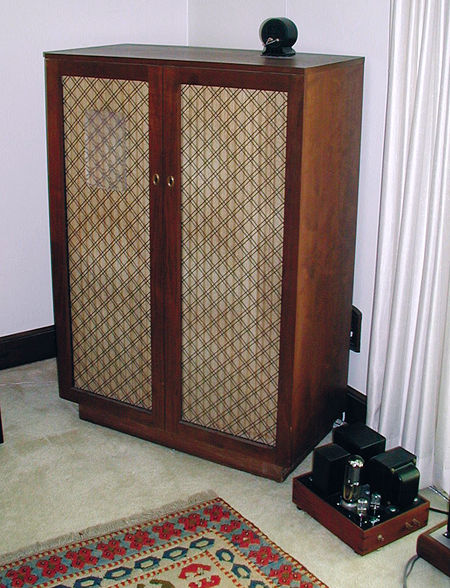
The Bozak Concert Grand is a loudspeaker dreams are made of. I was just a boy, but I remember to this day the impressive pictures of them in Audio magazine. I thought they must be the best loudspeakers ever made because they were so big—they would let more of the music come out. I suspect the Bozaks beckoned to me in some primal way, just as those giant construction trucks do—the ones that have tires bigger than a man.


The Nonstick Embrace Of Home Theater

Editor's Note: 24 years ago, in January 1995, we published the first issue of Stereophile Guide to Home Theater, a sister publication intended to appeal to the the growing number of home-theater enthusiasts. Stereophile's founder, the late J. Gordon Holt, had gotten early into the idea of accompanying movies with high-quality sound, and when I first visited his New Mexico home in January 1986, his system included an Advent NTSC-format video projector.

A New Size For Stereophile

By now you've no doubt realized that Stereophile has changed its size—from 5½" by 8 7/16" to 7½" by 10¼". (All right—maybe you didn't know the exact dimensions of the change, but that's what they are.) We have Edward Chen, Publisher of Stereophile's Chinese edition, to thank for our new size. It is the same size as the Chinese Stereophile and a common size in the Far East. We've been admiring it in Chinese for the last two-and-a-half years, and we thought it would make sense in English as well.


Advertisement
Advertisement
Advertisement