
Historical

Sort By: Post DateTitle Publish Date

The 1965 New York Audio Show
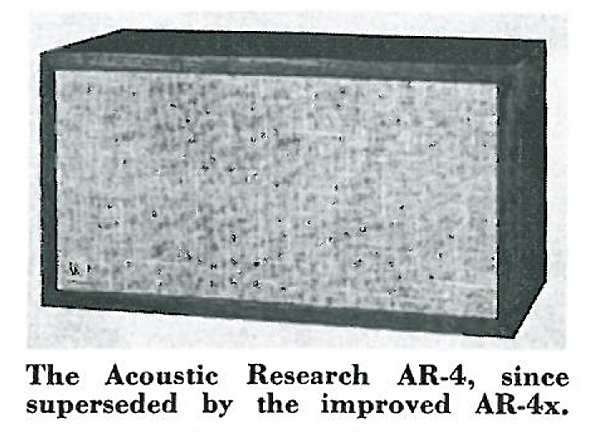
Note: As our coverage of the 2016 New York Audio Show has just been posted, I thought it would be interesting to post our report from the 1965 show, in particular to see which brands are still around 50 years later.—John Atkinson


The 1965 New York hi-fi show was, to these observers, most notable for the marked increase in the number of exhibits which featured good—ie, classical—music for demonstration purposes. In the past, only about a half dozen of the exhibitors played any thing of musical worth, the rest of them evidently figuring they could make more noise with wild brass-and-percussion "demo" records.
The Sound of Transistors

Editor's Note: Those of us who cut our engineering teeth on tubes still remember the advent of the solid-state amplifier with mixed feelings. Yes, they were lighter and cheaper per watt than the thermionic hulks we loved so much, but they broke all the time (thanks to the germanium transistor) and sounded like—well, let J. Gordon Holt tell us what they sounded like in an "As We See It" article from Vol.1 No.10, first published in May 1965. We also develop the theme with a JGH review of an early transistorized amp, as well as a selection of readers' letters from the early days of Stereophile. Enjoy.John Atkinson

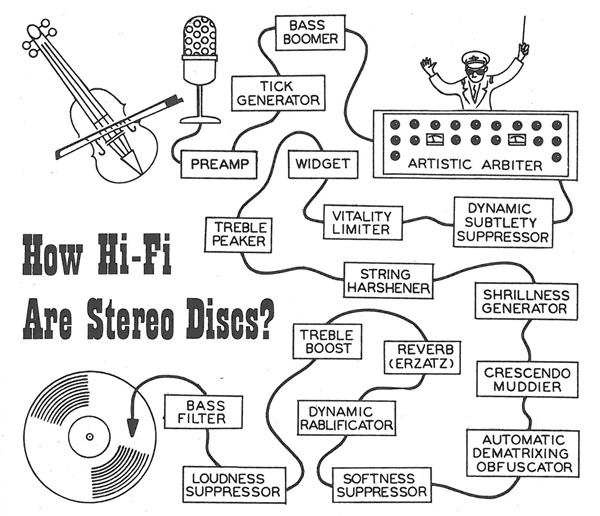
How Hi-Fi are Stereo Discs?

Editor's Note from 1992: This seminal J. Gordon Holt essay on how the art of recording natural sound became compromised in favor of unmusical artificiality for good commercial reasons was originally published in August 1964, in Vol.1 No.8. Though most people these days listen to classical music from CDs, not LPs, in the intervening decades, recording technology has not changed for the better as much as one might have hoped. Nevertheless, the days of wretched multimiking excess described by Gordon are past, and it's rare to find the music treated with the lack of respect typical of a mid-'60s Columbia session. Although some of the smaller companies—Reference Recordings, Delos, Chesky, Mapleshade, Dorian, and Sheffield Lab in the US; Meridian, Nimbus, and Hyperion in the UK—consistently use honest, minimal miking, it is not unknown for the majors in the '90s to do likewise. And the use of time delay for spot microphones, pioneered by Denon in the mid-'80s, means that instruments that might tend to become obscured at orchestral climaxes can now be brought up in level without unnaturally time-smearing the sound. I still find it sad, however, that it is rare to hear the sheer dynamic range of a live ensemble successfully captured on a commercial recording.—John Atkinson

Farewell to the Paper Cone

Ever since the first electrical loudspeaker—a glorified headphone with a horn on it—was outmoded by the balanced-armature cone speaker, paper has been the standard diaphragm material for speakers reproducing low frequencies. The Rice-Kellogg moving-coil transducer replaced the balanced-armature driving system in 1925, but the paper cone remained. And although many improvements have since been made, were no more major changes in loudspeaker design for over 30 years!
Advertisement
Advertisement
Advertisement