Historical

Sort By: Post DateTitle Publish Date

Readers Review Stereophile's Poem LP

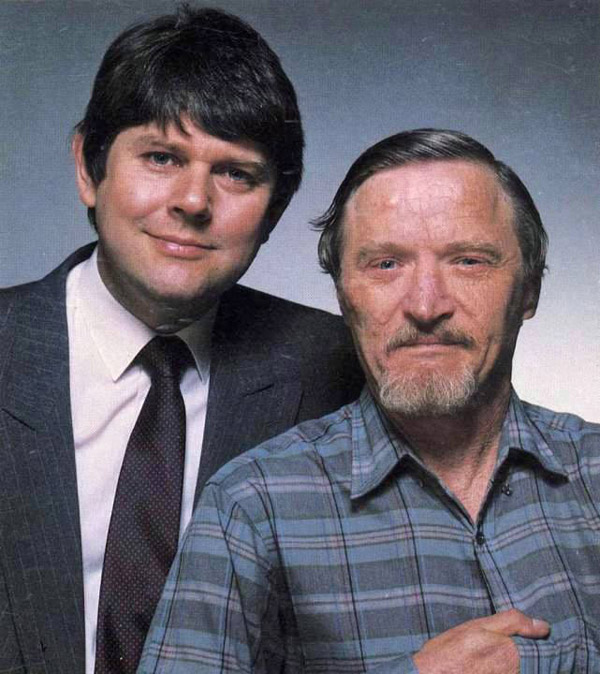
In the Fall of 1989, Stereophile magazine released its first recording, of Gary Woodward and Brooks Smith playing flute sonatas by Prokofiev and Reinecke, and a work by American composer Griffes that gave the LP its title: Poem (footnote 1). The full">http://www.stereophile.com//interviews/527/">full story was published in the September 1989 issue (p.66). We wanted to offer our readers an LP of acoustic music made with the minimum of electronics and processing—the sounds of the instruments would be as true to reality as possible. The images of the instruments were also captured with a purist microphone technique so that, with even a halfway decent system, a true soundstage would be created between and behind the loudspeakers when the recording was played back.

The Musician in the Middle

Ask most professional symphony musicians for their views concerning recording sessions, and you might be greeted with seemingly nonchalant and cavalier responses. You will probably be told that although recording can be quite lucrative, it is almost always an exercise in futility. If you press further, and inquire as to why these "artists" display such negative attitudes, they would treat you to both a lecture concerning the shortcomings and gross musical distortions usually involved in the recording process, and to a tirade on the incompetence and arrogance of many recording engineers and producers. And once you have opened this can of worms, you will undoubtedly be told about the frustrations of having to deal with inaccurate and distorted representations of their art at the hands of the musically inept.


No-Holts-Barred: 25 Years of Stereophile

Editor's Introduction: 1987 sees Stereophile celebrating its 25th anniversary of continuous—if occasionally sporadic—publication. For an ostensibly "underground" publication to have survived so long is a tribute to the skills and enthusiasm of the magazine's founder and Editor, J">http://www.stereophile.com//interviews/66/">J. Gordon Holt. I thought it fitting, therefore, to ask a contemporary of Gordon's, Ed Dell (footnote 1), himself a respected publisher and editor, to pen an appreciation of the man who defined the world of subjective reviewing.—John Atkinson


Audio: The View From Outside

I have a confession to make: I play contrabassoon . . . for a living. Now to many this may not seem like such a sin, but within the musical community my instrument is viewed with about as much regard as the common garden slug. This perception is not completely unjustified; often being relegated to roles depicting monsters and evil, along with the occasional digestive grunt, helps perpetuate the general disdain for the contra. However, playing the lowest (non-keyboard) instrument in the symphony orchestra gives me a somewhat different perspective on things, not unlike that of a dwarf in a crowded elevator: a view from the bottom up. It's amazing just how much pitch and harmonic coloration there is down in the subbasement. And shoring up the foundation of the wind section, as well as being the true bottom of the orchestral sonority, can be very satisfying. Although playing an instrument with a limited repertoire can sometimes be disconcerting, it also has its advantages. During rehearsals, if I'm not required for a certain work, I can go out into the house for my own private concert, or stay put in the orchestra and get a sonic thrill that makes the IRS and WAMM systems sound like tin cans.


Krell Power: A Visit to the Laboratory of Doctor Morbius

The only one who knows this ounce of words is just a token

Is he who has a tongue to tell, but must remain unspoken.
—Moondog, 1968


The Lockheed 1011 sits dormant on the ground at Chicago's O'Hare airport. "We have a little light bulb problem here" drawls the pilot in the approved Right Stuff manner. "We don't know if it's the bulb or what, we'll let you know."

The Pros & Cons of Electrostatic Loudspeakers

The main inherent advantage of the full-range electrostatic loud speaker system is that it allows a single diaphragm to embody the conflicting attributes needed for optimal performance at both extremes of the audio range. Its thin-membrane diaphragm can be made exceedingly light, for superb transient response and extended HF response, yet it can be about as large in area as desired, for extended LF response.

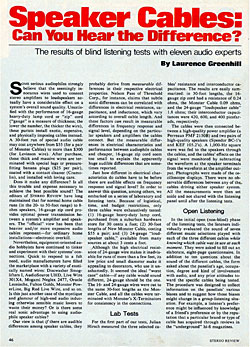
The Horse's Mouth (Stereo Review's 1983 cable tests)

It's not often that you get a chance to have extensive discussions with the horse's mouth, but we recently had that opportunity. Since July of this year there has been extensive discussion in the audio community, particularly the high-end segment, of Larry Greenhill's article">http://bruce.coppola.name/audio/Greenhill.pdf">article on speaker cable listening tests in the August, 1983 issue of Stereo Review (footnote 1). From recent talks with author Greenhill we've learned that the most interesting story was not in Stereo Review; instead it can be found in the varying reactions from different quarters, and what they say about the high-end industry in general.


Watkins WE-1 loudspeaker

First I should clear up what may be an ambiguity in the driver-lineup spec for these speakers. In each system, three 8" cone units serve as woofers. Two of these crossover from the midrange drivers at 100Hz. Crossover to the third 8-incher, the subwoofer, is at 40Hz. Thus, two woofers are active from 100Hz down to 40Hz, and all three are active below 40. In other words, the third woofer does not come into play until the frequency drops to the point where the radiating area of two 8-inchers starts to become inadequate for moving air, at which point the additional area of the third speaker is thrown in. Below 40Hz, all three are working together.


How to Write an Ad

Everyone knows that advertising people make more money than ordinary people, but many assume that the high pay is because ad writing is so difficult. This is not true. Low-income people can write advertisements, too, so just in case somebody should accost you on the street and ask you to write an advertisement, here is how you may go about it.
Advertisement
Advertisement
Advertisement