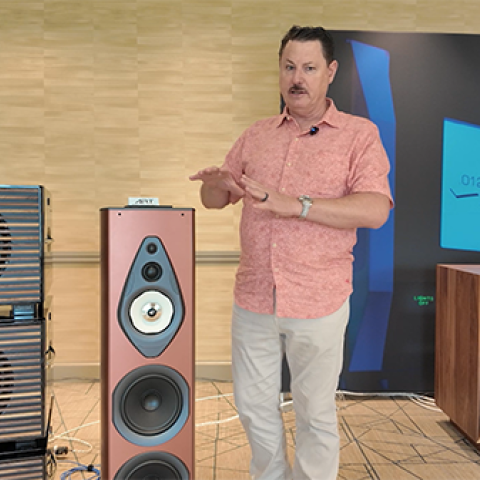
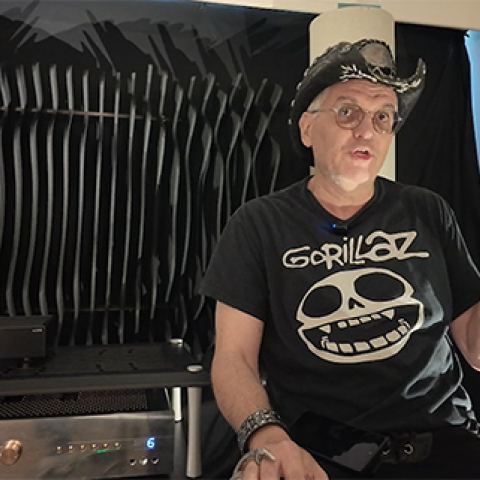
"If we have to sacrifice some profits to support our dealers and protect our brands, so be it."—Jay Rein, Bluebird Music (above, pictured at the 2010 Montreal audio show). Bluebird has informed its dealers that it will not raise prices.
Stereophile readers are surely aware of the tariff situation under the current administration—a situation that has changed rapidly, often daily. The tariff penalty—and arguably even more, the lack of economic stability resulting from tariff volatility—has a major impact on buying, pricing, and corporate strategy in the hi-fi industry. Hi-fi is just one of many industries experiencing the impacts of increased costs and uncertainty.
Over the past several weeks, I've spoken with several people from our industry—representatives of dealers, distributors, and manufacturers—about tariffs. I've found that the effects of tariffs on individual companies, and companies' responses to tariffs, vary widely. Even so, there's a lot of similarity in people's thinking. A common theme: the importance of volatility. No one knows if a new tariff is permanent or will disappear in a week. That hampers companies' abilities to make strategic decisions—even to set prices appropriately.
For domestic and mixed-origin manufacturers, the outlook is at best uncertain—a powerful word in the current situation. US manufacturers are, presumably, the intended beneficiaries of tariffs, but they too are adversely impacted by the increased cost of parts from overseas, especially China. And they are frustrated by the impact of reciprocal tariffs on their export business.
Harman Luxury Audio Group is scheduled to raise prices in July on its Levinson, Revel, and JBL brands as well as newly acquired brands Marantz, B&W, and Denon.
Binghamton, New York–based McIntosh announced price increases of 10%–18% just a few months after the McIntosh Group was acquired by Bose; Steve Rowell, president/owner of Audio Classics, a Binghamton-based dealership representing McIntosh and other brands, said a price increase was overdue. Prices could rise more, depending on tariffs. McIntosh home audio components are manufactured in the factory in Binghamton, but like almost every manufacturer, Mac uses some imported parts, plus they sell a lot of product overseas. Export sales are likely to be impacted by reciprocal tariffs.
Rowell told me that he was placing large orders that day from several brands to get ahead of the tariffs. Many other dealerships he knows are doing the same. The old prices will apply to products shipped up to the date of the increase; after that, pricing becomes uncertain. These early mass orders could be a boon to Mac and other companies in the short term, but they could lead to inventory depletion, especially if supply chains are interrupted by tariffs and tariff threats. Reduced inventories could cause prices to rise further.
Some tariffs have already gone into effect, and some prices have already risen. That doesn't just create a higher price barrier; it also creates new uncertainty. "Some are holding their breath, waiting to see what happens," VPI President Mat Weisfeld said about dealers and distributors. "If you pay the tariff today, and tomorrow it's lifted, you're not getting your money back."
On April 7, Cliff Duffey, head of AXISS Audio, sent dealers a letter informing them that AXISS would absorb tariff costs. "Raising prices now sends the wrong message—that a better deal might be available later," the letter read. "Many companies are increasing prices to protect their margins under these tariffs, but what good are those margins if customers choose to postpone or cancel their purchases altogether?"
Jay Rein of US importer-distributor Bluebird Music, believes tariff volatility gives retail customers a new reason to postpone major purchases. "I think customers are holding back. They're saying, 'We're going to wait and see, because I don't want to pay the tariff.'
"If you bought an expensive component and you paid $2000 for tariff, then you find out 60 days later that the tariffs have been dropped, I think you'd be quite unhappy."
Bluebird has informed its dealers that it will not raise prices. "I've been doing Bluebird for 25 years," Rein told me. "We're very fortunate that we're established, and we're in a financial situation where we can afford to do that." It helps that Bluebird imports only European products. "The tariff is 10% of cost, not retail," he said. "For importers, it's not that much. It's different if you're importing from China."
Trump's tariffs and threats have weakened the dollar, just as they were intended to do. That means that products manufactured overseas cost importers substantially more even before tariffs are factored in.
Steve Huntley, VP of business development for AXISS, wrote in an emailed response, "While it is very difficult financially on us as an importer/distributor to absorb the tariffs, as well as to adjust to the changes in exchange rates, we remain committed to holding steady retail prices for all AXISS brands." AXISS made this decision quickly to ensure that dealers would not increase their prices to consumers.
Other distributors are passing on tariff-related costs to their dealers. Rowell said he's seen some distributors adding a tariff surcharge instead of increasing prices outright. During the height of the COVID pandemic, freight-related costs were handled similarly. The advantage is that it's transparent, and it's easier to alter or remove as market circumstances change.
"That appeals to me a little bit more, because it indicates that if the tariffs fall back off, they could go back down in price," Rowell, of Audio Classics, told me. Price increases have permanent consequences while tariff surcharges might pass in a few days; indeed, it seems that every couple of days, new tariffs are announced and previously announced tariffs rescinded.
Tariff volatility can make it hard to make and keep contracts. Yet, prior pricing agreements must be honored.
While it might seem reasonable for buyers to buy sooner instead of waiting for tariff-related price increases, the effect is often the opposite. Distributors, dealers, and consumers crave stability.
Anecdotally, in hi-fi at least, there has been an economic slowdown, and indices of consumer confidence have lately dropped fast and hard.
It's hard to know what impact tariffs and tariff threats will have in the coming months. Rein, though, is hopeful that the situation will ease over the next 12 months or so, and that should be okay. "It's certainly not business as usual, but we're here for the long term, so if we have to sacrifice some profits to support our dealers and protect our brands, so be it."