Photo by Chloe Weir Photography
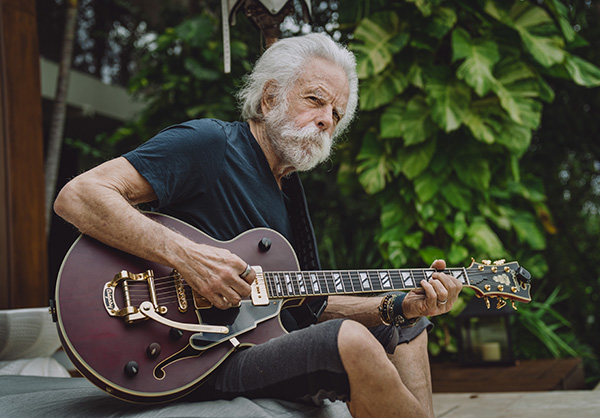
The Grateful Dead ushered in an era of open-minded experimentation and endless touring that paused occasionally but never really expired until its participants did. It follows that saying goodbye to cofounding Grateful Dead guitarist/vocalist Bob Weir, who passed away at age 78 on January 10, 2026, truly signifies the end of an era.
That phrase—the end of an era—gets thrown around too much when musicians of a certain stature die. But when it comes to Weir, one of the last, strongest, most direct connections to the mid-1960s migratory music movement that's as vibrant today as it ever was, its use is warranted.
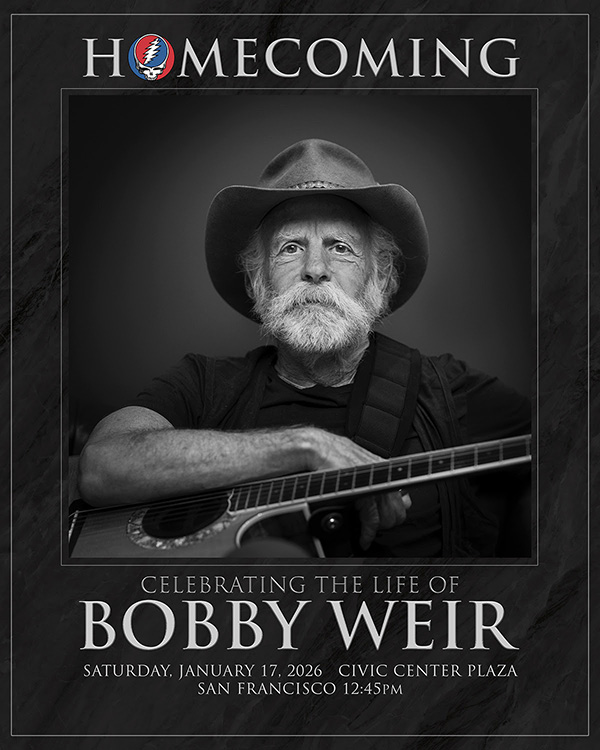
With Weir's passing, the extended Grateful Dead family may have finally heeded its truly final "fare thee well" once and for all—but they sure went out with a bang. Dead & Company, the latest (and last) Weir-led Dead offshoot collective, didn't merely wrap a series of triumphant "Dead Forever" live outings at The Sphere in Las Vegas in May 2025; it followed them with a trio of dates celebrating the original band's 60th anniversary in the Dead's hometown of San Francisco in August 2025, which turned out to be the very last shows Weir played. Then one of his Dead & Company bandmates, guitarist/vocalist John Mayer—plus key guests including Joan Baez and former Dead percussionist Mickey Hart—sent Weir off with "Homecoming," a memorial celebration in San Francisco's Civic Center Plaza on January 17, 2026, just a week after Weir's passing. It's now fair to say that the "Homecoming" event truly marked—wait for it—the end of an era.
"He's one of one," guitarist
Derek Trucks, who played with Weir in various musical settings over the years, told me recently in a Zoom interview. "I think Bob's one of those guys that developed
inside that band, because he was not fully formed until he got there. He was an incredibly intelligent guy. The Dead were a social experiment, an acid experiment—they were a lot of things—and with all those musicians around him, Bob was a sponge. Sue traveled and played with those guys a bunch (footnote 1), and she also became close with Bob. He's obviously a big loss musically—but personally, this one feels like you lost a
buddy, you know?
"For me, Bob's thing was macro, not micro," Trucks continued, "and the Dead were easy to underestimate because I didn't grow up with that music, so I didn't think about it a lot. But I remember the first time meeting Bob and really being
around him—and then every time I was around the Dead, I was like, 'Oh my God, these guys know a
lot about a lot of different stuff.' Whatever esoteric kind of music I thought I was into, they had some story about it or some real direct connection to it."
Is there one example of "Maximum Bob"—something Weir played that Trucks feels represented the artist to the core? "For me, the thing that hits me more than a song was when we were down in Mexico doing the Dead Ahead thing—Sturgill Simpson, Sue, and me," (footnote 2) Trucks replied. "It was the first time it really dawned on me that 'Oh,
this is the guy who's carrying on this whole thing.' When we were onstage there with him—just the way he was guiding it and moving it, I think it's the most moved I've been by that music and the most I ever felt a part of it. Even though I toured with Phil and had some incredible moments (footnote 3), it was the first time it really hit me, like, 'This is the guy.' It also happened with Gregg Allman at one point, where I realized when I was standing onstage with him, 'Oh, you turned into the thing that you loved.
You're that guy now.' Gregg always wanted to be an old blues man. Bob kinda did that, too. He became like Pete Seeger, Woody Guthrie, or any of those other early musicians. He was carrying the whole damn songbook."
"Most guitar players that I knew seemed to gravitate more to Jerry Garcia (footnote 4) because of his lead guitar playing, but since I wasn't very accomplished at lead lines and my scales at the time, it was Bob Weir I ended up dialing into," recalled Canadian guitarist/vocalist Julian Taylor, who had the good fortune to join Weir onstage in 2024 (footnote 5). I spoke to Taylor in an interview. "I've been a huge fan of the Dead ever since I was about 12 years old. I'd sit and learn their songs at campfires and park parties, and even on the lawn outside of my high school from time to time. As a kid who grew up with soul music, jazz, and a lot of blues in my home, Bob's rhythm playing really struck me—and it stuck to me. It felt like it was the glue holding things together."
I've always thought it was the rhythm guitar and the drums that held my favorite bands together and made them groove and roll," Taylor continued. "Like The Stones had Keith [Richards] and Charlie [Watts] and The Beatles had [ John] Lennon and Ringo [Starr], the Dead had Bob and Mickey. And I just love the way Bob's style incorporates all genres. His playing is like a metronome."
Some artists take their own sweet time finding their way to uncovering the magic of Weir and the Dead—but once they do, look out. "Truth be told, I wasn't that hip to the Dead until well into my 20s, years after the formation of The Dream Syndicate," observed DS guitarist/vocalist Steve Wynn in a lengthy email exchange conducted while he was on tour in Europe this past spring. "And that's strange, since over time, I've realized how much our love of expansive exploration onstage and embracing sonic derailment as an opportunity to get even higher is straight out of the handbook of Jerry, Bob, and company."
What took him so long? "It really wasn't some kind of punk-rock stance or commentary on the scene surrounding the band. I just hadn't found the way in—the almighty key to the door. And one day it just clicked. My friend and bandmate Robert Lloyd, quite the Dead fan himself, made just the right cassette comp with just the right tunes, and then he took me to see the band at the Long Beach Arena in 1987—and I was hooked.
"I like to think of my various combos—and particularly the interplay I've had with Dream Syndicate guitarist Jason Victor—as the continuation of the somewhat archaic, sometimes dying but never dead tradition of two guitarists weaving, bobbing, and playing off each other," he observed. "Two parts greater than the whole has been done best by the likes of Keith Richards and Ron Wood, Tom Verlaine and Richard Lloyd, Neil Young and Danny Whitten/Frank Sampedro—and, yes, Jerry Garcia and Bob Weir in the Dead." (footnote 6)
Like Julian Taylor, Wynn has a fine appreciation for Weir's rhythmic prowess. "Over time, I realized that the
sound that feels like the Dead is in fact coming from Bob's guitar—and it's a sound that reflects community, elasticity, humor, and both engagement
and casual diffidence," he explained. "It's so damn cool. Now, I enjoy taking a solo or two, but I mostly consider myself a rhythm guitarist. I'd like my musician membership card to say 'rhythm section.' I hang with the drummer and the bass player and like to duke it out with the lead guitarist or our other soloist.
I like to be the glue, adding whatever roux needs to go into the pot as needed—and that's what I think Bob Weir brought to the Dead.
"In the days after Weir's sad passing, a friend of mine sent a YouTube audio clip of Bob's guitar solo in a live version of 'Bertha,' and I just listened to it over and over," Wynn continued. "There was no pattern, no part—just a constantly evolving motion of chords, lines, two notes, three notes,
all notes, whatever worked, whatever was needed. He was the weathervane, the weather map of what was going down and what to expect—the lightning rod of the on-stage action. I listened to it over and over, and when I was touring across Europe with The Dream Syndicate this spring, I'd often stretch a song to its limits and find myself thinking, 'Hey, what would Bob Weir do?' It's a nice, groovy voice in my head, and it felt good hearing it every night onstage. Fly high, Bob Weir."
 Choice cuts
The Dead's live prowess is legendary, and master rhythmatist Weir's takes on extended live tracks like "Dark Star" and "Turn on Your Love Light" are clinics. Back in 2014, I discussed those two songs during a phone interview with Tom Constanten, the Dead's keyboardist from 1968 to '70.
"I look upon the performances of those pieces then as one single continuum," he told me. "'Dark Star' was a piece we didn't so much begin and end as we enter it in progress, you know? It was free and flowing and different every time. They say insanity is doing something over and over and expecting a different result—that just isn't true. In the '60s, we played 'Love Light' and 'Dark Star' over and over and over, and we could
count on the result being different. I think we had a much better set at the Fillmore East because we all played well there—and any time we were there, 'Dark Star'
killed. It's been a continuously wondrous adventure, or as some people have put it, a long strange trip."
It's nearly impossible to pinpoint my singular favorite performance of "Dark Star," but if pressed, I'd cite the version that appears on the
RFK Stadium, Washington, DC (6/10/73) four-CD portion of Rhino's 17-CD box set
Here Comes Sunshine 1973, released in June 2023. The whole
RFK '73 show is an Owsley "Bear" Stanley–recorded, dead-on Dead classic that features "Morning Dew" as the opener. Guitarist Dickey Betts and drummer Butch Trucks of The Allman Brothers Band join in for a final set that includes a heady run through Bob Dylan's "It Takes a Lot to Laugh, It Takes a Train to Cry" and an epic "Not Fade Away," with some special song-segue twists and turns that I won't spoil here.
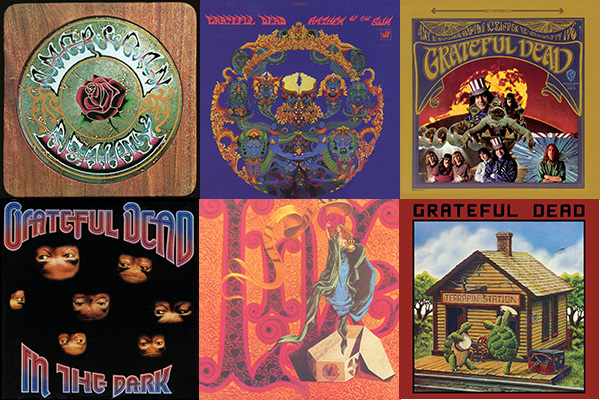
Weir's recorded legacy is intimately intertwined in both studio and live recordings—but it took the Dead a few good years to get the balance right. From the Dead's studio-recording universe, I'm partial to acknowledged Weir-led classics like "The Other One," which evolved from the third section of "That's It for the Other One"; the full-side suite on 1968's
Anthem of the Sun; "Sugar Magnolia" from 1970's
American Beauty; "Jack Straw" from 1972's
Europe '72; "Weather Report Suite" from 1973's
Wake of the Flood; and "Estimated Prophet" from 1977's
Terrapin Station. I also tip my skeletal top hat to a trio of joyfully buoyant songs from Weir's first solo album, 1972's
Ace (Warner Bros.): "Greatest Story Ever Told," One More Saturday Night," and "Playing in the Band." All became live Dead staples over the ensuing years.
My favorite latter-era studio Dead cut with Weir at its forefront is "Hell in a Bucket," from 1987's
In the Dark (Arista). That album's basic tracks were recorded live onstage at Marin Veterans' Memorial Auditorium in San Rafael, California (without an audience). "Bucket" has that off-the-cuff, live feel the Dead often failed to nail in standard studio settings. On "Bucket," Weir has his fun by changing the inflections and extending the vowel in the word "ride" in the back half of the song—and I'm still a sucker for the revving motorcycle and whipcrack sound effects. "Seems like the least I could do," indeed.
"The Music Never Stopped" is another long-beloved Weir track—and Rhino's September 2025 50th anniversary edition Blu-ray of the Dead album it lives on, 1975's
Blues for Allah, includes a Dolby Atmos mix by the omnipresent Steven Wilson, who understands how to put the listener in the middle of the Dead experience without it being jarring or off-putting. Weir's lead vocal on "The Music Never Stopped" is panned wide across the front channels, while the finger-snap percussion and handclaps, Steven Schuster's reeds, and Donna Godchaux's brief outburst of laughter nestle in the height channels. Jerry Garcia's guitar leads are over on the right, and Weir's rhythm accents and counters are mainly in the left side channel, especially during Garcia's second break. The "oooh" harmonies are summed to the rear channels—and you should be able to catch Garcia going "yeah, yeah" back there at some point, too.
The lines in "The Music Never Stopped" I cherish most, courtesy of Weir and his songwriting partner/foil John Perry Barlow, forever remain: "There's a band out on the highway / They're high steppin' into town / It's a rainbow full of sound / It's fireworks calliopes and clowns." That may well be the best-ever description of the combined band/Deadhead–acid/music mind meld experience.
I absolutely
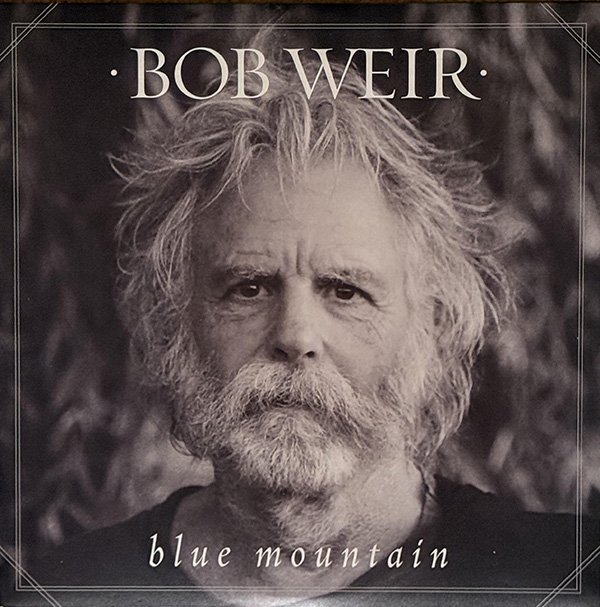
love Weir's final solo studio recording, 2016's two-LP
Blue Mountain (Columbia/Legacy/ROAR 88985366991), a detailed reminiscence of the time he spent as a teenage ranch hand in Wyoming.
Blue Mountain presents a cowboy-movie sound template that may best represent Weir's deep-seated jug-band and Americana roots.
Blue Mountain's opening track, "Only a River," bears the wisdom of a life long lived and well considered. Weir's throaty lead vocal is measured and deliberate, dolloped with the right amount of reverb, placed right down the middle, and accented by Josh Kaufman's mandolin and Rob Burger's orchestron (a 1970s-era keyboard). "Only a river gonna make things right," Weir repeats a number of times toward the end, the level of his insistence ratcheting up in intensity until the fade. The song's pure bookend, the foreboding album closer "One More River to Cross," eerily foretells things to come, and I love the way the backing vocalists, the Bandana Splits (is that a great band name or what?), fall in behind him each time he sings the title phase.
With 12 songs spread across four sides of 150gm vinyl,
Blue Mountain is a most fitting cap to Weir's five-decade-long studio-recording career.
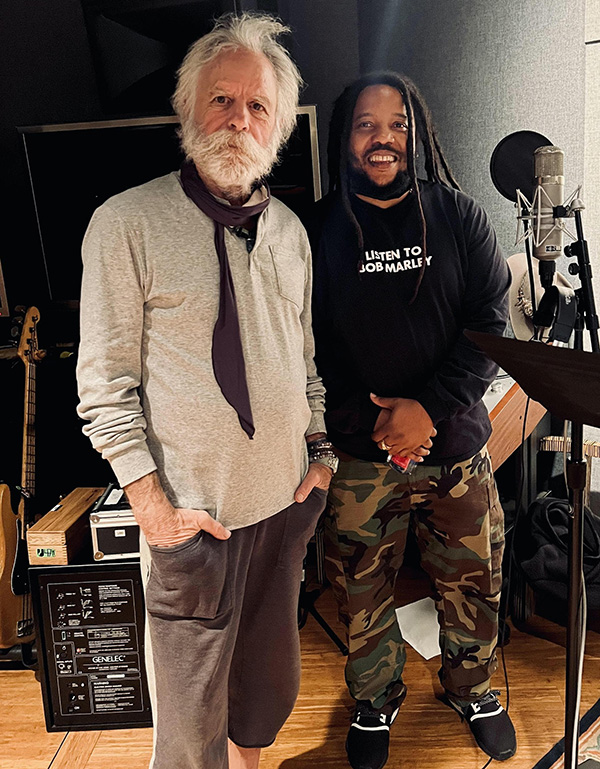
Bob Weir with Stephen Marley 2023. (Photo Courtesy of Silverback Music)
Never stopped
Going back to a telling lyrical moment in the aforementioned
Blue Mountain song "One More River to Cross," Weir seemed to have the end of the road clearly in his mind's eye: "I tried to be good for most of my life / Never done wrong when I knew what was right / So when I cross over my heart will be light / One more river to cross." Constanten, Weir's onetime keyboard brother in the Dead, understood from the jump the vibe of the artist's intent. "It's wonderful when the light shines down through the years," he concluded. "And it's a wonderful thing to share the light with those who will come to it in the future."
Amen to Bob Weir. May the four winds blow you safely home.
Footnote 1: Sue is Susan Tedeschi, Trucks's wife, who is also the lead vocalist/guitarist in Tedeschi Trucks Band. Tedeschi toured with Weir, original Dead drummers Mickey Hart and Bill Kreutzmann, and original Dead bassist Phil Lesh as The Other Ones in 2002.
Footnote 2: The Dead Ahead band turned in a one-off performance at the Dead Ahead Festival at Moon Palace Cancún Resort in Cancún, Mexico, on January 14, 2024. The short-lived band featured Trucks, Tedeschi, Simpson, Hart, and Weir along with Dead & Company bandmates Jay Lane and Jeff Chimenti. Oteil Burbridge played bass in the first set; Don Was handled bass in the second.
Footnote 3: Phil Lesh and Friends was an ongoing side project formed by the bassist after the Dead disbanded in 1995. Lesh passed away in 2024 at age 84.
Footnote 4: Jerry Garcia passed away in 1995 at age 53.
Stereophile's tributes can be found
here and an appreciation of both the Grateful Dead and Jerry Garcia by erstwhile Audio Engineering Society President Dr. Elizabeth Cohen
here.—
John Atkinson
Footnote 5: Taylor participated in the all-star tribute event "Life Is a Carnival: A Musical Celebration of Robbie Robertson," which took place at the Kia Forum in Inglewood, California, on October 17, 2024. Weir performed The Band classic "When I Paint My Masterpiece," which the Dead covered often, and joined Mavis Staples and Trey Anastasio on "The Weight," which also featured many of the night's performers, including Taylor.
Footnote 6: In The Rolling Stones, early punk band Television, and Crazy Horse, respectively.