Turntables:
A+:
BennyAudio Odyssey: $45,300 with 14" tonearm
This massive belt-drive turntable measures 15" wide × 10" high × 15" deep, and weighs 130 lb. The multilayer platter alone weighs more than 38 lb and is powered by a brushless three-phase, eight-pole, 20W motor via a Delrin pulley and a 3mm round, vinyl methyl silicone (VMQ) elastomer belt. The motor is governed by a custom-programmed microcontroller and features soft start and stop, continuous speed control via an open-loop system that monitors and corrects platter speed after each revolution, adaptive speed correction with a range of ±8°, smooth torque adjustment, and a rotary switch. The 14" unipivot arm’s effective mass ranges between 18gm and 30gm depending on whether a carbon fiber or titanium headshell is used. The internal wiring is silver core. Ken Micallef auditioned the Odyssey with his Benz Micro Gullwing cartridge and the optional Hexmat Eclipse record mat ($300–$375), which contacts the platter at a limited number of small, defined support points. “The Odyssey is a master at reproducing primal punch and conveying emotional weight,” he noted, adding that the Odyssey delivered everything a circa $50k ’table should: a massive soundstage, fat, bloody images, an ink-black background, and charged dynamics. What really captured his attention, though, “was its naturalness, rhythmic speed and weight, and sheer corporeal chunk.” Micallef concluded that the BennyAudio Odyssey was “a divine, sense-expanding machine that delivers total tonal saturation, translating the emotion of a record as if it were purpose-built for the task.” (Vol.49 No.6 WWW) Esoteric Grandioso T1: $85,000; $92,000 with TA-9D arm
The Grandioso T1 weighs a shelf-flexing 140 lb. Up to three tonearms can be accommodated, and Esoteric offers more than a dozen predrilled armboards; the review sample came equipped with Esoteric’s TA-9D tonearm, an OEM version of the superb Ikeda Sound Labs IT-345, which itself descends from the Fidelity Research FR-64. Unusually, 80% of the hefty platter’s mass is supported by opposing magnets on the platter’s underside and the top of the plinth. The drive system is also unusual: attached to the motor is a cylinder fitted with a set of alternating-polarity magnetic strips around its perimeter; on the bottom of the platter is what Esoteric calls an induction wheel: a series of vertical indentations cut into the lower edge of the platter that interact with the magnetic driver to rotate the platter. A set of plastic spacers allows the motor assembly to be precisely positioned so that the magnetic driver is very close to, but never touching, the induction wheel. A knob next to the display fine-tunes the distance between the magnetic driver and the induction wheel, changing the coupling strength, hence the drive system’s torque. Michael Trei liked the T1 best when the torque was cranked up to deliver the most PRaT, though the more relaxed sound resulting from lower torque seemed more appropriate for some music. Playing a track from PJ Harvey’s album Rid of Me on the T1, Trei felt like he was sitting in the room with the band, with audible images so well-defined that he could draw a picture showing the precise dimensions of the (rather small) space and exactly where everyone was within it. “This was the best I’ve heard this record in my system and room,” he wrote. “It somehow managed to combine the transparency and resolution of the Brinkmann [LaGrange], the dynamics and bass drive of the SME [30/2], and the PRaT (pace, rhythm, and timing) of the Roksan [TMS].” Trei concluded that The Esoteric T1 was the first turntable he’s heard in his system that could replace all of his reference turntables on a sonic level. (Vol.49 No.9 WWW) Garrard 301 Advanced: $65,000 with SME VA-12 tonearm
Michael Trei described this turntable, a painstakingly restored original Garrard 301 from the 1960s mounted in a heavy plinth made from advanced polymer resin (APR) and partnered with a 12" tonearm from SME (not sold separately), in June 2025, but it turned out that the review sample had suffered damage in shipping. He auditioned a better-packed sample in Spin Doctor #31, fitted with Lyra Atlas λ Lambda and Audio Technica AT-ART1000X cartridges. Trei found that, as well as offering superb measured performance, the 301 Advanced excelled at conveying the forward momentum of the music, what the British like to call PRaT (pace, rhythm, and timing). The 301 played a Kraftwerk track with fluidity and body and no artificial mechanical character despite the music itself being about as mechanical as it gets. “Transients were fast and as clean as a whistle, allowing the cartridge to track this dynamic track with complete security and not a hint of brittleness,” he wrote and concluded that “The engineers at Garrard/SME have done an extraordinary job of making this 60-year turntable look and sound brand new. I just wish its pricing didn’t leave it out of reach for so many people.” (Vol.48 Nos.6 & 12 WWW)
J.Sikora Standard Max Supreme: $40,790 in standard finish w/o tonearm
“The Standard Max Supreme is built like a heavy-metal layer cake, each massive section supporting another, from its oversized isolation platform to its 40 lb Delrin platter and its massive record weight,” wrote Ken Micallef about this Polish belt-drive turntable. Robert Sikora wrote that compared with the regular Max, “the separating layers at the base of the platter are now made of steel and solid brass plates. The motor housings … are made of 1cm–thick stainless steel, with improved internal damping. The bases of the motor housings are made of a 2cm–thick layer of brass.” The two EBM-Papst DC asynchronous motors are powered by an outboard supply, crowned with a CNC-machined anodized aluminum pulley, and housed within 1cm-thick Inox stainless steel enclosures. With the turntable fitted with J. Sikora’s silica-damped KV9 Max Zirconium unipivot tonearm ($11,750) and a MoFi UltraGold MC cartridge, Micallef found his attention shifted away from even the most important details—tone, texture, separation—and toward “the delicate spaces between notes, the interplay of musicians, the palpable air pressure in the recording space, the distances between performers in the studio.” He added that the Standard Max Supreme “proved one of the most rhythmically adept players I have encountered. It precisely communicated nuances of time, tempo, groove, and swing.” He concluded that, while the price is high, “the profound musicality it delivers renders the price justifiable.” (Vol.48 No.4 WWW) SME Model 60, includes SME Model VA tonearm: $75,789
This suspended, mass-loaded, belt-driven, flagship turntable comes preinstalled with SME’s Series VA tonearm, which is not available separately. The Model 60’s price depends on the finish: a honeycomb finish adds $7000; a diamond-polished finish adds $14,000. Offers 33⅓ and 45 rpm speeds only. “Intense dynamics and tight, powerful bass extension have long been hallmarks of SME turntables, and the Model 60 pushes that reputation even further,” wrote Michael Trei, adding that the Model 60 “also offers a sense of ease and effortlessness.” He summed up the Model 60 by writing “This turntable is capable of extracting an astonishing amount of music from the record groove. It should be considered the new real-world reference against which other turntables can be judged.” On Paul Miller’s test bench, the turntable’s sintered bronze bearing, with its oil-damped ball, was so precisely machined and polished that both through-groove and through-bearing rumble were truly state-of-the-art. The tonearm, which has a cast-magnesium-alloy armtube, featured a “freedom from complex resonance, and general clutter [that] was quite remarkable,” concluded Paul Miller. (Vol.46 No.8 WWW) A: Acoustic Signature Verona NEO: $18,999 in Macassar Ebony or Piano Black
The Verona NEO is a massive, high-performance, belt-drive German turntable with two motors and an external power supply. It can be fitted with two Acoustic Signature NEO tonearms; see Tonearms. “The Verona NEO may disguise its heavyweight approach behind a pretty wood veneer exterior, but it doesn’t hold anything back sonically,” Michael Trei wrote. He described the Acoustic Signature house sound as characterized by “solid, lean, powerful bass and rock ’em sock ’em dynamics.” He summed up his time with the Verona NEO by writing, “At around $16k plus the cost of the tonearm, the Verona NEO offers performance that is truly reference quality at a price that hopefully won’t require you to take out a second mortgage.” (Vol.47 No.6 WWW)
AMG Giro MK II: $9400 without tonearm ★
Significantly upgraded compared with the original Giro that Herb Reichert favorably reviewed in 2017, the MK II features a thicker, 40% heavier platter, which gives it a substantial increase in mass and rotational inertia, hence improved speed stability. Drive for 33⅓ and 45 is still via belt from a DC motor, with a switch-mode supply supplied as standard. (An outboard linear power supply is available as an optional upgrade for $1200.) Tonearm is still AMG’s 9W2—see Tonearms—with its wiring terminated in a DIN socket. The Giro doesn’t come with a standard tonearm cable; rather, AMG offers four levels made for them by Cardas: the Basic ($300), Standard ($600), Reference ($1500), and Turbo ($2250). The review sample came with the Reference cable. Michael Trei found setting up the Giro straightforward but noted that as the turntable doesn’t offer any isolation, care needs to be taken choosing where and on what to place it. Using a Benz SLR Gullwing phono cartridge, Trei commented on the excellent retrieval of recorded detail offered by the AMG “without muddling the sound or glossing over details.” He was also impressed by the player’s speed stability, commenting that with a close-miked piano recording the Giro was “able to combine tonal richness with the solidity you get from piano chords when there’s no insecurity or waffling about pitch.” (Vol.45 No.12 WWW) Dr. Feickert Analogue Blackbird: $8995 ★
The standard Feickert Blackbird is a belt-driven turntable in which a Delrin platter is propelled by two (!) high-torque AC motors, with provisions for mounting two tonearms. Its plinth is an aluminum-MDF-aluminum sandwich done up in a black Nextel finish. As reviewed by Herb Reichert, fitted with Jelco’s knife-bearing TK-850L tonearm and optional DIN-to-RCA cable, and upgraded with eight inertia-enhancing brass platter weights and a glossy wood finish ($9345 total), the Blackbird ingratiated itself in no time: “I admired the Dr. Feickert Analogue Blackbird the minute I set it up. After a couple of weeks, I was ready to propose marriage.” As Herb describes it, “bass through the Feickert-Jelco combo was tighter and more vigorous” than with his AMG G9 player (see elsewhere in “Recommended Components”), and compared to even his Linn LP12, the Blackbird impressed him by re-creating musical momentum in a way that was “noticeably more visceral.” Five years after his original review, and having used the Blackbird with dozens of cartridges and three tonearms, Reichert commented that this turntable moved music forward with a force and momentum that he attributed to the “coercive pull” of the Blackbird’s belt-drive motors. He also noted that another contributor to the Blackbird’s quiet, solid sound was the way the platter mated the record. Promoted to Class A following Herb’s long-term experience, in particular his revisit in Vol.46 No.11. (Vol.41 No.12, Vol.46 No.11 WWW) EMT 928 II: $12,995 without tonearm, $19,995 with EMT 909-HI tonearm, $24,995 with tonearm and EMT JSD Pure Black phono cartridge
Ken Micallef auditioned this belt-drive, three-speed, battery-powered turntable with EMT’s 909-HI 9" static-balance tonearm and EMT’s JSD Pure Black phono cartridge. The first qualities he noticed with the player powered with AC were “a banging sense of drive and impressive note-by-note resolution. Regardless of what phono stage or amplifier I used, it played music forcefully and subtly, capturing not just forceful rhythm but also the soundstage cues that make music sound real and alive and the intricate shifts of attention and focus that convey the presence of living, breathing musicians.” Changing to battery power, he found that piano and drums became cleaner and somehow lighter while bass became weightier and better defined. “The most surprising thing was that the music sounded louder, more upfront,” he commented. (Vol.47 No.9 WWW)
European Audio Team F-Dur: $6750; $11,999 with F-Note 12" tonearm
The review sample of this Austrian-designed, Czech-made, belt-drive turntable was fitted with the EAT F-Note 12" tonearm. Price with EAT’s C-Note tonearm is $8499. The 14" diameter, 25 lb, CNC-machined aluminum platter contains a TPE (thermoplastic elastomer) damping ring on its underside for resonance control. The platter is driven by two AC motors, each with its own belt, and rides on a magnetically supported, inverted main bearing, supported by a ceramic ball chosen for its hardness and low friction. The MDF plinth of the F-Dur sits on four TPE-damped, height-adjustable aluminum feet. Ken Micallef auditioned the F-Dur with an EAT Jo No.5 MC cartridge installed in the F-Note tonearm. Compared with his vintage Thorens TD-124 fitted with a Korf TA-SF9 tonearm and an Ortofon 2M Black LVB 250 MM cartridge, voices carried more weight with the EAT combo, the soundstage swelled and was filled out, and the presentation felt richer. “The F-Dur consistently surprised me with its ability to surprise. Even as it expanded the soundstage, it assembled the many elements of a recording into a well-polished, cohesive, refined whole,” wrote Micallef. (Vol.48 No.11 WWW) Gold Note Mediterraneo X: $14,995 w/B-7 Ceramic X tonearm
This elegant turntable combines traditional materials with touch-friendly digital technology in arresting fashion, wrote Ken Micallef when he first encountered the Italian Mediterraneo X at a show. Unusually, the belt-drive turntable’s motor has two torque settings: high torque results in a performance reminiscent of direct drive; low torque is more in line with the sound of the belt drive. The B-7 Ceramic X tonearm uses a headshell made from 6000-series aluminum alloy for resonance control and a titanium wand, this stabilized with four high-precision ceramic ball bearings. A touchscreen controls power, torque, rotation speed, a cartridge timer, display brightness, and even cartridge selection. Once the Mediterraneo X was set up in his system, using a VPI Shyla phono cartridge, Micallef noted that it was “one quiet record player. In my informal tests, tapping, poking, or rapping on its plinth during playback caused zero vibration/rumble/noise to its cartridge/tonearm assembly.” He summed up his time with the turntable by writing “though smooth and quiet, it never strays into blandness or homogeneity. It boasts exceptional forward momentum and, with the right cartridge, faithful adherence to the recorded source. This Gold Note ’table delivers a consistent, flowing, nonmechanical musical experience.” (Vol.47 No.3 WWW) J.Sikora Aspire: $10,595 with Aspire tonearm
This “entry-level” belt-drive turntable from Polish manufacturer J.Sikora keeps the stainless steel bearing from the higher-priced models, along with the isolation feet, controller, EBM-Papst DC motor, metal cueing lever, unipivot housing, and brass counterweights. The hefty, low-slung plinth is machined from a single aluminum billet and topped by a cast iron and stainless steel subplatter and a 2"-thick Delrin platter. The oil-damped, unipivot Aspire tonearm features a carbon fiber armwand. Ken Micallef used several cartridges during the review and was struck by how effortlessly they all paired with the Aspire tonearm. Playing oud player Rabih Abou-Khalil’s Nafas, the Aspire mined this album for “depth, girth, pressure, and focus, weaving subtle yet intense macro- and microdynamics that form music’s core.” Compared with Micallef’s vintage Thorens TD 124 he’d give the Aspire the edge in flow if not sheer drive. “But add in its cosmetic beauty, the unnervingly dark backgrounds it produces, its superquiet demeanor, its ability to expose cartridge differences, its massive bass fundamentals, and its commanding stage and scale, and the Aspire is clearly a winner,” Micallef concluded. (Vol.49 No.4 WWW)
Kuzma Stabi M: $31,985 as tested with walnut front and side panels
With its rectangular plinth and tinted, hinged 9 lb dust cover, the massive, suspended-design Stabi M gives off a retro vibe, “like an older Linn or Thorens that’s been going to the gym.” The turntable’s plinth is finished in heavily textured matte-black paint. The review sample came with the optional walnut panels on the front and sides, a $1686 option; for an additional $2909, you can get the Kuzma in a choice of colors from the RAL color chart. “If you really want to add some bling, get the polished solid-brass panels for $6792 extra,” advised Michael Trei. The Stabi M’s outer frame is constructed from bolted-together slabs of aluminum, with three adjustable feet for leveling. Four cylindrical pods within the frame, some kind of elastic damping material embedded in them, support a heavy aluminum top plate that cradles the tonearm board and platter bearing. The motor is suspended from the top plate, embedded in a heavy brass housing to damp vibrations. Four knobs on the top side can be adjusted to level the top plate and platter within the frame. The main bearing is an inverted design, supporting the aluminum subplatter on a tiny ruby ball. The hefty, 27 lb platter has two aluminum layers bolted around an acrylic layer, combining high rotational inertia and exceptional damping. Trei auditioned the Stabi M with Kuzma’s Safir 9 tonearm (see Tonearms) and cartridges from Lyra, Ortofon, and DS Audio. Playing a Telarc organ recording, as expected, the bass was as deep, clear, and powerful as he’s heard through his system, but what really struck him was the rest of the sound. His attention was drawn to the volume of air, the way notes hung in the acoustical space of Boston’s Symphony Hall, and how each stop’s tone was so clearly contrasted. “This turntable lays your recordings bare,” wrote Trei, “allowing you to hear the inherent beauty in the music making rather than creating a ‘warm analog’ sound. Such sonic honesty will deliver lasting musical enjoyment.” (Vol.48 No.9 WWW) Pure Fidelity Harmony: $9995 including the Encounter Mark 4 Orgin Live Tonearm ★
This Canadian turntable’s price includes the Conductor power supply, SS-10 Record Isolator clamp, three IsoAcoustics GAIA IV feet, and Origin Live Encounter tonearm. (This dual-pivot arm was reviewed by Michael Fremer in July 2004.) The review sample’s premium Quilted Maple finish adds $500. The 2", Ultra MDF plinth sits on a 19 lb isolation platform formed from aluminum alloy and is said to be virtually resonance-free and completely neutral in sound. Ken Micallef found that the Harmony fitted with the Origin Live tonearm and Pure Fidelity’s Stratos phono cartridge “took me on a joy ride, exuding all the liveliness and pace, rhythm, and timing of any well-made low-mass ‘table but with a neutral tonal balance and a vice-like low-end grip.” Micallef’s conclusion: “The Pure Fidelity Harmony brings a beautiful sonic signature to vinyl but with enough transparency to reveal the unique personality of each LP. … The Pure Fidelity Harmony is one of the finest analog playback machines I’ve heard, worth every penny of its $9995 asking price.” (Vol.45 No.12 WWW) Rega Naia: $14,995 w/tonearm
Based on the cost-no-object, limited-edition Naiaid, the top-of-the-line Naia resembles Rega’s Planar 10 and Planar 8. It uses the same skeletal plinth, built from a lightweight polyurethane foam core sandwiched between top and bottom layers of laminate and to maximize stability the belt-driven ceramic platter concentrates its mass at the rim. The Naia uses Rega’s familiar one-piece aluminum armtube, this fitted with an ultra-lightweight titanium bearing structure to minimize resonances. There is no provision for adjusting the cartridge’s azimuth or stylus rake angle, because Rega is adamant that this would compromise the structural rigidity, but a 2mm shim can be added at the arm mount if you want to use a particularly tall cartridge. The review sample was fitted with Rega’s Aphelion 2 MC cartridge ($5545 when sold separately), which brings the package price, including the Reference Power Supply, to $16,995. Michael Trei was immediately struck by how tidy and controlled the Naia/Aphelion 2 combination sounded, allowing him to focus on the music making. The Naia nails pace, rhythm, and timing “with extreme confidence,” he wrote, and concluded that the Naia “is compact, lightweight, and supremely easy to set up and get the best from. Most importantly, it sounds superb and pulls music from the grooves of a record better than the vast majority of turntables.” (Vol.48 No.1 WWW)
Technics SL-1200G: $4999.99 incl. tonearm, available in black or silver ★
Derived from Technics’s limited-edition SL-1200GAE, the three-speed, direct-drive SL-1200G bears little resemblance to the original ’1200 from the 1970s that had come to be a deejay favorite. It is an entirely new design “created for audiophiles.” The original SL-1200’s tonearm—“easily the chintziest thing about that turntable,” said Alex Halberstadt—has been reimagined, with a new armtube made of cold-drawn magnesium. The arm’s gimbal bearings revealed zero wiggle or twist, noted Halberstadt, who also found that the turntable rotated at exactly 33 1/3rpm with just 0.014% wow & flutter. Halberstadt installed a Dynavector Te Kaitora Rua cartridge in the tonearm’s detachable headshell and started listening. “In stock form, it sounded solid, agile, and impressively neutral, but also noticeably smaller, grayer, and more mechanical—with shorter note decay—than my Garrard 301/Schick/Box Furniture Co. record player,” he wrote. After replacing the stock mat with a Trans-Fi Reso-Mat, “the Technics produced a far larger soundfield, with obviously greater resolution and instrument separation and less apparent noise.” Replacing the stock headshell with either the DS Audio HE-001 or Schick graphite headshells improved tracking with the Dynavector “and lent the music more solidity and color.” Halberstadt then switched the turntable’s torque control from automatic to manual and reduced the torque by about a third of a revolution. “The turntable sounded mostly the same,” he noted, “but its somewhat mechanical, uptight character was nearly gone; now the music flowed and shimmied more convincingly. I also heard improved sustain and decay.” Overall, he could think of few turntables that offer as much value as the SL-1200G, adding that the quality of its engineering and execution “makes typical audiophile products look slightly homemade.” (Vol.45 No.12 WWW) Technics SL-1200GME/1210GME: $6599.99
This limited-edition—only 1200 SL-1200GMEs and 1210 SL-1210GMEs will be made—three-speed, direct-drive turntable features a digitally controlled twin-rotor, coreless, brushless DC motor, a 4-layer body, a magnesium S-shaped tonearm, and a 3-layer diecast aluminum, rubber, and brass platter. There are two versions: the SL-1200GME has a silver finish, the SL-1210GME a black finish. The turntable is supplied with a deluxe Technics headshell with gold-plated wire terminals and a standard plastic Technics alignment gauge (optimized for a Stevenson-like alignment). Tom Fine used a SL-1210GME with a Hana SL MK II cartridge and right away noticed that the combination was copacetic and minimized background noise. “With all the audible whoosh and rumble gone, the music danced out of the speakers and lived in the room,” he wrote, adding that his other cartridges—Ortofon 2M Blue and Bronze, Shure V15 Type III, and Audio-Technica AT-VM95—sounded exactly as expected, “though with quieter backgrounds, even more rock-solid pitch, and enhanced dynamics.” Fine bought the review sample: “That’s the strongest endorsement I can give.” (Vol.49 No.8 WWW) The Wand 14-4 Master: $8450; $15,255 with Dark-Light tonearm
Following his review of The Wand 14-4 turntable in January 2024, Michael Trei tried several upgrades, including optional battery motor drive and improved isolation feet. The Master incorporates the upgrades combines them into a much more elegant package. The plinth is now a two-layer affair, with the bottom level housing the battery motor–drive circuitry and the top layer isolated further by the lower plinth. A second tonearm can be mounted on an additional armboard on the lower plinth. Trei auditioned the Master with the Dark-Light tonearm (see Tonearms) to which he fitted either a Lyra Delos cartridge or an Ortofon MC 90X. With the Wand combo an early digital choral LP sounded refreshingly uncongested, with dynamic swings that were startling at times. Playing an album from jazz bassist Gary Peacock, Trei heard a level of refinement, clarity, and beauty of tone that he didn’t recall hearing with the original Wand turntable. (Vol.48 No.10 WWW)
The Wand 14-4: $9150 with Wand Master Lite 12" tonearm; $5800 without tonearm
This New Zealand–made belt-drive turntable’s name comes from its platter: the larger size (14") increases rotational inertia without adding significant mass; the platter has four layers including an aluminum/acrylic/aluminum sandwich (for damping), plus an acrylic mat to interface with the record. The 14-4 comes with a switching power supply; a battery supply is available as an option. A speed sensor under the platter automatically adjusts the speed; Michael Trei found the speed spot on at both 33⅓ and 45rpm. He used the 12" Wand tonearm with the 14-4 and warned that the arm’s length means that the cartridge ends up hovering precariously close to the power and speed-selector knob. “There are no compromises here, and few concessions to ease of setup and use,” Trei concluded. “But if you’re willing to put in the work and deal with the setup anxiety, your patience will be rewarded with extraordinary performance. The Wand excels in areas I consider fundamental to musical enjoyment, such as tonal color and timing. There’s nothing warm or sluggish sounding about The Wand, but because it’s able to resolve detail so well, it never sounds thin or anemic. ‘Vivid’ and ‘focused’ are the words that keep popping into my head.” Trei replaced the original turntable power supply with the EV Battery Power Supply, which takes the motor off the power grid using a battery housed in a separate enclosure styled to match the turntable’s design. He found that the EV battery made a small but repeatable improvement in resolution of low-level detail, raising the overall performance of the 14-4 by a notch or two. He then added a carbon-fiber platter mat. Compared with the bare acrylic surface of the stock platter, the new mat delivered improved detail and focus. (Vol.47 Nos.1 & 5 WWW) Thorens TD 404 DD: $6750
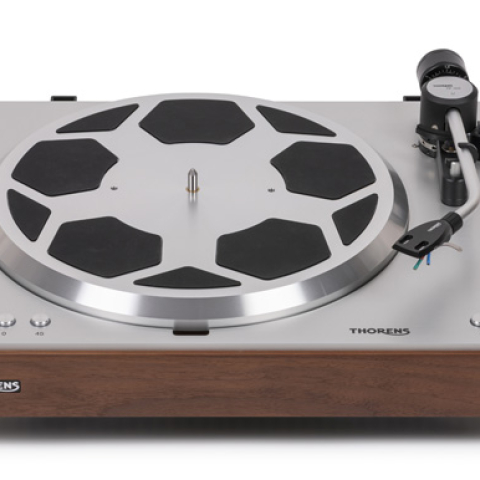
See Tom Fine’s review on p.137. (Vol.49 No.10) VPI Avenger Direct: $40,000 with tonearm
The review sample of this American turntable came with the 12" gimbaled version of the FatBoy tonearm ($4500 when purchased separately), the aluminum JMW Full VTA Base ($1500 separately), a direct drive assembly/motor, a machined aluminum platter, a vented chassis, a stainless steel Periphery Ring Clamp ($1300 separately), three air-suspension feet ($3450 separately), a VPI-branded alignment jig ($75 separately), a poly-weave platter mat, and a Signature record weight ($185 separately). With the Avenger/FatBoy combo fitted with an Ortofon Verismo MC cartridge and playing Henry Mancini’s “The Days of Wine and Roses” (from Our Man in Hollywood), Ken Micallef wrote that the Avenger Direct “mined all the musical detail, dimensionality, ambience, and opulence of the Mancini recording, but more importantly, it mined its emotions.” Micallef didn’t go into specifics regarding the player’s sonic character, writing instead that “I can’t help feeling it’s cheap to reduce the VPI’s performance to separate traits when its great strength is its presentation of such a unified, stirring whole.” His conclusion? “I don’t know what deed this Avenger is meant to avenge, but its place in the pantheon of great turntables is secure.” (Vol.46 No.6 WWW) Well Tempered Lab Amadeus 254 GT: $8750
The latest version of Bill Firebaugh’s classic belt-drive record player is manufactured in China for New Zealand–based Well Tempered Lab. The unique tonearm still hangs the armtube from a gantry and is still damped with a silicone bath. After installing an Ortofon Cadenza Bronze cartridge and even before he had optimized the tonearm damping, Alex Halberstadt noted that music sounded “irresistible,” an experience he found unsettling because he could not link it to any sonic criteria. “It was as though what I was experiencing happened entirely in the realm of musical interpretation,” he wrote. Subsequent listening, after the damping had been optimized, only deepened this impression. “Recordings played back through the Well Tempered ’table sounded more alive than I’d experienced them before, drawing my attention to the performances and making me notice musical nuances as opposed to sonic ones.” After he replaced the squash balls in the Amadeus’s suspension with birch balls that incorporated a layer of cork, as recommended by importer Mike Pranka, records sounded more consistently exciting and engaging, Halberstadt decided. Overall, “I cannot think of a more recommendable component,” he concluded. (Vol.47 No.6 WWW)
B:
Clearaudio Signature: $2500 by itself; $5000 as reviewed
The belt-drive Clearaudio Signature is a special edition of the new Concept Signature turntable, created exclusively for the US market. The review sample was fitted with Clearaudio’s Tracer Black Carbon Fiber tonearm ($3300 separately) and Clearaudio Professional Power 12V outboard power supply ($800 separately). The Signature’s plinth features constrained-layer construction, which is said to minimize vibrations. Its base is available in medium-density fiberboard or solid Baltic birch, with a satined plastic layer on top and a medium-density wood fiber layer on bottom. For an extra $500, customers can order the Baltic birch plinth upgrade consisting of pressure-formed, solid wood finished in light or dark stained wood. The 5 lb platter is made from POM thermoplastic. The AiR coreless motor is decoupled from the plinth by six rubber O-rings to improve vibration control and Tacho-Speed-Control (TSC) performs automatic speed calibration on startup. TSC then constantly monitors the rotational speed, providing real-time feedback to the control electronics so that the system can respond to dynamic influences such as stylus drag, belt tension, friction, or temperature. “The Signature proved its mettle as a graceful yet powerful machine, with transparency and flow its bywords,” decided Ken Micallef. “Clearaudio has achieved something special with the Signature/Tracer package, a system that held my rapt attention throughout the dozens of records I played on it, using different cartridges, phono stages, and speakers.” (Vol.48 No.1 WWW) Connected-Fidelity TT Hub: $5500; $6700 with Sorane TA-1 tonearm
Built primarily from bamboo ply, the British TT Hub is a three-layer, belt-drive design, with a rectangular base plinth that sits on four embedded, nonadjustable silicone rubber domed feet. The acrylic platter has a stiff but slightly compliant mat bonded to its top surface and sits directly on the subplatter. The platter bearing has a long shaft with sintered bronze bushings housed in aluminum that rides on a small sapphire ball with a PEEK (polyether ether ketone) thrust pad. Michael Trei used the TT Hub with a Sorane TA-1 9" tonearm (see Tonearms) and a Lyra Delos cartridge (see Phono Cartridges). He described the combo’s sound as “fast and pacey, not fat and deep like some more heavyweight designs.” “If there is such a thing as a British sound for turntables,” he wrote, “then the TT Hub has it in spades. I’m thinking of what my friend Herb Reichert likes to call the boogie factor, which makes you want to tap your toes and dance.” (Vol.48 No.5 WWW) Linn Sondek LP12: $3245 for turntable only in standard finish ★
Since 1972, Linn has devised and offered for their belt-drive, suspended-subchassis flagship all manner of upgrades; commendably, all have been retrofittable. Some standouts: The Lingo power-supply mod of 1990 minimizes the LP12’s propensity toward a slightly fat midbass and subjectively “adds an octave of low-bass extension,” according to John Atkinson. The Keel one-piece subchassis, tonearm board, and Linn-specific tonearm-mounting collar of 2006 makes “an unambiguous improvement in the LP12’s performance,” according to Art Dudley. And the Linn Radikal mod—a DC motor with an outboard switch-mode power supply—impressed Mr. D with “more force, more momentum, and a little more sheer grip on the notes.” At present, the least expensive LP12 package is the Majik LP12 ($4320): standard subchassis, wood-composite armboard, single-speed power supply, Pro-Ject 9cc tonearm, and a Linn Adikt moving magnet cartridge. Experience leads us to expect high Class B performance—superbly low measured rumble, excellent speed stability, and very good musical involvement—from an entry-level LP12, while previous incarnations of the full-monty LP12 have delivered true Class A sound. (Vol.7 No.2, Vol.13 No.3, Vol.14 No.1, Vol.16 No.12, Vol.17 No.5, Vol.19 No.2, Vol.26 No.11, Vol.28 No.2, Vol.30 No.10, Vol.34 No.6, Vol.39 No.6 WWW)
Mobile Fidelity Electronics UltraDeck: $1499 with tonearm $$$ ★
Decades after the first Mobile Fidelity Sound Lab record comes the first MoFi record player—the UltraDeck turntable with Ultra tonearm, both made in the US and created with design input from Spiral Groove’s Allen Perkins. The UltraDeck’s sturdy plinth comprises three aluminum plates bonded to the top of an MDF core, and its belt-driven platter—machined from Delrin and weighing 6.8 lb—rides on an inverted bearing. Four height-adjustable feet, designed in collaboration with Harmonic Resolution Systems (HRS), support the plinth. The Ultra tonearm has a 10" aluminum armtube, Cardas wiring, and a gimbaled bearing. According to Herb Reichert, the UltraDeck, when used with MoFi’s top-of-the-line moving magnet cartridge, the MasterTracker (a $2198 package; the MasterTracker is sold separately for $699), didn’t provide the “deep ‘black’ backgrounds or enormous sound spaces” of the considerably more expensive AMG Giro G9 player, “but it did present me with an infectious, easy-flowing, liquid vitality.” According to Herb, the MoFi combo “had stronger energy, achieved bigger dynamic swings, and was more detailed than comparatively priced ’tables from VPI and Rega.” (Vol.41 No.2, Vol.45 No.12 WWW) MoFi Electronics MasterDeck: $5995 w/tonearm
Designed by veteran analog engineer Allen Perkins, who was the brain behind Spiral Groove, Immedia’s RPM turntables, and various SOTA models, the Masterdeck has an exposed gold rubber belt driving its nearly 15 lb platter, this made from aluminum and Delrin and driven by a three-phase synchronous motor. Proprietary electronics monitor the speed of the platter. The MasterDeck’s constrained-layer plinth is topped by a two-tiered aluminum plate. The 10" tonearm consists of a carbon-fiber armtube made with an internal taper to aid rigidity and damping, and uses synthetic sapphire and ruby for its bearings. The lateral bearing is a unipivot, the vertical bearing a gimbal design. Azimuth, vertical tracking angle, overhang, vertical tracking force, and antiskate are all finely tunable parameters. The removable headshell is made from aluminum, and the arm’s hardwired cables are sourced from Cardas. Ken Micallef used a Luxman LMC-5 cartridge and noted that the MasterDeck “consistently played with determined certainty, resolving everything in a recording in an altogether fresh way, to my ears,” he wrote. His conclusion? “Perkins’s MasterDeck is a forensic tool, a musical CSI, dissecting a record’s every nuance, from the hidden depths of its grooves to surface muck and mire. It did so with intellectual indifference, a sense of precision that’s more akin to a studio monitor than a domestic turntable. It laid bare the mix, the soundstage, the tone, the dynamics, the frequency range, and lifeforce of the music, all with an unflinching eye. If there’s a better turntable for nearly $6k, I haven’t heard it.” (Vol.48 No.2 WWW) PTP Audio Solid9: $4850 as tested
The Solid9 ($2950 in basic form) is a restored, hot-rodded, replinthed Lenco idler drive design built in The Netherlands. A long, gently tapered, horizontally positioned motor shaft drives the bottom of the 8.8 lb platter via a skinny, spring-tensioned vertical idler wheel. The Solid9 comes with a completely rebuilt Lenco motor and a restored drive mechanism attached to two thick, stainless steel plates that are flush-mounted in a Corian plinth. Herb Reichert wrote that to his subconscious mind, “idler drive feels more solidly connected to the music’s forward momentum than direct drive does.” Reichert auditioned the Solid9 with PTP’s optional outboard Audio Power Controller ($1100), the Solid Bearing upgrade ($350), the optional SCC height-adjustable feet ($250), a Sorane SA-1 tonearm, and a Denon DL-103 phono cartridge. This record playing system never distracted him from what was happening in the music, he concluded: “That’s as high praise as I can give.” (Vol.46 No.6 WWW)
Technics SL-1200GR2: $2499.99 with tonearm, available in silver and black $$$
The successor to Technics’s SL-1200GR, the GR2 keeps the pitch slider control but features what the manufacturer describes as “a revolutionary new drive control method for smooth, accurate rotational stability, and a new power supply for an exceptionally low noisefloor.” A 3mm die-cast aluminum cartridge spacer allows improved cartridge compatibility. Ken Micallef thought the GR2 felt “sleek and responsive, like a sports car. Its solidity, ease of use, consistent performance, and ergonomic flow made it seem like a musical instrument—actually making music and not just spinning the vessel that stores those precious waveforms.” Micallef noted that with his EMT cartridge, the GR2’s drive and punch were “soul quickening.” He concluded that the GR2 “played with dynamic punch with all types of music, worked well with and proved remarkably transparent to the character of cartridges and phono stages, and it was always fun to use. … This is clearly an audiophile ’table, one capable of high performance at the price.” (Vol.47 No.4 WWW) Technics SL-1300G: $3999.99 w/tonearm in silver and black
This fourth-generation Technics direct-drive record player uses a high-torque, twin-rotor, nine-stator motor with what the company calls a delta-sigma drive system: a PWM rotational control technology that is said to suppress microvibrations. In combination with Technics‘s Multi-Stage Silent Power Supply, which features active noise canceling, the result, wrote Herb Reichert, is a modestly priced record player that performs (noise-, speed-stability-, and momentum-wise) “like those big-ticket luxury decks.” The SL-1300G tonearm has an aluminum armtube rather than the 1200’s magnesium arm and while it looks the same, it moved with noticeably lower stiction and friction. Reichert used Nagaoka MP-200 and Shure V15-III moving magnet cartridges in the Technics and commented that they tracked splendidly and sounded more solid, transparent, and finely detailed than he thought they ever could. Initially, the Technics SL-1300G played smooth and quiet to a point where for a while Reichert thought it was too smooth and too seductive. Then, just as he’d get lulled out, it would startle him with a sledgehammer bass transient, followed by a head-rushing bevy of train-wrecking momentum. He summed up his review by writing “Like all Technics turntables, the SL-1300G was engineered to be set up easily and correctly by average users, and to last decades under heavy use. In my system, the 1300G performed like a Class A turntable at a Class B price. That’s why it’s my new budget reference.” (Vol.48 No.1 WWW) Technics SL-50C: $899.99 $$$
The SL-50C has a smaller footprint, a new smaller, lighter tonearm, a new platter, and an “unwoven fabric” mat compared with earlier, more expensive Technics turntables and can run at 78rpm as well as the usual 33 1/3rpm and 45rpm speeds. Prefitted with an Ortofon 2M Red MM cartridge, the SL-50C has a built-in phono preamp similar to the one in the SC-CX700 active loudspeaker system (see Loudspeakers). This can be bypassed by those who want to use a third-party phono preamp. Tom Fine auditioned the SL-50C in two different systems and with other cartridges as well as the 2M Red. Playing a live 1980 Grateful Dead album, he heard a lot of good-time pickin’ music and not enough surface noise to distract him. “With small speakers, run-of-the-mill records, listening for enjoyment rather than picking apart the sound, the Technics SL-50C mated with the Ortofon 2M Red cartridge excelled,” he wrote. Listening in his big rig, he found that what the SL-50C lacked in precision, detail, imaging, and the nth degree of low bass was somewhat offset by its coherence of scale. “The music fit together well, and blood-and-guts humanity shone through.” Compared with his reference phono preamp and reference MM cartridge, Michael Fremer noted that Technics has succeeded in creating true value: similar mechanical and audio performance at a substantially lower price. “Very highly recommended.” (Vol.49 No.3 WWW)
VPI Forever Model One: $5950 with VPI S-tonearm
The belt-drive Forever Model One turntable builds on one of VPI’s long-ago bestsellers, the HW-19 from the early 1980s. Like the HW-19, the F1 is a suspended design and is supplied with VPI’s new sleek, S-shaped tonearm. The turntable’s dimensions (21.5" wide, 16" deep, 8" high) and substantial 40 lb weight juxtapose a modern aluminum plinth with the traditional warmth of a solid oak frame. The 20 lb aluminum platter is damped by a high-density fiberboard doughnut underneath. The floating subchassis is isolated by three inverted Sorbothane stanchions—not springs. Ken Micallef auditioned the F1 with a VPI Goldy cartridge and noted that pairing played music with the unmistakable VPI signature: “an unwavering rhythmic pulse, a wide soundstage, a gracefully unhurried pace, and palpable pleasure in playback.” It delivered music with purpose and directness, focusing on fun and forward flow, he found: “While the F1/Goldy’s soundstage was consistently broad and deep, its focus was the midrange, with airy treble.” When he replaced the Goldy with a VPI Shyla cartridge, Micallef found that the soundstage was fully fleshed out—and vast: top to bottom, back to front, side to side. He concluded that like all VPI ’tables he’d heard, the Forever Model One boogies well, swings hard, and seems replenished with every new spin. “Designed for upgrades and highly sensitive to ancillary components, the F1 offers muscle-car performance with speedster handling.” (Vol.48 No.7 WWW) Deletions
Luxman PD-151 Mark II, not auditioned in a long time.
This massive belt-drive turntable measures 15" wide × 10" high × 15" deep, and weighs 130 lb. The multilayer platter alone weighs more than 38 lb and is powered by a brushless three-phase, eight-pole, 20W motor via a Delrin pulley and a 3mm round, vinyl methyl silicone (VMQ) elastomer belt. The motor is governed by a custom-programmed microcontroller and features soft start and stop, continuous speed control via an open-loop system that monitors and corrects platter speed after each revolution, adaptive speed correction with a range of ±8°, smooth torque adjustment, and a rotary switch. The 14" unipivot arm’s effective mass ranges between 18gm and 30gm depending on whether a carbon fiber or titanium headshell is used. The internal wiring is silver core. Ken Micallef auditioned the Odyssey with his Benz Micro Gullwing cartridge and the optional Hexmat Eclipse record mat ($300–$375), which contacts the platter at a limited number of small, defined support points. “The Odyssey is a master at reproducing primal punch and conveying emotional weight,” he noted, adding that the Odyssey delivered everything a circa $50k ’table should: a massive soundstage, fat, bloody images, an ink-black background, and charged dynamics. What really captured his attention, though, “was its naturalness, rhythmic speed and weight, and sheer corporeal chunk.” Micallef concluded that the BennyAudio Odyssey was “a divine, sense-expanding machine that delivers total tonal saturation, translating the emotion of a record as if it were purpose-built for the task.” (Vol.49 No.6 WWW) Esoteric Grandioso T1: $85,000; $92,000 with TA-9D arm
The Grandioso T1 weighs a shelf-flexing 140 lb. Up to three tonearms can be accommodated, and Esoteric offers more than a dozen predrilled armboards; the review sample came equipped with Esoteric’s TA-9D tonearm, an OEM version of the superb Ikeda Sound Labs IT-345, which itself descends from the Fidelity Research FR-64. Unusually, 80% of the hefty platter’s mass is supported by opposing magnets on the platter’s underside and the top of the plinth. The drive system is also unusual: attached to the motor is a cylinder fitted with a set of alternating-polarity magnetic strips around its perimeter; on the bottom of the platter is what Esoteric calls an induction wheel: a series of vertical indentations cut into the lower edge of the platter that interact with the magnetic driver to rotate the platter. A set of plastic spacers allows the motor assembly to be precisely positioned so that the magnetic driver is very close to, but never touching, the induction wheel. A knob next to the display fine-tunes the distance between the magnetic driver and the induction wheel, changing the coupling strength, hence the drive system’s torque. Michael Trei liked the T1 best when the torque was cranked up to deliver the most PRaT, though the more relaxed sound resulting from lower torque seemed more appropriate for some music. Playing a track from PJ Harvey’s album Rid of Me on the T1, Trei felt like he was sitting in the room with the band, with audible images so well-defined that he could draw a picture showing the precise dimensions of the (rather small) space and exactly where everyone was within it. “This was the best I’ve heard this record in my system and room,” he wrote. “It somehow managed to combine the transparency and resolution of the Brinkmann [LaGrange], the dynamics and bass drive of the SME [30/2], and the PRaT (pace, rhythm, and timing) of the Roksan [TMS].” Trei concluded that The Esoteric T1 was the first turntable he’s heard in his system that could replace all of his reference turntables on a sonic level. (Vol.49 No.9 WWW) Garrard 301 Advanced: $65,000 with SME VA-12 tonearm
Michael Trei described this turntable, a painstakingly restored original Garrard 301 from the 1960s mounted in a heavy plinth made from advanced polymer resin (APR) and partnered with a 12" tonearm from SME (not sold separately), in June 2025, but it turned out that the review sample had suffered damage in shipping. He auditioned a better-packed sample in Spin Doctor #31, fitted with Lyra Atlas λ Lambda and Audio Technica AT-ART1000X cartridges. Trei found that, as well as offering superb measured performance, the 301 Advanced excelled at conveying the forward momentum of the music, what the British like to call PRaT (pace, rhythm, and timing). The 301 played a Kraftwerk track with fluidity and body and no artificial mechanical character despite the music itself being about as mechanical as it gets. “Transients were fast and as clean as a whistle, allowing the cartridge to track this dynamic track with complete security and not a hint of brittleness,” he wrote and concluded that “The engineers at Garrard/SME have done an extraordinary job of making this 60-year turntable look and sound brand new. I just wish its pricing didn’t leave it out of reach for so many people.” (Vol.48 Nos.6 & 12 WWW)
“The Standard Max Supreme is built like a heavy-metal layer cake, each massive section supporting another, from its oversized isolation platform to its 40 lb Delrin platter and its massive record weight,” wrote Ken Micallef about this Polish belt-drive turntable. Robert Sikora wrote that compared with the regular Max, “the separating layers at the base of the platter are now made of steel and solid brass plates. The motor housings … are made of 1cm–thick stainless steel, with improved internal damping. The bases of the motor housings are made of a 2cm–thick layer of brass.” The two EBM-Papst DC asynchronous motors are powered by an outboard supply, crowned with a CNC-machined anodized aluminum pulley, and housed within 1cm-thick Inox stainless steel enclosures. With the turntable fitted with J. Sikora’s silica-damped KV9 Max Zirconium unipivot tonearm ($11,750) and a MoFi UltraGold MC cartridge, Micallef found his attention shifted away from even the most important details—tone, texture, separation—and toward “the delicate spaces between notes, the interplay of musicians, the palpable air pressure in the recording space, the distances between performers in the studio.” He added that the Standard Max Supreme “proved one of the most rhythmically adept players I have encountered. It precisely communicated nuances of time, tempo, groove, and swing.” He concluded that, while the price is high, “the profound musicality it delivers renders the price justifiable.” (Vol.48 No.4 WWW) SME Model 60, includes SME Model VA tonearm: $75,789
This suspended, mass-loaded, belt-driven, flagship turntable comes preinstalled with SME’s Series VA tonearm, which is not available separately. The Model 60’s price depends on the finish: a honeycomb finish adds $7000; a diamond-polished finish adds $14,000. Offers 33⅓ and 45 rpm speeds only. “Intense dynamics and tight, powerful bass extension have long been hallmarks of SME turntables, and the Model 60 pushes that reputation even further,” wrote Michael Trei, adding that the Model 60 “also offers a sense of ease and effortlessness.” He summed up the Model 60 by writing “This turntable is capable of extracting an astonishing amount of music from the record groove. It should be considered the new real-world reference against which other turntables can be judged.” On Paul Miller’s test bench, the turntable’s sintered bronze bearing, with its oil-damped ball, was so precisely machined and polished that both through-groove and through-bearing rumble were truly state-of-the-art. The tonearm, which has a cast-magnesium-alloy armtube, featured a “freedom from complex resonance, and general clutter [that] was quite remarkable,” concluded Paul Miller. (Vol.46 No.8 WWW) A: Acoustic Signature Verona NEO: $18,999 in Macassar Ebony or Piano Black
The Verona NEO is a massive, high-performance, belt-drive German turntable with two motors and an external power supply. It can be fitted with two Acoustic Signature NEO tonearms; see Tonearms. “The Verona NEO may disguise its heavyweight approach behind a pretty wood veneer exterior, but it doesn’t hold anything back sonically,” Michael Trei wrote. He described the Acoustic Signature house sound as characterized by “solid, lean, powerful bass and rock ’em sock ’em dynamics.” He summed up his time with the Verona NEO by writing, “At around $16k plus the cost of the tonearm, the Verona NEO offers performance that is truly reference quality at a price that hopefully won’t require you to take out a second mortgage.” (Vol.47 No.6 WWW)
Significantly upgraded compared with the original Giro that Herb Reichert favorably reviewed in 2017, the MK II features a thicker, 40% heavier platter, which gives it a substantial increase in mass and rotational inertia, hence improved speed stability. Drive for 33⅓ and 45 is still via belt from a DC motor, with a switch-mode supply supplied as standard. (An outboard linear power supply is available as an optional upgrade for $1200.) Tonearm is still AMG’s 9W2—see Tonearms—with its wiring terminated in a DIN socket. The Giro doesn’t come with a standard tonearm cable; rather, AMG offers four levels made for them by Cardas: the Basic ($300), Standard ($600), Reference ($1500), and Turbo ($2250). The review sample came with the Reference cable. Michael Trei found setting up the Giro straightforward but noted that as the turntable doesn’t offer any isolation, care needs to be taken choosing where and on what to place it. Using a Benz SLR Gullwing phono cartridge, Trei commented on the excellent retrieval of recorded detail offered by the AMG “without muddling the sound or glossing over details.” He was also impressed by the player’s speed stability, commenting that with a close-miked piano recording the Giro was “able to combine tonal richness with the solidity you get from piano chords when there’s no insecurity or waffling about pitch.” (Vol.45 No.12 WWW) Dr. Feickert Analogue Blackbird: $8995 ★
The standard Feickert Blackbird is a belt-driven turntable in which a Delrin platter is propelled by two (!) high-torque AC motors, with provisions for mounting two tonearms. Its plinth is an aluminum-MDF-aluminum sandwich done up in a black Nextel finish. As reviewed by Herb Reichert, fitted with Jelco’s knife-bearing TK-850L tonearm and optional DIN-to-RCA cable, and upgraded with eight inertia-enhancing brass platter weights and a glossy wood finish ($9345 total), the Blackbird ingratiated itself in no time: “I admired the Dr. Feickert Analogue Blackbird the minute I set it up. After a couple of weeks, I was ready to propose marriage.” As Herb describes it, “bass through the Feickert-Jelco combo was tighter and more vigorous” than with his AMG G9 player (see elsewhere in “Recommended Components”), and compared to even his Linn LP12, the Blackbird impressed him by re-creating musical momentum in a way that was “noticeably more visceral.” Five years after his original review, and having used the Blackbird with dozens of cartridges and three tonearms, Reichert commented that this turntable moved music forward with a force and momentum that he attributed to the “coercive pull” of the Blackbird’s belt-drive motors. He also noted that another contributor to the Blackbird’s quiet, solid sound was the way the platter mated the record. Promoted to Class A following Herb’s long-term experience, in particular his revisit in Vol.46 No.11. (Vol.41 No.12, Vol.46 No.11 WWW) EMT 928 II: $12,995 without tonearm, $19,995 with EMT 909-HI tonearm, $24,995 with tonearm and EMT JSD Pure Black phono cartridge
Ken Micallef auditioned this belt-drive, three-speed, battery-powered turntable with EMT’s 909-HI 9" static-balance tonearm and EMT’s JSD Pure Black phono cartridge. The first qualities he noticed with the player powered with AC were “a banging sense of drive and impressive note-by-note resolution. Regardless of what phono stage or amplifier I used, it played music forcefully and subtly, capturing not just forceful rhythm but also the soundstage cues that make music sound real and alive and the intricate shifts of attention and focus that convey the presence of living, breathing musicians.” Changing to battery power, he found that piano and drums became cleaner and somehow lighter while bass became weightier and better defined. “The most surprising thing was that the music sounded louder, more upfront,” he commented. (Vol.47 No.9 WWW)
The review sample of this Austrian-designed, Czech-made, belt-drive turntable was fitted with the EAT F-Note 12" tonearm. Price with EAT’s C-Note tonearm is $8499. The 14" diameter, 25 lb, CNC-machined aluminum platter contains a TPE (thermoplastic elastomer) damping ring on its underside for resonance control. The platter is driven by two AC motors, each with its own belt, and rides on a magnetically supported, inverted main bearing, supported by a ceramic ball chosen for its hardness and low friction. The MDF plinth of the F-Dur sits on four TPE-damped, height-adjustable aluminum feet. Ken Micallef auditioned the F-Dur with an EAT Jo No.5 MC cartridge installed in the F-Note tonearm. Compared with his vintage Thorens TD-124 fitted with a Korf TA-SF9 tonearm and an Ortofon 2M Black LVB 250 MM cartridge, voices carried more weight with the EAT combo, the soundstage swelled and was filled out, and the presentation felt richer. “The F-Dur consistently surprised me with its ability to surprise. Even as it expanded the soundstage, it assembled the many elements of a recording into a well-polished, cohesive, refined whole,” wrote Micallef. (Vol.48 No.11 WWW) Gold Note Mediterraneo X: $14,995 w/B-7 Ceramic X tonearm
This elegant turntable combines traditional materials with touch-friendly digital technology in arresting fashion, wrote Ken Micallef when he first encountered the Italian Mediterraneo X at a show. Unusually, the belt-drive turntable’s motor has two torque settings: high torque results in a performance reminiscent of direct drive; low torque is more in line with the sound of the belt drive. The B-7 Ceramic X tonearm uses a headshell made from 6000-series aluminum alloy for resonance control and a titanium wand, this stabilized with four high-precision ceramic ball bearings. A touchscreen controls power, torque, rotation speed, a cartridge timer, display brightness, and even cartridge selection. Once the Mediterraneo X was set up in his system, using a VPI Shyla phono cartridge, Micallef noted that it was “one quiet record player. In my informal tests, tapping, poking, or rapping on its plinth during playback caused zero vibration/rumble/noise to its cartridge/tonearm assembly.” He summed up his time with the turntable by writing “though smooth and quiet, it never strays into blandness or homogeneity. It boasts exceptional forward momentum and, with the right cartridge, faithful adherence to the recorded source. This Gold Note ’table delivers a consistent, flowing, nonmechanical musical experience.” (Vol.47 No.3 WWW) J.Sikora Aspire: $10,595 with Aspire tonearm
This “entry-level” belt-drive turntable from Polish manufacturer J.Sikora keeps the stainless steel bearing from the higher-priced models, along with the isolation feet, controller, EBM-Papst DC motor, metal cueing lever, unipivot housing, and brass counterweights. The hefty, low-slung plinth is machined from a single aluminum billet and topped by a cast iron and stainless steel subplatter and a 2"-thick Delrin platter. The oil-damped, unipivot Aspire tonearm features a carbon fiber armwand. Ken Micallef used several cartridges during the review and was struck by how effortlessly they all paired with the Aspire tonearm. Playing oud player Rabih Abou-Khalil’s Nafas, the Aspire mined this album for “depth, girth, pressure, and focus, weaving subtle yet intense macro- and microdynamics that form music’s core.” Compared with Micallef’s vintage Thorens TD 124 he’d give the Aspire the edge in flow if not sheer drive. “But add in its cosmetic beauty, the unnervingly dark backgrounds it produces, its superquiet demeanor, its ability to expose cartridge differences, its massive bass fundamentals, and its commanding stage and scale, and the Aspire is clearly a winner,” Micallef concluded. (Vol.49 No.4 WWW)
With its rectangular plinth and tinted, hinged 9 lb dust cover, the massive, suspended-design Stabi M gives off a retro vibe, “like an older Linn or Thorens that’s been going to the gym.” The turntable’s plinth is finished in heavily textured matte-black paint. The review sample came with the optional walnut panels on the front and sides, a $1686 option; for an additional $2909, you can get the Kuzma in a choice of colors from the RAL color chart. “If you really want to add some bling, get the polished solid-brass panels for $6792 extra,” advised Michael Trei. The Stabi M’s outer frame is constructed from bolted-together slabs of aluminum, with three adjustable feet for leveling. Four cylindrical pods within the frame, some kind of elastic damping material embedded in them, support a heavy aluminum top plate that cradles the tonearm board and platter bearing. The motor is suspended from the top plate, embedded in a heavy brass housing to damp vibrations. Four knobs on the top side can be adjusted to level the top plate and platter within the frame. The main bearing is an inverted design, supporting the aluminum subplatter on a tiny ruby ball. The hefty, 27 lb platter has two aluminum layers bolted around an acrylic layer, combining high rotational inertia and exceptional damping. Trei auditioned the Stabi M with Kuzma’s Safir 9 tonearm (see Tonearms) and cartridges from Lyra, Ortofon, and DS Audio. Playing a Telarc organ recording, as expected, the bass was as deep, clear, and powerful as he’s heard through his system, but what really struck him was the rest of the sound. His attention was drawn to the volume of air, the way notes hung in the acoustical space of Boston’s Symphony Hall, and how each stop’s tone was so clearly contrasted. “This turntable lays your recordings bare,” wrote Trei, “allowing you to hear the inherent beauty in the music making rather than creating a ‘warm analog’ sound. Such sonic honesty will deliver lasting musical enjoyment.” (Vol.48 No.9 WWW) Pure Fidelity Harmony: $9995 including the Encounter Mark 4 Orgin Live Tonearm ★
This Canadian turntable’s price includes the Conductor power supply, SS-10 Record Isolator clamp, three IsoAcoustics GAIA IV feet, and Origin Live Encounter tonearm. (This dual-pivot arm was reviewed by Michael Fremer in July 2004.) The review sample’s premium Quilted Maple finish adds $500. The 2", Ultra MDF plinth sits on a 19 lb isolation platform formed from aluminum alloy and is said to be virtually resonance-free and completely neutral in sound. Ken Micallef found that the Harmony fitted with the Origin Live tonearm and Pure Fidelity’s Stratos phono cartridge “took me on a joy ride, exuding all the liveliness and pace, rhythm, and timing of any well-made low-mass ‘table but with a neutral tonal balance and a vice-like low-end grip.” Micallef’s conclusion: “The Pure Fidelity Harmony brings a beautiful sonic signature to vinyl but with enough transparency to reveal the unique personality of each LP. … The Pure Fidelity Harmony is one of the finest analog playback machines I’ve heard, worth every penny of its $9995 asking price.” (Vol.45 No.12 WWW) Rega Naia: $14,995 w/tonearm
Based on the cost-no-object, limited-edition Naiaid, the top-of-the-line Naia resembles Rega’s Planar 10 and Planar 8. It uses the same skeletal plinth, built from a lightweight polyurethane foam core sandwiched between top and bottom layers of laminate and to maximize stability the belt-driven ceramic platter concentrates its mass at the rim. The Naia uses Rega’s familiar one-piece aluminum armtube, this fitted with an ultra-lightweight titanium bearing structure to minimize resonances. There is no provision for adjusting the cartridge’s azimuth or stylus rake angle, because Rega is adamant that this would compromise the structural rigidity, but a 2mm shim can be added at the arm mount if you want to use a particularly tall cartridge. The review sample was fitted with Rega’s Aphelion 2 MC cartridge ($5545 when sold separately), which brings the package price, including the Reference Power Supply, to $16,995. Michael Trei was immediately struck by how tidy and controlled the Naia/Aphelion 2 combination sounded, allowing him to focus on the music making. The Naia nails pace, rhythm, and timing “with extreme confidence,” he wrote, and concluded that the Naia “is compact, lightweight, and supremely easy to set up and get the best from. Most importantly, it sounds superb and pulls music from the grooves of a record better than the vast majority of turntables.” (Vol.48 No.1 WWW)
Derived from Technics’s limited-edition SL-1200GAE, the three-speed, direct-drive SL-1200G bears little resemblance to the original ’1200 from the 1970s that had come to be a deejay favorite. It is an entirely new design “created for audiophiles.” The original SL-1200’s tonearm—“easily the chintziest thing about that turntable,” said Alex Halberstadt—has been reimagined, with a new armtube made of cold-drawn magnesium. The arm’s gimbal bearings revealed zero wiggle or twist, noted Halberstadt, who also found that the turntable rotated at exactly 33 1/3rpm with just 0.014% wow & flutter. Halberstadt installed a Dynavector Te Kaitora Rua cartridge in the tonearm’s detachable headshell and started listening. “In stock form, it sounded solid, agile, and impressively neutral, but also noticeably smaller, grayer, and more mechanical—with shorter note decay—than my Garrard 301/Schick/Box Furniture Co. record player,” he wrote. After replacing the stock mat with a Trans-Fi Reso-Mat, “the Technics produced a far larger soundfield, with obviously greater resolution and instrument separation and less apparent noise.” Replacing the stock headshell with either the DS Audio HE-001 or Schick graphite headshells improved tracking with the Dynavector “and lent the music more solidity and color.” Halberstadt then switched the turntable’s torque control from automatic to manual and reduced the torque by about a third of a revolution. “The turntable sounded mostly the same,” he noted, “but its somewhat mechanical, uptight character was nearly gone; now the music flowed and shimmied more convincingly. I also heard improved sustain and decay.” Overall, he could think of few turntables that offer as much value as the SL-1200G, adding that the quality of its engineering and execution “makes typical audiophile products look slightly homemade.” (Vol.45 No.12 WWW) Technics SL-1200GME/1210GME: $6599.99
This limited-edition—only 1200 SL-1200GMEs and 1210 SL-1210GMEs will be made—three-speed, direct-drive turntable features a digitally controlled twin-rotor, coreless, brushless DC motor, a 4-layer body, a magnesium S-shaped tonearm, and a 3-layer diecast aluminum, rubber, and brass platter. There are two versions: the SL-1200GME has a silver finish, the SL-1210GME a black finish. The turntable is supplied with a deluxe Technics headshell with gold-plated wire terminals and a standard plastic Technics alignment gauge (optimized for a Stevenson-like alignment). Tom Fine used a SL-1210GME with a Hana SL MK II cartridge and right away noticed that the combination was copacetic and minimized background noise. “With all the audible whoosh and rumble gone, the music danced out of the speakers and lived in the room,” he wrote, adding that his other cartridges—Ortofon 2M Blue and Bronze, Shure V15 Type III, and Audio-Technica AT-VM95—sounded exactly as expected, “though with quieter backgrounds, even more rock-solid pitch, and enhanced dynamics.” Fine bought the review sample: “That’s the strongest endorsement I can give.” (Vol.49 No.8 WWW) The Wand 14-4 Master: $8450; $15,255 with Dark-Light tonearm
Following his review of The Wand 14-4 turntable in January 2024, Michael Trei tried several upgrades, including optional battery motor drive and improved isolation feet. The Master incorporates the upgrades combines them into a much more elegant package. The plinth is now a two-layer affair, with the bottom level housing the battery motor–drive circuitry and the top layer isolated further by the lower plinth. A second tonearm can be mounted on an additional armboard on the lower plinth. Trei auditioned the Master with the Dark-Light tonearm (see Tonearms) to which he fitted either a Lyra Delos cartridge or an Ortofon MC 90X. With the Wand combo an early digital choral LP sounded refreshingly uncongested, with dynamic swings that were startling at times. Playing an album from jazz bassist Gary Peacock, Trei heard a level of refinement, clarity, and beauty of tone that he didn’t recall hearing with the original Wand turntable. (Vol.48 No.10 WWW)
This New Zealand–made belt-drive turntable’s name comes from its platter: the larger size (14") increases rotational inertia without adding significant mass; the platter has four layers including an aluminum/acrylic/aluminum sandwich (for damping), plus an acrylic mat to interface with the record. The 14-4 comes with a switching power supply; a battery supply is available as an option. A speed sensor under the platter automatically adjusts the speed; Michael Trei found the speed spot on at both 33⅓ and 45rpm. He used the 12" Wand tonearm with the 14-4 and warned that the arm’s length means that the cartridge ends up hovering precariously close to the power and speed-selector knob. “There are no compromises here, and few concessions to ease of setup and use,” Trei concluded. “But if you’re willing to put in the work and deal with the setup anxiety, your patience will be rewarded with extraordinary performance. The Wand excels in areas I consider fundamental to musical enjoyment, such as tonal color and timing. There’s nothing warm or sluggish sounding about The Wand, but because it’s able to resolve detail so well, it never sounds thin or anemic. ‘Vivid’ and ‘focused’ are the words that keep popping into my head.” Trei replaced the original turntable power supply with the EV Battery Power Supply, which takes the motor off the power grid using a battery housed in a separate enclosure styled to match the turntable’s design. He found that the EV battery made a small but repeatable improvement in resolution of low-level detail, raising the overall performance of the 14-4 by a notch or two. He then added a carbon-fiber platter mat. Compared with the bare acrylic surface of the stock platter, the new mat delivered improved detail and focus. (Vol.47 Nos.1 & 5 WWW) Thorens TD 404 DD: $6750
See Tom Fine’s review on p.137. (Vol.49 No.10) VPI Avenger Direct: $40,000 with tonearm
The review sample of this American turntable came with the 12" gimbaled version of the FatBoy tonearm ($4500 when purchased separately), the aluminum JMW Full VTA Base ($1500 separately), a direct drive assembly/motor, a machined aluminum platter, a vented chassis, a stainless steel Periphery Ring Clamp ($1300 separately), three air-suspension feet ($3450 separately), a VPI-branded alignment jig ($75 separately), a poly-weave platter mat, and a Signature record weight ($185 separately). With the Avenger/FatBoy combo fitted with an Ortofon Verismo MC cartridge and playing Henry Mancini’s “The Days of Wine and Roses” (from Our Man in Hollywood), Ken Micallef wrote that the Avenger Direct “mined all the musical detail, dimensionality, ambience, and opulence of the Mancini recording, but more importantly, it mined its emotions.” Micallef didn’t go into specifics regarding the player’s sonic character, writing instead that “I can’t help feeling it’s cheap to reduce the VPI’s performance to separate traits when its great strength is its presentation of such a unified, stirring whole.” His conclusion? “I don’t know what deed this Avenger is meant to avenge, but its place in the pantheon of great turntables is secure.” (Vol.46 No.6 WWW) Well Tempered Lab Amadeus 254 GT: $8750
The latest version of Bill Firebaugh’s classic belt-drive record player is manufactured in China for New Zealand–based Well Tempered Lab. The unique tonearm still hangs the armtube from a gantry and is still damped with a silicone bath. After installing an Ortofon Cadenza Bronze cartridge and even before he had optimized the tonearm damping, Alex Halberstadt noted that music sounded “irresistible,” an experience he found unsettling because he could not link it to any sonic criteria. “It was as though what I was experiencing happened entirely in the realm of musical interpretation,” he wrote. Subsequent listening, after the damping had been optimized, only deepened this impression. “Recordings played back through the Well Tempered ’table sounded more alive than I’d experienced them before, drawing my attention to the performances and making me notice musical nuances as opposed to sonic ones.” After he replaced the squash balls in the Amadeus’s suspension with birch balls that incorporated a layer of cork, as recommended by importer Mike Pranka, records sounded more consistently exciting and engaging, Halberstadt decided. Overall, “I cannot think of a more recommendable component,” he concluded. (Vol.47 No.6 WWW)
The belt-drive Clearaudio Signature is a special edition of the new Concept Signature turntable, created exclusively for the US market. The review sample was fitted with Clearaudio’s Tracer Black Carbon Fiber tonearm ($3300 separately) and Clearaudio Professional Power 12V outboard power supply ($800 separately). The Signature’s plinth features constrained-layer construction, which is said to minimize vibrations. Its base is available in medium-density fiberboard or solid Baltic birch, with a satined plastic layer on top and a medium-density wood fiber layer on bottom. For an extra $500, customers can order the Baltic birch plinth upgrade consisting of pressure-formed, solid wood finished in light or dark stained wood. The 5 lb platter is made from POM thermoplastic. The AiR coreless motor is decoupled from the plinth by six rubber O-rings to improve vibration control and Tacho-Speed-Control (TSC) performs automatic speed calibration on startup. TSC then constantly monitors the rotational speed, providing real-time feedback to the control electronics so that the system can respond to dynamic influences such as stylus drag, belt tension, friction, or temperature. “The Signature proved its mettle as a graceful yet powerful machine, with transparency and flow its bywords,” decided Ken Micallef. “Clearaudio has achieved something special with the Signature/Tracer package, a system that held my rapt attention throughout the dozens of records I played on it, using different cartridges, phono stages, and speakers.” (Vol.48 No.1 WWW) Connected-Fidelity TT Hub: $5500; $6700 with Sorane TA-1 tonearm
Built primarily from bamboo ply, the British TT Hub is a three-layer, belt-drive design, with a rectangular base plinth that sits on four embedded, nonadjustable silicone rubber domed feet. The acrylic platter has a stiff but slightly compliant mat bonded to its top surface and sits directly on the subplatter. The platter bearing has a long shaft with sintered bronze bushings housed in aluminum that rides on a small sapphire ball with a PEEK (polyether ether ketone) thrust pad. Michael Trei used the TT Hub with a Sorane TA-1 9" tonearm (see Tonearms) and a Lyra Delos cartridge (see Phono Cartridges). He described the combo’s sound as “fast and pacey, not fat and deep like some more heavyweight designs.” “If there is such a thing as a British sound for turntables,” he wrote, “then the TT Hub has it in spades. I’m thinking of what my friend Herb Reichert likes to call the boogie factor, which makes you want to tap your toes and dance.” (Vol.48 No.5 WWW) Linn Sondek LP12: $3245 for turntable only in standard finish ★
Since 1972, Linn has devised and offered for their belt-drive, suspended-subchassis flagship all manner of upgrades; commendably, all have been retrofittable. Some standouts: The Lingo power-supply mod of 1990 minimizes the LP12’s propensity toward a slightly fat midbass and subjectively “adds an octave of low-bass extension,” according to John Atkinson. The Keel one-piece subchassis, tonearm board, and Linn-specific tonearm-mounting collar of 2006 makes “an unambiguous improvement in the LP12’s performance,” according to Art Dudley. And the Linn Radikal mod—a DC motor with an outboard switch-mode power supply—impressed Mr. D with “more force, more momentum, and a little more sheer grip on the notes.” At present, the least expensive LP12 package is the Majik LP12 ($4320): standard subchassis, wood-composite armboard, single-speed power supply, Pro-Ject 9cc tonearm, and a Linn Adikt moving magnet cartridge. Experience leads us to expect high Class B performance—superbly low measured rumble, excellent speed stability, and very good musical involvement—from an entry-level LP12, while previous incarnations of the full-monty LP12 have delivered true Class A sound. (Vol.7 No.2, Vol.13 No.3, Vol.14 No.1, Vol.16 No.12, Vol.17 No.5, Vol.19 No.2, Vol.26 No.11, Vol.28 No.2, Vol.30 No.10, Vol.34 No.6, Vol.39 No.6 WWW)
Decades after the first Mobile Fidelity Sound Lab record comes the first MoFi record player—the UltraDeck turntable with Ultra tonearm, both made in the US and created with design input from Spiral Groove’s Allen Perkins. The UltraDeck’s sturdy plinth comprises three aluminum plates bonded to the top of an MDF core, and its belt-driven platter—machined from Delrin and weighing 6.8 lb—rides on an inverted bearing. Four height-adjustable feet, designed in collaboration with Harmonic Resolution Systems (HRS), support the plinth. The Ultra tonearm has a 10" aluminum armtube, Cardas wiring, and a gimbaled bearing. According to Herb Reichert, the UltraDeck, when used with MoFi’s top-of-the-line moving magnet cartridge, the MasterTracker (a $2198 package; the MasterTracker is sold separately for $699), didn’t provide the “deep ‘black’ backgrounds or enormous sound spaces” of the considerably more expensive AMG Giro G9 player, “but it did present me with an infectious, easy-flowing, liquid vitality.” According to Herb, the MoFi combo “had stronger energy, achieved bigger dynamic swings, and was more detailed than comparatively priced ’tables from VPI and Rega.” (Vol.41 No.2, Vol.45 No.12 WWW) MoFi Electronics MasterDeck: $5995 w/tonearm
Designed by veteran analog engineer Allen Perkins, who was the brain behind Spiral Groove, Immedia’s RPM turntables, and various SOTA models, the Masterdeck has an exposed gold rubber belt driving its nearly 15 lb platter, this made from aluminum and Delrin and driven by a three-phase synchronous motor. Proprietary electronics monitor the speed of the platter. The MasterDeck’s constrained-layer plinth is topped by a two-tiered aluminum plate. The 10" tonearm consists of a carbon-fiber armtube made with an internal taper to aid rigidity and damping, and uses synthetic sapphire and ruby for its bearings. The lateral bearing is a unipivot, the vertical bearing a gimbal design. Azimuth, vertical tracking angle, overhang, vertical tracking force, and antiskate are all finely tunable parameters. The removable headshell is made from aluminum, and the arm’s hardwired cables are sourced from Cardas. Ken Micallef used a Luxman LMC-5 cartridge and noted that the MasterDeck “consistently played with determined certainty, resolving everything in a recording in an altogether fresh way, to my ears,” he wrote. His conclusion? “Perkins’s MasterDeck is a forensic tool, a musical CSI, dissecting a record’s every nuance, from the hidden depths of its grooves to surface muck and mire. It did so with intellectual indifference, a sense of precision that’s more akin to a studio monitor than a domestic turntable. It laid bare the mix, the soundstage, the tone, the dynamics, the frequency range, and lifeforce of the music, all with an unflinching eye. If there’s a better turntable for nearly $6k, I haven’t heard it.” (Vol.48 No.2 WWW) PTP Audio Solid9: $4850 as tested
The Solid9 ($2950 in basic form) is a restored, hot-rodded, replinthed Lenco idler drive design built in The Netherlands. A long, gently tapered, horizontally positioned motor shaft drives the bottom of the 8.8 lb platter via a skinny, spring-tensioned vertical idler wheel. The Solid9 comes with a completely rebuilt Lenco motor and a restored drive mechanism attached to two thick, stainless steel plates that are flush-mounted in a Corian plinth. Herb Reichert wrote that to his subconscious mind, “idler drive feels more solidly connected to the music’s forward momentum than direct drive does.” Reichert auditioned the Solid9 with PTP’s optional outboard Audio Power Controller ($1100), the Solid Bearing upgrade ($350), the optional SCC height-adjustable feet ($250), a Sorane SA-1 tonearm, and a Denon DL-103 phono cartridge. This record playing system never distracted him from what was happening in the music, he concluded: “That’s as high praise as I can give.” (Vol.46 No.6 WWW)
The successor to Technics’s SL-1200GR, the GR2 keeps the pitch slider control but features what the manufacturer describes as “a revolutionary new drive control method for smooth, accurate rotational stability, and a new power supply for an exceptionally low noisefloor.” A 3mm die-cast aluminum cartridge spacer allows improved cartridge compatibility. Ken Micallef thought the GR2 felt “sleek and responsive, like a sports car. Its solidity, ease of use, consistent performance, and ergonomic flow made it seem like a musical instrument—actually making music and not just spinning the vessel that stores those precious waveforms.” Micallef noted that with his EMT cartridge, the GR2’s drive and punch were “soul quickening.” He concluded that the GR2 “played with dynamic punch with all types of music, worked well with and proved remarkably transparent to the character of cartridges and phono stages, and it was always fun to use. … This is clearly an audiophile ’table, one capable of high performance at the price.” (Vol.47 No.4 WWW) Technics SL-1300G: $3999.99 w/tonearm in silver and black
This fourth-generation Technics direct-drive record player uses a high-torque, twin-rotor, nine-stator motor with what the company calls a delta-sigma drive system: a PWM rotational control technology that is said to suppress microvibrations. In combination with Technics‘s Multi-Stage Silent Power Supply, which features active noise canceling, the result, wrote Herb Reichert, is a modestly priced record player that performs (noise-, speed-stability-, and momentum-wise) “like those big-ticket luxury decks.” The SL-1300G tonearm has an aluminum armtube rather than the 1200’s magnesium arm and while it looks the same, it moved with noticeably lower stiction and friction. Reichert used Nagaoka MP-200 and Shure V15-III moving magnet cartridges in the Technics and commented that they tracked splendidly and sounded more solid, transparent, and finely detailed than he thought they ever could. Initially, the Technics SL-1300G played smooth and quiet to a point where for a while Reichert thought it was too smooth and too seductive. Then, just as he’d get lulled out, it would startle him with a sledgehammer bass transient, followed by a head-rushing bevy of train-wrecking momentum. He summed up his review by writing “Like all Technics turntables, the SL-1300G was engineered to be set up easily and correctly by average users, and to last decades under heavy use. In my system, the 1300G performed like a Class A turntable at a Class B price. That’s why it’s my new budget reference.” (Vol.48 No.1 WWW) Technics SL-50C: $899.99 $$$
The SL-50C has a smaller footprint, a new smaller, lighter tonearm, a new platter, and an “unwoven fabric” mat compared with earlier, more expensive Technics turntables and can run at 78rpm as well as the usual 33 1/3rpm and 45rpm speeds. Prefitted with an Ortofon 2M Red MM cartridge, the SL-50C has a built-in phono preamp similar to the one in the SC-CX700 active loudspeaker system (see Loudspeakers). This can be bypassed by those who want to use a third-party phono preamp. Tom Fine auditioned the SL-50C in two different systems and with other cartridges as well as the 2M Red. Playing a live 1980 Grateful Dead album, he heard a lot of good-time pickin’ music and not enough surface noise to distract him. “With small speakers, run-of-the-mill records, listening for enjoyment rather than picking apart the sound, the Technics SL-50C mated with the Ortofon 2M Red cartridge excelled,” he wrote. Listening in his big rig, he found that what the SL-50C lacked in precision, detail, imaging, and the nth degree of low bass was somewhat offset by its coherence of scale. “The music fit together well, and blood-and-guts humanity shone through.” Compared with his reference phono preamp and reference MM cartridge, Michael Fremer noted that Technics has succeeded in creating true value: similar mechanical and audio performance at a substantially lower price. “Very highly recommended.” (Vol.49 No.3 WWW)
The belt-drive Forever Model One turntable builds on one of VPI’s long-ago bestsellers, the HW-19 from the early 1980s. Like the HW-19, the F1 is a suspended design and is supplied with VPI’s new sleek, S-shaped tonearm. The turntable’s dimensions (21.5" wide, 16" deep, 8" high) and substantial 40 lb weight juxtapose a modern aluminum plinth with the traditional warmth of a solid oak frame. The 20 lb aluminum platter is damped by a high-density fiberboard doughnut underneath. The floating subchassis is isolated by three inverted Sorbothane stanchions—not springs. Ken Micallef auditioned the F1 with a VPI Goldy cartridge and noted that pairing played music with the unmistakable VPI signature: “an unwavering rhythmic pulse, a wide soundstage, a gracefully unhurried pace, and palpable pleasure in playback.” It delivered music with purpose and directness, focusing on fun and forward flow, he found: “While the F1/Goldy’s soundstage was consistently broad and deep, its focus was the midrange, with airy treble.” When he replaced the Goldy with a VPI Shyla cartridge, Micallef found that the soundstage was fully fleshed out—and vast: top to bottom, back to front, side to side. He concluded that like all VPI ’tables he’d heard, the Forever Model One boogies well, swings hard, and seems replenished with every new spin. “Designed for upgrades and highly sensitive to ancillary components, the F1 offers muscle-car performance with speedster handling.” (Vol.48 No.7 WWW) Deletions
Luxman PD-151 Mark II, not auditioned in a long time.