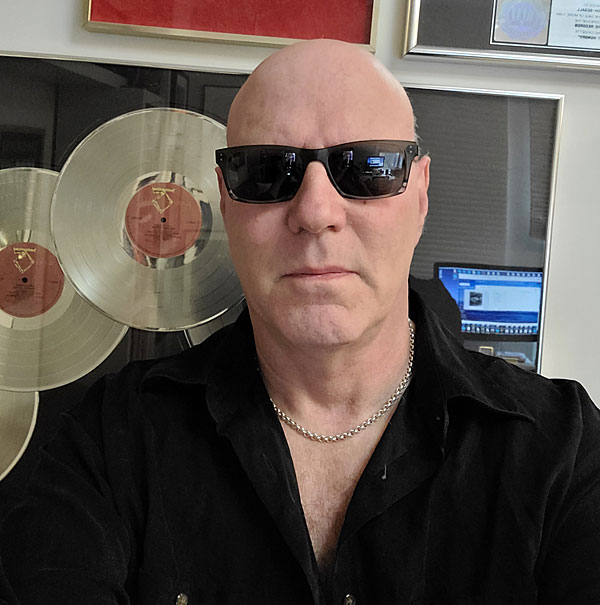
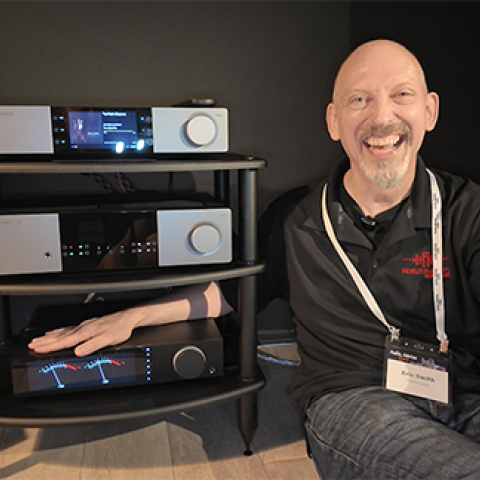
Jay Jay French, still Twisted today.
I bought my first real stereo setup—a Sony STR-6050 receiver, an Audio Research XA turntable, and a pair of KLH 6 speakers—in 1968. After that, I routinely changed my equipment, but it wasn't until 1982, when I started reading
Stereophile and
The Absolute Sound, that my pursuit of great sound began in earnest. That was the same year I started traveling the world in a rock band (Twisted Sister) and having enough income from touring and record sales to indulge in this hobby—a dangerous financial confluence!
Those of you reading this who are of a certain age know what those days were like. The magazines would champion a piece of gear, rhapsodize about its transformative power, and praise the technical breakthrough it contained, prompting many readers—including me—to lust after it. Add me to the list of
gotta have the latest.
In this essay, I want to address this
gotta have the latest syndrome, the pursuit of musical transcendence via the never-ending habit I call:
GAS (gear acquisition syndrome)
Until the early 1960s, measurements dominated notions of quality in hi-fi components, an orthodoxy represented by
HiFi/Stereo Review and its main writer, Julian Hirsch. Then in 1962, J. Gordon Holt—who had served as audio editor at
High Fidelity—
founded Stereophile with the then-radical notion that hi-fi equipment should be judged by how it sounds.
Borrowing in part from Holt, Harry Pearson founded
The Absolute Sound. Pearson, too, felt that reproduced music should reconstruct a reality anchored to a real-world reference point defined by the experience of listening. "The sound of unamplified instruments in real space" became the benchmark.
Incidentally, the album
The Weavers Reunion at Carnegie Hall, 1963, was often held up as a benchmark, a prime example of "the absolute sound"; it's still on the "TAS Super LP List," in the "Best of the Best" category. It was also the first concert I ever attended: My parents took me when I was 11 years old.
I was one of thousands around the world driven by the quest for the absolute sound, a quest that was never and will never be attainable because:
• We are listening to a facsimile: the recording;
• We are listening to a facsimile of a facsimile: a reproduction of the recording shaped by the components reproducing it and room acoustics.
Unfortunately—or fortunately, I'm not sure which it is—this realization escaped me at the time, as it has escaped so many others.
Holt's
Stereophile would go on to combine careful listening and
careful measurements. Pearson, meanwhile, freed us all from the constraint of numbers, graphs, and statistics. An astonishing blossoming of high-end audio reproduction followed, and with it the art of describing sound in high-minded literary terms.
In those early days, if an avid reader of
Stereophile and
The Absolute Sound paid close attention, a pattern began to emerge. In one issue, a reviewer would champion some piece of equipment (speaker, amp, preamp, turntable, cartridge, tuner, tape deck). In the following months, there would be a follow-up, often revealing some sonic flaw, which apparently wasn't noticeable at first. After that, that once-incredible piece of gear seemed to fade away, only to reappear the following year in a new version—a Mk.2 or Signature model—with that flaw and others addressed.
That's the pattern: a glowing magazine review followed by the notice of some flaw, followed by consumer paranoia, followed by new, improved versions.
This became almost comically obvious to me in 1996, when I started working at
Lyric HiFi. Almost daily, some client would return said gear to be sent back to the manufacturer for the all-important update. Without the update, the owner of that once-superhot piece of equipment was left with the sinking feeling that the ultimate sound, once within reach, had been yanked away, leaving the owner to drift off into an ocean of sonic mediocrity.
It was at Lyric that I started to wonder about this cycle. Where once I was a customer, now I was a salesman. I had at my disposal anything I wanted to borrow, or to buy at an accommodation price. This afforded me a certain level of cynicism about the nature of consumerism and how we salesmen fostered gear insecurity. I would call clients and say, "If you think the so-and-so was good"—here I would name a hot piece from the previous season—"you've got to come in and hear this!"
Was anyone really listening to what they bought? Were they even enjoying it?
We sold good products at Lyric, yet it seemed that the happiest clients were the least knowledgeable—the ones who trusted me, took the gear home, and played music instead of reading magazines.
What was happening? Were the flaws not apparent the first time around? Were the magazines creating discontent to drive sales and controversy? Was there collusion between the magazines and manufacturers?
I suspect a more benign explanation: The reviewer just got bored with the product. There was nothing really wrong with it. It was simply time to move on.
Today, there are dozens of YouTube channels, influencers, and online forums. Most of them magnify this paranoia a thousandfold. That is what prompted this essay.
Are we hi-fi consumers being driven by FOMO (fear of missing out) or GAS (gear acquisition syndrome)? Or are we really seeking excellent sound—sound we hear with our very own ears?
As a 60-year veteran of the high-end audio universe, I have come to this conclusion: Streamers and DACs, like the latest iPhone, get better almost monthly, but if you are not into streaming and are instead driven by analog—turntables, cartridges, phono stages—and CD/SACD reproduction, improvements in the quality and resolution of home audio reproduction are incremental even on an annual scale.
So, buy the magazines, read the reviews, always learn—this is a hobby after all—as many seasoned reviewers really know their stuff. Meanwhile, sit back and enjoy what your hard-earned money has bought. Fine-tune your setup. Give yourself time to get to know your system—to figure out what things really sound like. Wait at least 2–3 years before buying something new.
Do not fall prey to the endless upgrade cycle! This year's gobsmacked becomes next year's ho-hum
only if you let it!
Footnote:
Jay Jay French is the founder, manager, and lead guitarist for Twisted Sister.