In 1989, Cambridge Audio, then run by Stan Curtis—who is still active in hi-fi— introduced their DAC 1. At about the same time, within a few weeks of each other, Arcam introduced their Delta Black Box and Musical Fidelity their Digilog. I forget who was first among the three. Arcam, I think. But the DAC race was on, led by the British. (There was even a DAC called the Dacula.) US companies got into the DAC race, too—at higher prices, of course.
 At the time, there were almost no high-end CD players. Many audiophiles chose Philips/Magnavox models that had been modified by boutique kludgemeisters. It turned out that lavishing four or five hours of labor on a $149 frog to turn it into a $499 prince was not a sustainable business model. Once outboard DACs and upmarket CD players became available, modified players largely disappeared.
Today, Cambridge Audio is based in London, and their stuff is made in China at factories owned or controlled by Cambridge Audio, which in turn is part of The Audio Partnership, controlled by Julian Richer, who got richer than Croesus with Richer Sounds, said to be the UK's single most successful audio retailer in terms of revenue per square foot. And—my goodness—he did it by offering value. I visited the design headquarters of Cambridge Audio in London several years ago and met their technical director, Matthew Bramble, who used to work for another well-known British hi-fi manufacturer; now Bramble is a thorn in their side.
At the time, there were almost no high-end CD players. Many audiophiles chose Philips/Magnavox models that had been modified by boutique kludgemeisters. It turned out that lavishing four or five hours of labor on a $149 frog to turn it into a $499 prince was not a sustainable business model. Once outboard DACs and upmarket CD players became available, modified players largely disappeared.
Today, Cambridge Audio is based in London, and their stuff is made in China at factories owned or controlled by Cambridge Audio, which in turn is part of The Audio Partnership, controlled by Julian Richer, who got richer than Croesus with Richer Sounds, said to be the UK's single most successful audio retailer in terms of revenue per square foot. And—my goodness—he did it by offering value. I visited the design headquarters of Cambridge Audio in London several years ago and met their technical director, Matthew Bramble, who used to work for another well-known British hi-fi manufacturer; now Bramble is a thorn in their side.
 That Bramble likes to ramble is proven by the 105-page instruction manual for the Cambridge Audio DacMagic. In fairness, this is because the manual is in three languages (but why not Russian?). It's filled with things you don't need to know and that probably interest only John Atkinson. I bet the manual scares away some customers; it shouldn't. Operation of the DacMagic is as intuitive and straightforward as can be.
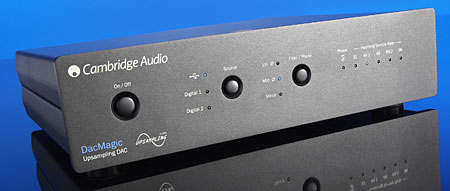
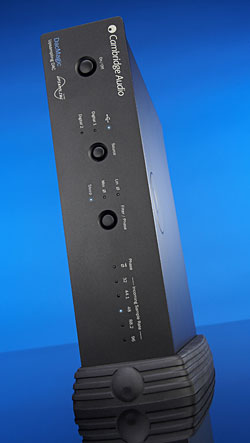
Ergonomically, this little bugger is brilliant: 8.6" (215mm) high by 2" (52mm) wide by 7.6" (191mm) deep when you place it on end on its rubbery bed. It weighs just 2.65 lbs (1.2kg). Squeeze it in next to your Slim Devices Squeezebox. Or your Sony PlayStation 3. One reason it takes up so little space is that it comes with a humongous wall-wart power supply so big it could conceivably fall out of a loose socket.
IKEA carries some nice, small power strips, and there are other accessories for dealing with awkward wall warts. I'd beware of power strips and conditioners, however, which, in my experience, are as likely to screw up as enhance the sound. I can imagine some British entrepreneurs offering alternative power supplies for the DacMagic. There's an On/Off switch, but the DacMagic sounds much better when left powered up most of the time. (Do turn it and the rest of your hi-fi off when you leave for a weekend or a vacation, and when electrical storms are forecast.)
The DacMagic has a suggested selling price of $449. That allows Audio Advisor to sell it for $399 and "save" you $50. When you consider that, 20 years ago, one of the first DACs, the Musical Fidelity Digilog, sold for $995, this is a fantastic bargain. (I calculated that I could save more than $16,500 by buying every product in a recent Audio Advisor catalog. Hallelujah! I'm rich!)
That Bramble likes to ramble is proven by the 105-page instruction manual for the Cambridge Audio DacMagic. In fairness, this is because the manual is in three languages (but why not Russian?). It's filled with things you don't need to know and that probably interest only John Atkinson. I bet the manual scares away some customers; it shouldn't. Operation of the DacMagic is as intuitive and straightforward as can be.
Ergonomically, this little bugger is brilliant: 8.6" (215mm) high by 2" (52mm) wide by 7.6" (191mm) deep when you place it on end on its rubbery bed. It weighs just 2.65 lbs (1.2kg). Squeeze it in next to your Slim Devices Squeezebox. Or your Sony PlayStation 3. One reason it takes up so little space is that it comes with a humongous wall-wart power supply so big it could conceivably fall out of a loose socket.
IKEA carries some nice, small power strips, and there are other accessories for dealing with awkward wall warts. I'd beware of power strips and conditioners, however, which, in my experience, are as likely to screw up as enhance the sound. I can imagine some British entrepreneurs offering alternative power supplies for the DacMagic. There's an On/Off switch, but the DacMagic sounds much better when left powered up most of the time. (Do turn it and the rest of your hi-fi off when you leave for a weekend or a vacation, and when electrical storms are forecast.)
The DacMagic has a suggested selling price of $449. That allows Audio Advisor to sell it for $399 and "save" you $50. When you consider that, 20 years ago, one of the first DACs, the Musical Fidelity Digilog, sold for $995, this is a fantastic bargain. (I calculated that I could save more than $16,500 by buying every product in a recent Audio Advisor catalog. Hallelujah! I'm rich!)
 The DacMagic features the Adaptive Time Filtering (ATF) process, which Cambridge licenses from Anagram Technologies of Switzerland. ATF is built around a 32-bit Texas Instruments digital signal processor that "upsamples" the signal fed to it. Upsampling creates additional digital data points out of thin air. They're not real, of course—except that they are. (I love to razz JA about this upsampling business.) The DacMagic upsamples to 24 bits/192kHz any incoming sample rate at 16 or 24 bits of resolution and from 32 to 96kHz.
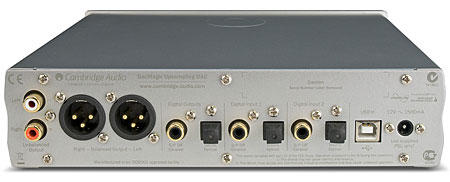
The D/A chips are the same Wolfson WMB8740 24-bit DACs used in Cambridge Audio's Azur 740C and 840C CD players. Two per channel operate in dual-differential mode for maximum noise reduction. You can run the DacMagic from its balanced XLR analog outputs into a balanced preamp and power amp for maximum noise cancellation. There's also a pair of RCA outs, for unbalanced types like me.
The DacMagic also features a phase-inversion button. It would be great to have this accessible from the remote control. But wait—there is no remote. Oh, well. A child might be trained and pressed into service. Two digital inputs allow a choice of connection via S/PDIF coaxial or TosLink optical. And there's a USB input for use with a computer or a networked music source.
The rear panel of the DacMagic is almost as crowded as my shaving shelf. It also includes S/PDIF coaxial and TosLink optical digital outputs for connecting to a digital recording device; these do nothing to the incoming digital signal, but simply pass it through.
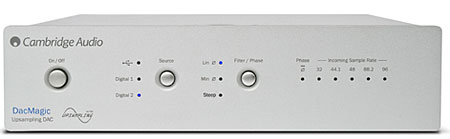
If you keep reading the instruction manual, your eyes, if they don't glaze over, will come to a long discussion of the three different analog filter modes: Linear Phase, Minimum Phase, and Steep. I wonder how many potential users will be scared away by Bramblearia. Actually, selecting the filters is simple: just tap the Phase button quickly (if you hold it down, the DacMagic reverses phase). Front-panel LEDs indicate the filter type selected.
The DacMagic features the Adaptive Time Filtering (ATF) process, which Cambridge licenses from Anagram Technologies of Switzerland. ATF is built around a 32-bit Texas Instruments digital signal processor that "upsamples" the signal fed to it. Upsampling creates additional digital data points out of thin air. They're not real, of course—except that they are. (I love to razz JA about this upsampling business.) The DacMagic upsamples to 24 bits/192kHz any incoming sample rate at 16 or 24 bits of resolution and from 32 to 96kHz.
The D/A chips are the same Wolfson WMB8740 24-bit DACs used in Cambridge Audio's Azur 740C and 840C CD players. Two per channel operate in dual-differential mode for maximum noise reduction. You can run the DacMagic from its balanced XLR analog outputs into a balanced preamp and power amp for maximum noise cancellation. There's also a pair of RCA outs, for unbalanced types like me.
The DacMagic also features a phase-inversion button. It would be great to have this accessible from the remote control. But wait—there is no remote. Oh, well. A child might be trained and pressed into service. Two digital inputs allow a choice of connection via S/PDIF coaxial or TosLink optical. And there's a USB input for use with a computer or a networked music source.
The rear panel of the DacMagic is almost as crowded as my shaving shelf. It also includes S/PDIF coaxial and TosLink optical digital outputs for connecting to a digital recording device; these do nothing to the incoming digital signal, but simply pass it through.
If you keep reading the instruction manual, your eyes, if they don't glaze over, will come to a long discussion of the three different analog filter modes: Linear Phase, Minimum Phase, and Steep. I wonder how many potential users will be scared away by Bramblearia. Actually, selecting the filters is simple: just tap the Phase button quickly (if you hold it down, the DacMagic reverses phase). Front-panel LEDs indicate the filter type selected.
 You may want to stick with Linear Phase as your default. The technical advantage here is no phase shift within the audioband, and a sharp rolloff at about half the sampling frequency. Minimum Phase does almost the same thing and sounds, to me, virtually identical.
An interesting alternative is the Steep filter, which is like Linear Phase but with a steeper rolloff above 20kHz. Steep is said to attenuate aliasing at 22kHz by 80dB. But there's no free lunch; Steep adds a small amount of passband ripple. So pick your poison: aliasing or passband ripple. Already your eyes have glazed over, and you don't even own the thing.
I tried switching between Linear Phase and Steep, playing one movement of a symphony straight through using each. (I had no child handy to act as remote control, and Marina was off watching one of her Russian prime-time serials.) Linear Phase gave a lighter, airier, more transparent sound, with extended highs and better-defined bass. Steep attenuated the highs in comparison, taming the top end of some more aggressive recordings, but bass definition and overall clarity suffered. The sound was more blended, slightly congested—something I noticed more with symphonic recordings than with string quartets. As for Minimum Phase, I didn't hear it do anything that Linear Phase didn't do.
Other than that, I've so far avoided the subject of how the DacMagic sounded. In a word, it sounded glorious—far better than you have any right to expect for 400 bucks. Especially in Linear Phase, I heard well-defined bass, exquisitely extended highs, and a natural midrange. The soundstage was admirably wide, and soloists and their instruments were precisely positioned. What more do you want?
Well, you might ask for an even wider, deeper soundstage and more gut-wrenching bass. It's possible that power-supply limitations kick in here, but for $400, who's complaining? And you might wish that if Cambridge (or someone) does offer an optional kick-ass power supply, it doesn't have to hang from a wall socket. And a remote control would be nice.
If you're looking for the romance of tubes, that's not on offer here. Try the DacMagic with a tubed line stage. I thought that Musical Fidelity's X-10DV3 tube buffer might work wonders. After all, Bramble used to ramble at MF. I have one of these. I put the X-10DV3 between the DacMagic and the LFD NCSE integrated amplifier. I got tube warmth in spades, but with more than a slight loss of transparency, which shows how resolving the DacMagic is.
You probably own an older, sturdier CD player that will do jim-dandy as a transport with the DacMagic. I used a Marantz CD63 SE that's almost 15 years old. Digital cable was Analysis Plus Oval (which I recommended last October).
If you have a really great CD player—such as Cambridge Audio's own 740C or 840C or Cary Audio's CDP 1—you're probably looking at a sideways change in sound, at best. Enjoy what you have. Meanwhile, I'm keeping the Cambridge Audio DacMagic.
You may want to stick with Linear Phase as your default. The technical advantage here is no phase shift within the audioband, and a sharp rolloff at about half the sampling frequency. Minimum Phase does almost the same thing and sounds, to me, virtually identical.
An interesting alternative is the Steep filter, which is like Linear Phase but with a steeper rolloff above 20kHz. Steep is said to attenuate aliasing at 22kHz by 80dB. But there's no free lunch; Steep adds a small amount of passband ripple. So pick your poison: aliasing or passband ripple. Already your eyes have glazed over, and you don't even own the thing.
I tried switching between Linear Phase and Steep, playing one movement of a symphony straight through using each. (I had no child handy to act as remote control, and Marina was off watching one of her Russian prime-time serials.) Linear Phase gave a lighter, airier, more transparent sound, with extended highs and better-defined bass. Steep attenuated the highs in comparison, taming the top end of some more aggressive recordings, but bass definition and overall clarity suffered. The sound was more blended, slightly congested—something I noticed more with symphonic recordings than with string quartets. As for Minimum Phase, I didn't hear it do anything that Linear Phase didn't do.
Other than that, I've so far avoided the subject of how the DacMagic sounded. In a word, it sounded glorious—far better than you have any right to expect for 400 bucks. Especially in Linear Phase, I heard well-defined bass, exquisitely extended highs, and a natural midrange. The soundstage was admirably wide, and soloists and their instruments were precisely positioned. What more do you want?
Well, you might ask for an even wider, deeper soundstage and more gut-wrenching bass. It's possible that power-supply limitations kick in here, but for $400, who's complaining? And you might wish that if Cambridge (or someone) does offer an optional kick-ass power supply, it doesn't have to hang from a wall socket. And a remote control would be nice.
If you're looking for the romance of tubes, that's not on offer here. Try the DacMagic with a tubed line stage. I thought that Musical Fidelity's X-10DV3 tube buffer might work wonders. After all, Bramble used to ramble at MF. I have one of these. I put the X-10DV3 between the DacMagic and the LFD NCSE integrated amplifier. I got tube warmth in spades, but with more than a slight loss of transparency, which shows how resolving the DacMagic is.
You probably own an older, sturdier CD player that will do jim-dandy as a transport with the DacMagic. I used a Marantz CD63 SE that's almost 15 years old. Digital cable was Analysis Plus Oval (which I recommended last October).
If you have a really great CD player—such as Cambridge Audio's own 740C or 840C or Cary Audio's CDP 1—you're probably looking at a sideways change in sound, at best. Enjoy what you have. Meanwhile, I'm keeping the Cambridge Audio DacMagic.
At the time, there were almost no high-end CD players. Many audiophiles chose Philips/Magnavox models that had been modified by boutique kludgemeisters. It turned out that lavishing four or five hours of labor on a $149 frog to turn it into a $499 prince was not a sustainable business model. Once outboard DACs and upmarket CD players became available, modified players largely disappeared.
Today, Cambridge Audio is based in London, and their stuff is made in China at factories owned or controlled by Cambridge Audio, which in turn is part of The Audio Partnership, controlled by Julian Richer, who got richer than Croesus with Richer Sounds, said to be the UK's single most successful audio retailer in terms of revenue per square foot. And—my goodness—he did it by offering value. I visited the design headquarters of Cambridge Audio in London several years ago and met their technical director, Matthew Bramble, who used to work for another well-known British hi-fi manufacturer; now Bramble is a thorn in their side.
That Bramble likes to ramble is proven by the 105-page instruction manual for the Cambridge Audio DacMagic. In fairness, this is because the manual is in three languages (but why not Russian?). It's filled with things you don't need to know and that probably interest only John Atkinson. I bet the manual scares away some customers; it shouldn't. Operation of the DacMagic is as intuitive and straightforward as can be.
Ergonomically, this little bugger is brilliant: 8.6" (215mm) high by 2" (52mm) wide by 7.6" (191mm) deep when you place it on end on its rubbery bed. It weighs just 2.65 lbs (1.2kg). Squeeze it in next to your Slim Devices Squeezebox. Or your Sony PlayStation 3. One reason it takes up so little space is that it comes with a humongous wall-wart power supply so big it could conceivably fall out of a loose socket.
IKEA carries some nice, small power strips, and there are other accessories for dealing with awkward wall warts. I'd beware of power strips and conditioners, however, which, in my experience, are as likely to screw up as enhance the sound. I can imagine some British entrepreneurs offering alternative power supplies for the DacMagic. There's an On/Off switch, but the DacMagic sounds much better when left powered up most of the time. (Do turn it and the rest of your hi-fi off when you leave for a weekend or a vacation, and when electrical storms are forecast.)
The DacMagic features the Adaptive Time Filtering (ATF) process, which Cambridge licenses from Anagram Technologies of Switzerland. ATF is built around a 32-bit Texas Instruments digital signal processor that "upsamples" the signal fed to it. Upsampling creates additional digital data points out of thin air. They're not real, of course—except that they are. (I love to razz JA about this upsampling business.) The DacMagic upsamples to 24 bits/192kHz any incoming sample rate at 16 or 24 bits of resolution and from 32 to 96kHz.
The D/A chips are the same Wolfson WMB8740 24-bit DACs used in Cambridge Audio's Azur 740C and 840C CD players. Two per channel operate in dual-differential mode for maximum noise reduction. You can run the DacMagic from its balanced XLR analog outputs into a balanced preamp and power amp for maximum noise cancellation. There's also a pair of RCA outs, for unbalanced types like me.
The DacMagic also features a phase-inversion button. It would be great to have this accessible from the remote control. But wait—there is no remote. Oh, well. A child might be trained and pressed into service. Two digital inputs allow a choice of connection via S/PDIF coaxial or TosLink optical. And there's a USB input for use with a computer or a networked music source.
You may want to stick with Linear Phase as your default. The technical advantage here is no phase shift within the audioband, and a sharp rolloff at about half the sampling frequency. Minimum Phase does almost the same thing and sounds, to me, virtually identical.