I have built up a large collection of CDs since the medium's launch more than a quarter century ago, along with a modest number of SACDs and a small number of DVD-As. But I find these days that, unless I'm getting down to some serious listening and can give the music my uninterrupted attention, I use iTunes to feed computer files to my high-end rig (footnote 1). I've mostly been using the superb-sounding combination of dCS Puccini U-Clock and Puccini player/DAC that I reviewed last December to take a USB feed from a Mac mini, but I've also been using the Bel Canto USB Link 24/96 and Stello U2 USB-S/PDIF converters, particularly for headphone listening, when I use one of those two format converters with a Benchmark DAC1 D/A headphone amplifier.
 The dCS combo goes back to the distributor a week or so after this issue goes to press, but I have very much appreciated its performance. The U-Clock operates the USB interface in what is called "asynchronous mode," which allows the DAC to act as the master system clock and control the flow of data from the PC, which very much reduces any potential for the introduction of timing uncertainty in the conversion of the data to analog. These timing variations in the datastream, called jitter, result in increased analog noise and reduced resolution in the reconstructed audio signal. (Once jitter has been introduced, you can never completely remove it, only filter it.) However, other than a very few products currently available from Ayre Acoustics, Wavelength, and dCS, all other USB audio devices function in "isochronous adaptive" mode, in which the host computer controls the data flow. A PC is not optimized for uninterrupted streaming, and has operating-system housekeeping chores to attend to—and while the sample rate of the output data, averaged over a longish period, will indeed be the specified 44.1 or 48kHz, there will be short-term fluctuations that will manifest as jitter.
There are strategies for reducing jitter with a USB connection operated in adaptive mode, and leading the development of such technology is CEntrance, a Chicago-based company that has licensed its USB technology to Benchmark, Lavry, Bel Canto, Empirical Audio, and PS Audio, among others. Stereophile has reviewed several products using licensed CEntrance's USB solutions, but at the 2010 Consumer Electronics Show the company introduced a high-end audio product to be sold under its own brand name: the CEntrance DACport headphone amplifier. Originally to be priced at $499.95, the DACport was reduced to $399.95 in February as part of CEntrance's 10th-anniversary celebration.
Shipbuilding
The dCS combo goes back to the distributor a week or so after this issue goes to press, but I have very much appreciated its performance. The U-Clock operates the USB interface in what is called "asynchronous mode," which allows the DAC to act as the master system clock and control the flow of data from the PC, which very much reduces any potential for the introduction of timing uncertainty in the conversion of the data to analog. These timing variations in the datastream, called jitter, result in increased analog noise and reduced resolution in the reconstructed audio signal. (Once jitter has been introduced, you can never completely remove it, only filter it.) However, other than a very few products currently available from Ayre Acoustics, Wavelength, and dCS, all other USB audio devices function in "isochronous adaptive" mode, in which the host computer controls the data flow. A PC is not optimized for uninterrupted streaming, and has operating-system housekeeping chores to attend to—and while the sample rate of the output data, averaged over a longish period, will indeed be the specified 44.1 or 48kHz, there will be short-term fluctuations that will manifest as jitter.
There are strategies for reducing jitter with a USB connection operated in adaptive mode, and leading the development of such technology is CEntrance, a Chicago-based company that has licensed its USB technology to Benchmark, Lavry, Bel Canto, Empirical Audio, and PS Audio, among others. Stereophile has reviewed several products using licensed CEntrance's USB solutions, but at the 2010 Consumer Electronics Show the company introduced a high-end audio product to be sold under its own brand name: the CEntrance DACport headphone amplifier. Originally to be priced at $499.95, the DACport was reduced to $399.95 in February as part of CEntrance's 10th-anniversary celebration.
Shipbuilding
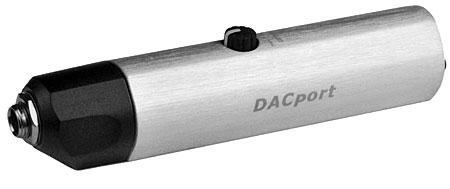
The DACport is a relatively small, well-finished, tubular device 4.5" long, with a small USB port and a white On LED at one end, and a ¼" stereo headphone jack at the other. The only thing disturbing its smooth lines is a small rubber knob to control volume, and as the amplifier is powered by the USB bus, there's no need for a separate power supply. The DACport uses CEntrance's AdaptiWave USB technology, running on a Texas Instruments TAS1020B chip; although the interface operates in USB's adaptive mode, CEntrance uses their proprietary, two-stage JitterGuard clock-management system, based on a "military-spec. clock oscillator with 10ppm [parts per million] precision." The DACport's D/A section will decode 24-bit data at sample rates up to 96kHz, and its direct-coupled output stage is claimed to run in class-A. I couldn't completely dismantle the DACport, to identify the DAC and the other chips used, but I could see that the D/A and analog circuits are carried on a separate printed circuit board from the USB and supply circuitry, to reduce noise contamination. Reading the spec sheet, I was puzzled by the reference to the output stage being powered by ±9V rails, as the USB interface will supply only 5V, at up to 500mA current. The answer was found on the developer's blog: "When you first plug it in, DACport starts in 'low-power' mode and takes only about 60mA of current on the 5V supply. In this startup mode, it performs initial USB handshaking, and then requests additional power. . . . which is granted by the OS. That starts up the main switch-mode power supply that ramps up the 5V to ±9V for the audio circuitry, +3.3V for the digital circuitry, and clean +5V for the converter circuitry. In total, DACport has 5 (five) separate internal power supplies! That's how we ensure that clean power is supplied to all circuitry to maintain the ultra-low distortion." Setup was as simple as plugging the DACport into one of my computer's USB ports with the supplied cable. No driver is required (though CEntrance does make available an optional ASIO driver for lower latency with Windows machines). The DACport is compatible with Mac, Windows, and Linux operating systems—I had no problems with either of my Macs or my PC. Running the Macintosh USB Prober program, the manufacturer was identified as "CEntrance Inc." and the product as "CEntrance DACport" running in "Isochronous adaptive" mode with a 1ms "Polling Interval" (ie, how often the reconstructed sample rate is adjusted). The compatible sample rates were listed as 44.1, 48, 88.2, and 96kHz, and the resolution a constant 24 bits. (This is so that, with Windows machines, the DACport will be sent audio with no unnecessary changes to the data.) The DACport does not allow digital-domain adjustment of its volume; its own volume control operates in the analog domain.
With its class-A output stage, the DACport's case gets comfortably warm after a few hours of operation. Commendably, the DACport is built in the US.
How do I know you're feeling?
I have been listening to a lot of Annie Lennox since I caught the Scottish diva performing at the 25th-anniversary Rock & Roll Hall of Fame concert broadcast in October 2009. Her 1995 solo album, Medusa, has long been a favorite, but I hadn't listened to it for some time. While the opener, "No More I Love You's," is perhaps the pinnacle of UK synth-rock mixes, it is her cover of The Blue Nile's "Downtown Lights" that I turned to first after the broadcast (ALC, originally CD, Arista). The arrangement, with Lennox's voice floating over a chugging eighth-note bass line and sustained and suspended synth chords, punctuated by chiming electric guitars and pizzicato strings, is inspired; I never fail to thrill at the return to the chorus after the third verse, when the bass hits the relative minor instead of the tonic, the dischord emphasizing the plaintive lyric. All was laid clear by the DACport driving my favorite Sennheiser HD-650s, with the clanking stereo sound effects at the beginning pristinely clean, and Lennox's voice sounding natural and free from grain. I had iTunes set to Shuffle, and in one of those inspired synchronicities that the program produces, "Downtown Lights" was followed by Elvis Costello's "Shipbuilding" (ALC, from Punch the Clock, F-Beat/Columbia)—a song I have loved ever since I first heard it performed by Robert Wyatt on a 12" 45rpm disc. The opening, with its heavily compressed stereo grand piano underpinning the organ chording and its left hand subsequently doubled by the bass guitar, exploded from the headphones, with then Elvis's distinctive and idiosyncratic voice, followed by the late Chet Baker's mournful trumpet solo with its climactic repeat-echoed scale. Every detail was faithfully reconstructed by the DACport, with no undue treble emphasis. In fact, the CEntrance's high frequencies impressed me with their silkiness and air throughout my auditioning—even with the Sony MDR-7506 headphones, which can sound a little overcooked in the top octaves.
Footnote 1: A basic guide to the various strategies for getting the best sound from a computer can be found here.
The dCS combo goes back to the distributor a week or so after this issue goes to press, but I have very much appreciated its performance. The U-Clock operates the USB interface in what is called "asynchronous mode," which allows the DAC to act as the master system clock and control the flow of data from the PC, which very much reduces any potential for the introduction of timing uncertainty in the conversion of the data to analog. These timing variations in the datastream, called jitter, result in increased analog noise and reduced resolution in the reconstructed audio signal. (Once jitter has been introduced, you can never completely remove it, only filter it.) However, other than a very few products currently available from Ayre Acoustics, Wavelength, and dCS, all other USB audio devices function in "isochronous adaptive" mode, in which the host computer controls the data flow. A PC is not optimized for uninterrupted streaming, and has operating-system housekeeping chores to attend to—and while the sample rate of the output data, averaged over a longish period, will indeed be the specified 44.1 or 48kHz, there will be short-term fluctuations that will manifest as jitter.
There are strategies for reducing jitter with a USB connection operated in adaptive mode, and leading the development of such technology is CEntrance, a Chicago-based company that has licensed its USB technology to Benchmark, Lavry, Bel Canto, Empirical Audio, and PS Audio, among others. Stereophile has reviewed several products using licensed CEntrance's USB solutions, but at the 2010 Consumer Electronics Show the company introduced a high-end audio product to be sold under its own brand name: the CEntrance DACport headphone amplifier. Originally to be priced at $499.95, the DACport was reduced to $399.95 in February as part of CEntrance's 10th-anniversary celebration.
The DACport is a relatively small, well-finished, tubular device 4.5" long, with a small USB port and a white On LED at one end, and a ¼" stereo headphone jack at the other. The only thing disturbing its smooth lines is a small rubber knob to control volume, and as the amplifier is powered by the USB bus, there's no need for a separate power supply. The DACport uses CEntrance's AdaptiWave USB technology, running on a Texas Instruments TAS1020B chip; although the interface operates in USB's adaptive mode, CEntrance uses their proprietary, two-stage JitterGuard clock-management system, based on a "military-spec. clock oscillator with 10ppm [parts per million] precision." The DACport's D/A section will decode 24-bit data at sample rates up to 96kHz, and its direct-coupled output stage is claimed to run in class-A. I couldn't completely dismantle the DACport, to identify the DAC and the other chips used, but I could see that the D/A and analog circuits are carried on a separate printed circuit board from the USB and supply circuitry, to reduce noise contamination. Reading the spec sheet, I was puzzled by the reference to the output stage being powered by ±9V rails, as the USB interface will supply only 5V, at up to 500mA current. The answer was found on the developer's blog: "When you first plug it in, DACport starts in 'low-power' mode and takes only about 60mA of current on the 5V supply. In this startup mode, it performs initial USB handshaking, and then requests additional power. . . . which is granted by the OS. That starts up the main switch-mode power supply that ramps up the 5V to ±9V for the audio circuitry, +3.3V for the digital circuitry, and clean +5V for the converter circuitry. In total, DACport has 5 (five) separate internal power supplies! That's how we ensure that clean power is supplied to all circuitry to maintain the ultra-low distortion." Setup was as simple as plugging the DACport into one of my computer's USB ports with the supplied cable. No driver is required (though CEntrance does make available an optional ASIO driver for lower latency with Windows machines). The DACport is compatible with Mac, Windows, and Linux operating systems—I had no problems with either of my Macs or my PC. Running the Macintosh USB Prober program, the manufacturer was identified as "CEntrance Inc." and the product as "CEntrance DACport" running in "Isochronous adaptive" mode with a 1ms "Polling Interval" (ie, how often the reconstructed sample rate is adjusted). The compatible sample rates were listed as 44.1, 48, 88.2, and 96kHz, and the resolution a constant 24 bits. (This is so that, with Windows machines, the DACport will be sent audio with no unnecessary changes to the data.) The DACport does not allow digital-domain adjustment of its volume; its own volume control operates in the analog domain.
I have been listening to a lot of Annie Lennox since I caught the Scottish diva performing at the 25th-anniversary Rock & Roll Hall of Fame concert broadcast in October 2009. Her 1995 solo album, Medusa, has long been a favorite, but I hadn't listened to it for some time. While the opener, "No More I Love You's," is perhaps the pinnacle of UK synth-rock mixes, it is her cover of The Blue Nile's "Downtown Lights" that I turned to first after the broadcast (ALC, originally CD, Arista). The arrangement, with Lennox's voice floating over a chugging eighth-note bass line and sustained and suspended synth chords, punctuated by chiming electric guitars and pizzicato strings, is inspired; I never fail to thrill at the return to the chorus after the third verse, when the bass hits the relative minor instead of the tonic, the dischord emphasizing the plaintive lyric. All was laid clear by the DACport driving my favorite Sennheiser HD-650s, with the clanking stereo sound effects at the beginning pristinely clean, and Lennox's voice sounding natural and free from grain. I had iTunes set to Shuffle, and in one of those inspired synchronicities that the program produces, "Downtown Lights" was followed by Elvis Costello's "Shipbuilding" (ALC, from Punch the Clock, F-Beat/Columbia)—a song I have loved ever since I first heard it performed by Robert Wyatt on a 12" 45rpm disc. The opening, with its heavily compressed stereo grand piano underpinning the organ chording and its left hand subsequently doubled by the bass guitar, exploded from the headphones, with then Elvis's distinctive and idiosyncratic voice, followed by the late Chet Baker's mournful trumpet solo with its climactic repeat-echoed scale. Every detail was faithfully reconstructed by the DACport, with no undue treble emphasis. In fact, the CEntrance's high frequencies impressed me with their silkiness and air throughout my auditioning—even with the Sony MDR-7506 headphones, which can sound a little overcooked in the top octaves.
Footnote 1: A basic guide to the various strategies for getting the best sound from a computer can be found here.