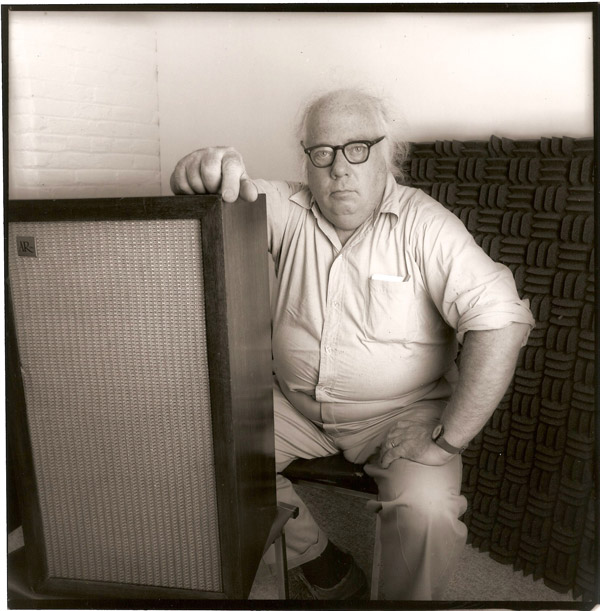
Photo: © Steven Stone (used with permission)
Henry Kloss, whose prolific hi-fi design and manufacturing career spanned a half century, died of a subdural hematoma on January 31, three weeks before his 73rd birthday.
Habitually clothed in khaki trousers and oxford cloth shirts, their button-down collars unbuttoned and sleeves rolled, Kloss (pronounced with a long o, to rhyme with "close") looked like someone familiar with tools. Indeed he was. As a boy, he was able to add rooms and bath fixtures to the Pennsylvania cabin he shared with his mother and two sisters.
After entering MIT in 1948, Kloss worked part-time for a contractor and bought woodworking tools to make furniture for his basement apartment. Instead, he used them to turn out enclosures for a speaker system an MIT professor and his student had designed. Henry dropped out of MIT after being drafted. Stationed in New Jersey, he took a New York University night course in high fidelity taught by Edgar Villchur, who had conceived a radically new type of loudspeaker.
In 1954, Villchur and Kloss founded Acoustic Research to develop and produce it. Henry provided the facility, a cabinet and speaker-assembly shop he was already operating in a Harvard Square loft. Two other partners, Malcolm Low and J. Anton Hofmann, son of the great pianist Josef Hofmann, supplied $5000 in capital. That led to the AR-1, the world's first acoustic-suspension loudspeaker system, with its relatively small enclosure and proportionally prodigious bass.
But Villchur remained home in Woodstock, New York, while Kloss ran the Massachusetts factory. That caused friction, leading Kloss, Low and Hofmann to break away and put their initials on a new firm. In 1957, they founded KLH.
In 1967, after producing more landmarks, including the KLH Model Six speaker, the fine-sounding Model Eight radio, and a hi-fi system in a suitcase designated Model Eleven, Henry started Advent to work on projection television. The speakers he built to fund that effort quickly became best-sellers.
Henry Kloss embraced innovation. He was quick to employ the transistor, which was crucial to the KLH Eleven's portability, and he ingeniously combined previously unrelated concepts with two Advent firsts: a cassette deck featuring Dolby noise reduction (which he had prodded Ray Dolby to adapt for consumers) and chromium dioxide cassettes. That synergy made the medium truly musicworthy.
Yet Kloss was genuinely modest about such achievements. "Some of the particular things I have done...could have and should have been done before," he once told me.
After leaving Advent, Henry started Kloss Video and, in 1988, co-founded Cambridge SoundWorks, for which he designed some three dozen products. His newest radios, marketed by Tivoli Audio, have the simple, signature look of his KLH models, even down to their planetary dials.
Kloss, informed by his own muse and unimpressed by fashion, created boldly original, straightforward, utilitarian products that lowered the price of performance. Longevity was another criterion, in what he built and what he bought. When he retired his second Checker automobile after 14 years of use, Henry vowed to drive his new Mercedes diesel for 20.
He owned it to the end, 17 years in all. For the many people who so admired Henry Kloss, that wasn't long enough.
Kloss's wife, Jacqueline, died last year. A son, two daughters, and seven grandchildren survive him.