Audiophile societies are frequently sources of interesting new equipment to review. Recently, trolling New York's Audiophile Society, I discovered a tremendous buzz about the Onix Reference 1 Mk.II, an affordable bookshelf speaker from AV123. Founded by Audio Alchemy cofounder Mark Schifter, AV123 is a Colorado-based manufacturer and retailer that specializes in affordable audio gear, mostly speakers and electronics, which it sells exclusively over the Internet with a 30-day money-back guarantee. AV123's factories in China and Colombia design, manufacture, and distribute speakers under the brand names Onix, X-Series, and Rocket, and, I am told, also make speakers for a number of other companies. If the name Onix rings a bell, this former UK brand has long been known for its dedication to making affordable audio gear. AV123 bought Onix from the Rogers speaker company more than 10 years ago.
 Description
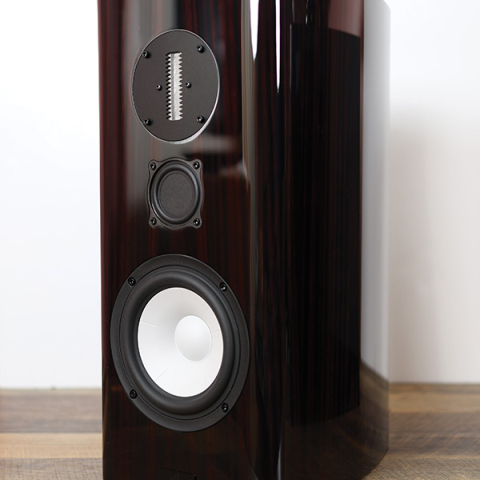
The Onix Reference 1 ($1200/pair) is a modestly sized bookshelf design, measuring 14.5" H by 8" W by 11" D. It has a 1" Vifa XT ring-radiator tweeter, a high-excursion, 5.25" low-frequency driver made in France by Atohm, and a 2.2"-wide flared port on the rear of the enclosure. The internally braced cabinet, built of 1"-thick MDF, is available in South American rosewood, high-gloss bird's-eye maple, and piano-black and gloss-white lacquers. I found my black-lacquered review samples fairly attractive; they should fit nicely and unobtrusively into a setting of modern décor, particularly in rooms with limited space. The Onix Reference 1 is not magnetically shielded for video applications. I listened to the Reference 1s with and without their grilles, and felt that, despite a negligible loss of detail, they sounded more coherent and tonally natural with the grilles on. So on they stayed for the balance of my listening sessions.
Listening
With all of the music I listened to, what struck me as most remarkable about the Onix Reference 1 were the speaker's consistently superb rendition of low-level detail, and a sense of delicate and organic articulation of low-level dynamic inflections, especially for a speaker at this price. Tomiko Kohjiba's Transmigration of the Soul, from the Santa Fe Chamber Music Festival's Festival (CD, Stereophile STPH007-2), was reproduced with an overall dynamic envelope that was both linear and involving, and I was easily able to follow the contribution of each instrument. Carol Wincenc's flute sounded airy, steely, and natural, and her phrasing in the solo passage near the beginning of this piece was breathtaking. Listening to Timothy Seelig and the Turtle Creek Chorale's recording of John Rutter's Requiem (CD, Reference RR-57CD), it was very easy to hear the acoustic of the church, and the dynamically blooming envelope of the choir let me follow each individual vocal line. The voice of solo soprano Nancy Kelton sounded holographic, angelic, and uncolored, and I could easily hear harpist David Williams's phrasing. Similarly, on Antal Dorati's reading of Stravinsky's The Firebird (CD, Mercury Living Presence SR 90226), I was able to follow each instrument—even in the cacophonous, densely orchestrated passages—and the ambience reflected off the concert hall's rear wall was quite evident. Well-recorded vocal performances sounded stunning through the Reference 1. In Cantus's perfomance of Eric Whitacre's Lux Aurumique, on their latest album, While You Are Alive (CD, Cantus CTS-1208, recorded by John Atkinson), the dense lower-register textures of these closely miked male singers were chilling and mesmerizing.
The Onix Reference 1 rendered all transient detail quite naturally, with no loss of speed, and with nary a trace of dullness or unnatural sharpness. Although this was very noticeable in the sounds of acoustic percussion instruments on the various jazz and classical recordings I played, I was quite taken with analyzing every little glitch, electronic bleep, and gated high-frequency blast in "Man/Machine," the opening track of Kraftwerk's Minimum/Maximum (CD, EMI ASW 60611). As I listened, I could almost "see" the score before me.
Description
The Onix Reference 1 ($1200/pair) is a modestly sized bookshelf design, measuring 14.5" H by 8" W by 11" D. It has a 1" Vifa XT ring-radiator tweeter, a high-excursion, 5.25" low-frequency driver made in France by Atohm, and a 2.2"-wide flared port on the rear of the enclosure. The internally braced cabinet, built of 1"-thick MDF, is available in South American rosewood, high-gloss bird's-eye maple, and piano-black and gloss-white lacquers. I found my black-lacquered review samples fairly attractive; they should fit nicely and unobtrusively into a setting of modern décor, particularly in rooms with limited space. The Onix Reference 1 is not magnetically shielded for video applications. I listened to the Reference 1s with and without their grilles, and felt that, despite a negligible loss of detail, they sounded more coherent and tonally natural with the grilles on. So on they stayed for the balance of my listening sessions.
With all of the music I listened to, what struck me as most remarkable about the Onix Reference 1 were the speaker's consistently superb rendition of low-level detail, and a sense of delicate and organic articulation of low-level dynamic inflections, especially for a speaker at this price. Tomiko Kohjiba's Transmigration of the Soul, from the Santa Fe Chamber Music Festival's Festival (CD, Stereophile STPH007-2), was reproduced with an overall dynamic envelope that was both linear and involving, and I was easily able to follow the contribution of each instrument. Carol Wincenc's flute sounded airy, steely, and natural, and her phrasing in the solo passage near the beginning of this piece was breathtaking. Listening to Timothy Seelig and the Turtle Creek Chorale's recording of John Rutter's Requiem (CD, Reference RR-57CD), it was very easy to hear the acoustic of the church, and the dynamically blooming envelope of the choir let me follow each individual vocal line. The voice of solo soprano Nancy Kelton sounded holographic, angelic, and uncolored, and I could easily hear harpist David Williams's phrasing. Similarly, on Antal Dorati's reading of Stravinsky's The Firebird (CD, Mercury Living Presence SR 90226), I was able to follow each instrument—even in the cacophonous, densely orchestrated passages—and the ambience reflected off the concert hall's rear wall was quite evident. Well-recorded vocal performances sounded stunning through the Reference 1. In Cantus's perfomance of Eric Whitacre's Lux Aurumique, on their latest album, While You Are Alive (CD, Cantus CTS-1208, recorded by John Atkinson), the dense lower-register textures of these closely miked male singers were chilling and mesmerizing.