Sidebar 2: Measurements
The ideal test instrument for measuring jitter in the S/PDIF outputs of jitter-reduction devices is the UltraAnalog unit, which takes in an S/PDIF (or AES/EBU) signal and outputs its jitter component. The jitter can then be measured as an RMS voltage, plotted spectrally, or even listened to. Unfortunately, there's only one such analyzer in existence, and although we had been able to borrow the unit in the past, this time UltraAnalog couldn't part with it—even briefly.
Consequently, I measured the effects of these jitter-reduction devices inside a digital processor with the Meitner LIM Detector (see Vol.16 No.1, p.114), which looks at the jitter on the word clock driving the D/A converter chip—the point where jitter degrades sound quality. In previous measurements, I've found that the greater the S/PDIF jitter, the greater the word-clock jitter. Although using the LIM Detector to measure the effects of S/PDIF jitter-reduction devices appears to be a step removed from measuring the actual device, it may actually be more subjectively relevant because it's DAC word-clock jitter that ultimately degrades sound quality.
I chose an original PS Audio UltraLink processor for the measurements—it uses the older Yamaha YM3623 input receiver, a chip with poor jitter-rejection performance compared to the Crystal CS8412 now used in nearly all processors. The following measurements were made on the 352.8kHz (8x) clock on the appropriate pin of the NPC 5803 digital filter chip. The test data, taken from the CBS Test Disc, represented a full-scale (0dBFS), 1kHz sinewave.
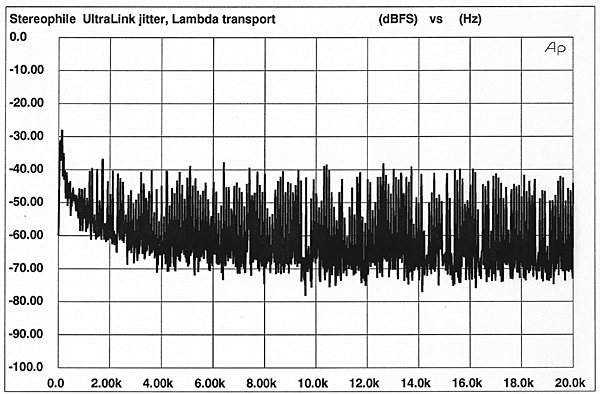
To establish a baseline, I measured the UltraLink's jitter when driven by a PS Audio Lambda transport—a very low-jitter model. Fig.1 shows the jitter spectrum. Note the presence of many periodic jitter components, seen as spikes in the plot. The RMS jitter level, measured over a 400Hz–22kHz bandwidth, was 338 picoseconds. With the UltraLink driven by a Radio Shack Optimus CD-3400 portable CD player used as a transport, the spectrum is slightly "dirtier" with the Radio Shack, and the RMS jitter level was nearly doubled to 610ps (who says transports don't make a difference?).
 Next up was the UltrajitterBug. The UltraLink's jitter spectrum with the Lambda transport and UJB is shown in fig.3. Although the spectrum looks only a little cleaner with the UltrajitterBug, the RMS jitter level dropped to 242ps (from 338ps). When driven by the Radio Shack player and the UJB, the jitter level and spectrum were nearly identical to those measured with the Lambda (not shown). Note that the UJB reduced the UltraLink's jitter from 610 to 244ps when driven by the CD-3400. In other words, the UltraLink had the same amount of jitter and the same jitter spectrum, regardless of the transport jitter when the UJB was in the signal path. These measurements suggest that the UJB will significantly improve mediocre or poor transports, and provide some benefit to even the lowest-jitter transports. Indeed, this was my experience in the listening room with the $299 NAD 502 CD player used as a transport and the $8500 Mark Levinson No.31 (footnote 2).

 Finally, I looked at the DTI Pro's claim of enhanced low-level resolution by capturing a –90dB, 1kHz sinewave reproduced by the UltraLink with and without the DTI Pro in the digital signal chain. The UltraLink was ideal for this purpose—its UltraAnalog DAC produces a very good-looking waveform to begin with. Fig.5 is the waveform without the DTI Pro; fig.6 is the same signal with the DTI Pro. Although they look nearly identical, there do appear to be minute differences, particularly on the positive waveform tops. These differences are so small, however, that they could be random variations.—Robert Harley


Footnote 1: When developing the No.30.5 processor, Madrigal found that the Radio Shack CD-3400 had the least accurate output frequency of any transport they'd tested. Footnote 2: I found a beneficial effect with the Sonic Frontiers UltrajitterBug used with my Mark Levinson No.31 transport, which already has very low measured jitter. Finding myself temporarily without a reference-quality digital processor, I hooked up the $8750 '31 to a $259 Audio Alchemy DAC-in-the-Box. The sound was okay, but it was obvious that the DITB was no Levinson No.30. Putting the $699 Sonic Frontiers in the chain wrought a major transformation! The sound, while still lacking bass impact and extension in absolute terms and featuring a flattish soundstage, now became enjoyable; it was several weeks before I felt the need to use something more better.—John Atkinson
Fig.1 PS Audio UltraLink I, word-clock jitter spectrum measured at digital filter, when processing 1kHz sinewave at 0dBFS sourced from PS Audio Lambda transport (linear frequency scale, 10dB/vertical div., 0dB=1ns).
Fig.2 is the UltraLink's jitter spectrum with the DTI Pro between the Lambda and the UltraLink. Note the much lower level of periodic jitter components (the smoother trace), and that the curve's overall shape is flatter below 2kHz, indicating lower jitter in this band. Unusually, however, the RMS jitter level increased to 466ps with the DTI Pro in the signal path.
Fig.2 PS Audio UltraLink I, word-clock jitter spectrum measured at digital filter, when processing 1kHz sinewave at 0dBFS sourced from PS Audio Lambda transport via Audio Alchemy DTI Pro (linear frequency scale, 10dB/vertical div., 0dB=1ns).
I attempted the same measurement on the DTI Pro with the Optimus CD-3400 as the source, but the DTI Pro wouldn't double-lock to the Radio Shack. The DTI Pro's first PLL engaged, but the secondary lock wouldn't; the CD-3400's output frequency was either too far out of spec, or its output was too jittered (footnote 1).
I did, however, measure the effect of the DTI Pro's secondary lock on the UltraLink's word-clock jitter. When driven by the Lambda and the DTI Pro, I measured 1620ps of clock jitter in the UltraLink with the first PLL engaged—a value that dropped to the previously cited 466ps figure when the secondary-lock LED illuminated (it takes about five seconds to double-lock).
Fig.3 PS Audio UltraLink I, word-clock jitter spectrum measured at digital filter, when processing 1kHz sinewave at 0dBFS sourced from PS Audio Lambda transport via Sonic Frontiers UltrajitterBug (linear frequency scale, 10dB/vertical div., 0dB=1ns).
I also measured the VSP's effect on the UltraLink's jitter. Fig.4 is the jitter spectrum with the Lambda source (the spectrum with the Radio Shack source was nearly identical). The VSP reduced the RMS jitter level to 203ps with the Lambda transport, and to 180ps with the Radio Shack player (go figure). Although the VSP removed most of the periodic jitter components, the unit did produce a few strong periodic components, seen as spikes in the trace. These spikes were present at each measurement, and did not always appear at the same frequency. I suspect that these are caused by the VSP's output circuit, not the AD1890 chip itself.
Fig.4 PS Audio UltraLink I, word-clock jitter spectrum measured at digital filter, when processing 1kHz sinewave at 0dBFS sourced from PS Audio Lambda transport via Digital Domain VSP (linear frequency scale, 10dB/vertical div., 0dB=1ns).
Incidentally, you must physically remove the VSP from the signal path to audition it—simply engaging and disengaging the jitter-reducing AD1890 chip by pressing the front-panel "SRC" button will lead you astray. Without the AD1890 in the circuit, the VSP significantly increased the UltraLink's word-clock jitter to 950ps. This increase in jitter will degrade sound quality without the AD1890 engaged, and lead you to think that the VSP's jitter-reduction ability is more beneficial than it is.
All three of these jitter-reduction devices affected the digital processor's clock jitter in a different way. The DTI Pro greatly cleaned up the jitter spectrum, yet increased the RMS jitter level; the UJB provided a significant reduction in the overall RMS jitter level, yet had very little effect on the jitter's spectrum; the VSP had the greatest effect on word-clock jitter (reducing the RMS level by nearly one-fourth when measured with the Radio Shack transport), and removed most of the periodic jitter components, but also added a few of its own periodic jitter components. We don't yet know how much weight to ascribe to the RMS jitter level, and how much to the spectrum.
Fig.5 PS Audio UltraLink I, waveform of undithered, 1kHz sinewave at –90.31dBFS.
Fig.6 PS Audio UltraLink I, waveform of undithered, 1kHz sinewave at –90.31dBFS with DTI Pro in circuit.
Table 1: RMS Jitter Levels
| Transport | Jitter Reducer | Ultralink word-clock jitter |
| PS Audio Lambda | None | 338ps |
| Optimus CD-3400 | None | 610ps |
| PS Audio Lambda | Audio Alchemy PLL1 | 1620ps |
| PS Audio Lambda | Audio Alchemy PLL2 | 466ps |
| PS Audio Lambda | Sonic Frontiers | 242ps |
| Optimus CD-3400 | Sonic Frontiers | 244ps |
| PS Audio Lambda | Digital Domain SRC | 203ps |
| Optimus CD-3400 | Digital Domain SRC | 180ps |
| PS Audio Lambda | Digital Domain Bypass | 950ps |
Footnote 1: When developing the No.30.5 processor, Madrigal found that the Radio Shack CD-3400 had the least accurate output frequency of any transport they'd tested. Footnote 2: I found a beneficial effect with the Sonic Frontiers UltrajitterBug used with my Mark Levinson No.31 transport, which already has very low measured jitter. Finding myself temporarily without a reference-quality digital processor, I hooked up the $8750 '31 to a $259 Audio Alchemy DAC-in-the-Box. The sound was okay, but it was obvious that the DITB was no Levinson No.30. Putting the $699 Sonic Frontiers in the chain wrought a major transformation! The sound, while still lacking bass impact and extension in absolute terms and featuring a flattish soundstage, now became enjoyable; it was several weeks before I felt the need to use something more better.—John Atkinson