Complete Audio Systems:
A:
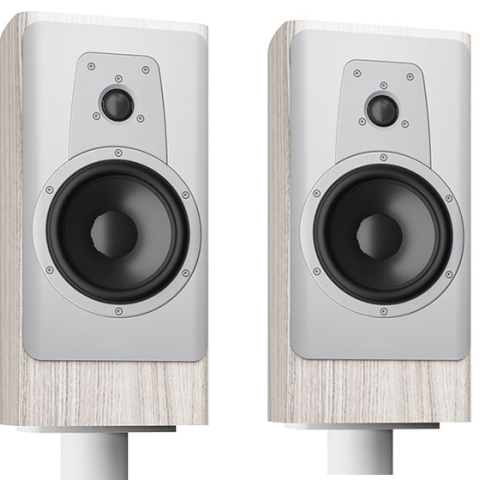
Dynaudio Focus 10: $5500/pair (stands necessary)
Class A rating is as a Complete Audio System only; class B (Restricted LF) as a regular loudspeaker. See Loudspeaker Systems. (Vol.46 Nos.2 & 11 WWW) FiiO M15S portable music player: $1352.39
The M15S is about the size of two iPhone 15s laid on top of one another. It uses the ESS 9038PRO DAC chip and can convert all files to DSD before they reach the DAC. Another feature, Second-Order Regulation, adds even-order harmonics to the output. Using Campfire in-ear headphones AH preferred the sound with both these features activated, noting that the FiiO player “offers more of everything—power, detail, drive, color, texture, and yes, engagement.” (Vol.48 No.10 WWW) Focal Diva Utopia: $39,999/pair
See Loudspeaker Systems (Vol.48 No.3 WWW) Klipsch The Nines: $1349.99/pair (stands necessary) $$$
Class A rating is as a Complete Audio System only; class B (Restricted LF) as a regular loudspeaker. See Loudspeaker Systems. (Vol.47 No.2 WWW)
B:
Naim Mu-so 2nd Generation: $1999 with standard grille fabric $$$ ★
This slim, all-in-one, Roon Ready networked music system has a tweeter, a midrange unit, and an oval-shaped woofer for each channel, all powered by direct-digital, class-D amplification. The integral DSP offers three room compensation settings. There is also an alarm and a sleep timer. The major digital streaming services, including Spotify, Tidal, and Qobuz, are handled natively, and the Mu-so also offers AirPlay 2 (iTunes and Apple Music) and Chromecast. There are analog, S/PDIF, USB, Bluetooth, HDMI ARC, and wired and Wi-Fi network inputs, though other than the USB port, the physical inputs are inconveniently placed on the bottom of the chassis. The Mu-so can be controlled by a remote control, by its own touch controls, and by the Naim app for Apple iPad, iPhone, iPod Touch, and Android devices. JMu was well-impressed by this app. She was also impressed by the sound, writing “a few sonic characteristics stood out: crisp clarity with more detail and dynamic output than I expected. Subjective impressions of bass extension seemed to exceed what’s possible from small drivers within a smallish box.” How did JMu conclude her review? “The musical Mu-so 2nd Generation offers serious sound and engineering from a respected maker, but it’s also built for fun. I wanted to keep on listening, and that speaks volumes.” Additional grille color options add $90 to price. (Vol.43 No.10 WWW) Technics SC-CX700: $3499.99/pair in three color choices $$$
This Roon Ready, wireless, active loudspeaker uses a reflex-loaded coaxial drive unit. As well as wireless streaming, the SC-CX-700 features an Ethernet port that supports up to 24/384 PCM and up to DSD256; a TosLink input (up to 24/96); HDMI (ARC) (up to 24/48); and two USB-C ports (up to 24/192). It also has line and phono analog inputs, which are converted to digital at 48kHz, and an analog subwoofer output. The speaker can be controled by a remote control, buttons on the Primary speaker’s top panel, or the Technics Audio Center app, which also allows treble and bass controls and room-correction EQ settings to be activated. (A microphone is provided for room-correction measurements.) KR noted that the four correction presets—Free, Wall, Corner, Shelf—weren’t very satisfactory; he found the results from the “Measured” EQ, made using the microphone at the listening position, the most natural, balanced, and spacious sounding. He summed up his time with the Technics speakers by writing that the SC-CX700 “has an impressive feature set that will allow it to play almost any music source. Its sonic and musical performance exceeded my expectations. Its modest size belies its ability to create a broad, deep, detailed soundstage filled with balanced, pleasing sound, without the need for a subwoofer. The effectiveness of its measurement-based EQ permits it to be placed almost anywhere. Impressive!” JA was also impressed, noting that the speaker’s radiation pattern was even and well-controlled through the midrange and low treble. In a follow-up review, TF auditioned the MM phono input and wrote that the system passed the test for engagement, “presenting a sound quality focused on the music in the grooves rather than surface noise or the mechanical process of playing the records. ... I was surprised how large the sound seemed coming out of those little coaxial drivers. The stereo images were focused and detailed.” Comparing LP and digital versions of the same albums, he thought that the images were more stable in the digital files, but the vinyl versions’ presentations sometimes sounded more lifelike. “Whatever the ‘vinyl black box’ was doing, it wasn’t messing up the sound, and at times it brought out a greater feeling of living musicians playing music together,” he concluded. (Vol.48 Nos.4 & 6 WWW) Deletions
JBL 4329P, Sonus faber Omnia, not auditioned in a long time. Music Surround-Sound Components: A+: StormAudio ISP Evo immersive sound preamp/processor: $20,799–$24,999 depending on channel count and digital format
See Digital Processors. (Vol.47 No.3 WWW)
A:
Arvus H2-4D multichannel Dolby ATMOS digital processor: $5350
The H2-4D combines HDMI and word clock inputs with 16-channel digital (AES3), balanced analog, and LAN outputs. It decodes and renders all extant varieties of Dolby (including Atmos), DTS (including DTS-X), and stereo and multichannel PCM (up to 24/192). Setup and control is via a local webpage, accessible via the user's network. After wrestling with setting up the channels, KR found with the Arvus's digital outputs that while Apple Music's Atmos is lossy and limited to a 48kHz sample rate, he found it a credible alternative to high-rez stereo, "swapping the latter's clarity and immediacy for a huge enhancement in the acoustic space." In the test lab, JA found that while the Arvus's digital outputs preserved the resolution and sample rate of hi-rez files, the analog outputs downsampled the data to 48kHz, with not much better than 16 bits of resolution. He felt that this rules out the H2-4D for use in a system where the owner wants to play back hi-rez music files as well as movies, with just one processor. Nevertheless, KR concluded that the Arvus H2-4D "is the single piece of audio hardware that can deliver Atmos into a component audio system." (Vol.46 No.5 WWW) exaSound s88 Mark II: $7599 ★
See “Digital Processors.” (Vol.44 No.4 WWW) Lyngdorf Audio MXA-8400 eight-channel: $8999
See Power Amplifiers. (Vol.48 No.6 WWW) Okto dac8 PRO: €1289 ★ $$$
An 8-channel DAC with USB input and output, 8 channels of AES3 input, 8 channels of balanced (XLR) analog output, a headphone output, and a choice of seven reconstruction filters, the made-in-Prague dac8 Pro so impressed KR that he bought the review sample. JA’s measurements indicated that, with just over 20 bits of effective resolution and vanishingly low linearity error and distortion, no compromises had been made to pack eight D/A channels into the Pro’s slim chassis. (Vol.43 No.12, Vol.44 No.2 WWW) B: Primare A35.8 8-channel power amplifier: $5500 ★
See Power Amplifiers. (Vol.45 No.11 WWW)
Class A rating is as a Complete Audio System only; class B (Restricted LF) as a regular loudspeaker. See Loudspeaker Systems. (Vol.46 Nos.2 & 11 WWW) FiiO M15S portable music player: $1352.39
The M15S is about the size of two iPhone 15s laid on top of one another. It uses the ESS 9038PRO DAC chip and can convert all files to DSD before they reach the DAC. Another feature, Second-Order Regulation, adds even-order harmonics to the output. Using Campfire in-ear headphones AH preferred the sound with both these features activated, noting that the FiiO player “offers more of everything—power, detail, drive, color, texture, and yes, engagement.” (Vol.48 No.10 WWW) Focal Diva Utopia: $39,999/pair
See Loudspeaker Systems (Vol.48 No.3 WWW) Klipsch The Nines: $1349.99/pair (stands necessary) $$$
Class A rating is as a Complete Audio System only; class B (Restricted LF) as a regular loudspeaker. See Loudspeaker Systems. (Vol.47 No.2 WWW)
This slim, all-in-one, Roon Ready networked music system has a tweeter, a midrange unit, and an oval-shaped woofer for each channel, all powered by direct-digital, class-D amplification. The integral DSP offers three room compensation settings. There is also an alarm and a sleep timer. The major digital streaming services, including Spotify, Tidal, and Qobuz, are handled natively, and the Mu-so also offers AirPlay 2 (iTunes and Apple Music) and Chromecast. There are analog, S/PDIF, USB, Bluetooth, HDMI ARC, and wired and Wi-Fi network inputs, though other than the USB port, the physical inputs are inconveniently placed on the bottom of the chassis. The Mu-so can be controlled by a remote control, by its own touch controls, and by the Naim app for Apple iPad, iPhone, iPod Touch, and Android devices. JMu was well-impressed by this app. She was also impressed by the sound, writing “a few sonic characteristics stood out: crisp clarity with more detail and dynamic output than I expected. Subjective impressions of bass extension seemed to exceed what’s possible from small drivers within a smallish box.” How did JMu conclude her review? “The musical Mu-so 2nd Generation offers serious sound and engineering from a respected maker, but it’s also built for fun. I wanted to keep on listening, and that speaks volumes.” Additional grille color options add $90 to price. (Vol.43 No.10 WWW) Technics SC-CX700: $3499.99/pair in three color choices $$$
This Roon Ready, wireless, active loudspeaker uses a reflex-loaded coaxial drive unit. As well as wireless streaming, the SC-CX-700 features an Ethernet port that supports up to 24/384 PCM and up to DSD256; a TosLink input (up to 24/96); HDMI (ARC) (up to 24/48); and two USB-C ports (up to 24/192). It also has line and phono analog inputs, which are converted to digital at 48kHz, and an analog subwoofer output. The speaker can be controled by a remote control, buttons on the Primary speaker’s top panel, or the Technics Audio Center app, which also allows treble and bass controls and room-correction EQ settings to be activated. (A microphone is provided for room-correction measurements.) KR noted that the four correction presets—Free, Wall, Corner, Shelf—weren’t very satisfactory; he found the results from the “Measured” EQ, made using the microphone at the listening position, the most natural, balanced, and spacious sounding. He summed up his time with the Technics speakers by writing that the SC-CX700 “has an impressive feature set that will allow it to play almost any music source. Its sonic and musical performance exceeded my expectations. Its modest size belies its ability to create a broad, deep, detailed soundstage filled with balanced, pleasing sound, without the need for a subwoofer. The effectiveness of its measurement-based EQ permits it to be placed almost anywhere. Impressive!” JA was also impressed, noting that the speaker’s radiation pattern was even and well-controlled through the midrange and low treble. In a follow-up review, TF auditioned the MM phono input and wrote that the system passed the test for engagement, “presenting a sound quality focused on the music in the grooves rather than surface noise or the mechanical process of playing the records. ... I was surprised how large the sound seemed coming out of those little coaxial drivers. The stereo images were focused and detailed.” Comparing LP and digital versions of the same albums, he thought that the images were more stable in the digital files, but the vinyl versions’ presentations sometimes sounded more lifelike. “Whatever the ‘vinyl black box’ was doing, it wasn’t messing up the sound, and at times it brought out a greater feeling of living musicians playing music together,” he concluded. (Vol.48 Nos.4 & 6 WWW) Deletions
JBL 4329P, Sonus faber Omnia, not auditioned in a long time. Music Surround-Sound Components: A+: StormAudio ISP Evo immersive sound preamp/processor: $20,799–$24,999 depending on channel count and digital format
See Digital Processors. (Vol.47 No.3 WWW)
The H2-4D combines HDMI and word clock inputs with 16-channel digital (AES3), balanced analog, and LAN outputs. It decodes and renders all extant varieties of Dolby (including Atmos), DTS (including DTS-X), and stereo and multichannel PCM (up to 24/192). Setup and control is via a local webpage, accessible via the user's network. After wrestling with setting up the channels, KR found with the Arvus's digital outputs that while Apple Music's Atmos is lossy and limited to a 48kHz sample rate, he found it a credible alternative to high-rez stereo, "swapping the latter's clarity and immediacy for a huge enhancement in the acoustic space." In the test lab, JA found that while the Arvus's digital outputs preserved the resolution and sample rate of hi-rez files, the analog outputs downsampled the data to 48kHz, with not much better than 16 bits of resolution. He felt that this rules out the H2-4D for use in a system where the owner wants to play back hi-rez music files as well as movies, with just one processor. Nevertheless, KR concluded that the Arvus H2-4D "is the single piece of audio hardware that can deliver Atmos into a component audio system." (Vol.46 No.5 WWW) exaSound s88 Mark II: $7599 ★
See “Digital Processors.” (Vol.44 No.4 WWW) Lyngdorf Audio MXA-8400 eight-channel: $8999
See Power Amplifiers. (Vol.48 No.6 WWW) Okto dac8 PRO: €1289 ★ $$$
An 8-channel DAC with USB input and output, 8 channels of AES3 input, 8 channels of balanced (XLR) analog output, a headphone output, and a choice of seven reconstruction filters, the made-in-Prague dac8 Pro so impressed KR that he bought the review sample. JA’s measurements indicated that, with just over 20 bits of effective resolution and vanishingly low linearity error and distortion, no compromises had been made to pack eight D/A channels into the Pro’s slim chassis. (Vol.43 No.12, Vol.44 No.2 WWW) B: Primare A35.8 8-channel power amplifier: $5500 ★
See Power Amplifiers. (Vol.45 No.11 WWW)