

High-End Tunes to Go

Photo Credit: Tim Austin Photography
A true story: I got tagged for doing a howling 90mph on the way back to New York on the Jersey Turnpike late one night and got off with a warning.
I was pulled over by a beefy young Trooper, lights blinking furiously. Oops. [heh heh]. He saw Kathleen and I weren't nuts, checked the papers and my license, then checked out the Lexus very carefully with his flashlight. There was much oohing and ahhing.How To Write Manufacturers' Comments
"Equipment Reports," "Record Reviews," "Letters," "Industry Update," "Sam's Space," "As We See It," "The Final Word"---I read and enjoy them all. But the section of Stereophile I especially look forward to reading is "Manufacturers' Comments." How is the manufacturer going to respond to a review that's considerably less than 100% positive? Can they take criticism gracefully, or do they have an attitude? If I were a consumer considering purchase of one of their products, would their comments convince me that they'd be a good company to deal with? Are they uptight beyond reason, or do they have a sense of humor? Can they respond to a positive review without gloating?
Illusions, Riddles, & Toys
Remember the old mathematical riddle about moving a football from a hundred yards out to the goal line? Known as Xeno's Paradox, it goes like this: if each time the ball is moved it travels half the distance to the goal, how many moves will it take to get there? The answer: an infinite number, because no matter how many times you cut the distance to the goal by half, you'll always be some infinitesimal distance away from it.
In Search of the Perfect 300B Tube

In the last two years, the available choices in 300B output tubes for one's low-wattage single-ended power amplifier have become an embarrassment of riches. If we include the souped-up versions—which, in fact, deviate from the original 1930s Western Electric (WE) specifications—the number of 300Bs to choose from now includes about 15 different brands and types.
Inside MQA

Jim Austin briefly discusses MQA in his review of the Explorer2 in this issue, but a more complete description of MQA can be found in an article posted on Stereophile's website at the end of 2014.
MQA involves two fundamental concepts, discussed in a paper presented to the Audio Engineering Society in October 2014, the first responsible for a potential improvement in sound quality, the second responsible for a large reduction in the bandwidth required for storage and streaming of high-resolution files...
Installing a Dedicated AC Line
The most important change made to the system was one that held up the writing of my review of the Mark">http://www.stereophile.com/solidpoweramps/991ml23">Mark Levinson No.23.5 power amplifier for several months, such was its anticipated impact. Though my listening room is well-equipped with wall sockets, there are actually only two 15A circuits serving these outlets. Ever since I had converted what had hitherto been our house's master bedroom into my listening room, I had intended to run new circuits to it.
Jitterbuggin'
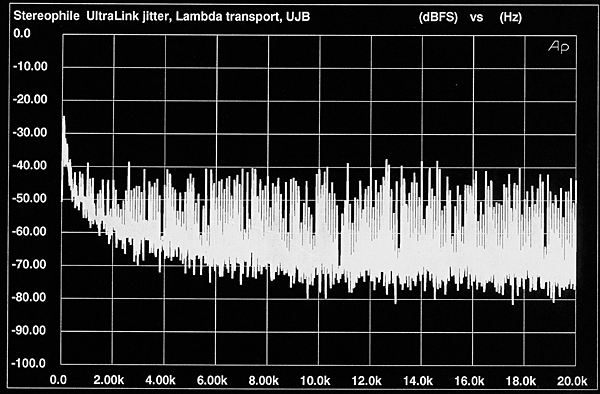
If there's one buzzword in high-end audio for the 1990s, it's undoubtedly jitter. "Jitter" describes timing variations in the clock controlling the ones and zeros that represent the analog audio signal. If that clock isn't stable to an extraordinarily precise degree, the sound quality of the digital processor will be degraded.
A CD transport/digital processor combination introduces jitter in three ways: 1) the transport puts out a jittered signal; 2) the S/PDIF or AES/EBU interface between the transport and processor creates jitter; and 3) the digital processor adds its own jitter to the clock. These additive factors are largely responsible for the great range in sound quality we hear from different transports and interfaces.
Lighting Strikes: a Bolt From the Blue

One evening late last summer I took the most expensive workout of my life. In my hurry to meet a friend at the gym, I left the house, leaving my computer and hi-fi on despite the ominous look of the sky. In the South, experience teaches you to dash about disconnecting everything at the first sign of a thunderstorm. Usually I do, but this time my mind was elsewhere.
Lights in a Box?
"Without content, television is nothing more than lights in a box."
---Edward R. Murrow.
---Edward R. Murrow.
Listening Tests and Absolute Phase

The problem confronting the magazine reviewer when organising the necessary listening tests to accompany/reinforce the measured behavior of a device under test is complex. There has never been a problem with the measurement aspect; as long as someone has access to the same test gearand full knowledge of the test conditionsthen he should be able to replicate the critic's findings exactly (assuming an infinitely narrow spread of behaviour from sample to samplea rasher assumption with some manufacturers' equipment than of others). However, when it comes to determining reliably the audible (or inaudible?) effects on music program by an amplifier/cartridge/loudspeaker etc. then the going gets tough.